
By the HMNDP Editorial Team, independent reporting on lawn care, landscaping, fertilizer, and water.
Last reviewed: June 2026
What is bahia grass?
Bahia grass (Paspalum notatum) is a warm-season perennial grass grown across the southern United States as a low-input lawn turf, erosion cover, and pasture forage. It tolerates poor sandy soil, deep drought, and full sun, but it is coarse-textured, light green, and throws constant Y-shaped seedheads that need frequent mowing. Homeowners pick it for toughness, not for a manicured look.
It is the grass you choose when the alternative is bare sand or a water bill you cannot afford. It is also the grass many homeowners later try to remove once they want a finer lawn.
That split, plant it or kill it, is the real question this guide answers. Most pages pick one side. We cover both so you can decide before you buy seed or herbicide.
Where bahia grass comes from and where it grows
Bahia grass is native to Mexico, Central America, and South America, and it naturalized across the southeastern United States after being introduced to Florida around 1914 for pasture and soil stabilization. It thrives in USDA hardiness zones 7 through 11, which covers Florida, the Gulf Coast, and most of the Deep South. It struggles north of zone 7 and dies back hard in extended freezes.
Florida is the heartland of bahia grass because of its sandy, acidic, low-fertility soils. The grass evolved for exactly those conditions and outcompetes finer turf where irrigation and fertilizer are limited.
Climate and region notes
Bahia grass is sun-loving and cold-sensitive. It needs at least 6 to 8 hours of direct sun and performs poorly in shade, going thin and patchy under tree canopy. Along the Gulf Coast and central Florida it stays semi-evergreen, while in north Florida, south Georgia, and the broader Deep South it browns out from first frost until spring green-up around March or April.
Soil, drought, and root system
Bahia grass thrives in infertile, sandy, acidic soils with a pH of 5.5 to 6.5, where most turf grasses fail. Its deep root system, reaching several feet down, makes it one of the most drought-tolerant lawn grasses available, surviving weeks without rain by going dormant and recovering when water returns. This is why it dominates unirrigated roadsides and rural lots across the South.
The tradeoff is texture and density. Those same survival traits produce an open, coarse sod rather than the tight carpet of irrigated Bermuda or zoysia.
Growth habit and seedheads
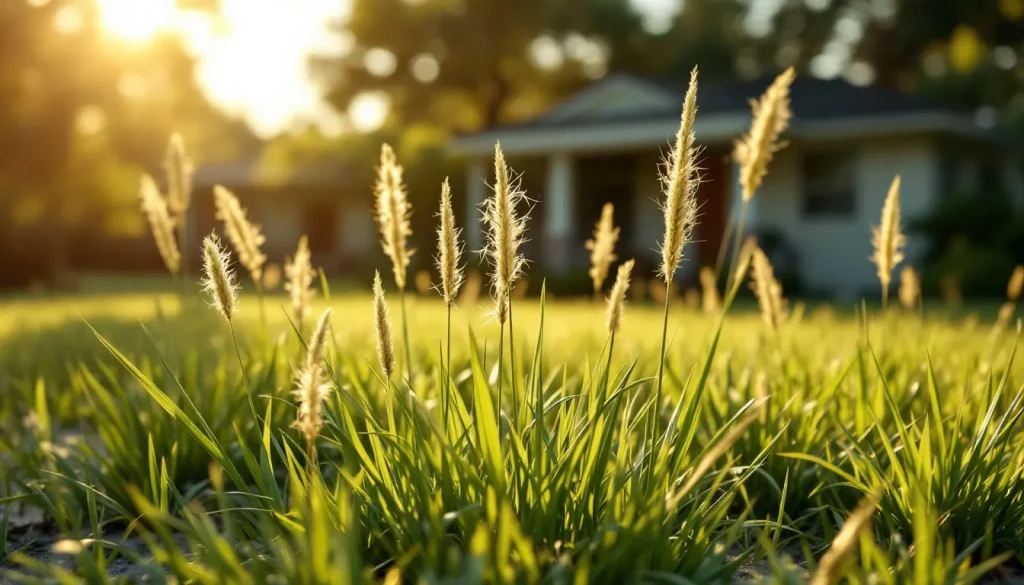
Bahia grass spreads by short, stout stolons and rhizomes, forming an open sod that resists traffic but leaves visible soil gaps. From May through October it sends up tall, branched seed stalks topped with a distinctive Y-shaped or V-shaped pair of spikes. These seedheads grow faster than the leaf blades, so an established bahia lawn can look unmown days after cutting. Expect to mow weekly in summer just to control them.
Common bahia grass varieties
The two varieties that matter for most buyers are Argentine and Pensacola. Argentine has wider, darker, denser leaves and fewer seedheads, making it the better lawn choice. Pensacola is more cold-hardy and drought-tough with narrower leaves, which suits pasture, erosion control, and colder zones. Other named types include Tifton 9, Pensacola-type UF-Riata, and Sand Mountain.
| Trait | Argentine | Pensacola |
|---|---|---|
| Leaf texture | Wider, denser, darker green | Narrower, lighter |
| Cold tolerance | Moderate (best zones 8 to 11) | Higher (best zones 7 to 10) |
| Seedhead frequency | Fewer, slightly shorter | More, taller stalks |
| Drought tolerance | High | Very high |
| Best use | Home lawns in central and south Florida | Pasture, erosion, colder Deep South |
Quick rule: pick Argentine for a south Florida or Gulf Coast lawn, and Pensacola or Tifton 9 for pasture, roadside slopes, or anywhere winters bite harder.
How to plant bahia grass from seed
Plant bahia grass from seed in late spring to early summer (April through July) once soil temperatures hold above 65 to 70 degrees Fahrenheit. Seed at 5 to 10 pounds per 1,000 square feet, or 50 to 100 pounds per acre for pasture. Use scarified, hulled seed for faster sprouting. Germination is slow and erratic, taking 14 to 28 days, and full establishment runs 60 to 90 days.
- Test soil and adjust pH toward 5.5 to 6.5 if needed; bahia tolerates acidity well.
- Till or rake to loosen the top inch and create seed-to-soil contact.
- Spread scarified seed evenly with a broadcast spreader at the rate above.
- Rake lightly to cover seed 1/4 inch deep, no deeper.
- Keep the surface moist for the first 3 to 4 weeks, watering lightly once or twice daily.
- Hold off on heavy nitrogen until seedlings are established at 30 to 45 days.
The slow germination surprises new growers. Unscarified seed can sit dormant for months. For a deeper timeline on sprouting expectations across grass types, see our breakdown of how long grass seed takes to grow.
Where to buy bahia grass seed and cost
Bahia grass seed is widely available at farm and home stores including Tractor Supply, Lowe’s, Home Depot, and seed suppliers like Hancock Seed and Scotts. Expect roughly 4 to 8 dollars per pound retail, or 2 to 4 dollars per pound in 50-pound bags for pasture. Seeding a 5,000 square foot lawn costs about 25 to 60 dollars in seed, far cheaper than sodding Bermuda or zoysia.
Mowing, watering, and fertilization
Bahia grass is a low-input lawn: mow at 3 to 4 inches, water only during extended drought, and fertilize lightly. Mow weekly in summer to manage seedheads, monthly or less in cooler months. It needs far less nitrogen than Bermuda, typically 2 to 4 pounds of nitrogen per 1,000 square feet per year split across the growing season. Overfeeding wastes money and invites disease.
Fertilization and iron notes
Bahia grass often shows yellowing (chlorosis) on high-pH or sandy soils due to iron deficiency rather than lack of nitrogen. A foliar iron application, such as chelated iron or iron sulfate, greens it up without forcing growth or extra mowing. Save heavy nitrogen for spring and early summer. For matching products to your soil and grass type, review our notes on the best fertilizer for grass.
Bahia grass as a weed: how to control or kill it
In Bermuda, St. Augustine, or zoysia lawns, bahia grass is a coarse, fast-seeding weed. To control it, mow seedheads before they mature and spot-treat with metsulfuron-based herbicides (such as MSM Turf) on tolerant turf, or use glyphosate for full kill on non-selective areas. Repeat applications over 4 to 6 weeks are usually needed because of the deep root system.
Glyphosate kills bahia and everything around it, so reserve it for renovations or driveways. On St. Augustine lawns, metsulfuron suppresses bahia selectively but read the label for turf tolerance first.
Unsure what you actually have before you spray? Confirm with our guide on identifying what kind of grass you have, since bahia’s Y-shaped seedhead is the giveaway.
Bahia grass vs Bermuda grass
Bahia grass and Bermuda grass are both warm-season Southern turfs, but they serve different owners. Bahia wins on drought tolerance, low fertilizer needs, and price. Bermuda wins on density, fine texture, and a manicured look, at the cost of more water, mowing, and nitrogen. Choose bahia for low-maintenance rural and unirrigated lots, Bermuda for high-input show lawns and sports turf.
| Factor | Bahia grass | Bermuda grass |
|---|---|---|
| Texture | Coarse, open sod | Fine, dense carpet |
| Water need | Very low, deep roots | Moderate to high |
| Fertilizer (N/yr per 1,000 sq ft) | 2 to 4 lb | 4 to 6 lb |
| Mowing frequency | Weekly (seedheads) | Twice weekly for show quality |
| Shade tolerance | Poor | Poor |
| Establishment cost | Low (seed 25 to 60 dollars per 5,000 sq ft) | Higher (sod common) |
| Best for | Sandy, dry, low-input lots | Irrigated, fertilized show lawns |
Bahia grass for horses and pasture
Bahia grass is a safe, durable forage and pasture grass for horses, cattle, and goats, valued because it withstands heavy grazing and grows on poor soil without irrigation. It offers moderate protein (8 to 12 percent) and good fiber, though it is lower in nutritional density than improved Bermuda hybrids. Pensacola and Tifton 9 are the common pasture choices, seeded at 15 to 20 pounds per acre.
One caution: mature bahia seedheads can host ergot fungus in wet conditions, which can affect grazing livestock, so mowing seedheads benefits pasture health, not just looks. Check with a local extension office for regional grazing guidance.
The honest verdict: plant it or kill it?
Plant bahia grass if you have sandy, unirrigated, full-sun ground in zones 7 to 11 and you want a tough, cheap, low-maintenance lawn or pasture and can accept coarse texture and weekly seedhead mowing. Remove it if you want a fine, dense, manicured lawn, have shade, or run an irrigated Bermuda, zoysia, or St. Augustine yard where bahia reads as a weed.
The grass is not good or bad in the abstract; it is matched or mismatched to your site and your tolerance for mowing seedheads. A rural Florida acre with no sprinklers is a perfect fit. A watered suburban Bermuda lawn is exactly where bahia becomes the enemy.
For more region-specific lawn coverage and ongoing turf reporting, browse the HMNDP Learn library.
Frequently Asked Questions
What is bahia grass and what is it used for?
Bahia grass (Paspalum notatum) is a warm-season perennial grass used as a low-maintenance lawn, erosion-control cover, and livestock pasture across the southern United States. It tolerates poor sandy soil, drought, and full sun. Homeowners use it for tough, unirrigated lawns, while farmers and horse owners use it as durable grazing forage on land that cannot support finer grasses.
Is bahia grass good for a lawn?
Bahia grass is good for low-maintenance, unirrigated, full-sun lawns in zones 7 to 11, especially on sandy Southern soil. It needs little water or fertilizer and tolerates drought well. The downsides are a coarse, open texture, light green color, and constant Y-shaped seedheads that force weekly summer mowing. For a fine, dense, manicured lawn, Bermuda or zoysia is a better fit.
What is the difference between bahia grass and Bermuda grass?
Bahia grass is coarser, far more drought tolerant, and needs less water and fertilizer, making it ideal for dry, low-input lots. Bermuda grass is finer, denser, and greener but requires more water, mowing, and nitrogen for a manicured look. Bahia costs less to establish from seed, while Bermuda is often sodded. Choose bahia for toughness, Bermuda for appearance.
What is the difference between Argentine and Pensacola bahia grass?
Argentine bahia has wider, denser, darker leaves with fewer seedheads, making it the better home lawn choice for central and south Florida and the Gulf Coast. Pensacola bahia has narrower leaves, more seedheads, and higher cold and drought tolerance, suiting pasture, erosion control, and colder Deep South zones. Pick Argentine for lawns, Pensacola or Tifton 9 for forage and slopes.
How do I plant bahia grass from seed and how long does it take to germinate?
Plant scarified bahia seed in late spring to early summer at 5 to 10 pounds per 1,000 square feet for lawns, covering it 1/4 inch deep and keeping the soil moist. Germination is slow and erratic, taking 14 to 28 days, with full establishment over 60 to 90 days. Using hulled, scarified seed and warm soil above 65 degrees speeds sprouting.
How do I get rid of or control bahia grass in my lawn?
To control bahia grass in another turf, mow seedheads before they mature and spot-treat with metsulfuron-based herbicides (like MSM Turf) on tolerant lawns, or use glyphosate for total kill in renovation areas. Because of bahia’s deep roots, repeat treatments over 4 to 6 weeks are usually needed. Always check the herbicide label for your specific turf’s tolerance first.
Is bahia grass good for horses and pasture?
Bahia grass is a safe, durable pasture and forage grass for horses, cattle, and goats, prized for withstanding heavy grazing on poor, dry soil. It provides moderate protein around 8 to 12 percent. Pensacola and Tifton 9 are common pasture types, seeded at 15 to 20 pounds per acre. Mow seedheads to reduce ergot fungus risk in wet conditions.
What climate, soil, and USDA zones does bahia grass grow best in?
Bahia grass grows best in USDA hardiness zones 7 through 11 across Florida, the Gulf Coast, and the Deep South. It needs full sun, at least 6 to 8 hours daily, and thrives in infertile, sandy, acidic soils with a pH of 5.5 to 6.5. It tolerates drought and heat but performs poorly in shade and dies back in hard freezes.