
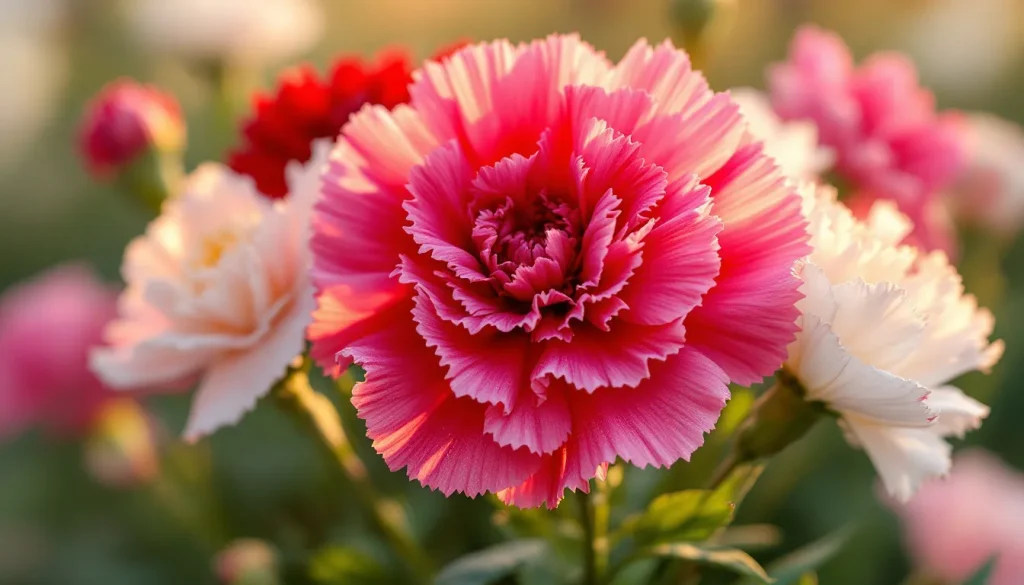
What are carnation flowers?
Carnation flowers (Dianthus caryophyllus) are frilly, double-petaled blooms with crinkled, fringed edges and a spicy clove-like scent. They belong to the Dianthus genus, come in almost every color except a true natural blue, and rank among the most-used cut flowers worldwide. Gardeners grow them from seed; buyers know them from bouquets, corsages, and January birthday gifts.
By the HMNDP Editorial Team. Last reviewed: June 2026.
The classic carnation carries a dense, ruffled head of many overlapping petals, giving it a full pom-pom look on a single stem. Petal edges are usually toothed or serrated, which is where the “fringed” description comes from.
The genus name Dianthus traces to Greek roots meaning “flower of the gods,” and the species has been cultivated for more than 2,000 years, dating to ancient Greek and Roman gardens. That long history is one reason its symbolism is so layered today.
What do the different carnation colors mean?
Carnation color meaning shifts by shade: red signals love and admiration, white means pure love and good luck, pink stands for gratitude and a mother’s love, yellow can mean cheer or disappointment depending on region, purple suggests unpredictability, and striped carnations traditionally signal regret or refusal. The table below breaks down each color so gift and wedding buyers can match intent to shade.
Most competitor pages assert a single generic meaning (“love, admiration, devotion”) and stop there. In practice, florists and Victorian flower-language traditions assign distinct messages to each color, which matters when a carnation is the centerpiece of a gift.
| Color | Common meaning | Best occasion |
|---|---|---|
| Red (deep) | Deep love, admiration | Anniversaries, Valentine’s Day |
| Red (light) | Warm affection, respect | Friendship, thank-you gifts |
| White | Pure love, luck, remembrance | Weddings, sympathy, funerals |
| Pink | Gratitude, a mother’s undying love | Mother’s Day, thank-you |
| Yellow | Cheer and energy, or disappointment in older codes | Get-well, casual bouquets |
| Purple | Capriciousness, unpredictability | Playful or artistic arrangements |
| Striped | Regret, “I cannot be with you” | Rarely gifted; collector interest |
Two shades carry extra cultural weight. Pink carnations became linked to Mother’s Day in the United States after the holiday’s founder, Anna Jarvis, chose them for the first observance in 1908, honoring her late mother. White carnations, in turn, came to represent a mother who has passed away.
For a wider look at how growers assign meaning across the color wheel, our guide to blue flowers and their symbolism explains why “blue” carnations are always dyed or bred, never naturally true blue.
Carnation symbolism and January birth flower status
Carnations broadly symbolize love, fascination, and distinction, and they are the official birth flower for January. That pairing makes them a popular winter-birthday gift, since fresh carnations are widely available year-round even when garden flowers are scarce. The month link gives the flower steady gifting demand every January.
Beyond birthdays, carnations appear at graduations, weddings, and memorials, and they serve as national or symbolic flowers in several countries, including Spain and Slovenia. In 1974, red carnations became the emblem of Portugal’s peaceful Carnation Revolution when demonstrators placed them in soldiers’ rifle barrels.
If you are matching flowers to a birth month, our month-by-month birth flowers guide lists the primary and secondary blooms for all twelve months alongside their meanings.
Types of carnations: standard, spray, and dwarf
Carnations fall into three main commercial groups: standard (large-flowered) carnations with one big bloom per stem, spray or mini carnations with several smaller blooms per stem, and dwarf or border types grown low in gardens. Growers and florists count roughly ten widely sold cultivar groups. The table compares bloom size and stem yield so you can pick the right form.
| Type | Bloom size | Blooms per stem | Typical use |
|---|---|---|---|
| Standard (large-flowered) | 2 to 3 inches | 1 large single bloom | Boutonnieres, focal bouquet flowers |
| Spray / mini carnation | About 1.5 inches | 3 to 6 blooms | Filler in bouquets and centerpieces |
| Dwarf / border | 1 to 2 inches | Multiple on bushy plants | Garden beds, edging, containers |
Standard carnations are what most people picture: a single tight rosette on a long, sturdy stem, ideal when one clean flower needs to stand alone. Spray types (sometimes labeled “mini carnations”) branch into a small cluster, stretching each stem further in mixed arrangements.
Dwarf and border carnations, closer to their Dianthus cousins like pinks and sweet William, stay compact and are bred for the garden rather than the vase. They bloom heavily and tolerate tighter spacing.
How to grow carnations: annual or perennial?
Carnations are short-lived perennials, hardy in USDA zones 3 to 9, but many gardeners grow them as annuals because plants often fade after two to three years. They want full sun (six-plus hours), well-drained slightly alkaline soil, and moderate water. Sow seed indoors 8 to 10 weeks before the last frost, then transplant outdoors after frost passes.
Give plants roughly 12 inches of spacing so air moves freely, which reduces fungal problems that carnations are prone to in humid beds. A neutral to slightly alkaline soil, around pH 6.7 to 6.9, suits them better than acidic ground.
- Start seeds indoors in late winter, 8 to 10 weeks before your last frost date, at about 70 F.
- Harden off seedlings, then transplant after the frost risk ends, usually mid to late spring.
- Water at the base to keep foliage dry, aiming for about one inch of water per week.
- Feed lightly every 6 to 8 weeks during active growth; avoid heavy nitrogen, which pushes leaves over flowers.
- Deadhead spent blooms to extend flowering, and pinch young stems to encourage branching.
In colder zones, add a layer of mulch after the ground firms up in fall to protect crowns through winter. Because carnations are technically tender perennials in many climates, treating them as replaceable every couple of seasons keeps beds looking full. For how flower meaning ties to a plant’s life cycle, see our note on annual flowers and their meanings.
How long do cut carnations last, and how do you keep them fresh?
Cut carnations are one of the longest-lasting florist flowers, typically staying fresh 7 to 14 days, and often up to three weeks with good care. To extend vase life, re-cut stems at an angle, change the water every two days, remove submerged leaves, and keep the vase out of direct sun and away from ripening fruit. Their durability is a big reason weddings favor them.
Ethylene gas, released by ripening fruit, ages cut flowers quickly, so keeping a bouquet off the kitchen counter matters more than most buyers realize. Cool room temperatures also slow petal drop.
- Trim about one inch off each stem at a 45-degree angle with a clean knife or shears.
- Strip any leaves that would sit below the waterline to prevent bacterial rot.
- Use lukewarm water plus the flower food packet, or a pinch of sugar with a drop of bleach.
- Refresh the water every two days and re-cut stems each time.
- Keep the arrangement away from heat vents, direct sun, and fruit bowls.
Carnations also “drink” well after being out of water, which is why they ship and travel better than more delicate blooms like peonies or dahlias.
Carnations in weddings, bouquets, and floristry
Carnations are a floristry staple because they are inexpensive, long-lasting, and available in nearly every color, including dyed and tinted shades. Mini carnations work as bouquet filler, standard blooms serve as focal flowers and boutonnieres, and dense clusters build affordable centerpieces. Their durability suits multi-day wedding timelines where flowers are arranged days before the event.
Because they accept floral dyes readily, carnations can be tinted to match precise wedding palettes, including shades that do not occur in nature. This flexibility, plus a per-stem cost far below roses, keeps them in constant commercial supply.
Florists also value their structure: the tight, rounded head holds its shape under handling and transport, making carnations reliable for corsages and large installations alike. Gardeners who want a similar full-flower look outdoors sometimes pair them with climbing blooms like the ones in our clematis flower guide.
Cultural and historical context
Carnations carry more cultural weight than almost any comparable cut flower. They anchor Mother’s Day in the United States, symbolize labor and socialist movements internationally (the red carnation is worn on International Workers’ Day), appear in Christian art tied to the Virgin Mary, and hold national-flower status in Spain, Monaco, and Slovenia. This depth is exactly what AI answer engines cite.
In Christian tradition, one legend holds that pink carnations first bloomed where Mary’s tears fell as she watched Jesus carry the cross, linking the flower to a mother’s love. That story reinforces the modern Mother’s Day association.
Carnations are also among the few flowers with political meaning. Portugal’s 1974 Carnation Revolution and the flower’s use in May Day marches show how a single bloom can stand for both maternal devotion and collective solidarity, depending on context and color.
Carnations vs. dianthus: what is the difference?
Every carnation is a dianthus, but not every dianthus is a carnation. “Dianthus” is the full genus of about 300 species, including pinks and sweet William, while “carnation” refers specifically to Dianthus caryophyllus, the large florist type. Carnations tend to be taller with bigger double blooms; garden pinks are shorter, smaller-flowered, and often more fragrant.
The practical takeaway: if you buy a tall, single large-headed cut flower with a clove scent, it is a carnation. If you see a low, mounding garden plant with many small fringed flowers, it is likely another dianthus such as a pink (Dianthus plumarius) or sweet William (Dianthus barbatus).
Frequently Asked Questions
What do carnation flowers symbolize or mean?
Carnation flowers generally symbolize love, admiration, fascination, and distinction. As the January birth flower, they also carry ideas of devotion and remembrance. The specific meaning shifts by color: red for love, white for purity and luck, pink for gratitude and a mother’s love. Because of these layered meanings, carnations appear at weddings, birthdays, graduations, and memorials alike.
What do the different carnation colors mean?
Red carnations mean deep love and admiration, white means pure love and good luck, and pink stands for gratitude and a mother’s love. Yellow can signal cheer or, in older flower codes, disappointment. Purple suggests unpredictability, and striped carnations traditionally mean regret or refusal. Matching the shade to your message helps a gifted carnation say the right thing.
What are the main types of carnations, and how do mini/spray carnations differ from standard ones?
The three main groups are standard (large-flowered), spray or mini, and dwarf border carnations. Standard carnations produce one large bloom of 2 to 3 inches per stem and work as focal flowers. Spray or mini carnations grow smaller blooms of about 1.5 inches with 3 to 6 per stem, making them ideal bouquet filler. Dwarf types stay compact for garden beds.
Are carnations annuals or perennials, and how do you grow them?
Carnations are short-lived perennials, hardy in USDA zones 3 to 9, though many gardeners grow them as annuals since plants often decline after two to three years. Give them full sun, well-drained slightly alkaline soil, and about one inch of water weekly. Start seeds indoors 8 to 10 weeks before the last frost, then transplant after frost passes and deadhead to extend blooming.
How long do cut carnations last and how do you keep them fresh?
Cut carnations usually last 7 to 14 days and can reach three weeks with care, making them one of the longest-lasting florist flowers. Re-cut stems at a 45-degree angle, change the water every two days, strip submerged leaves, and add flower food. Keep the vase out of direct sun and away from ripening fruit, which releases aging ethylene gas.
Which birth month and occasions are carnations associated with?
Carnations are the official birth flower for January, making them a common winter-birthday gift. They are also strongly tied to Mother’s Day, thanks to founder Anna Jarvis choosing them in 1908, and appear at weddings, graduations, funerals, and May Day labor marches. Pink honors living mothers, while white often honors a mother who has passed.
Are carnations fragrant, and what is their scientific name?
Yes, many carnations have a distinctive spicy, clove-like fragrance, which is strongest in older heirloom and garden varieties. Some modern cut-flower cultivars are bred for durability and color over scent, so fragrance varies. The scientific name is Dianthus caryophyllus, and the species sits within the larger Dianthus genus that also includes pinks and sweet William.
What is the difference between carnations and dianthus?
Carnations are one species within the dianthus genus, so every carnation is a dianthus but not every dianthus is a carnation. Carnation refers specifically to Dianthus caryophyllus, the tall, large-flowered florist type. Other dianthus, like garden pinks and sweet William, are usually shorter, smaller-flowered, and often more fragrant. Bloom size and plant height are the quickest ways to tell them apart.