
By the HMNDP Editorial Team, independent reporting on lawn care, landscaping, water, and the green-industry business.
Last reviewed: June 2026
What a storm drain is
A storm drain is a system of inlets, pipes, and outlets built to carry excess rainwater and snowmelt off impervious surfaces (roads, roofs, parking lots, driveways) and move it away before it floods streets and buildings. Unlike a sanitary sewer, most storm drains carry that water untreated, discharging it directly to the nearest creek, river, lake, or ocean.
The core job is volume control. A single inch of rain on a 2,000-square-foot roof produces roughly 1,200 gallons of runoff, and paved cities generate that at a scale sanitary systems were never sized to handle. Storm drains exist to move water fast, not to clean it.
Two things surprise most homeowners. First, the water is not treated. Second, “storm drain” refers to both the municipal network in your street and the smaller residential water drainage system you might install in your own yard. This guide covers both, and the bridge between them.
How a storm drain works: components and flow
A storm drain works by gravity. Water enters through grated inlets or curb openings, drops into a catch basin, then travels through underground pipes to an outfall that releases it into a natural waterway or a detention basin. There is no pump and no filter in a standard municipal line, so the system relies entirely on slope and pipe size to keep water moving.
The main components form a predictable chain:
- Curbs and gutters: the street edge that channels sheet flow toward inlets.
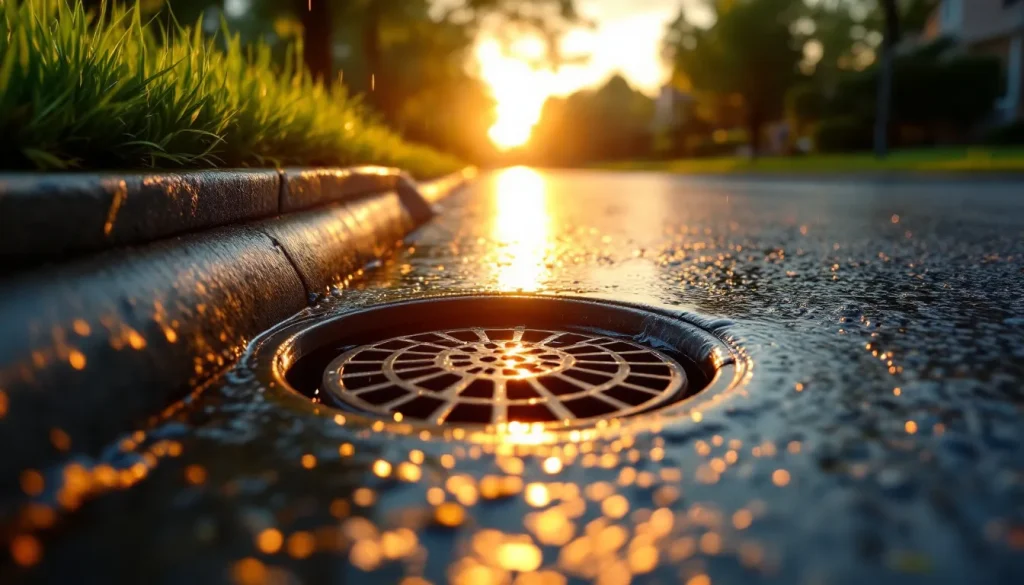
- Inlets and catch basins: the openings (grate-topped or curb-side) where water enters. Catch basins include a sump that traps sediment and debris.
- Grates: the metal covers that block large debris while letting water through.
- Pipes (conduits): underground concrete, HDPE, or corrugated metal lines, often 12 to 48 inches in diameter, that carry flow downhill.
- Manholes: access points for inspection and cleaning.
- Outfalls: the discharge point where water exits into a stream, river, retention pond, or the ocean.
Because the chain ends at a waterway, anything that enters an inlet travels the same path. That single fact drives both the pollution problem and the “only rain down the drain” rule covered below.
Where storm drain water goes
Storm drain water goes directly to the nearest local waterway (creek, river, lake, wetland, or ocean) in most of the United States, and it arrives untreated and unfiltered. The system is designed to discharge, not to clean. That means whatever washes off a street, oil, fertilizer, pet waste, trash, reaches natural water bodies within minutes to hours of a storm.
This is the single most misunderstood fact about storm drains. Many people assume all drains lead to a treatment plant. In a separate storm sewer system (the standard in most modern US cities), they do not. The U.S. Environmental Protection Agency regulates these networks as Municipal Separate Storm Sewer Systems, or MS4s, precisely because their discharge is a leading source of surface-water pollution nationwide.
The practical takeaway: a storm drain is an express lane to the environment. That reframes everything from how you wash your car to what you should never pour into the grate at your curb.
Storm drain vs sanitary sewer vs combined sewer
A storm drain carries untreated rainwater to waterways; a sanitary sewer carries wastewater from toilets, sinks, and drains to a treatment plant. A combined sewer carries both in one pipe. This distinction is the most confused concept in the topic, and it changes what happens to the water and what you are allowed to put in it.
| System | Carries | Goes to | Treated? | Where common |
|---|---|---|---|---|
| Storm drain (separate storm sewer / MS4) | Rain, snowmelt, surface runoff | Local creek, river, lake, ocean | No | Most modern US cities and suburbs |
| Sanitary sewer | Wastewater from buildings | Wastewater treatment plant | Yes | Nearly universal |
| Combined sewer | Both rain and wastewater in one pipe | Treatment plant, until it overflows | Usually, except during overflows | ~700 older US cities (Northeast, Great Lakes, Pacific NW) |
The complication is the combined sewer overflow, or CSO. In older cities, one pipe carries both sewage and stormwater to the treatment plant. During heavy rain the combined volume can exceed plant capacity, so the system is designed to overflow, releasing a mix of stormwater and untreated sewage into waterways. The EPA estimates combined sewers still serve roughly 40 million people and discharge on the order of 850 billion gallons of untreated overflow in a typical year.
For a homeowner, the rule of thumb is simple. If your municipality has separate systems, the grate in your street leads straight to a stream. If it has a combined system, your rain still often reaches waterways during storms. Either way, the storm drain is not a filter.
Why storm drains matter: flood control and pollution
Storm drains matter for two competing reasons: they prevent urban flooding by moving huge volumes of water quickly, and they transport pollution to waterways because that water is untreated. Both effects trace back to the same cause, impervious surfaces that stop rain from soaking into the ground.
On the flood side, the math is stark. Undeveloped land might absorb the majority of a rainfall, but a paved parking lot converts nearly all of it to runoff. As cities add roofs and pavement, runoff volume and speed rise, and storm drains are the engineered response that keeps streets, basements, and intersections passable.
On the pollution side, stormwater runoff is classified by the EPA as one of the largest remaining sources of water-quality impairment in US rivers and lakes. Common pollutants include:
- Nutrients: nitrogen and phosphorus from lawn fertilizer, which fuel algae blooms.
- Sediment: soil from construction and bare yards that clouds water and smothers habitat.
- Hydrocarbons: oil, gas, and grease from vehicles.
- Bacteria: from pet and wildlife waste.
- Trash and microplastics: from litter that washes off streets.
Fertilizer runoff is where lawn care intersects directly with water quality, and it is why timing, rate, and buffer strips matter. Local rules increasingly reflect that, which we track in our 2026 US turf water-use restriction tracker.
Types of storm drains and when to use each
Storm drains fall into two broad families: municipal drains that manage public streets, and residential drains that manage water on a single property. The type you need depends on scale, where water pools, and whether you are collecting surface sheet flow or subsurface water. The table below is the side-by-side that most sources leave out.
| Type | What it does | Best for | Typical installed cost | DIY or pro |
|---|---|---|---|---|
| Curb inlet | Opening in the curb face captures street sheet flow | Municipal streets, large paved lots | Municipal / commercial scale | Pro |
| Grate inlet / catch basin | Grate-topped box collects surface water, traps debris in a sump | Low spots in yards, driveways, patios | $150 to $600 per basin | DIY-friendly for small units |
| Trench / channel drain | Long linear grate captures water across a wide line | Driveway aprons, pool decks, garage thresholds | $30 to $150 per linear foot installed | Moderate, often pro |
| French drain | Perforated pipe in gravel intercepts subsurface water | Soggy lawns, water against foundations | $20 to $60 per linear foot | DIY-possible, labor-heavy |
| Area / yard drain | Small grate connected to buried pipe carries water to daylight or a dry well | Localized standing-water spots | $100 to $400 per drain | DIY-friendly |
| Dry well | Buried chamber lets collected water infiltrate slowly | Sites with no downhill outlet | $500 to $2,500 | Pro recommended |
The rule that decides between them: surface water (puddles you can see) calls for a grate, area drain, or channel drain, while subsurface water (soggy ground with no visible pool) calls for a French drain. Mixing these up is the most common reason a homeowner installs a drain that does not fix the problem. For deeper guidance on the grate-and-basin option, see our explainer on the area drain.
Residential storm drains: fixing standing water in your yard
A residential storm drain is a small-scale drainage system (a grate, buried pipe, and an outlet) that collects standing water from a yard, driveway, or foundation and carries it to a safe discharge point. It is the homeowner version of a municipal storm drain, and it is the fix when water pools after every rain, kills grass, or seeps toward a basement.
Before buying anything, diagnose the water. Answer three questions:
- Where does it collect? Mark the low points where water sits 24 hours after rain.
- Is it surface or subsurface? Visible puddles are surface water. Squishy ground with no pool is subsurface.
- Where can it go? You need a lower outlet: a street, a swale, a dry well, or daylight on a downslope. Water moves by gravity, so no downhill outlet means you need a dry well or pump.
A workable residential fix usually combines two elements: a collection point (grate or channel for surface water, French drain for subsurface) and a conveyance pipe running at least a 1 percent slope (about 1/8 inch drop per foot) to the outlet. Undersizing the slope is the top DIY failure.
One legal note that varies by location: you generally cannot discharge collected water so it floods a neighbor’s property, and some jurisdictions restrict connecting private drains to the public storm sewer. Check local rules before you tie in. For a walkthrough of common configurations, our guide to backyard drainage solutions maps the options to specific yard problems.
Are storm drains dangerous?
Yes, storm drains can be dangerous, primarily during heavy rain. Fast-moving water can sweep a person off their feet in as little as 6 inches of flow, pull a body into a pipe, and cause drowning or entrapment against a grate. Storm drain tunnels are also confined spaces with drop-offs, poor air quality, and flash-flood risk, which is why entering them is hazardous and often illegal.
The everyday risks worth knowing:
- Entrapment: suction and current can pin a child or pet against a grate or draw them into a pipe.
- Flash flooding: a dry culvert can fill within minutes during a storm, well before rain reaches that spot.
- Confined-space hazards: low oxygen, toxic gases, and no easy exit inside pipes.
Practical rule: keep children and pets away from open inlets and channels during and right after rain, never walk or drive through flowing storm water, and never enter a storm drain pipe. Turn around, do not drown, is the guidance the National Weather Service applies to flooded roadways and drainage channels alike.
What you can and cannot put down a storm drain
The rule is “only rain down the drain.” Because a storm drain discharges untreated to local waterways, the only thing that legally and safely belongs in it is clean stormwater. Dumping anything else (paint, oil, chemicals, yard waste, pet waste, or soapy wash water) is illegal in most jurisdictions under the Clean Water Act and local stormwater ordinances, with fines that can reach thousands of dollars.
| Never put in a storm drain | Why | Where it should go instead |
|---|---|---|
| Motor oil, antifreeze, fuel | Toxic, one quart of oil can foul thousands of gallons of water | Auto parts store or hazardous-waste facility |
| Paint, solvents, cleaners | Poison aquatic life | Household hazardous-waste drop-off |
| Grass clippings, leaves, mulch | Clog inlets and fuel algae blooms | Compost or yard-waste collection |
| Pet waste | Adds bacteria and nutrients | Trash |
| Soapy car-wash or pressure-wash water | Detergents and grime reach waterways untreated | Commercial car wash (drains to sanitary sewer) or a grassed area |
| Concrete or construction slurry | Alkaline and clogging | Contained washout area |
What can go down: rainwater, and in most places the runoff from watering a lawn with plain water. When in doubt, keep it out.
How to clear and maintain a clogged storm drain
You maintain a storm drain by keeping the inlet and catch basin clear of debris and confirming water flows to the outlet. For a residential drain you can safely rake leaves off the grate, remove sediment from the catch-basin sump, and flush the line with a hose or drain snake. For a clogged municipal drain in the public street, report it to your city rather than attempting to clear it yourself.
A basic maintenance routine for a residential system:
- Clear the grate before and after storm season, and after heavy leaf drop.
- Scoop the catch-basin sump once or twice a year to remove trapped sediment before it reaches the pipe.
- Flush the pipe with a garden hose. Slow or backed-up flow points to a clog downstream.
- Snake or jet the line if flushing fails. A drain auger clears roots and packed debris; a pressure jetter clears longer runs.
- Check the outlet to confirm it is not buried, crushed, or blocked by growth.
When to call a pro: standing water that will not drain after cleaning the visible parts usually means a collapsed pipe, invasive tree roots, or a buried outlet, all of which need excavation or camera inspection. For a municipal drain that floods the street, backs up, or smells of sewage (a sign of a combined-system issue), contact your public works department, which is responsible for that infrastructure.
Frequently Asked Questions
What is a storm drain and how does it work?
A storm drain is a network of inlets, pipes, and outlets that carries rainwater and snowmelt off streets, roofs, and pavement to prevent flooding. It works by gravity: water enters through grated inlets or curb openings, drops into a catch basin, flows through underground pipes, and discharges at an outfall into a creek, river, lake, or ocean, usually untreated.
Where does storm drain water go?
In most US cities, storm drain water goes directly to the nearest local waterway (creek, river, lake, or ocean) with no treatment or filtration. Unlike a sanitary sewer, a separate storm sewer does not route to a treatment plant. This is why pollutants that enter a storm drain, oil, fertilizer, trash, reach natural water bodies within hours of a storm.
What is the difference between a storm drain and a sewer?
A storm drain carries untreated rainwater to waterways. A sanitary sewer carries wastewater from toilets and sinks to a treatment plant. A combined sewer carries both in one pipe and can overflow untreated during heavy rain. Most modern US cities use separate systems, while about 700 older cities still run combined sewers that overflow during storms.
Are storm drains dangerous?
Yes, especially during heavy rain. Just 6 inches of moving water can sweep a person off their feet, and current can pull people or pets into pipes, causing drowning or entrapment. Storm drain tunnels are confined spaces with flash-flood risk, low oxygen, and drop-offs. Keep children and pets away from inlets during storms, and never enter a storm drain pipe.
What are the different types of storm drains?
Main types include curb inlets and grate inlets (which capture surface water), catch basins (which trap debris), trench or channel drains (which capture water along a line), French drains (which intercept subsurface water), and residential area drains and dry wells. Surface water calls for a grate or channel drain; soggy ground with no visible pool calls for a French drain.
Do I need a residential storm drain for my yard?
You likely need one if water pools for more than 24 hours after rain, kills grass, or seeps toward your foundation. First diagnose whether the water is surface (visible puddles) or subsurface (soggy ground), then confirm you have a lower outlet for gravity flow. Surface water needs a grate or channel drain; subsurface water needs a French drain.
What can and can’t you put down a storm drain?
Only rain belongs in a storm drain. Because it discharges untreated to waterways, dumping oil, paint, chemicals, grass clippings, pet waste, or soapy wash water is illegal in most areas under the Clean Water Act and local ordinances, with possible fines. Hazardous liquids go to a waste facility, yard waste to compost, and car washing to a commercial wash or grassed area.
How do you clear or maintain a clogged storm drain?
For a residential drain, rake debris off the grate, scoop sediment from the catch-basin sump, flush the pipe with a hose, and snake or jet the line if flow stays slow. Check the outlet is clear. Persistent flooding after cleaning suggests a collapsed pipe or tree roots needing a pro. For a clogged public street drain, report it to city public works.