
By the HMNDP Editorial Team, independent reporting on lawn care, landscaping, and the green industry.
Last reviewed: June 2026
The 18 best yellow perennial flowers at a glance
Yellow perennial flowers that return every year include Achillea (yarrow), Coreopsis (tickseed), Rudbeckia (black-eyed Susan), Heliopsis, Helenium, and daylily, most blooming full sun from June through October across USDA zones 3 to 9. The table below lists all 18 by botanical name, bloom months, zone, height, and sun so you can compare without scrolling plant by plant.
| # | Common name | Botanical name | Bloom months | USDA zones | Height | Sun |
|---|---|---|---|---|---|---|
| 1 | Yarrow ‘Firefly Sunshine’ | Achillea millefolium | June to September | 3 to 8 | 24 to 36 in | Full sun |
| 2 | Tickseed ‘Double the Sun’ | Coreopsis grandiflora | June to September | 4 to 9 | 14 to 18 in | Full sun |
| 3 | Threadleaf coreopsis ‘Zagreb’ | Coreopsis verticillata | June to September | 3 to 9 | 12 to 18 in | Full sun |
| 4 | Black-eyed Susan ‘Goldsturm’ | Rudbeckia fulgida | July to October | 3 to 9 | 24 to 30 in | Full sun to part sun |
| 5 | False sunflower | Heliopsis helianthoides | June to September | 3 to 9 | 36 to 60 in | Full sun |
| 6 | Perennial sunflower ‘Lemon Queen’ | Helianthus | August to October | 4 to 9 | 60 to 84 in | Full sun |
| 7 | Sneezeweed ‘Mardi Gras’ | Helenium autumnale | July to October | 3 to 8 | 36 to 48 in | Full sun |
| 8 | Daylily ‘Stella de Oro’ | Hemerocallis | June to September | 3 to 9 | 10 to 12 in | Full sun to part sun |
| 9 | Basket-of-gold | Aurinia saxatilis | April to May | 4 to 7 | 6 to 12 in | Full sun |
| 10 | Leopard’s bane | Doronicum orientale | April to May | 4 to 8 | 18 to 24 in | Part sun to part shade |
| 11 | Yellow columbine | Aquilegia chrysantha | May to June | 3 to 8 | 24 to 36 in | Part sun to part shade |
| 12 | Yellow corydalis | Corydalis lutea | May to October | 5 to 8 | 12 to 15 in | Part shade to shade |
| 13 | Big-leaf ligularia ‘The Rocket’ | Ligularia stenocephala | July to August | 4 to 8 | 48 to 72 in | Part shade to shade |
| 14 | Goldenrod ‘Fireworks’ | Solidago rugosa | August to October | 4 to 8 | 36 to 42 in | Full sun |
| 15 | Yellow coneflower | Echinacea paradoxa | June to August | 3 to 9 | 24 to 36 in | Full sun |
| 16 | Cushion spurge | Euphorbia polychroma | April to June | 4 to 9 | 12 to 18 in | Full sun to part sun |
| 17 | Yellow foxglove | Digitalis grandiflora | June to August | 3 to 8 | 24 to 36 in | Part sun to part shade |
| 18 | Lady’s mantle | Alchemilla mollis | June to July | 3 to 8 | 12 to 18 in | Part sun to part shade |
Heights and bloom windows shift with your climate and cultivar. Northern gardeners see later starts, southern gardeners see earlier and longer displays. For broader context on which returning plants suit your beds, see our guide to perennial flowers.
Full-sun yellow perennials for beds and borders
Full-sun yellow perennials need at least 6 hours of direct light and carry the summer border. The strongest performers are Achillea ‘Firefly Sunshine’, Coreopsis grandiflora ‘Double the Sun’, Rudbeckia fulgida ‘Goldsturm’, and Heliopsis helianthoides. Each returns yearly in zones 3 to 9 and blooms roughly June through October, giving beds four months of gold.
1. Yarrow, Achillea millefolium ‘Firefly Sunshine’
Yarrow ‘Firefly Sunshine’ is a clumping perennial with flat golden flower heads on 24 to 36 inch stems, blooming June to September in zones 3 to 8. It tolerates drought, poor soil, and heat once established. Cut spent flower heads to trigger a second flush and divide clumps every 3 years to keep it vigorous.
2. Tickseed, Coreopsis grandiflora ‘Double the Sun’
Coreopsis ‘Double the Sun’ produces double golden-yellow blooms on compact 14 to 18 inch plants from June to September in zones 4 to 9. It thrives in full sun and lean, well-drained soil. Deadhead lightly or shear by a third in midsummer to extend flowering into fall. It suits the front of a border and mixed containers.
3. Threadleaf coreopsis, Coreopsis verticillata ‘Zagreb’
Threadleaf coreopsis ‘Zagreb’ forms an airy mound of fine foliage topped with small golden stars, blooming June to September in zones 3 to 9. It is one of the most drought-tolerant yellow perennials and needs no staking. Shear the whole plant back by half after the first flush to force a clean, dense rebloom.
4. Black-eyed Susan, Rudbeckia fulgida ‘Goldsturm’
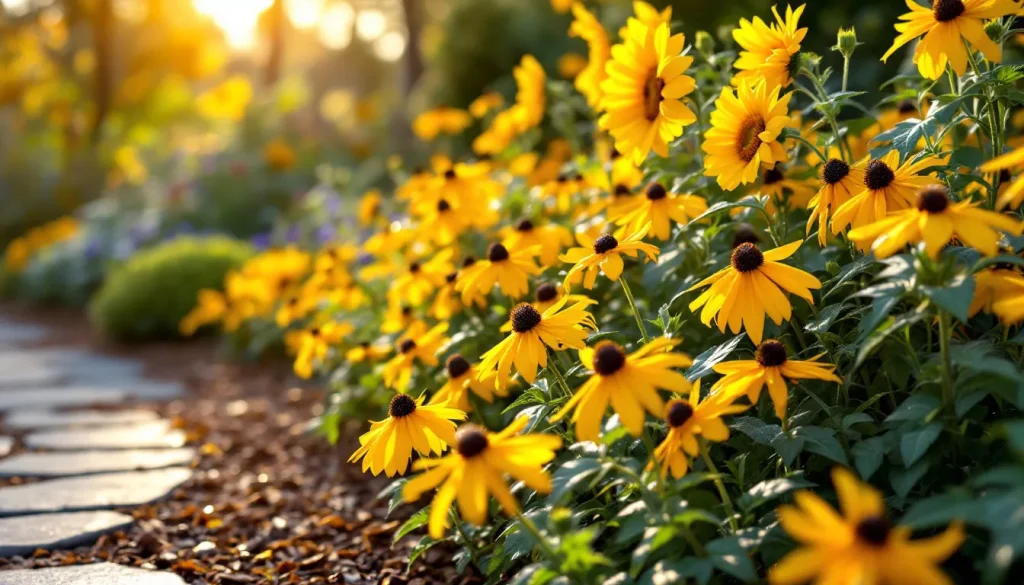
Black-eyed Susan ‘Goldsturm’ is a classic golden daisy with a dark central cone, blooming July to October on 24 to 30 inch stems in zones 3 to 9. It handles full sun to part sun and average soil. Leave the seed heads standing through winter to feed goldfinches and add structure to the dormant border.
5. False sunflower, Heliopsis helianthoides
False sunflower is a tall, upright native producing masses of bright yellow daisies June to September on 3 to 5 foot stems in zones 3 to 9. It is more heat and humidity tolerant than true sunflowers and reblooms steadily if deadheaded. Use it as a mid-border backbone. See our roundup of tall perennial flowers for pairing partners.
6. Perennial sunflower, Helianthus ‘Lemon Queen’
‘Lemon Queen’ is a towering perennial sunflower reaching 5 to 7 feet, covered in soft lemon-yellow blooms from August to October in zones 4 to 9. It anchors the back of a large border and extends color deep into fall. Give it room and full sun. Divide every 3 to 4 years to control its spreading clumps.
7. Sneezeweed, Helenium autumnale ‘Mardi Gras’
Helenium ‘Mardi Gras’ carries warm yellow-and-orange daisies July to October on 3 to 4 foot stems in zones 3 to 8. It prefers full sun and consistent moisture, unlike most drought-tough yellows here. Pinch stems in early June for bushier plants and later, denser bloom. It is a strong late-season nectar source for pollinators.
8. Daylily, Hemerocallis ‘Stella de Oro’
‘Stella de Oro’ is a compact reblooming daylily, 10 to 12 inches tall, with golden trumpets from June through September in zones 3 to 9. It is one of the most forgiving perennials for beginners, tolerating heat, drought, and clay. Remove spent scapes to keep it reblooming. It edges paths and fills containers reliably.
Shade-tolerant yellow perennials (the gap most lists ignore)
Yellow perennials for shade exist, though few garden lists mention them. For 3 to 6 hours of light or dappled shade, plant yellow corydalis, big-leaf ligularia, yellow columbine, yellow foxglove, and leopard’s bane. These bring gold to north-facing beds and woodland borders where sun-lovers like Rudbeckia and Coreopsis fail. Heights range from 12 inches to 6 feet.
Yellow corydalis, Corydalis lutea
Yellow corydalis blooms an unusually long May to October in part shade to full shade, zones 5 to 8, on ferny 12 to 15 inch mounds. It self-seeds gently into wall crevices and shady gaps, giving the longest bloom window of any shade yellow here. It asks only for moist, well-drained soil and needs no deadheading.
Big-leaf ligularia, Ligularia stenocephala ‘The Rocket’
‘The Rocket’ sends up dramatic yellow flower spikes 4 to 6 feet tall in July and August, in zones 4 to 8 part shade to shade. It demands consistently moist soil and wilts in dry heat, so site it near a pond edge or in a low, damp bed. Its dark stems and jagged foliage add bold structure.
Leopard’s bane, Doronicum orientale
Leopard’s bane is a rare early-spring shade daisy, blooming bright yellow in April and May on 18 to 24 inch stems, zones 4 to 8. It fills the gap before hostas and ferns leaf out, then often goes summer-dormant. Plant it among later-emerging perennials that will hide the fading foliage.
Which yellow perennials bloom the longest?
The longest-blooming yellow perennials are Coreopsis verticillata ‘Zagreb’ and Coreopsis grandiflora ‘Double the Sun’, both delivering 12 to 16 weeks from June to September when sheared, followed by Rudbeckia ‘Goldsturm’ (July to October) and Corydalis lutea (May to October in shade). Reblooming daylily ‘Stella de Oro’ also flowers June through September with deadheading.
| Plant | Bloom window | Approx. weeks | Trick to extend it |
|---|---|---|---|
| Corydalis lutea | May to October | 20+ | None needed, self-cleaning |
| Coreopsis ‘Zagreb’ | June to September | 14 to 16 | Shear by half after first flush |
| Rudbeckia ‘Goldsturm’ | July to October | 14 | Deadhead early, leave late seed heads |
| Daylily ‘Stella de Oro’ | June to September | 14 | Remove spent scapes |
| Achillea ‘Firefly Sunshine’ | June to September | 12 | Cut back for second flush |
A spring-to-fall succession plan for continuous yellow
To keep yellow in the garden spring through fall, chain early, mid, and late bloomers so something is always flowering. Start with basket-of-gold and cushion spurge in April, hand off to Coreopsis and daylily in June, then finish with Helianthus ‘Lemon Queen’ and goldenrod in September and October. Overlapping bloom windows prevent color gaps.
| Season | Lead plants | Bloom months | Role |
|---|---|---|---|
| Early spring | Basket-of-gold, cushion spurge, leopard’s bane | April to May | Open the season before daisies wake |
| Late spring | Yellow columbine, lady’s mantle | May to June | Bridge into summer |
| Early summer | Coreopsis, Achillea, daylily, Heliopsis | June to July | Peak volume of gold |
| Late summer | Rudbeckia, Helenium | July to September | Hold the border |
| Fall | Helianthus ‘Lemon Queen’, goldenrod ‘Fireworks’ | August to October | Carry color to frost |
Plant three to five of one variety in a drift rather than singles, and repeat a color anchor like Rudbeckia across the bed to tie the seasons together. For pairing with other long bloomers, see our list of perennial flowers that bloom all summer.
How to identify a yellow perennial: telling the daisies apart
Four common yellow daisies look nearly identical: Coreopsis, Rudbeckia, Helianthus, and Heliopsis. Separate them by center color, petal shape, height, and leaf. Rudbeckia has a dark brown-black cone, Coreopsis stays low with notched petal tips, Heliopsis and Helianthus grow tall with yellow centers, and Helianthus is the tallest with the largest leaves.
| Plant | Center | Petals | Height | Quick tell |
|---|---|---|---|---|
| Coreopsis (tickseed) | Yellow or gold | Broad, notched tips | 12 to 18 in | Low, fine or lobed leaves |
| Rudbeckia (black-eyed Susan) | Dark brown-black cone | Smooth, slightly drooping | 24 to 30 in | The only dark eye |
| Heliopsis (false sunflower) | Yellow, small | Even, pointed | 3 to 5 ft | Tall with a yellow center |
| Helianthus (perennial sunflower) | Yellow to brown, large | Long ray petals | 5 to 7 ft | Tallest, biggest leaves |
The fastest field check: look at the center. A dark eye means Rudbeckia. A yellow center on a plant over 3 feet means Heliopsis or Helianthus, and if it tops 5 feet with coarse, hand-sized leaves, it is Helianthus. Anything short and mounding with notched petals is Coreopsis.
Yellow perennials for cold climates (zones 3 to 5)
For zones 3 to 5, choose the hardiest yellow perennials that survive deep freezes and return each spring: Achillea ‘Firefly Sunshine’, Coreopsis verticillata ‘Zagreb’, Rudbeckia ‘Goldsturm’, Heliopsis helianthoides, daylily ‘Stella de Oro’, and Helenium ‘Mardi Gras’. All are rated to zone 3, tolerate frost heave, and need no winter protection beyond a light mulch.
In cold zones, plant in spring rather than fall so roots establish before the first freeze. A 2 inch layer of shredded leaf mulch after the ground freezes reduces heaving. Avoid marginal choices like Corydalis lutea (zone 5) and basket-of-gold (zone 4) in true zone 3 gardens unless you can offer a sheltered microclimate.
Using yellow perennials in containers
Compact yellow perennials work well in containers when you give them a large pot, drainage holes, and a full-sun spot. Best container picks are daylily ‘Stella de Oro’ (10 to 12 in), Coreopsis ‘Double the Sun’ (14 to 18 in), and threadleaf coreopsis ‘Zagreb’. In zones 3 to 6, sink pots in the ground or move them to an unheated garage for winter, since container roots freeze faster than in-ground roots.
Pair a mounding daylily with trailing yellow corydalis for a two-layer pot, and topdress with fresh compost each spring. For the difference between these returning plants and one-season fillers, read our explainer on the meaning of annual flowers.
Frequently Asked Questions
What perennial has yellow flowers all summer long?
Coreopsis verticillata ‘Zagreb’ and Coreopsis grandiflora ‘Double the Sun’ bloom yellow from June through September, roughly 14 to 16 weeks, when sheared by half after the first flush. Reblooming daylily ‘Stella de Oro’ and Achillea ‘Firefly Sunshine’ also flower most of the summer with regular deadheading. All three thrive in full sun across USDA zones 3 to 9.
Which yellow perennials bloom the longest?
Yellow corydalis (Corydalis lutea) leads at 20-plus weeks, blooming May to October in shade. Among sun-lovers, Coreopsis ‘Zagreb’ runs 14 to 16 weeks, and Rudbeckia ‘Goldsturm’ and daylily ‘Stella de Oro’ each hold about 14 weeks. Shearing coreopsis, removing spent daylily scapes, and deadheading Rudbeckia early all stretch these windows further into fall.
Are there yellow perennials that grow in shade?
Yes. Yellow corydalis (Corydalis lutea), big-leaf ligularia ‘The Rocket’, yellow columbine (Aquilegia chrysantha), yellow foxglove (Digitalis grandiflora), and leopard’s bane (Doronicum orientale) all bloom yellow in part shade to full shade. They suit north-facing beds and woodland borders where sun-loving Rudbeckia and Coreopsis fail. Most prefer moist, well-drained soil and 3 to 6 hours of dappled light.
What is the tall yellow perennial that looks like a daisy?
The tall yellow daisy-like perennials are Heliopsis helianthoides (false sunflower, 3 to 5 feet) and Helianthus ‘Lemon Queen’ (perennial sunflower, 5 to 7 feet). Both carry masses of yellow daisies on upright stems in summer and fall, zones 3 to 9. Helianthus is taller with larger leaves. Both anchor the back of a full-sun border.
How do I identify a yellow perennial flower?
Check the flower center first. A dark brown-black cone means Rudbeckia (black-eyed Susan). A yellow center on a plant over 3 feet means Heliopsis or Helianthus, and over 5 feet with coarse leaves points to Helianthus. Low mounds under 18 inches with notched petal tips are Coreopsis. Petal shape, height, and leaf texture confirm the rest.
What yellow perennials come back every year in zones 3 to 5?
In cold zones 3 to 5, the reliably hardy yellow perennials are Achillea ‘Firefly Sunshine’, Coreopsis ‘Zagreb’, Rudbeckia ‘Goldsturm’, Heliopsis helianthoides, daylily ‘Stella de Oro’, and Helenium ‘Mardi Gras’. All are rated to zone 3 and need no winter protection beyond light mulch. Plant in spring so roots establish before the first hard freeze.
How do I combine yellow perennials for continuous bloom spring through fall?
Chain early, mid, and late bloomers. Start with basket-of-gold and cushion spurge in April to May, hand off to Coreopsis, Achillea, and daylily in June to July, then finish with Helianthus ‘Lemon Queen’ and goldenrod ‘Fireworks’ from August to October. Plant in drifts of three to five and repeat one anchor plant across the bed to tie seasons together.
What are the best low-maintenance yellow perennials for beginners?
The most forgiving yellow perennials for beginners are daylily ‘Stella de Oro’, Coreopsis ‘Zagreb’, Rudbeckia ‘Goldsturm’, and Achillea ‘Firefly Sunshine’. All tolerate heat, drought, poor soil, and neglect once established, return yearly in zones 3 to 9, and bloom for months with minimal deadheading. They resist most pests and need dividing only every 3 to 4 years.