
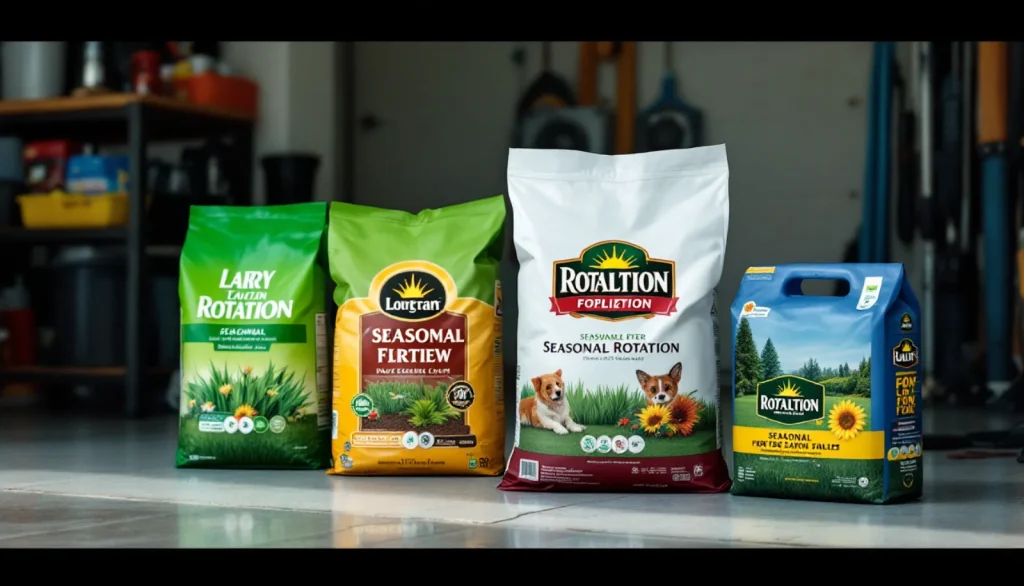
Most homeowners buy one bag of lawn care fertilizer in April, dump it on the grass, and wonder in October why their lawn looks tired. The fix is not a better single bag. It is a four-bag yearly rotation: pre-emergent plus starter feed in spring, slow-release nitrogen in early summer, an iron and micros bag in late summer, and a winterizer in fall. That rotation, applied at the right rate on a measured lawn, is what separates a green yard from a thatched, weedy one by the third year.
The short version
- The 4-bag yearly program for cool-season turf: spring pre-emergent, early-summer slow-release N, late-summer iron, fall winterizer. Warm-season swaps the timing.
- Application rate math never changes: lbs of product per 1,000 sq ft = 100 divided by the first NPK number.
- Total annual fertilizer cost on a 5,000 sq ft lawn in 2026: $90 to $180 DIY, $320 to $520 contracted.
- Slow-release nitrogen should be 50% or more of the N source on summer bags. Anything less burns.
- Real brands worth buying: Lesco 24-0-11, Andersons Humic DG, Milorganite 6-4-0, Yard Mastery, Scotts Turf Builder for the big-box rotation.
- Sardonic note: the “step 1 through step 4” branded program at the big box is not wrong, just expensive and light on iron.
The four bags, in plain English
A lawn is a perennial monoculture. It needs nitrogen, but not all at once. It needs phosphorus only when establishing. It needs potassium for stress tolerance. And it needs iron and micros to stay green in the heat without pushing growth that triggers fungus. One bag cannot do all that, because the timing is wrong and the chemistry is wrong. The four-bag rotation breaks the year into windows where one input matters most, applies the right product at the right rate, and ignores the marketing that says “feed your lawn every six weeks.”
Cool-season turf (Kentucky bluegrass, tall fescue, perennial ryegrass, fine fescue blends) gets its heavy feeding in fall, when roots are growing and shoots are not. Warm-season turf (Bermuda, Zoysia, St. Augustine, centipede) gets its heavy feeding in late spring through midsummer, when it is actively growing. Same four bags, different calendar. The rest of this guide walks the cool-season schedule because that is what most of the US Northeast, Midwest, Pacific Northwest, and Transition Zone lawns are. Warm-season swaps are flagged where they matter.
The four-bag schedule at a glance
| Bag | Timing (cool-season) | Target product | Application rate | Cost per 5,000 sq ft |
|---|---|---|---|---|
| 1. Spring pre-emergent + light feed | Soil temp 50 to 55 F, usually mid-March to mid-April | Prodiamine 0.38% on 0-0-7 carrier, or Scotts Halts | 4 lbs per 1,000 sq ft | $45 to $65 |
| 2. Early summer slow-release N | Memorial Day to mid-June | Lesco 24-0-11 50% PCSCU, or Milorganite 6-4-0 | 4 lbs per 1,000 sq ft (Lesco), 16 lbs (Milorganite) | $28 to $90 |
| 3. Late summer iron + micros | Mid-August | Andersons Humic DG plus ferrous sulfate, or Yard Mastery Iron 6-0-0 | 3 lbs per 1,000 sq ft | $35 to $55 |
| 4. Fall winterizer | Late October to mid-November, before first hard freeze | Lesco 32-0-10, or Scotts WinterGuard 28-0-12 | 3 lbs per 1,000 sq ft | $32 to $48 |
That is roughly $140 to $258 in product per year for a 5,000 sq ft lawn, plus a spreader you already own. If you want the lazy comparison, the big-box four-step program (Scotts Step 1 through 4) lands around $180 to $220 for the same square footage and gives you a different but workable rotation. The Lesco and Andersons route at a contractor supply yard is denser nitrogen per bag, costs less per 1,000 sq ft, and is what real lawn-care operators run. See our plant fertilizer outdoor guide for more.
Bag 1: spring pre-emergent plus light feed
This is the most important bag and the one homeowners get wrong. Forsythia bloom is the visual cue. Soil temperature at 4 inches hitting 50 to 55 F is the real cue. Apply too early and the herbicide breaks down before crabgrass germinates. Apply too late and the seeds are already up. Prodiamine (Barricade) at 0.38% on a fertilizer carrier gives you 4 to 5 months of pre-emergent protection. Dimension (dithiopyr) gives you 3 months and a small post-emergent kick on already-germinated crabgrass. See our turf maintenance guide for more.
The “feed” part of bag 1 should be light. A 0-0-7 carrier or a low-nitrogen carrier (around 12-0-5) is correct. Heavy spring nitrogen pushes top growth before the roots are ready and sets up summer disease pressure (brown patch, dollar spot). If you are confused about what those numbers mean, the NPK fertilizer guide explains the ratio and where each nutrient actually goes in the plant.
Bag 2: early summer slow-release nitrogen
This is where the math matters. The rule is: lbs of product per 1,000 sq ft = 100 divided by the first NPK number. A 24-0-11 bag means 4.17 lbs of product spreads 1 lb of nitrogen across 1,000 sq ft. A 6-4-0 Milorganite bag means 16.7 lbs of product to deliver the same 1 lb of N. Same nitrogen, different bag weight, different cost. See our best plant fertilizer guide for more.
The slow-release fraction matters more than the brand. Look for “PCSCU” (polymer coated sulfur coated urea), “MESA” (methylene urea on ammonium sulfate), or “IBDU” on the label. You want 50% or more of the N as slow-release. Milorganite is 100% slow-release because it is heat-dried biosolids, which is why it is forgiving even at 1.5x rate. Lesco 24-0-11 50% PCSCU is the contractor standard and what shows up on most pro lawns. Sunday Lawn Care’s subscription pouches are real fertilizer in a marketing wrapper at roughly double the per-lb-N price. See our best lawn fertilizer guide for more.
Measure your lawn first. A 5,000 sq ft estimate that is actually 7,200 sq ft means you underapplied by 30% all year. The lawn square footage measuring guide walks the parcel-map method that beats pacing it off.
Bag 3: late summer iron and micros
August is when lawns look tired. The fix is not more nitrogen. More N in August is how you get brown patch on tall fescue and large patch on Zoysia. The fix is iron, a humic carrier, and sometimes a tiny dose of potassium. Iron greens the lawn cosmetically without pushing growth. Andersons Humic DG plus a ferrous sulfate spray, or a bagged product like Yard Mastery Iron 6-0-0, gets you there for around $35 to $55 on 5,000 sq ft.
If you are seeing actual disease (circular brown rings, water-soaked edges), iron will not fix it and you have a separate problem. The brown patches in lawn diagnosis guide walks the visual diagnosis tree. Fungicide is rarely worth it for a homeowner, but knowing whether you have brown patch versus dog spot versus drought versus grub feeding is what changes the August bag decision.
Bag 4: fall winterizer
This is the bag that builds next year’s lawn. Cool-season grass roots grow until soil temperature drops below 40 F. A late October to mid-November application of a 25-0-10 or 32-0-10 product gives the plant nitrogen and potassium to store as carbohydrate reserves, which is what drives the early spring green-up that has nothing to do with whether you applied step 1 in March. Skipping winterizer is the single most common mistake on cool-season lawns.
For warm-season turf the timing inverts. Bermuda and Zoysia should get their last nitrogen 4 to 6 weeks before expected dormancy, which is roughly September 1 in the Transition Zone and mid-September in the Deep South. Pushing nitrogen into October on Bermuda invites spring dead spot, which you will not see until next April when you cannot do anything about it.
How much fertilizer per year, total
Cool-season turf needs roughly 3 to 4 lbs of actual nitrogen per 1,000 sq ft per year, split across the four bags. Warm-season turf in full sun can take 4 to 6 lbs. Shade lawns and fine fescue blends want closer to 2 lbs. More than 5 lbs of N per year on most lawns is wasted, runs off, and drives thatch.
The math for a 5,000 sq ft lawn at 3.5 lbs N total: bag 1 contributes 0.35 lbs N, bag 2 contributes 1 lb, bag 3 contributes 0.3 lbs, bag 4 contributes 1 lb. That leaves a small “spoon-feeding” budget if you want to do a liquid mid-summer application of 0.5 lbs N from urea. Most homeowners do not need to bother.
DIY versus hiring a service
A 5,000 sq ft lawn done DIY runs $90 to $180 per year in product and 4 hours of labor. A contracted four-round program from TruGreen, Lawn Doctor, or a local independent runs $320 to $520 for the same square footage, typically billed as five or six rounds because they spread the work and the invoices. The lawn care cost guide breaks out what is actually in a “program” versus add-ons like grub control and aeration.
The honest answer: if you can read a spreader setting and walk in a straight line, DIY beats the service on price by 2x to 3x. What you pay the service for is consistency, equipment, and not having to remember the August iron app when you are at the beach. For contractor-side readers, the landscaper hub and the operator playbook cover route density, per-stop pricing, and product margin.
Common rotation mistakes
Three mistakes show up over and over. First, doubling up bag 1 because “the crabgrass came back last year” without measuring whether prodiamine was applied at the right rate the first time. Pre-emergent that splits the rate (split application six weeks apart) outperforms a single heavy app, but most homeowners do one and done. Second, putting bag 2 down in May during a dry stretch. Granular fertilizer needs irrigation or rain within 48 hours to dissolve and move into the root zone, or you lose 20% to volatilization. Third, skipping bag 4 because “the lawn looks fine in November.” It is fine because of bag 4 from last fall. Cause and effect are 12 months apart on a lawn.
Where suppliers fit
SiteOne Landscape Supply and Ewing Outdoor Supply are the two national chains stocking Lesco, Andersons, and Yard Mastery in commercial bag sizes (40 to 50 lbs). Most locations let homeowners walk in with a credit card, no account needed. Big-box (Home Depot, Lowes) stocks Scotts, Milorganite, Pennington, and Vigoro. The Scotts step program is the easiest entry point. The Lesco bag at SiteOne is the lower per-acre cost and the route most pros take. The supplier hub tracks which chains carry which brands by region.
FAQ
Can I skip the spring pre-emergent if I have no weeds?
Only if you have no crabgrass, goosegrass, or annual bluegrass to speak of, which is rare. Pre-emergent prevents seeds that are already in the soil from germinating. If you skip a year and then try to catch up, the post-emergent options for crabgrass (quinclorac, Tenacity) are more expensive, harder to time, and can leave bleached spots in the lawn. Pre-emergent is the cheapest weed control by a wide margin.
Is organic fertilizer (Milorganite, chicken pellets, compost tea) enough on its own?
Yes, but slower. Milorganite at 16 lbs per 1,000 sq ft delivers 1 lb of slow-release organic N. A four-bag all-Milorganite program costs roughly $280 per year on 5,000 sq ft, versus $140 to $180 for the synthetic Lesco route. The lawn will look slightly less aggressive in spring and slightly better in heat. There is no measurable disease difference if your watering and mowing are right.
What spreader setting do I use?
Use the setting printed on the bag for your spreader model. If your spreader is not listed, set it midway between two similar spreaders and apply half the lawn going north-south at half rate, then half the lawn going east-west at half rate. Two perpendicular passes at half rate beat one heavy pass for coverage uniformity, and cuts striping on any bag.
Do I need a soil test before starting the rotation?
For year 1, no. The four-bag rotation works on the assumption that your soil has reasonable phosphorus and potassium already, which is true on most established US lawns. If your lawn has never been fertilized, or you are establishing new sod, a $20 soil test from your state extension office is worth it because it tells you whether to add phosphorus (which most rotations skip) and lime.
What about drought years when watering is restricted?
Cut nitrogen by half and skip bag 2 entirely. Iron in late summer is still fine. Winterizer is still fine, because by October most municipal watering restrictions have lifted. If you are in a chronic drought region, the drought-tolerant lawn alternatives guide covers buffalograss, blue grama, and Kurapia, all of which need a fraction of the fertilizer of bluegrass.
Bottom line
Buy four bags. Apply them on a measured lawn at the rate printed on the bag, timed to soil temperature, not the calendar. Spend $140 to $260 per year and put 4 hours into the work, or pay a service $320 to $520 to do it for you. Either way, the rotation matters more than the brand on the bag.
The branded step programs at the big box are not wrong. They are just heavier on nitrogen, lighter on iron, and priced for the convenience of finding everything on one shelf. The contractor-supply route (Lesco, Andersons, Yard Mastery) costs less per pound of nutrient and gives you control over the iron and micros bag that no big-box program includes. Year 1 you will see modest improvement. Year 3 you will see a lawn that other people stop to look at, and the entire delta is the rotation.