
Turf maintenance at the professional level is a different animal from residential lawn care. A high-school football field, a public golf course, a 200-unit HOA common area, and a 240-acre sod farm all run on the same agronomic principles, but the tolerances tighten by an order of magnitude. Mowing height matters to a tenth of an inch. Fertilizer goes down to a tenth of a pound of nitrogen per thousand square feet. Irrigation is monitored by ET (evapotranspiration), not the homeowner’s tuna can. This is the pro-grade guide to how sports fields, courses, and large commercial properties get maintained in 2026.
The short version
- A regulation high school football field (57,600 sq ft) costs $24,000 to $58,000 a year to maintain at competition grade in 2026.
- An 18-hole municipal golf course budget runs $1.1M to $1.8M for turf operations alone, with greens consuming 35% of the chemical and labor spend on 3% of the acreage.
- Sports turf uses bench-setting reel mowers (Toro Greensmaster 3250D, John Deere 2750 PrecisionCut) at 0.5 to 0.75 inches for Bermuda, 0.125 to 0.250 inches on bentgrass greens.
- Premier sand-based football fields use 100% Tifway 419 Bermuda or Latitude 36 in the south, Kentucky bluegrass blends or HGT bluegrass in the north.
- Topdressing with 80-20 USGA-spec sand at 0.125 inches per pass, 8 to 12 passes a year, is the differentiator between an okay field and a championship surface.
- Aerification windows are non-negotiable on competition turf: solid-tine pre-season, hollow-tine post-season, plus needle-tine venting every 2 to 3 weeks in growing season.
What “pro-grade” actually means
The line between residential lawn care and pro turf maintenance is drawn by tolerance, frequency, and instrumentation. A residential mower expects to stripe a lawn at 3.5 inches once a week. A pro sports-turf manager expects to mow at 0.625 inches three to five times a week, with bench-set blade height verified before every cut and a stimpmeter or surface hardness test (Clegg Hammer) run weekly. The Sports Turf Managers Association (STMA, now Sports Field Management Association SFMA) sets the playing-surface standards that NCAA and most state high school athletic associations adopt by reference.
The instrumentation matters because the surface is being judged. A Clegg Hammer reading on a Division I football field needs to sit between 80 and 100 Gmax for player safety. Higher than 100 is a concussion risk. Lower than 80 is mushy and rotational injury risk. The turf manager’s job is to hit the band every Friday night for nine weeks. Add the agronomic calendar to that, and you understand why a head turf manager at a SEC football program earns $145,000 to $210,000.
Cost benchmarks by venue type
| Venue Type | Acreage | Annual Budget | Cost per Acre | Primary Grass |
|---|---|---|---|---|
| Premium HOA Common Area | 4 to 12 acres | $48K to $215K | $12K to $18K | Tall fescue, Bermuda |
| High School Football Field | 1.3 acres | $24K to $58K | $18K to $45K | Tifway 419 Bermuda, KBG north |
| D1 College Football Field | 1.3 acres | $185K to $340K | $140K to $260K | Latitude 36, HGT bluegrass |
| Municipal Golf Course (18-hole) | 80 to 130 acres | $1.1M to $1.8M | $11K to $20K | 007 bent (greens), Bermuda (fairways) |
| Sod Farm (production) | 200 to 800 acres | $2,100 to $3,400 per acre | $2.4K avg | Single cultivar, monoculture |
| Commercial Office Park | 10 to 40 acres | $95K to $385K | $8K to $12K | Tall fescue, Zoysia |
The cost-per-acre spread (from $2,400 on a sod farm to $260,000 on D1 football) explains everything about why pro turf is a separate discipline. Sod farms are growing one product on flat ground with center-pivot irrigation. D1 football is hand-mowing the hash marks with a pedestrian Toro Flex 21, hand-painting the logos with a 12-gallon Graco TurfMaker, and core-aerifying at 4 AM after a home game.
Mowing equipment and bench-set practice
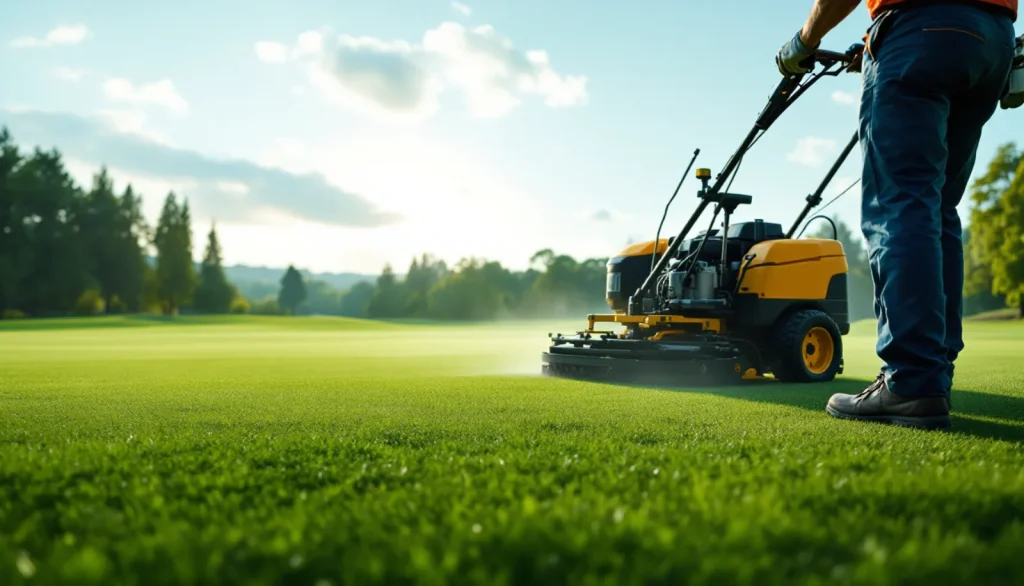
The mower is the most visible piece of equipment but the bench-setting is what separates pros from amateurs. A Toro Greensmaster 3250D (triplex reel mower, $42,000 new) is bench-set with a feeler gauge to within 1/64th of an inch before each cut. The reel-to-bedknife contact is set with a piece of newsprint, a properly adjusted reel slices the paper cleanly with no tearing. John Deere’s 2750 PrecisionCut and the Jacobsen Eclipse 360 are the other two machines you’ll see on a course.
For sports fields, the workhorses are larger: Toro Reelmaster 5510, John Deere 8000A E-Cut Hybrid, Jacobsen LF570. These are five-gang fairway-style mowers that handle the bulk of a football field or athletic complex. Sand-based fields with stadium lighting often run hybrid-electric variants now because of the 4 AM mowing requirement and stadium noise ordinances. Initial capital is $78,000 to $115,000 per machine, with a service life of 5,500 to 7,500 hours.
The fertility program at venue scale
The pro fertility program is built on grams of nitrogen per square meter, not pounds per thousand. Translated back to American units, a high-end sports field runs 4 to 6 lbs of nitrogen per 1,000 sq ft per growing season for cool-season turf, 6 to 10 lbs for warm-season Bermuda. That’s 2 to 4x what a residential lawn gets, and it’s why the field looks the way it does on Friday night.
The product list is different too. Foliar feeds at 0.10 to 0.25 lbs N per application using Floratine, Aquatrols, or Harrell’s MAX products go down weekly. Granular applications use coated urea (Lesco’s Carbon Pro G, Andersons’ Contec DG, Pursell’s PCSCU) on a 21 to 28 day schedule. Slow-release percentage on a competition surface should sit at 50% minimum. The math for a 5 lb N/1,000 sq ft annual program on a 57,600 sq ft football field works out to 288 lbs of actual nitrogen, which at $1.45 per pound of nitrogen as urea (the cheap end) is $418 a year, but the coated and methylene-urea products that pros actually use run $4.20 to $6.80 per pound of N, putting the annual fertility bill at $1,200 to $1,960. Our turf fertilizer guide walks the full ratio-by-venue breakdown.
Aerification windows and topdressing
Aerification is the single most disruptive maintenance event of the year and also the most important. The standard cycle on a sports field: solid-tine venting (5/8 inch tines) every 2 to 3 weeks during the growing season to relieve compaction, hollow-tine core aerification (5/8 or 3/4 inch tines, 2 to 3 inch depth) once in the spring and once after the playing season, deep-tine (Verti-Drain, 9 to 14 inch depth) once a year on heavily-trafficked surfaces.
Topdressing is the other half of the equation. USGA-spec sand (a specific particle-size distribution, 80% medium sand, 20% fine sand, less than 5% silt and clay) is applied at 0.125 to 0.25 inches per pass, 8 to 14 passes per growing season on a championship-level field. That’s 35 to 70 tons of sand a year on a single football field, at $48 to $72 per ton delivered. The annual topdressing bill alone on a SEC-grade field runs $4,200 to $7,800. Topdressing dilutes thatch, levels micro-undulations, and protects the crowns of the grass plants from cleat damage.
Pest and disease pressure at venue scale
Pro turf attracts pro pests. Spring dead spot on Bermuda, summer patch on Kentucky bluegrass, dollar spot on bent and ryegrass, gray leaf spot on perennial ryegrass overseeded fields, these are the recurring problems. The product list is professional-only: Heritage Action (azoxystrobin + propiconazole), Pillar SC (triticonazole + pyraclostrobin), Lexicon Intrinsic (pyraclostrobin + fluxapyroxad), Tartan Stressgard. A single application of Pillar SC on an 18-hole course costs $2,400 to $3,800 in chemical alone, and a course will make 8 to 14 fungicide applications a year.
The licensing is also more serious. State turf-and-ornamental pesticide certification (Category 3A in most states) is the floor. Many states require a separate golf course superintendent license, and the GCSAA Class A certification is the de facto industry standard. The cost of getting compliance wrong is real, FIFRA off-label violations start at $5,000 per documented event and can run to $25,000 plus state-level penalties. For practical diagnosis of disease pressure, our brown patches diagnostic guide covers the residential-equivalent symptoms.
Irrigation and water management at scale
Pro turf irrigation is run by central control systems (Toro Lynx, Rain Bird Cirrus Pro, Hunter Pilot) that pull weather data from on-site ET stations and run zones to within 1% of calculated demand. A modern 18-hole course has 1,800 to 2,800 individual sprinkler heads, each addressable through the central, with monthly water bills running $18,000 to $45,000 in arid regions like Phoenix or Las Vegas.
Water-use restrictions and reclaimed-water mandates are now common. California’s State Water Resources Control Board, Arizona’s ADWR, and Nevada’s Southern Nevada Water Authority all require pro turf operators to file annual water-use reports. Many courses have switched to reclaimed (purple-pipe) water, which adds salinity-management complexity but cuts cost by 40 to 60%. The water-management piece is also where the EPA WaterSense and drought-rebate programs intersect with pro turf, and our drought-tolerant alternatives guide covers the homeowner side of that math.
Sod farm operations: a parallel discipline
Sod farms run a different calendar. The product is sold by the pallet (a typical pallet is 450 to 500 sq ft of cut sod, weighing 2,800 to 3,400 lbs depending on moisture). Wholesale prices in 2026: Tifway 419 Bermuda at $0.42 to $0.55 per sq ft, Zoysia (Empire, Zeon) at $0.65 to $0.85, premium Kentucky bluegrass blends at $0.55 to $0.72. A 200-acre Bermuda sod farm grosses $2.1M to $2.8M annually, with EBITDA margins of 22 to 32% in a normal year.
The operational tempo is brutal. Sod is cut, harvested by a Trebro AutoStack or Brouwer Triple Roll harvester, palletized, and on a truck within 4 hours of cutting in hot weather, 24 hours in cool weather. The sod farm’s mowing fleet is bigger than a golf course’s: 5 to 8 batwing flex mowers (Land Pride RCFM, Bush Hog 12815), 2 to 4 reel-type harvesters, 3 to 5 sand topdressers (Dakota 410, Turfco WideSpin 1550). Operators ship within a 300-mile radius for fresh-cut sod, beyond that the product loses too much vigor in transit.
The HOA / commercial maintenance contract
The unsexy middle of pro turf is the HOA and commercial maintenance contract. A 12-acre HOA common area runs $185,000 to $245,000 a year in 2026, broken into mowing (35%), chemical applications (22%), seasonal cleanup and mulch (18%), irrigation management (12%), and aeration/overseeding (13%). The contractor typically runs the property on a 12-month flat-rate billing structure, with crews on the property twice a week May through October and once a week the rest of the year.
The pricing model is the operator’s edge. LMN, Aspire, and Service Autopilot all have HOA-specific estimating templates that produce a 3-year contract price with built-in 4 to 6% annual escalators. Crews running these systems are quoting at 38 to 42% gross margin, well above the 28 to 32% the mow-and-go residential crews are seeing. The volume guide we wrote at measuring lawn square footage is the starting point for any commercial bid.
FAQ
What does it cost to maintain a high school football field for a year?
$24,000 to $58,000 in 2026 for a competition-grade Bermuda or bluegrass field. The spread is driven by sand-based versus native soil construction, lighting (which dictates 4 AM mowing schedules), and whether the school carries its own staff or contracts the work out.
What grass is used on professional sports fields?
In the south, Tifway 419 or Latitude 36 Bermuda for most football and baseball. In the north, Kentucky bluegrass blends or HGT bluegrass on football, bentgrass-only on golf greens (007, A1/A4, Tyee). Cool-season fields in the transition zone often overseed with perennial ryegrass in October for winter playability.
How often does a golf course mow its greens?
Daily during the playing season, sometimes twice a day for tournament play. Greens height ranges 0.090 inches (PGA Tour tournament setup) to 0.150 inches (resort daily play). Fairways are mowed 3 to 5 times a week at 0.375 to 0.625 inches.
What is topdressing and why does it matter?
Topdressing is applying a thin layer of sand (sometimes a sand-soil-compost blend) over turf to dilute thatch, level the surface, and protect plant crowns. On pro turf it’s applied 8 to 14 times a season at 0.125 to 0.25 inches per pass. Without it, thatch builds, the field gets soft, and player injury risk goes up.
Do I need a pesticide license to maintain a sports field?
Yes, in all 50 states. The base requirement is a state turf-and-ornamental category certification (usually Category 3A) plus the Core exam. Many jurisdictions require an additional commercial applicator license and continuing education credits. The GCSAA Class A certification is the gold standard for golf course superintendents.
Bottom line
Pro turf maintenance is residential lawn care with the tolerances tightened by 10x and the budget multiplied by 50. The principles are the same, mow, fertilize, irrigate, aerate, manage pests, but the instruments, the products, and the consequences of getting it wrong all scale up. A sports turf manager is part agronomist, part operations manager, part EPA compliance officer, and on Friday nights, part risk-management consultant for the school’s insurance carrier.
For homeowners reading this, the takeaway is that the practices the pros use scale down. Use a slow-release fertilizer, mow at the right height for your species, irrigate deep and infrequent, aerate every fall. You won’t have a SEC football field, but you’ll be in the top 5% of your zip code. For deeper coverage of the agronomy, the grass maintenance schedule piece breaks down the cool-season versus warm-season calendar in detail, and the HMNDP Playbook has the venue-specific operating procedures.