
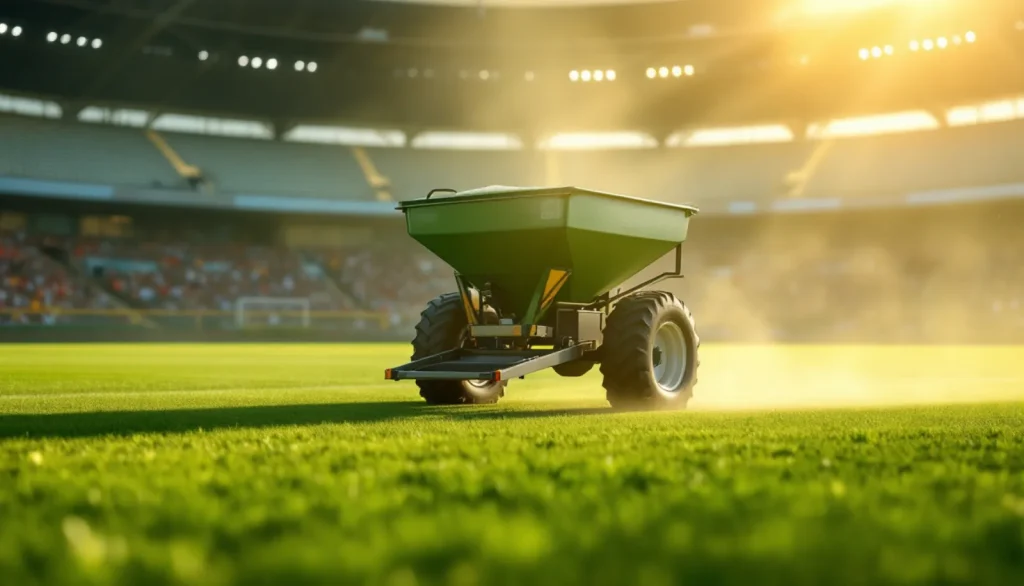
Turf fertilizer selection is where pro operators separate themselves from the homeowner crowd. A sports-field manager picks a 32-3-8 polymer-coated urea blend with 65% slow-release because the playing surface has to recover from cleat damage in 48 hours. A sod farm picks a straight 46-0-0 urea because it’s the cheapest pound of nitrogen and the growth window is measured in dollars per pallet. A premium residential customer picks an organic 10-0-2 Milorganite blend because they want the grass green without burning their dog’s paws. NPK selection is the whole game. This guide walks the matrix.
The short version
- Turf fertilizer NPK math: lbs of product per 1,000 sq ft = 100 divided by the first NPK number, to deliver 1 lb of nitrogen.
- Sports fields run 4 to 6 lbs N/1,000 sq ft/year on cool-season, 6 to 10 lbs on Bermuda. Premium residential runs 3 to 4 lbs. Sod farms push 8 to 12 lbs.
- Top contractor brands in 2026: Lesco (Carbon Pro G, 24-0-11), Andersons (Contec DG, 16-0-8), Pursell (PCSCU), Harrell’s MAX. Homeowner pros: Milorganite (6-4-0), Scotts (Turf Builder 32-0-4), Yard Mastery (24-0-6).
- Slow-release percentage matters more than total N: 50% minimum on competition turf, 30 to 40% on residential, 25% acceptable on sod farms.
- Cost per pound of actual nitrogen in 2026: straight urea $1.45, coated urea (SCU/PCU) $4.20 to $6.80, organic (Milorganite) $9.40, foliar Floratine $14 to $22.
- Application timing matters as much as product: cool-season programs anchor on Memorial Day, Labor Day, Halloween. Warm-season anchor on green-up, peak summer, pre-dormancy.
The NPK shorthand, explained in pro terms
Every bag of fertilizer carries three numbers: nitrogen (N), phosphorus (P), and potassium (K). On a bag labeled 24-0-11, those numbers are percent by weight of each nutrient. A 50 lb bag of 24-0-11 contains 12 lbs of actual nitrogen, 0 lbs of phosphorus, and 5.5 lbs of potassium. The remaining 32.5 lbs is filler, carrier, and the slow-release coating that makes the product release nitrogen over 60 to 120 days.
The application rate is calculated to deliver a target rate of nitrogen per thousand square feet, almost always 0.5 to 1.0 lbs N per 1,000 sq ft per application. The math: 100 divided by the first number equals lbs of product per 1,000 sq ft to deliver 1 lb of N. So 24-0-11 at 1 lb N: 100/24 = 4.17 lbs of product per 1,000 sq ft. On a 5,000 sq ft lawn, that’s 20.8 lbs. On a 57,600 sq ft football field, it’s 240 lbs. Our complete NPK fertilizer guide walks the calculation across every common ratio.
The product matrix: residential, HOA, sports turf, sod farm
| Venue | Annual N (lbs/M) | Common Product | NPK | Slow-Release % | Cost per 1,000 sq ft/yr |
|---|---|---|---|---|---|
| Premium Residential | 3 to 4 | Milorganite 6-4-0 | 6-4-0 | 100% organic | $38 to $58 |
| Standard Residential | 3 to 4 | Scotts Turf Builder | 32-0-4 | 30% | $24 to $36 |
| HOA / Commercial | 3 to 5 | Lesco Carbon Pro G | 24-0-11 | 50% | $28 to $42 |
| Sports Field (cool) | 4 to 6 | Andersons Contec DG | 16-0-8 | 50% MUF | $58 to $92 |
| Sports Field (Bermuda) | 6 to 10 | Harrell’s PCSCU | 32-3-8 | 65% PCU | $72 to $145 |
| Golf Greens | 3 to 5 | Floratine foliar program | Various low-rate | Foliar weekly | $185 to $340 |
| Sod Farm Production | 8 to 12 | Urea 46-0-0 (straight) | 46-0-0 | 0% (fast) | $22 to $34 |
The cost-per-thousand spread (from $22 on a sod farm to $340 on golf greens) is driven entirely by slow-release percentage and product form. The sod farm wants the cheapest pound of nitrogen because they’re growing a commodity. The golf course superintendent wants foliar control at 0.10 lbs N per application because the surface is being judged at the millimeter scale. See our plant fertilizer outdoor guide for more.
Slow-release nitrogen: the 50% rule
The slow-release percentage on a fertilizer bag is the single most important number after the NPK ratio. Pro operators target 50% minimum slow-release on competition turf, because the alternative (100% quick-release urea) creates a surge-and-crash growth pattern that’s both visually ugly and agronomically harmful. The grass plant gets a nitrogen flood, grows top growth at the expense of roots, then crashes when the nitrogen runs out 18 days later. See our turf maintenance guide for more.
The slow-release technologies on the market in 2026: sulfur-coated urea (SCU) is the old workhorse, cheap and predictable, releases over 6 to 10 weeks. Polymer-coated urea (PCU) is the premium product, releases over 12 to 16 weeks based on soil temperature, brands include Andersons’ Contec, Pursell’s PCSCU, Harrell’s MAX. Methylene urea (MUF) is the third option, breaks down via microbial activity and lasts 10 to 14 weeks. Most pro blends combine all three for a tiered-release profile.
Cool-season fertilization calendar
Cool-season turf (Kentucky bluegrass, tall fescue, perennial ryegrass, fine fescue) hits peak growth in spring and fall, with a summer dormancy stress period. The pro calendar for a 5,000 sq ft KBG/fescue lawn:
Round 1, early April: 0.75 lbs N starter fertilizer (Scotts Turf Builder Starter 24-25-4, or Lesco 18-24-12). Phosphorus-included rules apply, check your state law (Minnesota, Maryland, Virginia, New Jersey all restrict P unless soil test justifies it). Round 2, Memorial Day: 1.0 lbs N PCU blend (Lesco 24-0-11 or Andersons Contec 16-0-8). Round 3, late July: 0.5 lbs N foliar feed for summer stress relief, use a low-salt-index product. Round 4, Labor Day: 1.0 lbs N PCU. Round 5, mid-October: 1.0 lbs N “winterizer” with high potassium (Scotts WinterGuard 24-0-11 or Lesco 18-0-18). Round 6, Halloween: optional 1.0 lbs N late-season application for root development.
That’s 4.5 to 5.0 lbs of actual N per growing season, perfectly aligned with the species’ agronomic needs. For Kentucky bluegrass specifically on a premium residential property, push to 5 to 6 lbs N annually. Our best lawn fertilizer for 2026 guide compares the specific products by use case.
Warm-season fertilization calendar
Warm-season grasses (Bermuda, Zoysia, St. Augustine, Centipede) have the opposite curve, dormant in winter, exploding in summer heat. The Bermuda calendar on a sports field in zone 8:
Round 1, full green-up (mid-April in central GA, early May in TN): 1.0 lbs N (Harrell’s 32-3-8 PCU). Rounds 2 through 7, every 21 days through mid-September: 1.0 lbs N each application. Final round, late September: 1.0 lbs N with elevated potassium (16-0-22 winterizer). Total: 7 to 8 lbs N per growing season. Bermuda will use every pound, and on a sports field that takes 200 hours of game and practice traffic, it needs every pound.
St. Augustine and Centipede run the opposite extreme. St. Aug wants 3 to 4 lbs N annually max, applied as 0.5 lb increments to prevent chinch bug and gray leaf spot. Centipede is the lazy-man’s lawn, 1 to 2 lbs N annually and you’re done. Over-fertilization on Centipede causes Centipede Decline, a documented agronomic failure mode that’s killed thousands of southern lawns. The Centipede over-fertilizer problem is exactly the kind of expensive lesson that costs a homeowner the entire lawn, and frankly the warning on the bag is one of the few places where the fine print actually matters.
Sports field versus sod farm versus premium residential
The three biggest categories of pro turf fertility have different objectives. A sports field wants playing-surface recovery, so it runs 50%+ slow-release at high total rates. A sod farm wants growth-to-harvest speed, so it runs near-zero slow-release at maximum total rates (a sod farm’s product is literally the grass plant, so growth equals revenue). A premium residential customer wants visual quality and environmental conscience, so they run organic blends like Milorganite or biosolids-based products from Sustane and Purely Organic.
Sod farms in Florida, Georgia, Texas, and California push 10 to 12 lbs N per growing season per acre. The product is almost always granular urea (46-0-0) at $0.34 to $0.42 per pound of N, applied with a 12-foot spinner spreader behind a tractor. Cost per acre per year for fertility alone: $340 to $480. The sod farmer is selling a 450 sq ft pallet for $185 to $240 wholesale (Bermuda), so the fertility cost is 4 to 6% of revenue. That’s the math that drives the cheap-N product choice.
Foliar feeding and the golf-course program
Golf course greens are the most intensively managed turf on earth. The bentgrass surface at 0.110 inches isn’t fertilized with granular product at all, it’s fed weekly through the irrigation system or hand-sprayed with a Floratine, Aquatrols, or Harrell’s MAX foliar program. Application rates are 0.05 to 0.15 lbs N per 1,000 sq ft per application, with a full season totaling 3 to 5 lbs N.
The cost is staggering. A weekly foliar program on 18 greens (averaging 5,000 sq ft each, so 90,000 sq ft total) runs $185 to $340 per 1,000 sq ft per year, or $16,650 to $30,600 for greens fertility alone. Add in the surfactants, plant-growth regulators (Primo Maxx, Trimmit), and bio-stimulants (humic acid, kelp extract, amino acids), and the greens chemical budget on an average course is $80,000 to $145,000. The fairways and tees get a more conventional granular program at far lower cost.
Application equipment and calibration
For residential and small commercial, a Scotts Edgeguard Mini or Lesco 80 lb push spreader is the standard. Pro contractors run a Lesco 80 lb walk-behind or a Z-Spray Z-Plug ride-on (which combines spray and granular in one machine, $14,800 to $22,400 new). Sports fields use rotary spreaders (Lely 1250, Vicon RS) behind a Toro Workman utility vehicle. Sod farms run pull-behind spinners (Salford BBI Crossover, Adams 5-ton) behind 100+ HP tractors.
Calibration is the part everyone skips. A spreader rated at “setting 4” delivers different rates depending on walking speed, product density, humidity, and how full the hopper is. Pros calibrate every season with a calibration kit (a tarp, a scale, a measuring tape) to verify actual output. The 5-minute calibration check has prevented more burned lawns than any single piece of advice in the industry. To calculate the application area accurately, use our lawn square footage measurement guide.
Liquid versus granular: the form factor decision
Granular fertilizer dominates the residential and HOA market because it’s storage-stable, easy to apply with a push spreader, and forgiving of operator error. Liquid fertilizer dominates the high-end sports turf and golf greens market because it lets the applicator hit precise rates (down to 0.05 lbs N per 1,000 sq ft) and combine fertility with foliar bio-stimulants, surfactants, and plant-growth regulators in a single tank mix.
The crossover product is the liquid soluble fertilizer (Lesco LESCO 18-3-6 Liquid, Andersons FloraQuick, JR Peters Jack’s Classic), which dissolves in water and sprays through a backpack or boom sprayer. Cost per pound of nitrogen runs $5.40 to $9.80 in soluble form versus $1.45 to $6.80 for granular. The premium is justified on golf greens and sports fields where precision matters, less so on a residential lawn where granular at the right rate produces the same visible outcome.
Foliar feeding (low-rate liquid sprayed onto the leaf blade) is its own discipline. Floratine and Aquatrols have built entire product lines around foliar feeding, with sequence-specific tank mixes for spring green-up, summer stress relief, fall recovery, and winter dormancy preparation. A Floratine consultant on a golf course charges $4,800 to $12,000 a year for the agronomic program plus chemical at cost. Sports turf managers building their own programs from raw components save 30 to 40% but need the chemistry background to do it right.
Regulations: state restrictions and label compliance
Phosphorus restrictions are now in force in 14 states. Minnesota, New Jersey, Maryland, Virginia, Wisconsin, Michigan, New York, Vermont, Maine, Florida, Washington, Illinois, Indiana, and Ohio all restrict application of phosphorus-containing fertilizer to established turf unless a soil test documents a deficiency. The “starter fertilizer” exception applies to new seeding and sodding, where phosphorus is permitted for plant establishment. Read the label and your state’s Department of Agriculture turf fertilizer rules before applying.
Slow-release nitrogen labeling is also regulated. Products marketed as “slow-release” must contain a documented percentage of water-insoluble nitrogen (WIN) or controlled-release nitrogen (CRN). Look for the AAPFCO (Association of American Plant Food Control Officials) standards label, which requires the slow-release percentage to be printed on the bag. Products claiming “slow-release” without an AAPFCO-compliant label are typically using non-coated urea with minor additives, which doesn’t perform like true PCU or SCU products.
Applicator licensing varies by state. Most jurisdictions require a commercial pesticide applicator license (Category 3A Turf and Ornamental) for any for-hire fertilizer application that contains a pesticide (weed-and-feed products, fertilizer plus pre-emergent combinations). Straight fertilizer application typically doesn’t require a license but does require business registration, sales tax collection, and in some states a fertilizer dealer permit (Florida, Maine, Maryland specifically). The compliance burden on a small lawn-care operator running fertilizer applications is real, factor 4 to 8 hours a quarter for licensing renewals, continuing-ed credits, and state-mandated record-keeping.
FAQ
What NPK is best for a residential lawn?
For most cool-season lawns, a 24-0-11 or 32-0-4 with at least 30% slow-release is the standard. For Bermuda or Zoysia, a 16-4-8 or 32-3-8 with potassium emphasis. Spring starter applications can use phosphorus (24-25-4) but only where state law allows. Always read the label and your local restrictions.
How many pounds of fertilizer do I need per year?
The target is total pounds of actual nitrogen per 1,000 sq ft per year: 3 to 4 lbs for standard residential, 5 to 6 lbs for premium residential or sports field, 8 to 12 lbs for sod farm production. Use the 100/NPK math to convert to bag pounds: 24-0-11 at 4 lbs N/year = 16.7 lbs of product per 1,000 sq ft, applied across 4 to 5 rounds.
Is organic fertilizer worth the price premium?
Milorganite at $0.94 per pound of nitrogen (versus $0.34 for straight urea) costs roughly 3x. The case for it: no burn risk, builds soil organic matter, releases over 6 to 10 weeks naturally, low salt index, kid and pet safe immediately after application. For premium residential, it’s worth it. For sports turf where you need precise N timing, it’s not the right tool.
Why does my fertilizer bag say to apply at different rates?
Because the bag is designed for multiple application scenarios. The label will give a “low rate” (typically 0.5 lbs N/1,000) and a “high rate” (1.0 lbs N/1,000). Pick based on your timing, lower rates for summer applications under stress, higher rates for spring and fall when the grass is actively growing.
Can I apply turf fertilizer year-round?
No. Cool-season grass goes semi-dormant in summer heat and dormant in winter, fertilizing during those windows wastes product and stresses the plant. Warm-season grass is dormant in winter, fertilizing then is throwing money on frozen ground. Match the calendar to the species, not your weekend availability.
Bottom line
Turf fertilizer in 2026 is a precise tool, not a generic input. The NPK number, the slow-release percentage, the application rate, and the timing are the four levers that determine whether you’re growing championship turf or wasting money on an over-fed lawn. Pro operators have known this since the 1970s, and the products available today are an order of magnitude more sophisticated than the straight urea and 10-10-10 generic blends most homeowners still use.
For homeowners, the move is to step up from Scotts Turf Builder to a Lesco 24-0-11 or Andersons Contec DG product, available at SiteOne Landscape Supply at roughly the same price per pound of N as the big-box products but with substantially better release profiles. For contractors, the move is to build the fertility program into the annual contract, sell it as a single number, and let the route density carry the margin. The fertilizer types comparison and best plant fertilizer for 2026 pieces cover the adjacent product categories, and the HMNDP Landscapers directory has the operators who know how to apply this correctly.