
By the HMNDP Editorial Team | Last reviewed: June 2026
The best way to remove weeds from a large area depends on your surface
The best way to remove weeds from a large area is a systemic herbicide (for speed over a quarter-acre or more), sheet mulching or solarization (for chemical-free clearing of bare soil), or a string trimmer plus tarp for tall growth. There is no single winner. The right method changes based on whether you want to keep the lawn, replant later, or clear gravel.
Scale is the whole problem. Hand-pulling and boiling water make sense for a 100 sq ft bed. Across 10,000 sq ft (roughly a quarter-acre), they cost days of labor and gallons of fuel. Large areas force a tradeoff between speed, cost, soil safety, and whether anything can grow there afterward.
Use the decision matrix below first, then read the method that matches your situation. Every option here includes coverage math so you can price the job before you start.
Decision matrix: match the method to your surface and goal
Pick the row that describes your area, then the column that describes your goal. This is the step most guides skip. A gravel driveway you never plant tolerates salt and strong acetic acid, while a bed you want to replant in three weeks rules both out. Match first, then buy supplies.
| Your surface / goal | Fastest option | Best chemical-free option | Avoid |
|---|---|---|---|
| Gravel driveway or path (no replanting ever) | Glyphosate or 20% horticultural vinegar | Boiling water on cracks; 20% vinegar | Nothing off-limits; salt is acceptable here only |
| Overgrown lawn you want to keep as lawn | Selective broadleaf herbicide (2,4-D based) | Hand-pull plus overseed bare spots | Glyphosate, salt, vinegar (all kill grass) |
| Bare soil bed you plan to replant soon | Solarization or sheet mulch (3 to 6 weeks) | Sheet mulching (cardboard plus mulch) | Salt (sterilizes soil for years) |
| Vacant lot or neglected patch (tall growth) | String trimmer, then tarp or herbicide | Mow low, then solarize under clear plastic | Hand-pulling as primary method |
| Densely planted bed (weeds among keepers) | Targeted syringe injection or hand-pull | Hand-pulling after rain | Broadcast spray (drift kills your plants) |
For lawns you want to keep, our guide on how to get rid of weeds without killing the grass covers selective herbicides in more depth.
Chemical herbicides: systemic vs contact for large areas
Herbicides are the fastest way to clear a large weed-infested area, and the systemic-versus-contact distinction decides whether weeds regrow. Systemic herbicides like glyphosate (the active ingredient in Roundup) move into the roots and kill the whole plant in 7 to 14 days. Contact herbicides burn only what they touch, so perennials with deep roots often resprout.
Systemic glyphosate is the standard choice for clearing bare ground you will replant later, because it leaves little soil residue and breaks down in days to weeks. It is non-selective, meaning it kills grass and desirable plants too. Never broadcast-spray it on a lawn you want to keep.
Selective herbicides (such as 2,4-D or dicamba formulations) kill broadleaf weeds while sparing grass. These are the correct pick when your “large area” is an overgrown lawn and the goal is a clean lawn, not bare dirt.
Coverage math: a concentrate that mixes to roughly 1 gallon of spray typically covers about 300 sq ft. A quarter-acre (10,890 sq ft) needs roughly 36 gallons of mixed spray. Buying concentrate rather than ready-to-use bottles drops the cost from dollars per hundred square feet to cents. Always follow the label rate; over-applying wastes money and can violate the label, which is federal law under FIFRA.
Homemade vinegar, salt, and Dawn dish soap spray: read this before you mix it
The viral vinegar-salt-Dawn recipe works as a contact burn-down on young weeds in gravel, but it has two problems most articles never mention: household 5% vinegar is too weak for tough growth, and salt can sterilize your soil for years. It kills tops, rarely kills roots, and is a poor choice anywhere you want to plant again.
The acetic acid concentration is what matters. Kitchen vinegar is about 5% acetic acid and browns only tender seedlings. Horticultural vinegar at 20% to 30% acetic acid actually kills many weeds, but it is a corrosive that can burn skin and eyes and requires gloves and eye protection. Do not assume the pantry bottle equals the horticultural product.
The Dawn dish soap is a surfactant. It helps the spray stick to waxy leaves. It does not kill anything by itself and adds no root-killing power.
The salt is the real hazard. Sodium chloride does not break down. Enough of it makes soil inhospitable to plants for months or years, and heavy rain can carry it into nearby beds or a neighbor’s yard. Reserve salt for cracks in a driveway you will never plant, and even then use it sparingly.
One legal note: mixing and selling or widely applying a homemade herbicide can run into EPA and state pesticide rules, because a substance marketed to kill pests may need registration. For personal use on your own property the risk is lower, but off-label claims and off-label use can create liability. When in doubt, use a registered product labeled for the site.
Boiling water and targeted syringe injection: small-scale precision tools
Boiling water and syringe injection are precision methods, not large-area methods. Boiling water kills weeds in cracks and small clumps by scalding cells, and syringe-injecting vinegar or horticultural oil into a stem targets one plant without harming neighbors. Both are labor-intensive and impractical past a few hundred square feet.
Boiling water works well on sidewalk and driveway cracks and on isolated clumps. Pour it directly on the crown of the plant. It offers zero residual control, so seeds in the soil still germinate, and heating enough water for a large lot is not realistic.
Syringe injection (drawing horticultural vinegar or oil into a needle and injecting the base of a tough weed) is the surgical option for a weed growing inside a shrub or perennial you want to keep. It avoids spray drift. It is slow, one plant at a time, so it belongs in a densely planted bed, never across open ground.
Hand-pulling and manual removal: best in dense beds, brutal at scale
Hand-pulling is the best method inside densely planted beds where spray would drift onto plants you want to keep, and it is the worst choice for open ground larger than a few hundred square feet. Pulling removes the plant now, but leaving roots behind lets perennials return, and the labor across a quarter-acre is measured in days.
Pull after rain or a deep watering, when soil is soft and roots release intact. Grip low at the base and pull steadily so taproots come out whole. A weeding tool or hori-hori knife helps lever out dandelions and docks.
The scale reality: hand-clearing dense weeds runs roughly 1 to 2 hours per 100 sq ft. That is 100-plus hours across a quarter-acre, which is why manual removal is a finishing tool, not a clearing strategy for big areas.
Smothering, sheet mulching, and solarization: the chemical-free heavy hitters
Smothering methods are the best chemical-free way to clear a large area for replanting, because they kill everything including roots and seeds without touching soil chemistry. Sheet mulching blocks light with cardboard and mulch, while solarization bakes weeds and seeds under clear plastic. Both take 3 to 8 weeks but leave soil ready to plant.
Sheet mulching (also called the cardboard method): mow or trim low, lay overlapping plain cardboard with no tape, wet it, then top with 3 to 4 inches of wood-chip mulch or compost. It blocks sunlight, and most weeds die and break down in 4 to 8 weeks. It also builds soil as the cardboard decomposes.
Solarization: clear the area, water it, then stretch clear plastic sheeting tight to the soil and seal the edges. Over 4 to 6 weeks of hot, sunny weather the trapped heat can push topsoil past 120°F and kill weeds, seeds, and many soil pathogens. Clear plastic traps more heat than black; black plastic (a tarp) shades weeds out more slowly but works when sun is weaker.
Landscape fabric is a longer-term barrier rather than a killer. Laid under gravel or mulch it blocks new weeds for years, though windblown seeds can still root in the mulch on top. For beds, our notes on clearing moss and shade-loving growth pair well with these light-blocking tactics.
Killing weeds vs pulling them: which actually solves the problem
Killing a weed with a systemic herbicide destroys the roots so it will not resprout, while pulling removes the visible plant but often leaves root fragments that regrow. For perennial weeds with deep roots (bindweed, thistle, quackgrass), killing beats pulling. For shallow annuals, a clean pull is enough.
Contact methods (vinegar, boiling water, contact herbicides) sit in between: they kill the top but not always the root, so treat them like a strong version of pulling. Expect repeat treatments on tough perennials.
The practical rule: identify whether your dominant weeds are annuals (die off yearly, spread by seed) or perennials (return from roots). Perennials demand a root-killing approach or they win the long game.
Natural vs chemical weed control: the honest tradeoffs
Chemical control is faster and cheaper per square foot; natural control is safer around kids, pets, and edible gardens but slower and more labor-intensive. Neither is universally best. The decision hinges on how fast you need results, whether you will replant, and your tolerance for synthetic products.
| Method | Speed to visible kill | Approx. cost per 1,000 sq ft | Effort | Safe to replant after |
|---|---|---|---|---|
| Systemic herbicide (glyphosate concentrate) | 7 to 14 days | $5 to $15 | Low (spray) | Yes, typically days to a few weeks (per label) |
| Selective herbicide (2,4-D, keeps grass) | 7 to 14 days | $8 to $20 | Low | Lawn stays; N/A for bare soil |
| 20% horticultural vinegar | Hours to 2 days (tops only) | $40 to $90 | Medium | Yes, no lasting residue |
| Vinegar + salt + Dawn (5%) | 1 to 3 days (weak) | $10 to $25 | Medium | No if salt used (soil harmed) |
| Sheet mulching (cardboard + mulch) | 4 to 8 weeks | $30 to $120 (mulch) | Medium | Yes, improves soil |
| Solarization (clear plastic) | 4 to 6 weeks | $15 to $40 (plastic) | Low after setup | Yes |
| Hand-pulling | Immediate (per plant) | Labor: 10 to 20+ hours | Very high | Yes |
Costs are ballpark ranges for U.S. retail supplies in 2026 and vary by brand and region. Labor is your own time.
Original analysis: the fastest large-area plan by scenario, with real numbers
For a quarter-acre (about 10,890 sq ft), the fastest realistic plan is trim the tall growth, spray a systemic herbicide, wait 10 to 14 days, then clear the dead material. This runs roughly $50 to $150 in supplies and one to two working days total, versus 100-plus hours of hand-pulling. Below is the plan mapped to each surface, because scale changes the answer.
- Neglected quarter-acre lot, will replant grass: mow or string-trim to 2 to 3 inches, let regrowth green up for a week, then spray glyphosate concentrate (about 36 gallons mixed). Rake off dead material at day 14. Total: 1 to 2 days, roughly $50 to $150. This is the fastest large-area route.
- Quarter-acre, chemical-free, will replant: mow low, then solarize under clear plastic for 4 to 6 weeks in summer heat, or sheet-mulch with cardboard and 3 to 4 inches of chips. Slower (weeks) but leaves plantable soil. Supplies roughly $40 to $250 depending on mulch volume.
- Gravel driveway, never replant: spray 20% horticultural vinegar on a hot day, or glyphosate for deep-rooted growth, then lay landscape fabric under fresh gravel to stop recurrence. Boiling water handles isolated cracks.
- Overgrown lawn you keep: mow, then apply a selective broadleaf herbicide so grass survives, then overseed thin spots. Never glyphosate the whole lawn.
The takeaway competitors miss: for anything above a few thousand square feet, boiling water, hand-pulling, and the 5% vinegar recipe are not serious clearing methods. They are finishing and spot-treatment tools. Choose a systemic herbicide or a light-blocking method as your primary strategy, then use the small-scale tools for touch-ups.
Best tools for clearing weeds from a large area
The most useful large-area tools are a string trimmer or brush cutter for tall growth, a backpack or pump sprayer for even herbicide coverage, and clear plastic or cardboard plus mulch for chemical-free smothering. A stand-up weed puller helps with finishing work. Match the tool to the method above, not the other way around.
- String trimmer / brush cutter: knocks down tall weeds and brush fast so you can treat regrowth. Essential first step on any overgrown lot.
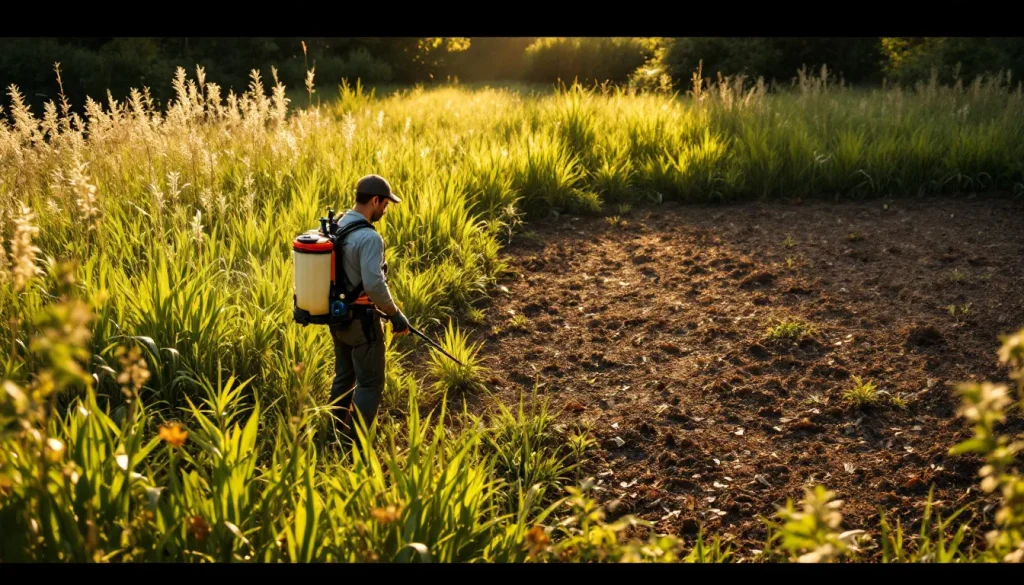
- Backpack or pump sprayer (2 to 4 gallon): delivers herbicide or 20% vinegar evenly and covers a quarter-acre in manageable passes. Far faster than trigger bottles.
- Clear plastic sheeting (4 to 6 mil): for solarization; buy in a roll to cover large sections.
- Cardboard plus wood chips: the cheapest smothering combo; chips are often free from local tree services.
- Stand-up / long-handle weed puller: saves your back on finishing passes in beds.
How to stop weeds from coming back after you clear a large area
To stop weeds returning, block bare soil with a barrier or ground cover and apply a pre-emergent herbicide before weed seeds germinate. Cleared ground is an open invitation for the seed bank already in the soil. Without a post-clearance plan, most large areas grow weeds back within two to six weeks.
Apply a pre-emergent herbicide (such as a corn gluten meal product for a natural option, or a synthetic pre-emergent) to stop new seeds from sprouting. Timing matters: put it down before germination, which for many summer weeds means early spring soil temperatures near 55°F. It stops seeds, not established plants.
Cover bare soil. Keep 3 to 4 inches of mulch on beds, because that depth blocks the light most weed seeds need. On paths and driveways, landscape fabric under gravel is a multi-year barrier.
Replant fast. Bare ground fills with weeds by default, so establish desirable plants or grass to outcompete them. If you are seeding a cleared lawn area, time it right; see our guide on the best time to plant grass seed, and if part of the area is shaded, read how to get grass to grow in shade. A dense stand of grass or ground cover is the most durable long-term weed control there is.
Wait the label interval before replanting after herbicide use. Glyphosate typically allows replanting within days to a few weeks depending on the product, while soil where salt was applied may stay hostile to plants for a long time.
Frequently Asked Questions
What is the fastest way to get rid of weeds over a large area?
The fastest large-area method is a systemic herbicide like glyphosate: trim tall growth, spray, and weeds die to the roots in 7 to 14 days. For a quarter-acre this takes one to two working days and roughly $50 to $150 in supplies, far faster than hand-pulling, which can run 100-plus hours across the same space.
What is the best way to remove weeds from a large area naturally?
The best natural method for a large area is smothering: sheet-mulch with cardboard topped by 3 to 4 inches of wood chips, or solarize under clear plastic for 4 to 6 weeks in summer heat. Both kill roots and seeds without harming soil chemistry and leave the ground ready to replant, unlike salt-based sprays.
Does vinegar, salt, and Dawn dish soap actually kill weeds permanently?
No, not permanently on most weeds. The mix burns leaves on contact but usually spares deep roots, so perennials regrow. Household 5% vinegar is too weak; 20% horticultural vinegar works better. The Dawn is only a sticker. Expect repeat treatments, and avoid it anywhere you plan to plant, because the salt harms soil.
Will salt or vinegar ruin my soil so I can’t plant anything after?
Salt can ruin soil for months or years because sodium chloride does not break down and makes ground inhospitable to plants. Reserve it for gravel or cracks you will never plant. Vinegar (acetic acid) does not persist and leaves no lasting residue, so soil treated with vinegar alone is generally safe to replant.
What is the best tool to clear weeds from a large area?
The best tool combination is a string trimmer or brush cutter to knock down tall growth, followed by a 2 to 4 gallon backpack or pump sprayer for even herbicide coverage across the area. For chemical-free clearing, clear plastic sheeting (solarization) or cardboard plus mulch (sheet mulching) does the heavy work instead.
Is it better to kill weeds or pull them up in a big overgrown area?
In a big overgrown area, killing is usually better. Pulling leaves root fragments that let perennials regrow, and hand-pulling a quarter-acre takes days. A systemic herbicide destroys roots so weeds do not return, and light-blocking methods kill everything at once. Reserve pulling for finishing touches and dense beds where spray would drift onto plants you keep.
How do I get rid of tall weeds quickly?
Cut tall weeds down first with a string trimmer or brush cutter, then treat the shorter regrowth after about a week with a systemic herbicide or by covering it with a tarp. Spraying tall, dense weeds directly wastes product and leaves lower stems alive. Trimming first exposes the crowns so treatment reaches the plant.
How do I stop weeds from coming back after I clear the area?
Stop regrowth by covering bare soil and applying a pre-emergent herbicide before seeds germinate. Keep 3 to 4 inches of mulch on beds, use landscape fabric under gravel, and replant grass or ground cover quickly so desirable plants outcompete weeds. Bare, cleared ground reseeds itself with weeds within two to six weeks if left open.