
By the HMNDP Editorial Team | Independent reporting on lawn care, landscaping, water, and the green-industry business.
Last reviewed: June 2026
What Pond Weeds Are (and the One Decision That Fixes Them)
Pond weeds are aquatic plants that grow faster than a pond owner wants, crowding open water, docks, or shorelines. The word “weed” is about location and abundance, not species. A plant is a pond weed when it interferes with swimming, fishing, drainage, or aesthetics. The fastest way to control them is to first sort the plant into one of three categories, because each category responds to a different method.
Most guides list a dozen species, then list a dozen treatments, and leave you to guess which pairs with which. That guessing is why people spend money on the wrong herbicide or rake a plant that grows back in two weeks. This guide runs the decision in order: identify the category, then apply the one method that works for it.
The three-category decision at a glance
Every pond weed falls into submerged (grows under the surface), floating (leaves or whole plant sit on top), or emergent (rooted at the edge, stems rise above water). Match the category to the method below, then read the detailed section for rates and timing.
| Category | Where it grows | Common examples | Method that works best |
|---|---|---|---|
| Submerged | Rooted under the surface, may top out | Curly-leaf pondweed, coontail, hydrilla, elodea | Systemic aquatic herbicide (spring) or bottom barrier |
| Floating | On or just below the surface | Duckweed, watermeal, water lily, watershield | Contact herbicide plus surface skimming; aeration |
| Emergent | Rooted shoreline, stems above water | Cattail, rush, sedge, alligator weed, phragmites | Foliar herbicide (glyphosate-based, aquatic label) or cutting below water |
How to Identify Pond Weeds by Category
Identify a pond weed by asking where it lives relative to the water surface. Reach in with a rake or your hand. If the plant is entirely underwater, it is submerged. If leaves float flat on top, it is floating. If it is rooted in shallow edge mud with stems standing above the water, it is emergent. This single test routes you to the right control method.
Submerged pond weeds
Submerged pond weeds root in the bottom and grow up through the water column, sometimes reaching the surface in mats. They are the most common complaint on farm ponds. Named species include curly-leaf pondweed (Potamogeton crispus), coontail (Ceratophyllum), elodea, and the invasive hydrilla, which is regulated or banned in states such as Florida and California.
Coontail has whorls of stiff, forked leaves and no roots. Curly-leaf pondweed has crinkled, lasagna-edged leaves and dies back naturally in early summer. Correct species ID matters because hydrilla can require a state permit before treatment.
Floating pond weeds
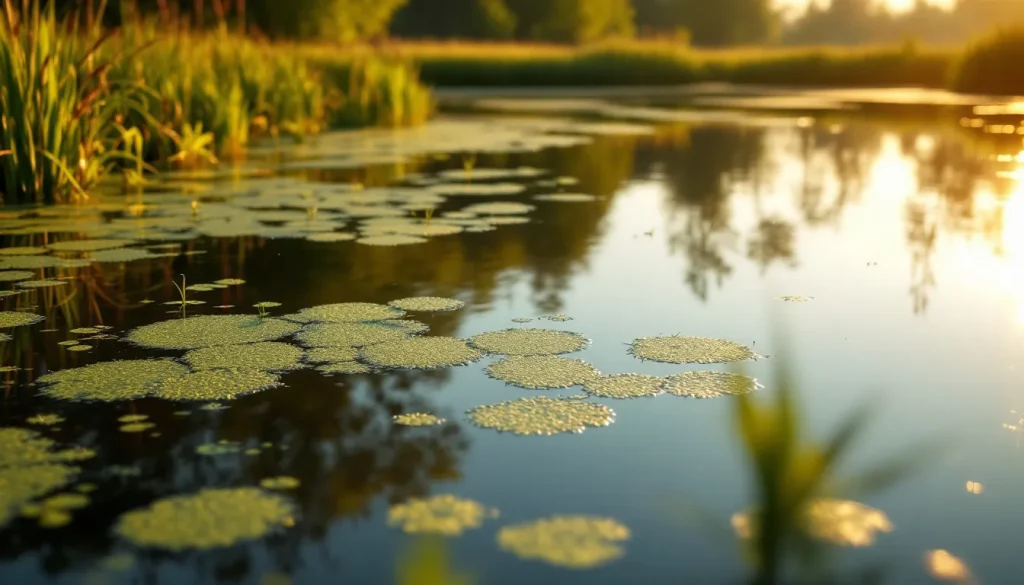
Floating pond weeds sit on the surface, either free-floating or rooted with floating leaves. Duckweed (Lemna) looks like tiny green ovals the size of a pea, each with one dangling root. Watermeal (Wolffia) is even smaller, like green grains of sand, and is one of the hardest weeds to eradicate. Water lily and watershield are rooted with round leaves floating on top.
Free-floating types multiply fast in still, nutrient-rich water. A pond can go from clear to fully covered in duckweed in under three weeks during warm months.
Emergent (marginal / shoreline) pond weeds
Emergent pond weeds root in shallow water or saturated banks and push stems above the surface. Cattail (Typha), bulrush, sedges, and the invasive phragmites and alligator weed are typical. These plants stabilize banks and shelter wildlife, so many owners keep a fringe of them on purpose and only remove excess that blocks access.
Cattail spreads by thick underground rhizomes, so pulling tops alone fails. Control targets the root system through the leaves or by repeated cutting below the waterline.
Pond Weeds vs Algae vs Beneficial Native Plants
Pond weeds are rooted or floating vascular plants with visible leaves and stems. Algae have no true leaves, stems, or roots. Beneficial native plants are pond weeds you should keep. Confusing these three is the top reason people apply the wrong product, and it is worth two minutes to tell them apart before buying anything.
Is it a weed or algae?
Algae come in three forms: green water (planktonic, a pea-soup tint), filamentous or “string algae” (hair-like green mats you can lift out), and chara or “muskgrass” (looks like a plant but is a grainy, gritty alga that smells musky). String algae is the classic misidentification. If you can pull it up and it has no leaves, just fine strands, it is filamentous algae and needs an algaecide, not a weed herbicide.
| Feature | Pond weed | Filamentous algae |
|---|---|---|
| Leaves and stems | Present, distinct | None, just strands |
| Roots | Usually present | None |
| Feel | Firm, structured | Slimy or cottony |
| Right product | Aquatic herbicide | Algaecide (copper-based) |
Which pond weeds are beneficial?
Some pond weeds are good and should stay. Submerged plants like coontail and elodea oxygenate water and feed fish. Emergent natives like bulrush and pickerelweed stabilize banks and filter runoff. A pond with 15 to 30 percent plant coverage usually holds the best fishing. The goal is control, not eradication. Only treat when coverage passes roughly 30 to 40 percent or blocks the use you care about.
What Causes Pond Weeds to Grow Out of Control
Pond weeds overgrow when three conditions align: excess nutrients, shallow sunlit water, and slow circulation. Nutrients (nitrogen and phosphorus) come from lawn fertilizer runoff, livestock, goose droppings, and decaying leaves. Shallow water under about 2 to 3 feet lets sunlight reach the bottom, and sunlight plus nutrients is the fuel for growth.
Fertilizer is the biggest lever most owners control. Runoff from turf is a leading nutrient source, which is why the same discipline behind managing lawn weeds and fertilizer timing reduces the load reaching a pond. A vegetated buffer strip and a backyard rain garden that intercepts runoff both cut the nutrients feeding weed blooms.
How to Get Rid of Pond Weeds: Method by Category
The best way to get rid of pond weeds is to match the method to the category, then treat at the right time of year. Physical removal works immediately but is temporary. Chemical control lasts longer but carries label and permit rules. Prevention keeps both from being an annual chore. Below are rates, costs, and timelines for each.
Physical and mechanical removal
Physical removal means raking, cutting, pulling, or laying bottom barriers. It works on any category and is the fastest visible fix, but weeds regrow unless the roots come out. A weighted aquatic rake (a lake rake) costs about $60 to $150. Bottom barrier fabric runs roughly $0.50 to $1.50 per square foot and smothers submerged weeds in 6 to 8 weeks.
- Rake submerged weeds and string algae toward shore, pulling roots when possible.
- Skim duckweed and watermeal with a fine net; even small pieces regrow.
- Cut cattail stems below the waterline twice in a season to drown the rhizomes.
- Compost removed weeds away from the shoreline so nutrients do not wash back.
Expect submerged weeds to regrow in 3 to 6 weeks after raking. Physical removal is best for small ponds or spot-clearing a swim area.
Chemical control with aquatic herbicides
Aquatic herbicides are chemicals labeled specifically for use in water. Never substitute a lawn product. Systemic herbicides (like fluridone) move through the whole plant and suit submerged weeds. Contact herbicides (like diquat and endothall) kill on touch and suit floating and spot treatments. Foliar glyphosate formulas labeled for aquatic use (such as Rodeo) treat emergent cattail and phragmites.
| Herbicide type | Example | Best for | Typical timeline | Rough cost |
|---|---|---|---|---|
| Systemic granular | Fluridone (Sonar) | Submerged, hydrilla | 30 to 90 days, low regrowth | $$$ per acre |
| Contact | Diquat, endothall | Floating, fast knockdown | 1 to 2 weeks, may regrow | $$ per acre |
| Foliar aquatic glyphosate | Rodeo | Emergent cattail, phragmites | 2 to 4 weeks to brown out | $$ per acre |
Always follow the product label, which is the law in the US. Many states require an aquatic pesticide permit, and a few (Florida for hydrilla, for example) restrict certain treatments. Rates depend on water volume, so measure pond acreage and average depth first. Whole-pond herbicide treatment often runs $200 to $1,000 or more per acre depending on product and applicator, and professional application may be required for restricted products depending on your state.
Safety: fish, livestock, and swimming
Aquatic herbicides have re-entry and use restrictions printed on the label. The single most important safety rule is to avoid killing too much plant matter at once. Decaying weeds pull oxygen from the water and can suffocate fish, so treat no more than one-quarter to one-third of a pond at a time and wait 10 to 14 days between sections.
- Fish: Treat in sections; low oxygen from dying weeds is the main fish-kill risk, worst in hot weather.
- Swimming: Many labels allow swimming within 24 hours or immediately, but confirm on the specific product.
- Livestock and irrigation: Some products set waiting periods (from 0 up to several days) before water is used for drinking or irrigation. Read the label.
When to Treat: Seasonality and Timing
Timing decides whether a treatment works or wastes money. Treat submerged weeds in late spring when they are actively growing but before they top out and mat, because systemic herbicides need active growth to translocate. Treat emergent weeds like cattail in late summer to early fall, when plants move energy to their roots and carry the herbicide down with it.
- Early spring: Best window for fluridone on submerged weeds and hydrilla.
- Late spring to early summer: Contact herbicides and raking for floating weeds and quick knockdown.
- Late summer to fall: Foliar glyphosate on cattail and phragmites for a lasting kill.
- Winter drawdown: Lowering water to expose and freeze weed roots, where local rules allow.
How to Prevent Pond Weeds From Coming Back
Prevention attacks the fuel: nutrients, sunlight, and stagnation. No single tactic is permanent, but stacking three or four keeps weeds below the nuisance line for years. The core moves are cutting nutrient input, shading the water, adding circulation, and using biological helpers where legal.
- Buffer strip: Leave a 10 to 20 foot band of unmowed native plants around the shore to filter runoff.
- Aeration: A bottom diffuser or fountain circulates water and cuts the still, warm zones weeds and duckweed love.
- Pond dye: Blue or black dye shades the bottom and slows submerged weed and algae growth, roughly $30 to $80 per treatment per acre.
- Grass carp: Triploid grass carp eat submerged weeds; stocking is regulated and requires a permit in many states.
- Deepen edges: Steepening shallow shelves below 2 to 3 feet during construction removes the sunlit zone weeds need.
For the broader logic of starving weeds instead of only cutting them, our guide on how to get rid of weeds covers the same prevention-first mindset applied on land. You can go deeper on water and landscape topics through the HMNDP learn hub.
Once your pond is clear, the same identify-then-treat approach helps with trouble spots around the rest of the yard, from stopping tumbleweeds before they seed and spread to spotting and controlling grubs chewing through your lawn.
Frequently Asked Questions
How do I identify pond weeds, and what are the three main types?
Identify a pond weed by where it grows relative to the surface. The three types are submerged (fully underwater, like coontail and hydrilla), floating (on top, like duckweed and water lily), and emergent (rooted at the shore with stems above water, like cattail). Reach in with a rake: entirely underwater is submerged, flat on top is floating, standing above the edge is emergent.
What is the difference between pond weeds and pond algae?
Pond weeds are vascular plants with true leaves, stems, and usually roots. Algae have none of these. Filamentous or “string” algae is just hair-like strands you can lift out, with no leaves. This distinction decides the product: weeds need an aquatic herbicide, while algae need an algaecide (often copper-based). Applying a weed herbicide to algae wastes money and does not work.
How do I get rid of pond weeds naturally without chemicals?
Rake or pull submerged weeds, skim floating duckweed with a fine net, and cut cattail below the waterline twice per season. Add aeration to circulate water, apply pond dye to shade the bottom, and stock triploid grass carp where permitted. Cut nutrient runoff with a shoreline buffer strip. Natural methods work but are slower and need repeating, usually every few weeks in summer.
What is the best herbicide for pond weeds, and is it safe for fish?
The best herbicide depends on category: fluridone (Sonar) for submerged weeds, diquat or endothall for floating weeds, and aquatic glyphosate (Rodeo) for emergent cattail. All must carry an aquatic label; lawn products are unsafe in water. To protect fish, treat only one-quarter to one-third of the pond at a time and wait 10 to 14 days, because decaying weeds lower oxygen.
What causes pond weeds to grow out of control?
Three conditions drive overgrowth: excess nutrients, shallow sunlit water, and poor circulation. Nitrogen and phosphorus from lawn fertilizer runoff, livestock, goose waste, and decaying leaves feed the plants. Water shallower than 2 to 3 feet lets sunlight reach the bottom, fueling submerged weeds. Still, warm water speeds floating weeds like duckweed. Reducing any one of these three slows growth noticeably.
Are pond weeds bad, or are some of them good for the pond?
Some pond weeds are beneficial and should stay. Submerged plants like coontail oxygenate water and feed fish, and shoreline natives like bulrush stabilize banks and filter runoff. A pond with 15 to 30 percent plant coverage often has the healthiest fishing. Weeds become a problem only when coverage passes roughly 30 to 40 percent or blocks swimming, fishing, or drainage. Aim to control, not eradicate.
How do I permanently prevent pond weeds from coming back?
No method is truly permanent, but stacking prevention keeps weeds below nuisance levels for years. Cut nutrient input with a 10 to 20 foot shoreline buffer, add aeration to end stagnation, apply pond dye to shade the bottom, and deepen shallow shelves below 2 to 3 feet. Grass carp help with submerged weeds where permitted. Together these starve weeds of nutrients, sunlight, and still water.
How much does it cost to treat pond weeds, and how long does it take to work?
Costs vary by method and pond size. A weighted lake rake is $60 to $150. Pond dye runs $30 to $80 per acre. Whole-pond herbicide treatment often runs $200 to $1,000 or more per acre. Timelines: contact herbicides brown weeds in 1 to 2 weeks, systemic products take 30 to 90 days, and raking works instantly but regrows in 3 to 6 weeks.