
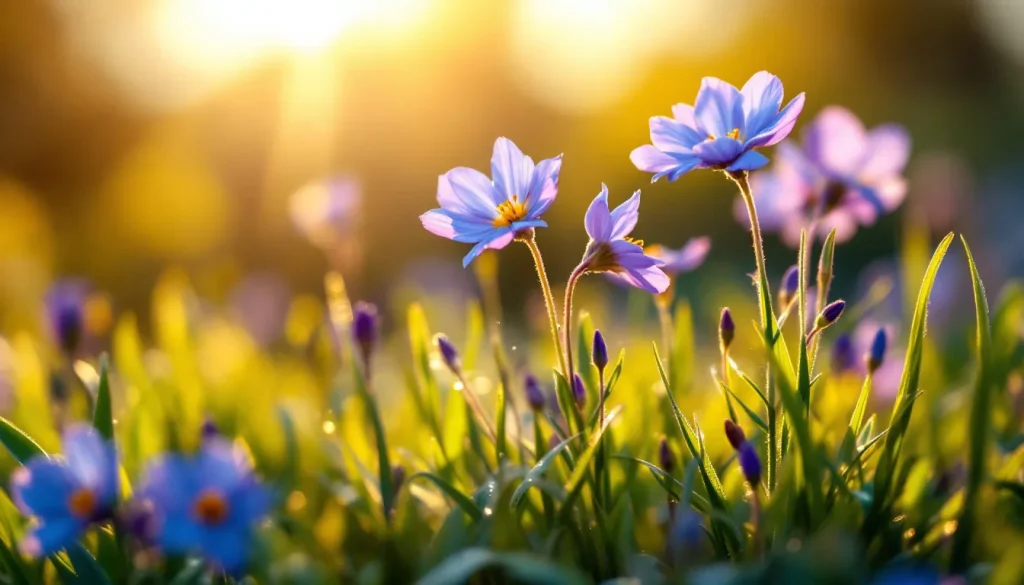
What blue-eyed grass is (and why it is not a grass)
Blue-eyed grass (botanical name Sisyrinchium) is a clumping North American perennial in the iris family Iridaceae, not the true grass family. It grows about 1 foot tall with narrow, grass-like tufted foliage and star-shaped blue to violet flowers that have a bright yellow center. It blooms in spring, thrives in full sun to part shade, and feeds native bees.
The name misleads people. The leaves look like grass blades, but the flower gives it away: six petal-like tepals arranged in a flat star, the signature structure of the iris family. True grasses (family Poaceae) never produce a showy six-part bloom like this.
Last reviewed: June 2026.
Quick identification profile
Blue-eyed grass forms a low tuft of flat, narrow, fan-arranged leaves and sends up thin flowering stems in spring. Flowers open on sunny mornings and often close by afternoon. Each bloom is roughly half an inch wide, blue to blue-violet, with a yellow eye and six pointed tepals. Mature clumps reach about 12 inches.
| Feature | Detail |
|---|---|
| Botanical name | Sisyrinchium (iris family, Iridaceae) |
| Flower | Star-shaped, blue to violet, yellow center, 6 tepals |
| Foliage | Narrow, flat, grass-like, tufted into clumps |
| Habit | Herbaceous perennial, often short-lived |
| Mature height | About 12 inches (species range 4 to 20 inches) |
| Bloom timing | Spring, mornings; flowers close midday |
| Light | Full sun to part shade |
| Soil | Moist, well-drained |
| Native to | North America (genus is native to the Americas) |
| Wildlife value | Native bees, bumblebees, sweat bees, syrphid flies; deer-resistant |
Blue-eyed grass species compared across the US
The four most-grown blue-eyed grass species differ mainly by native range, height, and hardiness. S. bellum is the West Coast native, S. angustifolium the eastern one, S. idahoense the mountain-and-Pacific-Northwest species, and S. montanum the wide-ranging northern species. Pick the one native to your region for the easiest care and the most wildlife value.
Most single-species guides never let you compare these side by side. Here is the unified table, drawn from state extension and native-plant sources.
| Species | Common name | Native range | Height | USDA zones | Best for |
|---|---|---|---|---|---|
| S. bellum | Western blue-eyed grass | California, Oregon | ~12 in | 8 to 10 | West Coast, dry-summer gardens |
| S. angustifolium | Narrowleaf / Bermuda blue-eyed grass | Eastern North America, Florida to Canada, west to Texas | 8 to 20 in | 3 to 10 | Eastern US, widest hardiness, cultivar ‘Lucerne’ |
| S. idahoense | Idaho blue-eyed grass | N. California to British Columbia, east to Montana and New Mexico | 4 to 16 in | 4 to 9 | Pacific Northwest, mountain meadows |
| S. montanum | Mountain / strict blue-eyed grass | Northern US, Canada, Rockies | 6 to 18 in | 3 to 8 | Cold northern climates |
The practical takeaway: if you garden east of the Rockies, S. angustifolium (hardy zones 3 to 10) is the safest, most widely sold choice. On the West Coast, S. bellum handles dry summers better. In cold northern gardens, S. montanum tolerates zone 3 winters.
Is blue-eyed grass invasive, or does it just spread?
Blue-eyed grass is native to North America and is not classified as invasive by the USDA or state invasive-plant councils. What people mistake for invasiveness is vigorous self-seeding: in moist, sunny beds it drops seed freely and new plants appear nearby. It does not form choking monocultures or push out other natives, so it spreads without being invasive.
The distinction matters. An invasive plant displaces native species and gets listed by regulators. Blue-eyed grass does neither. Its clumps also creep slowly by short rhizomes, which is a gradual, easy-to-manage spread rather than an aggressive takeover.
If self-seeding bothers you, control it two ways: shear or deadhead the spent flower stems before seed sets, and pull unwanted seedlings in spring while they are small. Growing it in a container removes the question entirely, which is one reason many gardeners treat it like an ornamental clumper rather than a groundcover.
How to grow and care for blue-eyed grass
Blue-eyed grass grows best in full sun to part shade in moist, well-drained soil. Water regularly during establishment, then let rainfall handle most of the load in suitable climates. It needs little fertilizer, tolerates poor soils, and rewards a spring shearing with a tidier clump. The main maintenance task is dividing the clump every 2 to 3 years, since the plant is naturally short-lived.
These native clumpers pair well with other low-water plantings. If you are building a naturalized bed, our guide to choosing ornamental grasses covers companions, and the notes on feeding plants during drought apply directly, because overfeeding blue-eyed grass causes floppy growth.
Light, soil, and water
Give blue-eyed grass at least a half day of sun for the heaviest bloom; too much shade thins the flowers. It prefers consistently moist, well-drained soil and dislikes both drought stress and standing water. In hot inland climates, part-afternoon shade keeps foliage from scorching. Sandy loam amended with a little compost suits it.
Feeding and seasonal cleanup
Blue-eyed grass is a light feeder. A thin spring topdress of compost is enough; heavy nitrogen produces weak, floppy leaves and fewer flowers. After the spring bloom fades, shear the clump back by a third to refresh the foliage and cut down on self-seeding. Leave the base intact so the plant regrows.
Container growing
Blue-eyed grass grows well in pots, which is the simplest way to enjoy it without managing self-seeding in the garden. Use a container at least 8 inches deep with drainage holes and a well-drained mix. Keep it evenly moist, place it in sun to light shade, and divide the rootball every 2 years to keep the clump vigorous.
How to propagate and divide blue-eyed grass
The reliable way to keep blue-eyed grass alive long-term is division, because the plant loses vigor after a few years. Divide established clumps every 2 to 3 years in early spring (fall also works). Lift the clump, split it into sections that each keep 3 to 4 shoots plus roots, and replant. You can also grow it from seed, though seedlings vary and take longer to bloom.
- In early spring, water the clump the day before to soften the soil.
- Lift the whole plant with a garden fork or shovel, keeping the rootball intact.
- With a sharp knife or shears, cut the clump into divisions of 3 to 4 shoots each, each with its own roots.
- Replant divisions at the same depth, about 8 to 12 inches apart, and firm the soil.
- Water in well and keep evenly moist for 3 to 4 weeks while roots re-establish.
For seed, blue-eyed grass self-sows readily; collect ripe seed in early summer and sow fresh, or let volunteers appear and transplant them. Division is faster and keeps named cultivars like ‘Lucerne’ true to type.
Blue-eyed grass vs. liriope: how to tell them apart
Blue-eyed grass and liriope both look like grassy clumps, but they are unrelated and easy to separate by flower and family. Blue-eyed grass is a spring-blooming iris relative (Iridaceae) with flat star-shaped blue flowers and yellow centers. Liriope (lilyturf) is a late-summer asparagus relative (Asparagaceae) with purple flower spikes. If it blooms blue in spring with a yellow eye, it is blue-eyed grass.
| Trait | Blue-eyed grass (Sisyrinchium) | Liriope (lilyturf) |
|---|---|---|
| Family | Iridaceae (iris) | Asparagaceae (asparagus) |
| Native status | Native to North America | Native to East Asia; L. spicata is invasive in parts of the US Southeast |
| Flower | Flat blue star, yellow center, 6 tepals | Purple spike, dense clusters |
| Bloom time | Spring (March to May) | Late summer (August to September) |
| Height | ~12 inches | 12 to 18 inches |
| Roots | Short rhizomes | Fleshy, tuberous roots |
One caution: creeping liriope (Liriope spicata) is listed as invasive in several southeastern states, while blue-eyed grass is a native alternative. Gardeners in Georgia and neighboring states increasingly plant blue-eyed grass as a native swap. For more on distinguishing ornamental clumpers, see our overview of Mexican feather grass and its look-alikes.
How tall it gets, when it blooms, and wildlife value
Blue-eyed grass typically reaches about 12 inches tall (species range 4 to 20 inches) and blooms in spring, opening on sunny mornings and closing by midday. It is a strong native-bee plant, drawing bumblebees, sweat bees, and syrphid flies for nectar and pollen. It is deer-resistant, and as a herbaceous perennial it dies back and returns each year.
For pollinator gardens, the morning bloom window is worth planning around: place it where you and early-flying bees can see it before noon. Pair it with other spring natives so bloom overlaps. To keep learning about native and low-input plantings, browse the HMNDP learn library.
Frequently Asked Questions
Is blue-eyed grass actually a grass?
No. Blue-eyed grass (Sisyrinchium) is a member of the iris family, Iridaceae, not the true grass family Poaceae. Its narrow, flat leaves look grass-like, which is where the name comes from, but the plant produces a six-part star-shaped blue flower with a yellow center. True grasses never make a showy bloom like that.
Is blue-eyed grass invasive or does it just spread?
Blue-eyed grass is native to North America and is not classified as invasive by the USDA or state invasive-plant councils. It self-seeds vigorously in moist, sunny beds and creeps slowly by rhizomes, which people mistake for invasiveness. It does not form monocultures or displace natives. Deadhead spent flowers or grow it in a container to limit self-seeding.
Is blue-eyed grass native to my region?
Likely yes, since the genus is native across North America, but the exact species differs. S. angustifolium covers the eastern US and Canada (zones 3 to 10), S. bellum the West Coast (zones 8 to 10), S. idahoense the Pacific Northwest and mountains (zones 4 to 9), and S. montanum the cold northern US and Canada (zones 3 to 8).
How do you care for blue-eyed grass?
Grow blue-eyed grass in full sun to part shade in moist, well-drained soil. Water regularly while establishing, then rely mostly on rainfall in suitable climates. Feed lightly, since excess nitrogen causes floppy growth. Shear the clump by a third after spring bloom to tidy it and reduce self-seeding, and divide the plant every 2 to 3 years to keep it vigorous.
How tall does blue-eyed grass get and when does it bloom?
Blue-eyed grass usually grows about 12 inches tall, with species ranging from 4 to 20 inches. It blooms in spring, typically March through May depending on region, and its flowers open on sunny mornings and often close by afternoon. The blue to violet flowers each carry a bright yellow center and last several weeks across the clump.
How do you propagate or divide blue-eyed grass?
Divide blue-eyed grass every 2 to 3 years in early spring or fall. Lift the clump with a fork, cut it into sections that each keep 3 to 4 shoots plus roots, and replant 8 to 12 inches apart at the same depth. Water in well. It also self-sows from seed, so you can transplant volunteer seedlings that appear near the parent.
What is the difference between blue-eyed grass and liriope?
Blue-eyed grass is a native iris relative (Iridaceae) with flat blue star-shaped spring flowers and a yellow center. Liriope, or lilyturf, is a non-native asparagus relative (Asparagaceae) with purple flower spikes in late summer. Blue-eyed grass has short rhizomes; liriope has tuberous roots. Blue-eyed grass is often planted as a native alternative to invasive creeping liriope.
Does blue-eyed grass come back every year and is it deer-resistant?
Yes to both. Blue-eyed grass is a herbaceous perennial that dies back in winter and returns each spring, though individual plants are short-lived, which is why dividing every 2 to 3 years keeps a planting going. It is also deer-resistant: deer tend to avoid browsing it, though no plant is fully deer-proof in high-pressure areas.