
By the HMNDP Editorial Team, independent reporting on lawn care, landscaping, water, and the green-industry business.
Last reviewed: June 2026
What ornamental grass is (and how it differs from lawn grass)
Ornamental grass is a decorative perennial or annual grown for its foliage, plumes, height, and movement, not for a walkable turf surface. Unlike lawn grass (fescue, Kentucky bluegrass, Bermuda), which you mow short and walk on, ornamental grass grows in upright clumps from 6 inches to 14 feet tall and is left standing for color and texture through three or four seasons.
The category includes true grasses plus grass-like plants such as lilyturf (Liriope) and mondo grass (Ophiopogon), which gardeners and nurseries sell under the same banner.
The practical difference is maintenance. A lawn needs weekly mowing and regular feeding. An ornamental grass usually needs cutting once a year and rarely any fertilizer. For the turf side of the comparison, see our overview of common types of grass.
The one thing to check before you buy: clumping vs. running
Before height, color, or price, check growth habit. Clumping (bunch-forming) grasses stay in a tidy mound that slowly widens a few inches per year. Running (rhizomatous) grasses send out underground stems and can colonize a bed or escape into a neighbor’s yard in two or three seasons. This single trait, almost never explained on catalog pages, decides whether a grass is a pleasure or a nightmare.
Most popular ornamental grasses sold at nurseries are clumpers, including maiden grass, fountain grass, switchgrass, feather reed grass, and blue fescue. They are safe choices for beds and borders.
Runners include ribbon grass (Phalaris), blue lyme grass (Leymus), and some bamboo-adjacent species. Plant runners only inside a buried root barrier (at least 18 inches deep) or in a sunken container with the bottom cut out.
| Habit | How it spreads | Risk | Examples |
|---|---|---|---|
| Clumping | Mound widens slowly from the center | Low. Stays put for years | Maiden grass, fountain grass, switchgrass, feather reed grass, blue fescue, Liriope (clumping types) |
| Running | Underground rhizomes shoot outward | High. Can take over a bed | Ribbon grass, blue lyme grass, creeping Liriope spicata, some bamboo |
Types of ornamental grasses (named varieties)
The popular ornamental grasses for zones 4-9 fall into a handful of named groups. Below is each one with mature size, sun need, hardiness zone, growth habit, and the job it does best, so you can compare in one place instead of hunting across nursery pages.
| Variety | Mature height | Sun | USDA zones | Habit | Best use |
|---|---|---|---|---|---|
| Blue fescue (Festuca glauca) | 6-12 in | Full sun | 4-8 | Clumping | Front edging, rock gardens, blue accent |
| Mondo grass (Ophiopogon japonicus) | 6-10 in | Part to full shade | 6-10 | Slow spreader | Shady groundcover, path edging |
| Lilyturf (Liriope muscari) | 12-18 in | Sun to shade | 5-10 | Clumping | Border edging, dry shade, purple flower spikes |
| Fountain grass (Pennisetum alopecuroides ‘Hameln’) | 24-36 in | Full sun | 5-9 | Clumping | Mid-border, bottlebrush plumes |
| Feather reed grass (Calamagrostis x acutiflora ‘Karl Foerster’) | 4-5 ft | Full sun to part shade | 4-9 | Clumping (sterile) | Vertical accent, narrow beds, very cold-hardy |
| Switchgrass (Panicum virgatum) | 3-6 ft | Full sun | 4-9 | Clumping | Native screening, rain gardens, airy seed heads |
| Maiden grass (Miscanthus sinensis) | 5-8 ft | Full sun | 5-9 | Clumping | Specimen, screening (see invasive note) |
| Pampas grass (Cortaderia selloana) | 8-12 ft | Full sun | 7-10 | Clumping (heavy seeder) | Tall screen (banned in some states, see below) |
Note: green fountain grass (Pennisetum setaceum, the species, not the ‘Hameln’ cultivar) and purple fountain grass behave differently by region. The straight species reseeds aggressively in warm climates.
Sun requirements: most ornamental grasses want full sun
Most ornamental grasses need full sun, defined as 6 or more hours of direct light per day. Sun-grown clumps stand upright, color well, and flower reliably. In too much shade, the same plants flop, fade, and produce few plumes. A short list tolerates shade: mondo grass, lilyturf, and Hakone grass (Hakonechloa).
If your bed gets fewer than 4 hours of sun, choose mondo grass or Liriope rather than forcing a sun-lover like fountain grass or switchgrass to perform where it cannot.
Drought tolerance and low water needs
Once established, most ornamental grasses are drought tolerant and need little supplemental water. Native warm-season grasses such as switchgrass and little bluestem are among the toughest, surviving on rainfall in much of zones 4-9 after year one. This low water demand is a main reason landscapers use them in xeric and low-input beds.
“Established” means after the first full growing season. First-year watering still matters (see the care calendar below). For pairing grasses with low-water feeding choices, see our notes on the best garden fertilizer for drought conditions.
Perennial vs. annual, and cool-season vs. warm-season
Most ornamental grasses sold for zones 4-9 are perennials that return every year from the same crown. A few, including purple fountain grass (Pennisetum ‘Rubrum’), are perennial only in zones 9-10 and are grown as annuals farther north. Separately, every ornamental grass is classed as cool-season or warm-season, which changes when it grows and when you cut it.
| Class | Active growth | Look | Cut-back timing | Examples |
|---|---|---|---|---|
| Cool-season | Spring and fall, dormant in summer heat | Green up earliest | Late winter or early spring, light trim only | Blue fescue, feather reed grass, Calamagrostis |
| Warm-season | Late spring through summer | Peak in late summer and fall | Late winter, hard cut to a few inches | Switchgrass, maiden grass, fountain grass, pampas grass |
Hardiness zones and matching grass to your region
Ornamental grasses are rated by USDA hardiness zone, and matching the rating to your zone decides whether a plant returns. Feather reed grass and switchgrass survive to zone 4 (winter lows near -30F). Pampas grass and mondo grass generally need zone 7 or warmer. Check your zone on the USDA Plant Hardiness Zone Map (2023 update) before buying.
Buying one zone colder than your own is the safe move. A grass rated to zone 5 is a reliable perennial in zone 6 but may die over winter in zone 4.
Heights and sizes: short, medium, and tall
Ornamental grasses sort into three height tiers, and choosing by tier prevents the most common design mistake of putting a tall grass at the front of a bed. Short grasses run 6 to 18 inches, medium grasses 2 to 4 feet, and tall grasses 5 feet and up.
- Short (6-18 in): blue fescue, mondo grass, lilyturf. Use as edging and groundcover.
- Medium (2-4 ft): fountain grass, feather reed grass. Use in the middle of a border.
- Tall (5 ft+): maiden grass, switchgrass, pampas grass. Use at the back, as specimens, or for screening.
Ornamental grasses for landscaping: borders, beds, and accents
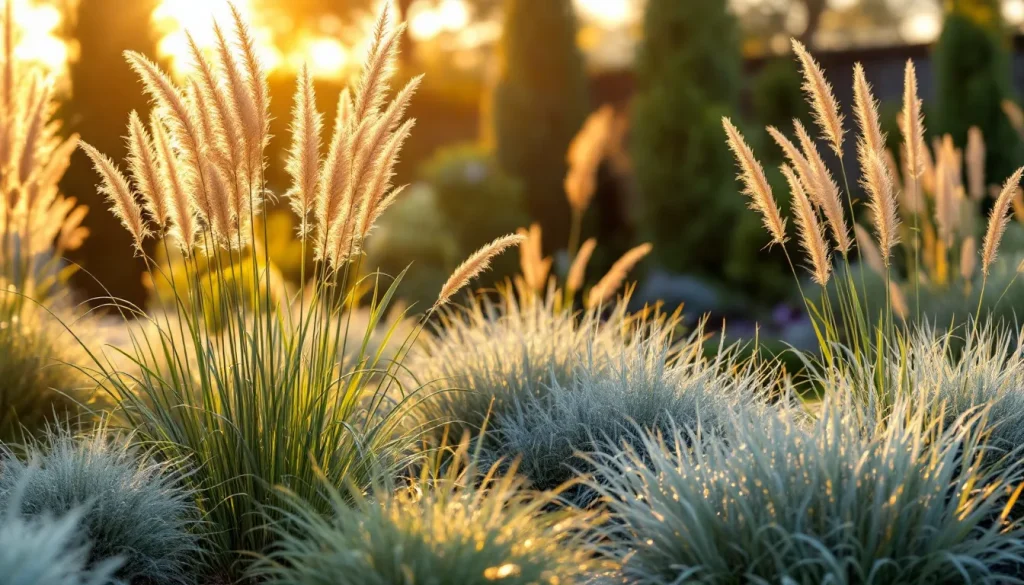
In landscaping, ornamental grasses do three main jobs: edging the front of a border, filling the middle of a mixed bed, and standing alone as a specimen accent. Color and texture carry the design. Blue fescue adds steely blue, switchgrass turns gold and red in fall, and most varieties hold winter interest as tan plumes catch frost and light.
For massed beds, plant in odd-numbered groups (3, 5, 7) of one variety for a calm, modern look. For accents, set a single tall grass where its plumes read against a fence or wall.
Tall ornamental grasses for privacy and screening
For a privacy screen, tall clumping grasses give a fast, soft hedge that fills in within one or two seasons. Switchgrass (3-6 ft), giant maiden grass cultivars (6-8 ft), and, in warm zones, pampas grass (8-12 ft) form dense visual barriers from late spring through winter. They die back in late winter, so they screen for roughly three seasons, not year-round.
Native switchgrass ‘Northwind’ or ‘Heavy Metal’ is the safest screening pick because it is non-invasive across most of the US and stands stiffly upright without flopping.
Which ornamental grasses are invasive (and what to plant instead)
Several common ornamental grasses are invasive or legally restricted in parts of the US, a warning missing from most catalog and listicle pages. Pampas grass, Chinese silvergrass (Miscanthus sinensis), and green fountain grass (Pennisetum setaceum) reseed into wild land and crowd out native plants. Some are banned for sale in California and discouraged across the Southeast.
Always check your state’s noxious-weed list before buying. Rules vary by state, and a plant sold freely in one state may be prohibited in another.
| Avoid (where restricted) | Where it is a problem | Non-invasive alternative |
|---|---|---|
| Pampas grass (Cortaderia selloana) | California, coastal Southeast, Texas | Switchgrass ‘Northwind’, ravenna grass where legal |
| Chinese silvergrass / maiden grass (Miscanthus sinensis) | Mid-Atlantic, Southeast, parts of the Midwest | Native switchgrass (Panicum) or little bluestem (Schizachyrium) |
| Green fountain grass (Pennisetum setaceum, species) | California, Arizona, Hawaii, warm South | ‘Hameln’ fountain grass (sterile-leaning) or prairie dropseed |
Native and sterile cultivars give the same look without the spread. Feather reed grass ‘Karl Foerster’ is sterile and sets no viable seed, making it a safe choice nationwide.
How far apart to space ornamental grasses
Space ornamental grasses at roughly their mature width, which usually equals their mature height for clumping types. Plant short grasses 8 to 12 inches apart, medium grasses 18 to 24 inches apart, and tall grasses 3 to 4 feet apart. Tighter spacing fills in faster but crowds plants and reduces airflow within two or three years.
- Short grasses (under 18 in): 8-12 in apart.
- Medium grasses (2-4 ft): 18-24 in apart.
- Tall grasses (5 ft+): 3-4 ft apart.
Planting and first-year care calendar
Ornamental grass care follows a simple yearly rhythm: plant in spring or early fall, water through the first season, cut back once in late winter, and divide every few years. The full month-by-month calendar below is the end-to-end care that catalog pages leave out.
| Timing | Task | Detail |
|---|---|---|
| Spring or early fall | Plant | Best windows. Avoid planting tall warm-season grasses late in fall in cold zones. |
| First growing season | Water | Deeply 1-2 times per week until established. This is the only year most grasses need regular water. |
| Late winter (Feb-Mar) | Cut back | Warm-season: cut to 3-6 in. Cool-season: light trim of dead tips only. |
| Spring | Optional feed | Most need none. A light feeding suits poor soil. See fertilizer guidance below. |
| Every 3-4 years, spring | Divide | Dig the clump, split with a spade or saw, replant the vigorous outer sections. |
Cut back in late winter rather than fall. Standing foliage protects the crown over winter and feeds birds. Most ornamental grasses need no fertilizer, but if your soil is poor, a light spring feeding using the right product, as covered in our guide to the best fertilizer for grass, is enough. For more planting fundamentals, browse the HMNDP learn library.
Divide a clump when its center dies out and growth shifts to the edges, a sign it is overcrowded. Spring division, just as new growth starts, gives the fastest recovery.
Where to buy ornamental grasses
Ornamental grasses are sold at local nurseries, big-box garden centers (Home Depot, Lowe’s), and mail-order growers such as Monrovia and regional perennial farms. Buy from a source that lists the botanical name and cultivar, not just “ornamental grass,” so you can confirm habit, zone, and whether the variety is restricted in your state.
Buy small. A 1-gallon clumping grass usually catches up to a 3-gallon plant within two seasons and costs far less. Spring stock gives the plant a full season to establish before winter.
Frequently Asked Questions
What is the difference between ornamental grass and regular lawn grass?
Ornamental grass is grown for looks, foliage, height, and plumes, and is left standing in clumps from 6 inches to 14 feet tall. Lawn grass (fescue, bluegrass, Bermuda) is mowed short into a walkable turf. Ornamental grass is cut once a year. Lawn grass is mowed weekly through the growing season.
What are the best ornamental grasses for low maintenance?
The lowest-maintenance ornamental grasses are clumping, drought-tolerant perennials that need only one cut a year and little to no fertilizer. Top picks for zones 4-9 are feather reed grass ‘Karl Foerster’, switchgrass, fountain grass ‘Hameln’, and blue fescue. All stay put, tolerate dry spells once established, and offer color across three or four seasons.
What are the best tall ornamental grasses for privacy?
The best tall ornamental grasses for privacy are dense clumping types that reach 5 feet or more. Switchgrass cultivars ‘Northwind’ and ‘Heavy Metal’ (4-6 ft) are non-invasive and stand upright. Giant maiden grass reaches 6-8 ft. Pampas grass hits 8-12 ft in zones 7-10 but is restricted in some states. These screen spring through winter.
Which ornamental grasses are perennial and come back every year?
Most ornamental grasses sold for zones 4-9 are perennials that return yearly, including switchgrass, maiden grass, fountain grass ‘Hameln’, feather reed grass, blue fescue, and lilyturf. Match the variety’s USDA zone rating to your zone to be sure. Purple fountain grass is perennial only in zones 9-10 and is grown as an annual in colder regions.
When should you cut back ornamental grasses?
Cut back ornamental grasses in late winter or very early spring (February to March), before new growth starts, not in fall. Cut warm-season grasses such as switchgrass and maiden grass down to 3-6 inches. Give cool-season grasses such as blue fescue only a light trim. Standing winter foliage protects the crown and shelters birds.
Are ornamental grasses invasive, and which ones should I avoid?
Some ornamental grasses are invasive or restricted. Pampas grass, Chinese silvergrass (Miscanthus sinensis), and green fountain grass (Pennisetum setaceum) reseed into wild land and are banned or discouraged in California, the Southeast, and other regions. Check your state’s noxious-weed list before buying. Safe alternatives include native switchgrass, little bluestem, and sterile feather reed grass ‘Karl Foerster’.
How far apart should you space ornamental grasses?
Space ornamental grasses at about their mature width. Plant short grasses (under 18 inches) 8 to 12 inches apart, medium grasses (2-4 feet) 18 to 24 inches apart, and tall grasses (5 feet and up) 3 to 4 feet apart. Tighter spacing fills in faster but crowds the plants and reduces airflow within a few years.
What is the difference between clumping and spreading (running) ornamental grasses?
Clumping grasses grow in a tidy mound that widens slowly from the center and stay where you plant them. Running grasses send out underground rhizomes and can colonize a bed or escape into a neighbor’s yard in two or three seasons. Most popular varieties are clumpers. Plant runners like ribbon grass only inside a buried root barrier.
Which ornamental grasses grow best in full sun versus shade?
Most ornamental grasses need full sun (6 or more hours daily), including switchgrass, maiden grass, fountain grass, feather reed grass, and blue fescue. In shade they flop and fade. For part to full shade, choose mondo grass, lilyturf (Liriope), or Hakone grass, which keep their form and color in 4 hours of sun or less.