
By the HMNDP Editorial Team, independent reporting on lawn care, landscaping, and the green industry.
Last reviewed: June 2026
What is Mexican feather grass?
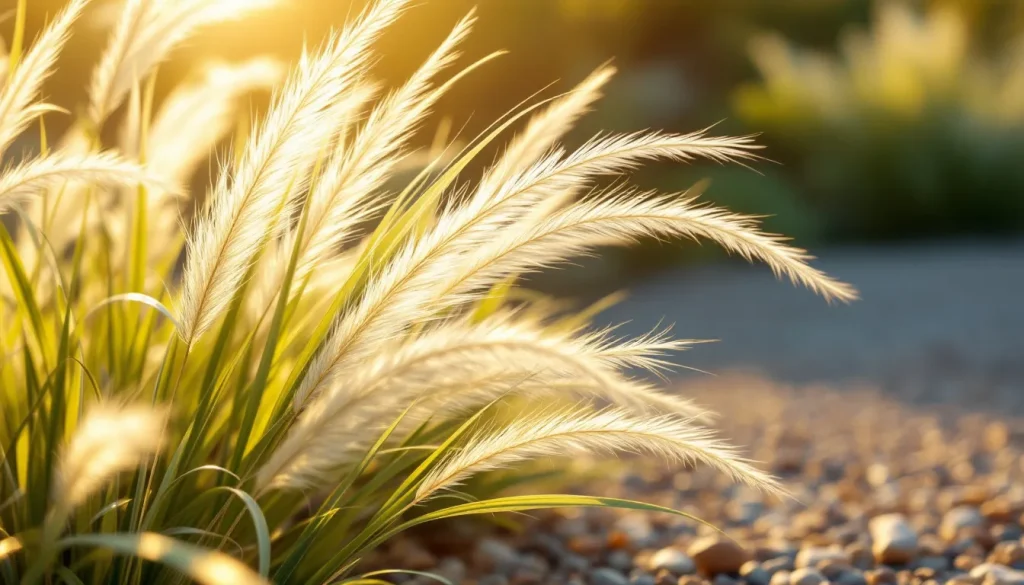
Mexican feather grass (Nassella tenuissima, formerly classified as Stipa tenuissima) is a fine-textured ornamental grass that grows in a soft, hair-like clump about 1.5 to 2 feet tall and wide. Its lime to bright-green blades turn golden by late summer, topped by tan, silvery, feathery flower plumes that ripple in the lightest breeze. It thrives in full sun, tolerates drought, and is hardy in USDA zones 7 to 10.
Gardeners prize it for movement and texture in borders, gravel gardens, and mass plantings. The same trait that makes it beautiful, prolific seed, is also why several Western states regulate it. We cover both below, plus how to grow it responsibly.
Botanical identity and appearance
Mexican feather grass is Nassella tenuissima, a cool-season bunchgrass in the Poaceae family, widely sold under its older synonym Stipa tenuissima. It forms a dense tuft of needle-thin leaves roughly 1/64 inch wide, giving the whole plant a flowing, wig-like look. In late spring it sends up airy, tan-to-silver plumes that hold their feathery shape into autumn.
Native range: Nassella tenuissima is native to the dry grasslands of west Texas and New Mexico, extending south into Mexico and into parts of Argentina and Chile. That arid heritage explains its drought tolerance and its preference for lean, well-drained soil over rich, wet ground.
For a sturdier, upright grass with a different silhouette, compare it against feather reed grass (Calamagrostis), which stands taller and is a sterile or low-seeding choice in most landscapes.
Where is Mexican feather grass invasive, and is it banned in my state?
Mexican feather grass is regulated or banned in California, listed as a problem in Oregon and Washington, and generally legal to plant elsewhere in zones 7 to 10. It self-seeds heavily, so the concern centers on the West Coast, where it escapes into wildlands. The table below gives a clearer region-by-region verdict than a single “it’s invasive” warning.
| State / region | Status | Practical verdict |
|---|---|---|
| California | Listed by Cal-IPC as invasive (Moderate); some nurseries and counties discourage or restrict sales | Do not plant. Choose a non-seeding alternative. |
| Oregon | On the Oregon Department of Agriculture watch/listed weeds radar | Avoid. Substitute a native bunchgrass. |
| Washington | Flagged by the Washington Invasive Species Council / noxious weed reviewers | Avoid, especially near natural areas. |
| Texas, New Mexico, Arizona (native range) | Native; not listed as invasive | Plant freely; it belongs here. |
| Southeast and mid-Atlantic (zones 7-9) | Not formally listed in most states | Plant with self-seeding controls (see below). |
| Cold-winter North (zones 6 and below) | Usually not winter-hardy | Grow as an annual or in containers; low escape risk. |
Always confirm with your state department of agriculture or local extension office, since lists may change and county rules can be stricter than state ones. For grasses with similar texture but without the seeding risk, our ornamental grass guide covers safer picks by region.
How tall does it get and how far apart should you space it?
Mexican feather grass matures at about 1.5 to 2 feet tall and 1.5 to 2 feet wide, forming a rounded clump. Space individual plants 18 to 24 inches apart center to center for a flowing, connected drift, or 12 to 15 inches if you want a fast, solid sweep. In containers, one plant fills a 12-inch pot nicely.
- Border or specimen: 24 inches apart so each clump reads as an individual.
- Mass planting: 18 inches apart for a meadow-like flow within one to two seasons.
- Edging a path: 15 inches apart for a continuous low ribbon.
Plant in full sun (six or more hours daily) in well-drained soil. It tolerates poor, sandy, and rocky ground and resents soggy clay.
How to care for and cut back Mexican feather grass each year
Mexican feather grass is low maintenance once established: it needs full sun, sharp drainage, and an annual cut-back. Water new plants weekly for the first season, then taper to deep watering every two to three weeks in drought. The one timed task that matters is shearing the clump down in late winter before new growth begins.
- Late winter (February to early March): Shear the entire clump to 3 to 4 inches tall to remove the previous year’s tan blades and trigger fresh green growth.
- Spring: Apply a thin top-dressing of compost if soil is poor. Avoid heavy nitrogen, which causes floppy growth. See our notes on fertilizing on dry sites.
- Summer: Water deeply only during prolonged drought. The clump may brown and look dead in heat (more on that below).
- Fall: Leave plumes for winter interest, or cut them off if you want to limit seed (see self-seeding controls).
- Dividing: Optional. Lift and split crowded or dead-centered clumps in early spring every three to four years. Most gardeners never need to.
How do you stop Mexican feather grass from self-seeding?
To stop Mexican feather grass from spreading, remove the seed heads before they ripen and drop. The plumes set viable seed within a few weeks of forming, so the window is short. Combine deadheading, grooming, and container culture to keep volunteers near zero while still enjoying the plant. This is the actionable middle ground between “plant it” and “it’s banned.”
- Cut plumes early: Shear off flower stalks in early summer as soon as they turn tan, before seed drops. This removes most of the seed load.
- Comb it out: Run gloved fingers or a hand rake through the clump every few weeks to pull loose, ripe seed and dead blades into a bag, not onto the soil.
- Grow in containers: Potted plants on a paved surface cannot seed into open ground; collect and bag any shed plumes.
- Mulch the bed: A 2-inch mulch layer suppresses many germinating seedlings; pull stragglers while small.
- Bag, do not compost: Dispose of plumes and pulled seedlings in the trash so seed does not survive a cool home compost pile.
Is it a perennial, and why does it look dead in summer?
Mexican feather grass is a short-lived evergreen-to-semi-evergreen perennial in zones 7 to 10, typically living three to five years while reseeding to replace itself. It often turns straw-colored in midsummer heat or drought, which looks dead but usually is not. Cool weather and a deep soak revive the green; a hard late-winter shear resets it each spring.
In zones 6 and colder it rarely survives winter and is best treated as an annual or overwintered in pots. If a clump fails to green up after a spring shear and a watering, it has likely died of age or waterlogging, and you can replace it.
Mexican feather grass vs. ponytail grass and other lookalikes
“Mexican feather grass vs. ponytail grass” trips up shoppers because the two names often point to the same plant. Nassella tenuissima is sold as both “Mexican feather grass” and “pony tails” or “ponytail grass,” so they are usually identical. True alternatives that look similar but seed far less include blue grama and pink muhly. Use the table to choose.
| Grass | Botanical name | Height | Zones | Self-seeding risk |
|---|---|---|---|---|
| Mexican feather grass / ponytail grass | Nassella tenuissima | 1.5-2 ft | 7-10 | High (regulated in CA) |
| Blue grama | Bouteloua gracilis | 1-2 ft | 3-10 | Low; US-native |
| Pink muhly | Muhlenbergia capillaris | 2-3 ft | 5-9 | Low; US-native |
| Mexican feather grass (sterile-type cultivars) | Nassella tenuissima selections | 1.5-2 ft | 7-10 | Lower, but verify with grower |
If you garden in California, Oregon, or Washington, blue grama (Bouteloua gracilis) and pink muhly (Muhlenbergia capillaris) deliver similar fine texture and movement without the escape risk. Browse more options in our landscaping learn hub.
If reading about an invasive ornamental has you looking for a safer, low-maintenance ground cover, consider a drought-tolerant native lawn like buffalo grass, which spreads without the spread-anywhere risk of feather grass.
Frequently Asked Questions
Is Mexican feather grass invasive, and is it banned in my state?
Mexican feather grass self-seeds aggressively and is treated as invasive on the West Coast. California’s Cal-IPC lists it as invasive and some areas discourage sales, while Oregon and Washington flag it as a problem species. In its native west Texas and New Mexico it is not invasive. Elsewhere it is usually legal. Confirm with your state department of agriculture before planting.
How tall does Mexican feather grass get and how far apart should I space it?
Mexican feather grass matures at about 1.5 to 2 feet tall and equally wide. Space plants 18 to 24 inches apart center to center for distinct clumps, or 12 to 15 inches for a fast, solid drift. One plant fills a 12-inch container. Give it full sun, at least six hours daily, and well-drained soil for the best form.
How do you care for and cut back Mexican feather grass each year?
Care is minimal: full sun, sharp drainage, and one annual cut-back. Water weekly the first season, then deeply every two to three weeks in drought. In late winter (February to early March), shear the whole clump to 3 to 4 inches before new growth starts. Skip heavy nitrogen fertilizer, which causes floppy, weak growth. Divide only every three to four years if crowded.
Is Mexican feather grass a perennial, and what zones is it hardy in?
Mexican feather grass is a short-lived perennial, usually living three to five years, and is reliably hardy in USDA zones 7 to 10. It is evergreen to semi-evergreen in mild winters. In zones 6 and colder it rarely overwinters, so grow it as an annual or keep it in pots that you move to shelter for the cold months.
How do I stop Mexican feather grass from spreading or self-seeding?
Cut the tan flower plumes off in early summer before seed ripens and drops, since the seed-set window is only a few weeks. Comb out loose seed and dead blades with gloved hands every few weeks and bag them. Grow plants in containers on paving, mulch the bed two inches deep, and trash rather than compost all plumes.
What is the difference between Mexican feather grass and ponytail grass?
There is usually no difference. Both names commonly refer to the same species, Nassella tenuissima (synonym Stipa tenuissima), sold as “Mexican feather grass,” “ponytail grass,” or “pony tails.” Always check the botanical name on the label. If you want a similar look without the seeding risk, choose blue grama or pink muhly instead, which are US-native and far less likely to escape.
Why does my Mexican feather grass look dead in summer?
Mexican feather grass often turns straw-colored in midsummer heat or drought, which looks dead but rarely is. It is a cool-season grass that semi-dormant in peak heat. A deep watering and the return of cooler weather usually green it back up, and a hard late-winter shear to 3 to 4 inches resets fresh growth each spring.
What are good non-invasive alternatives to Mexican feather grass?
For similar fine texture and movement without the self-seeding risk, plant blue grama (Bouteloua gracilis), hardy in zones 3 to 10, or pink muhly (Muhlenbergia capillaris), hardy in zones 5 to 9. Both are US-native and low-seeding. Feather reed grass (Calamagrostis) is another low-seeding choice with an upright form, well suited to California, Oregon, and Washington gardens.