
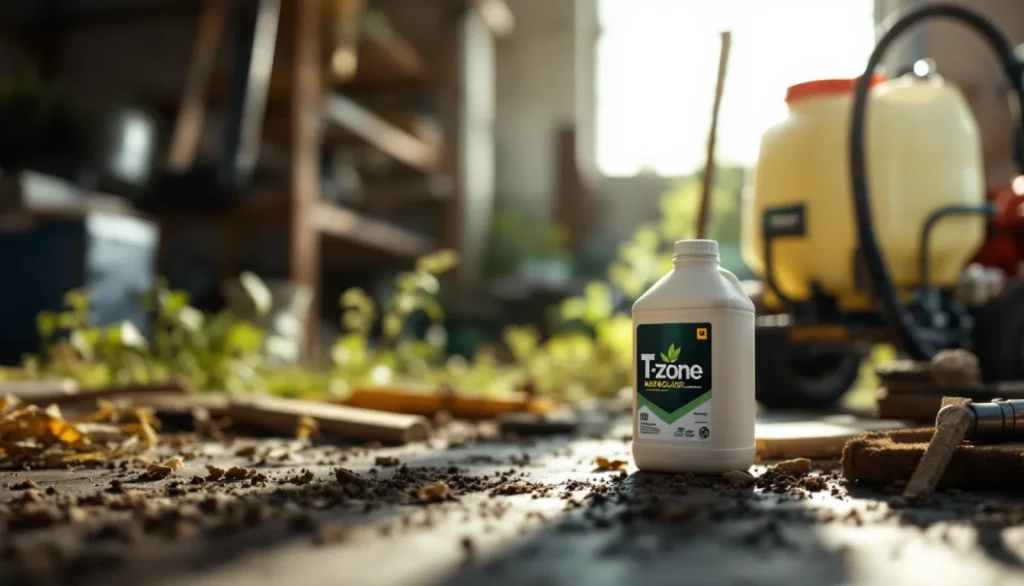
T Zone herbicide is PBI-Gordon’s four-way selective broadleaf killer built for cool-season turf, and it is the product professional lawn-care operators reach for when Speedzone or Trimec leaves clover and ground ivy standing. The active ingredient stack (triclopyr 8.24 percent plus sulfentrazone 0.61 percent plus 2,4-D 33.40 percent plus dicamba 2.36 percent) is heavier on the tough-to-kill broadleafs than any other PBI-Gordon four-way. At 1.0 to 1.5 oz per 1,000 square feet, T-Zone runs about $0.04 to $0.07 per 1,000 square feet for the active ingredient cost. Below is what it actually does in the field, what it costs, and where Speedzone and Trimec are still better picks.
The short version
- T-Zone SE is PBI-Gordon’s selective broadleaf herbicide for cool-season turf. Four actives: triclopyr 8.24 percent, sulfentrazone 0.61 percent, 2,4-D 33.40 percent, dicamba 2.36 percent.
- Application rate: 1.0 to 1.5 oz per 1,000 sq ft for most weeds, up to 2.1 oz for tough perennials. Annual cap of 6.0 oz per 1,000 sq ft.
- Strongest spectrum: clover, oxalis, ground ivy, wild violet, dollarweed, spurge. Most reliable broadleaf killer in the PBI-Gordon lineup.
- Container sizes and 2026 contractor pricing: 1 gallon roughly $130 to $160 (SiteOne, Ewing), 2.5 gallon roughly $290 to $340. Active-ingredient cost per 1,000 sq ft: about $0.04 to $0.07.
- Speed visible: leaf cupping in 24 to 48 hours, full kill in 7 to 21 days. Rainfast in 6 hours.
- Not labeled for St. Augustine, centipede, bahiagrass, or bermudagrass (will injure or kill warm-season turf). For warm-season, use a different selective.
What T-Zone is and who makes it
T-Zone SE (the SE stands for “Specialty Edition”) is a selective post-emergent broadleaf herbicide manufactured by PBI-Gordon Corporation, the Kansas City company that has built the lawn-care selective broadleaf category for the last six decades. PBI-Gordon’s product family in this space includes Trimec Classic (the original three-way 2,4-D / MCPP / dicamba), Trimec 992 (a higher-density version), Trimec Southern (formulated for southern grasses), Speedzone (the carfentrazone-enhanced version with faster visible activity), Speedzone Southern, and T-Zone SE (the version with triclopyr and sulfentrazone added for tough broadleafs).
The product positioning is straightforward: when Trimec or Speedzone leaves residual weeds, especially clover, oxalis, wild violet, ground ivy, or dollarweed, T-Zone is the next escalation. The triclopyr component is the workhorse for woody-stemmed and ester-tolerant weeds. The sulfentrazone component is an ALS inhibitor added to the mix specifically to broaden the spectrum and provide secondary kill of yellow nutsedge, kyllinga, and tough spurges.
EPA Registration Number is 2217-902. Signal word is Caution. The product carries Category 3A Turf and Ornamental commercial applicator licensing requirements in most states. It is not a Restricted Use Pesticide. Homeowners can buy it through SiteOne (with a business account), Ewing, Site One open accounts, or DoMyOwn and similar online retailers. See our professional weed killer guide for more.
The four-way active ingredient stack, explained
| Active ingredient | Percent | WSSA Group | What it kills well |
|---|---|---|---|
| 2,4-D, 2-ethylhexyl ester | 33.40% | 4 (auxin mimic) | Dandelion, plantain, chickweed, the easy broadleafs |
| Triclopyr, butoxyethyl ester | 8.24% | 4 (auxin mimic) | Clover, wild violet, ground ivy, kudzu, woody and ester-tolerant weeds |
| Dicamba | 2.36% | 4 (auxin mimic) | Knotweed, lambsquarter, ragweed, broad spectrum filler |
| Sulfentrazone | 0.61% | 14 (PPO inhibitor) | Nutsedge, kyllinga, spurge, oxalis, broadleaf accelerator |
Three of the four actives (2,4-D, triclopyr, dicamba) are synthetic auxin mimics. They share a kill mechanism: bind to the plant’s auxin receptors, trigger uncontrolled growth signaling, and burn the plant out metabolically over 7 to 21 days. The reason to combine three auxin mimics rather than just dose one heavily is that different broadleaf species have different sensitivities to different auxin mimics. Triclopyr nails clover and woody perennials. Dicamba covers knotweed and ragweed. 2,4-D handles the dandelion and plantain class. Together they cover roughly 80 plus broadleaf species at label rate. See our commercial grade weed killer guide for more.
The fourth active (sulfentrazone) is in a completely different mode of action group. It is a PPO (protoporphyrinogen oxidase) inhibitor that disrupts chlorophyll synthesis and causes rapid membrane disruption. Its inclusion does two things: broadens the spectrum (adds nutsedge, kyllinga, and tough spurges), and accelerates visible activity. The first 24 to 48 hours of visible leaf damage on a T-Zone-sprayed weed is largely the sulfentrazone working before the slower auxin mimics catch up. For more on how synthetic auxins kill plants at the cellular level, see our piece on how weed killer works.
What it kills (and what it does not)
T-Zone’s label spectrum is one of the broadest in the selective broadleaf category. The strongest controls (rated excellent on the label) include white clover, hop clover, oxalis (yellow woodsorrel), ground ivy (creeping Charlie), wild violet, dollarweed (pennywort), Florida betony, English daisy, dandelion, plantain, chickweed (common and mouse-ear), henbit, deadnettle, knotweed, lambsquarter, ragweed, spurge (prostrate and spotted), and Virginia buttonweed. See our herbicide definition guide for more.
It also provides partial control of yellow nutsedge and kyllinga (the sulfentrazone contribution), though for heavy nutsedge pressure most contractors still reach for a dedicated product like Sedgehammer (halosulfuron) or Dismiss (sulfentrazone alone at higher rate). See our commercial weed killer guide for more.
It does not kill grass weeds at meaningful rates. Crabgrass survives. Goosegrass survives. Bermudagrass in fescue survives. For grass weeds in cool-season turf, the typical pair is T-Zone for broadleafs plus Tenacity (mesotrione) or a Pylex / Acclaim Extra pair for crabgrass and bermuda contamination.
The label is explicit on what it cannot be used on. T-Zone will injure or kill St. Augustine, centipede, bahiagrass, and bermudagrass at label rate. For warm-season turf, PBI-Gordon’s Trimec Southern or Speedzone Southern is the correct pick. T-Zone is also not labeled for residential turfgrass in California (a state-specific restriction). Always check the state-specific labeling and our regulatory tracker for current state restrictions.
Mixing rate and application math
Label rates by weed difficulty:
Easy weeds (dandelion, plantain, chickweed): 1.0 oz per 1,000 sq ft. Tank rate of about 1.0 oz per gallon of finished spray for a typical 1 gal per 1,000 sq ft carrier rate.
Moderate weeds (clover, oxalis, henbit, knotweed): 1.2 oz per 1,000 sq ft.
Tough weeds (ground ivy, wild violet, dollarweed, Virginia buttonweed): 1.5 oz per 1,000 sq ft.
Maximum single application: 2.1 oz per 1,000 sq ft for established perennials. Maximum annual: 6.0 oz per 1,000 sq ft per year. Minimum re-treatment interval: 30 days.
Worked example for a 10,000 sq ft lawn at the 1.2 oz rate, suburban property with mixed clover and dandelion: 10,000 sq ft divided by 1,000 sq ft equals 10 thousand-square-foot units. 10 units times 1.2 oz per unit equals 12 oz of T-Zone needed. Mix that into your spray tank with enough water for a 1 gal per 1,000 sq ft carrier volume, so 10 gallons of finished spray. Add a non-ionic surfactant at 0.25 percent v/v (about 3 oz per 10 gallons) for better leaf wetting. Spray to wet coverage, not runoff. Knowing the actual square footage matters: see our guide to measuring lawn square footage.
Cost math for the same job at SiteOne 2026 pricing (1 gallon T-Zone roughly $135, so $1.05 per fl oz): 12 oz times $1.05 equals $12.60 of T-Zone for a 10,000 sq ft lawn. That is $0.001 per square foot in chemistry cost, or about $1.26 per 1,000 sq ft. The labor and equipment cost dwarfs the chemistry, which is why pricing T-Zone vs Speedzone vs Trimec on chemistry cost alone is the wrong economic question. The right question is which product gets the job done in one pass vs a callback. T-Zone earns its spot in the truck because clover and ground ivy callbacks are expensive.
T-Zone vs Speedzone vs Trimec: when each one wins
| Product | Active ingredients | Best for | 2026 price (1 gal) |
|---|---|---|---|
| Trimec Classic | 2,4-D + MCPP + dicamba (three-way auxin) | Standard broadleafs, dandelion, plantain, chickweed | $75 to $95 |
| Speedzone | 2,4-D + MCPP + dicamba + carfentrazone (four-way with PPO accelerator) | Fast visible activity (24 hr leaf burn), cooler temperatures, late fall | $140 to $170 |
| T-Zone SE | 2,4-D + triclopyr + dicamba + sulfentrazone (four-way with triclopyr and PPO) | Tough weeds: clover, oxalis, ground ivy, wild violet, dollarweed, plus some nutsedge | $130 to $160 |
Trimec Classic is the workhorse for a standard broadleaf job in mature turf. If the weeds are mostly dandelion, plantain, and chickweed, Trimec at 1.1 to 1.5 oz per 1,000 sq ft will clean it up at the lowest chemistry cost.
Speedzone wins when temperature is below 60 degrees and you need visible activity in 24 hours instead of waiting 5 to 7 days for the auxin mimics to do their work. The carfentrazone component is a PPO inhibitor that burns leaf surfaces fast. The full kill is still 7 to 14 days, but the immediate visual feedback matters for customer-facing work in the cooler shoulder seasons.
T-Zone wins when there is meaningful pressure from any of the tough perennials: clover, oxalis, wild violet, ground ivy, dollarweed. These are the weeds that get knocked back by Trimec and Speedzone but consistently regrow. The triclopyr in T-Zone is what closes that gap. T-Zone is also the better pick when there is some nutsedge mixed into the broadleaf pressure, because the sulfentrazone provides partial nutsedge suppression that Trimec and Speedzone cannot.
The decision tree in most lawn operations: Trimec for the standard September and April broadcast applications, Speedzone for the late-fall pass when temperatures are dropping, T-Zone for spot spraying or whole-lawn applications where the previous broadcast left clover or ground ivy standing.
Real-world performance and timing
Optimal application window: air temperature 60 to 85 degrees Fahrenheit, no rain expected for 6 hours, weeds actively growing. Below 60 degrees the auxin mimics work slowly and visible activity stretches to 10 days plus. Above 85 degrees the volatility of the ester formulations creates off-target drift risk and turf stress combines with the chemistry to cause cool-season grass yellowing.
Visible activity at proper temperature: leaf cupping and slight twist in 24 to 48 hours (mostly the sulfentrazone and the early auxin response). Yellowing in 4 to 7 days. Brown and dying in 7 to 14 days. Complete kill of above-ground tissue in 14 to 21 days. Re-treatment for survivors at the 30-day minimum interval.
Surfactant matters. The label recommends a non-ionic surfactant at 0.25 percent v/v for difficult weeds. Hi-Wett, Activator-90, or any equivalent NIS works. Without surfactant on waxy-leafed weeds like ground ivy or wild violet, expect 20 to 30 percent reduction in efficacy. The price of surfactant is trivial compared to a callback.
Rainfastness is 6 hours per the label. Do not spray if rain is forecast within 6 hours, and watch for irrigation timing on programmed systems. A common rookie error is spraying at 5 PM on a property with a 9 PM irrigation cycle and washing the chemistry off the foliage before it can absorb. Coordinate with the irrigation schedule or skip the application.
Mow timing: avoid mowing 24 hours before and 48 hours after application. Pre-mow timing matters because you need leaf surface for the chemistry to land on. Post-mow timing matters because you do not want to clip off the leaves that are actively translocating the chemistry to the roots. For broader stewardship of mowing and watering routines that compound with herbicide programs, see our pieces on brown patches in lawn and the NPK fertilizer guide.
Limitations and what the label does not say loudly
Three things the T-Zone label tells you but does not flag with bold red text.
Sensitive ornamentals. The auxin mimic actives, especially triclopyr and dicamba esters, are damaging to many ornamentals at very low drift concentrations. Tomato plants are extraordinarily sensitive (you can see damage from drift hundreds of feet downwind). Redbud, grape, and many flowering shrubs are also highly sensitive. Vapor drift on hot days is a real risk with ester formulations. If the property has vegetable gardens, sensitive ornamental beds, or grape vines within 100 feet, switch to an amine formulation or pick a different product entirely.
Cool-season turf yellowing. Even at label rate, T-Zone can cause temporary yellowing or slight stunting of Kentucky bluegrass, perennial ryegrass, and tall fescue in hot conditions or on stressed turf. The yellowing usually resolves in 7 to 14 days but it does look ugly during the recovery window. Spot spraying instead of broadcast on stressed lawns avoids the cosmetic hit.
Seed timing. Do not spray T-Zone within 3 to 4 weeks before seeding cool-season turf, and wait at least 21 days after spraying before overseeding. The auxin mimic residues damage germinating turf seedlings the same way they damage broadleaf weeds. Many fall renovation programs fail because the late-September T-Zone application got overseeded the following week.
Sardonic aside on the marketing
PBI-Gordon’s marketing copy implies T-Zone is the universal solution to every broadleaf problem in cool-season turf, which is the inevitable rhetoric of an active-ingredient stack that took the marketing team six chemistry consultations to assemble. In practice, on routine broadleaf pressure, Trimec at half the price does the same work, and the right time to pull T-Zone out of the locker is when the cheaper product has left a residual problem you need to close. Use the right tool for the right job and the chemistry will pay for itself in fewer callbacks.
FAQ
How much T-Zone do I need per gallon of water?
Match the per-gallon mix to your carrier rate. For a 1 gallon per 1,000 sq ft carrier, add 1.0 to 1.5 oz of T-Zone per gallon of water. For a 2 gallon per 1,000 sq ft carrier, add 0.5 to 0.75 oz per gallon. Always calibrate to deliver the labeled per-1,000-sq-ft rate, not to a particular per-gallon ratio.
Can I use T-Zone on Bermuda or St. Augustine?
No. The label specifically excludes Bermuda, St. Augustine, centipede, and bahiagrass. For warm-season turf, use PBI-Gordon’s Trimec Southern or Speedzone Southern, which are formulated to be safe on those species.
Is T-Zone better than Speedzone?
Not categorically. Speedzone has faster visible activity in cool weather thanks to the carfentrazone. T-Zone has a broader spectrum thanks to the triclopyr and sulfentrazone. For tough perennial broadleafs like clover, ground ivy, and wild violet, T-Zone is the stronger pick. For fast visible kill in cool weather on standard broadleafs, Speedzone is the stronger pick.
How long after spraying T-Zone can I let my dog or kids on the lawn?
The label re-entry interval is “until dry,” which is typically 1 to 2 hours in normal drying conditions. Most contractors recommend 24 hours as a conservative buffer for pets and children. Do not let pets graze on treated grass or chew on treated weeds.
Will T-Zone kill crabgrass?
No. T-Zone is a broadleaf herbicide and crabgrass is a grass. For crabgrass control in cool-season turf, use Tenacity (mesotrione) post-emergent or prodiamine (Barricade) pre-emergent. Many contractors tank-mix T-Zone with Tenacity for combined broadleaf and crabgrass coverage.
Bottom line
T-Zone SE earns its place in the contractor truck as the cool-season selective broadleaf escalation when Trimec or Speedzone has left clover, oxalis, ground ivy, wild violet, or dollarweed standing. The four-way active stack (2,4-D, triclopyr, dicamba, sulfentrazone) covers about 80 broadleaf species at the 1.0 to 1.5 oz per 1,000 sq ft label rate, with chemistry cost running roughly $0.04 to $0.07 per 1,000 sq ft at 2026 SiteOne pricing. It does not work on St. Augustine, centipede, or Bermuda. It does not kill grass weeds. It can yellow cool-season turf if applied to stressed lawns in heat. Used correctly, on the right turf, against the weeds it is designed for, it delivers the cleanest broadleaf kill in the PBI-Gordon lineup. For the broader question of how selective broadleaf chemistry works at the cellular level, see how weed killer works. For the foundational definition of herbicide chemistry families, see what is a herbicide.