
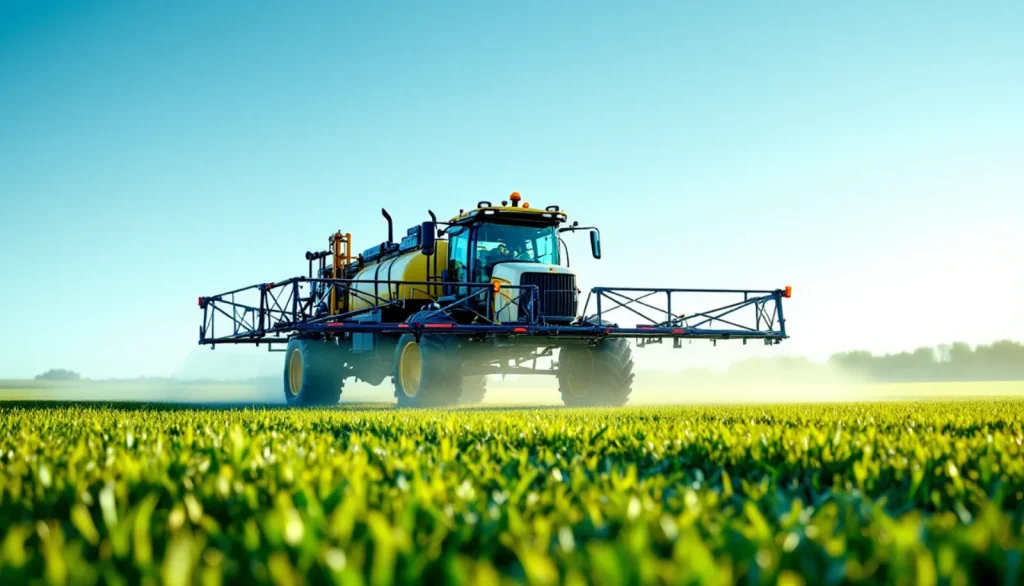
A commercial weed killer is any herbicide formulated, packaged, and labeled for use by licensed commercial applicators on jobs they are paid to perform. The category covers everything from selective broadleaf concentrates a lawn care contractor sprays on a 5,000 sq ft suburban yard to total-vegetation residual herbicides a right-of-way operator applies along miles of railroad track. What ties the category together is not chemistry but regulation. Commercial application means an EPA-registered product, applied by a licensed person, with records kept under state law.
The short version
- “Commercial” in herbicide is a regulatory term, not a marketing one. It means application by a licensed applicator under EPA FIFRA, for hire.
- Commercial-tier products split into selective (turf and ornamental), non-selective (renovation, hardscape), and total vegetation control (industrial, right-of-way, fence line).
- Most states require a Commercial Applicator License, Category 3A Turf and Ornamental, for lawn services. Industrial and ROW work uses Category 6 (Right-of-Way) in many states.
- Restricted-use products (RUPs) include paraquat, certain dicamba and 2,4-D formulations, fumigants, and most long-residual industrial herbicides. RUP purchases require license verification.
- Recordkeeping rules vary by state but typically require date, site, product, EPA Reg. No., rate, and applicator license number for every application. Records held 2 to 3 years minimum.
- Commercial application liability insurance minimums run $100K to $1M per occurrence depending on state and contract type. Most municipal contracts require $1M+.
What “commercial” actually means under FIFRA
The EPA distinguishes three classes of pesticide applicator under the Federal Insecticide, Fungicide, and Rodenticide Act. Private applicators apply pesticides to land they own or operate, typically for agricultural production. Commercial applicators apply pesticides for hire on someone else’s property. Non-certified applicators work under the direct supervision of a certified commercial applicator.
Commercial applicator certification is administered by each state’s lead agency, usually the Department of Agriculture, with EPA oversight under 40 CFR Part 171. The certification consists of a general core exam plus one or more category exams. For lawn care and ornamental work, the relevant category in nearly every state is Category 3A Turf and Ornamental. For industrial vegetation control along power lines, pipelines, railroads, and roadways, Category 6 (Right-of-Way) is the typical credential.
Once licensed, a commercial applicator can purchase Restricted Use Products (RUPs), tank-mix RUPs with general-use products, and apply them on jobs as long as the application matches the EPA label. The label is law. Off-label application, including a rate higher than the label maximum or use on a site not listed, is a federal violation under FIFRA Section 12(a)(2)(G), enforceable by state regulators with penalties typically ranging from $500 to $10,000 per violation.
The commercial herbicide categories that actually matter
| Category | Use site | Representative actives | Representative products | License required |
|---|---|---|---|---|
| Selective broadleaf (turf) | Residential, commercial lawn | 2,4-D, MCPP, dicamba, triclopyr, carfentrazone, sulfentrazone | Speedzone, T-Zone, Trimec Classic, Q4 Plus | 3A Turf and Ornamental |
| Selective grass weed (turf) | Lawn, sports turf, sod | Quinclorac, mesotrione, fenoxaprop | Drive XLR8, Tenacity, Acclaim Extra | 3A |
| Pre-emergent | Lawn, ornamentals | Prodiamine, dithiopyr, pendimethalin, isoxaben | Barricade, Dimension, Pendulum, Gallery | 3A |
| Non-selective (post) | Renovation, hardscape, beds | Glyphosate, glufosinate, diquat, pelargonic acid | Roundup Pro, Reward, Avenger | 3A or 5 (Aquatic) or 6 (ROW) |
| Total vegetation, residual | Fence line, gravel, industrial | Imazapyr, sulfometuron, tebuthiuron, indaziflam | Arsenal, Oust XP, Spike, Esplanade | 6 ROW or 10 Industrial |
| Aquatic | Ponds, lakes, drainage | Diquat, flumioxazin, fluridone, glyphosate aquatic | Reward, Clipper, Sonar | 5 Aquatic |
| Forestry | Pine plantations, hardwood release | Imazapyr, triclopyr, hexazinone | Arsenal, Garlon, Velpar | 2 Forest |
License category numbers vary slightly by state. The federal model under 40 CFR Part 171 sets ten standard categories, and most states adopt them with minor renaming. A contractor doing both lawn work and right-of-way work would carry 3A plus 6, with separate exams and continuing education for each.
Restricted Use Products: which actives trip the RUP threshold
Not every herbicide a commercial applicator uses is restricted. Most lawn herbicides (Speedzone, T-Zone, Tenacity, Prodiamine, Roundup Pro) are classified general use, which means a homeowner could legally buy and apply them on their own property. The restricted-use label exists when EPA determines the product has the potential to cause unreasonable adverse effects on the environment or applicator without licensed handling.
The big RUP herbicides commercial operators encounter include paraquat (Gramoxone), atrazine (in many turf and industrial labels), some 2,4-D ester formulations above certain concentrations, dicamba over-the-top labels for soybeans (XtendiMax, Engenia, Tavium), and most long-residual industrial herbicides like Spike (tebuthiuron) and Velpar (hexazinone). For lawn and ornamental work specifically, atrazine on warm-season turf is the most commonly encountered RUP in the southeast.
Purchasing an RUP requires presenting a current applicator license at the point of sale. Suppliers like SiteOne, Ewing, Helena Agri-Enterprises, and Nutrien Ag Solutions verify the license number against the state database before completing the sale and retain records of every RUP transaction. Loaning or transferring RUPs to a non-licensed person is a federal violation.
Recordkeeping: the unglamorous compliance side
Every state requires commercial applicators to keep records of every pesticide application. The federal minimum, under the Pesticide Recordkeeping Program for RUPs, requires brand name, EPA Reg. No., total amount applied, location, size of treated area, month/day/year, applicator name and certification number. Most states extend the requirement to general-use commercial applications and add weather conditions (temperature, wind speed and direction) and target pest.
Recordkeeping minimums by representative state:
- California: Monthly Pesticide Use Report (PUR) filed with County Ag Commissioner, plus 2-year retention. Use of any pesticide (general or RUP) must be reported.
- Florida: Records retained 2 years for general-use commercial applications, plus separate records for any RUP application.
- Texas: 2-year retention for all commercial applications, with structural pest control records held 2 years under TDA rules.
- New York: Annual report to DEC for all commercial applications, plus 3-year retention.
- Minnesota: 5-year retention for commercial applicator records.
Most contractor software (RealGreen, Service Autopilot, Aspire) generates application records that satisfy state requirements, but the applicator is responsible for confirming the records meet their state’s specific format. Audit failures usually come down to missing weather data or missing license numbers on customer-facing invoices.
Insurance and bonding requirements
Commercial herbicide application carries enough liability exposure that most states require minimum insurance to issue a commercial applicator business license. The minimums:
- Florida: $300K combined single limit for commercial applicator businesses, with proof filed annually with FDACS.
- Texas: $200K liability minimum for TDA-licensed lawn and ornamental businesses.
- California: $1M general liability for QAL-licensed applicators serving multiple sites.
- Most other states: $100K to $500K general liability, often coupled with a $5K to $25K surety bond.
Municipal, school district, and HOA contracts typically require $1M to $2M general liability plus $1M auto liability, naming the contracting entity as additional insured. Herbicide drift damage claims are the most common loss type, followed by tree and ornamental injury from off-label application. Carriers that specialize in green industry include Hortica, Rancho Mesa, and the McGowan Program Administrators turf coverage program. Premiums for a $1M GL policy on a small commercial applicator business run $1,200 to $3,500 annually.
Industrial and right-of-way: the other commercial channel
Outside the residential and commercial turf world, commercial herbicide application covers utility right-of-way (power lines, pipelines, railroads), highway shoulders, oil and gas pads, mining sites, and large industrial properties. This work uses different chemistry: long-residual total-vegetation products like imazapyr (Arsenal), sulfometuron (Oust XP), tebuthiuron (Spike), and indaziflam (Esplanade). A single application can keep a fence line bare for 12 to 24 months.
The work is performed under Category 6 (Right-of-Way) or in some states Category 10 (Industrial). Contractors include large national operators like Asplundh, Davey, Wright Tree Service, and Lewis Tree Service for utility ROW, plus regional vegetation management contractors for state highway DOTs. Per-acre application pricing typically runs $35 to $90 depending on terrain, access, and product mix.
Industrial weed control overlaps with our coverage of industrial weed killer, which goes deeper on the residual-chemistry side and the equipment used on miles-long jobs.
The applicator licensing path in 2026
Getting licensed is the same process in most states: study, exam, supervised hours, continuing education. The typical sequence for a new lawn care contractor:
- Order the state study manual. Most states publish a Core Manual (general pesticide safety, label, calibration, environmental fate) plus a category-specific manual for 3A Turf and Ornamental. Combined cost $40 to $80.
- Schedule the exam. Most states use proctored computer-based testing through PSI, Pearson VUE, or a state-run testing center. Fee $50 to $150.
- Pass the Core and Category exams. Passing score is typically 70%. Multiple-choice format, 50 to 100 questions per section.
- Apply for the Commercial Applicator License. Fee $50 to $250, plus proof of liability insurance and any state bond requirement.
- Register the business. Most states require a separate Commercial Pesticide Business license tied to the company entity, not the individual.
- Complete annual continuing education. 4 to 8 hours of approved CE annually, with renewal every 1 to 3 years depending on state.
Total time from start to licensed is typically 30 to 90 days. Total cost including manuals, exam fees, license, business registration, and initial insurance runs $500 to $1,500. After that, annual renewal cost is $200 to $600 plus CE time. For the broader compliance picture and state-by-state rules, see our regulatory hub. The financial side of running a lawn service is covered in our lawn care cost guide and the chemistry coordination is in the herbicide guide.
Common compliance failures and what they cost
State regulators audit commercial applicators on three things: license currency, recordkeeping, and label compliance. The most common findings:
Expired license: Continuing education hours not completed before renewal deadline. Fine $250 to $1,000, plus suspension until cured.
Missing records: No weather conditions logged, or no license number on customer invoice, or records older than 2 years discarded. Fine $250 to $2,500 per violation.
Off-label rate: Applying Speedzone at 2.0 oz per 1,000 sq ft when the label maximum on cool-season turf is 1.5 oz. Found through soil sampling after a drift complaint. Fine $1,000 to $5,000 plus possible license action.
Off-label site: Applying a turf-only herbicide to a vegetable garden bed at the customer’s request. Fine $500 to $2,500, plus liability for crop damage.
Drift onto neighboring property: Most common in spring when temperature jumps from 65 to 85 between morning and afternoon, causing volatilization of 2,4-D ester or dicamba. Fine $500 to $5,000 plus civil damages, typically $200 to $2,000 for tomato or grape injury per claim.
The pattern that keeps a commercial applicator out of trouble is straightforward. Check the license. Read the label. Calibrate the sprayer. Document the application. Run those four habits and the audit risk drops by an order of magnitude.
The other compliance trap is the contractor who lets a junior crew member apply pesticides without direct supervision. Federal rules under 40 CFR Part 171 require non-certified applicators to work under the direct supervision of a certified commercial applicator, which is defined in most states as the supervisor being available by phone and physically present on the site at the start of application, with the responsibility for label compliance, mix ratios, and recordkeeping retained by the licensed person. Showing up at the office and telling a helper to spray a route alone fails the direct supervision standard. The fine for unlicensed application by an employee falls on the licensed supervisor and the business, typically $500 to $2,500 per occurrence plus possible license action against the supervisor.
A related trap is buying commercial herbicide in a different state from where you apply it. RUPs purchased under a Texas applicator license cannot be applied in Oklahoma without a separate Oklahoma license. State reciprocity exists for some categories between some states (the EPA Pesticide Reciprocity Agreement under the Worker Protection Standard) but does not cover most lawn care or industrial applications. For multi-state operators, the rule is one license per state where the business operates and applies. The good news is most state license applications are straightforward for an applicator already certified in another state, often requiring only the state-specific law and regulation exam rather than the full core and category exam.
FAQ
Do I need a commercial license to spray weed killer on a rental property I own?
If you are applying general-use pesticides to a property you own or operate, no commercial license is required under federal law. State rules vary slightly. If you charge a tenant for the application as a separate service, some states treat it as a commercial application requiring a license. Check your state Department of Agriculture rules.
What is the difference between commercial weed killer and professional weed killer?
The terms overlap heavily. “Professional” is a marketing label for higher-concentrate products sold through wholesale supply (SiteOne, Ewing). “Commercial” is a regulatory category referring to application by a licensed applicator for hire. Most professional products are general use and can be purchased without a license but are typically used by commercial applicators.
Can a homeowner buy commercial weed killer?
General-use commercial products yes, through online suppliers (DoMyOwn, Solutions Pest and Lawn) or by cash purchase at SiteOne or Ewing. Restricted-Use Products (RUPs) require a current applicator license to purchase, regardless of intended use site.
How long does the EPA take to register a new herbicide?
New active ingredient registration under FIFRA Section 3 typically takes 4 to 6 years from initial submission to approval, with $1.5M to $4M in EPA fees plus tens of millions in safety and efficacy studies. New formulations or labels of existing active ingredients can be registered in 12 to 24 months.
What records does a commercial applicator have to keep?
At minimum: date, site (address and treated area in sq ft or acres), product brand and EPA Reg. No., total amount applied, applicator name and license number, target pest. Most states add temperature and wind conditions. Retention is typically 2 to 3 years, with California requiring monthly PUR filings.
Bottom line
Commercial weed killer is not a single product category. It is a regulatory framework that covers everything from selective broadleaf herbicide for residential lawns to long-residual industrial vegetation control along a pipeline corridor. What makes it “commercial” is who applies it (a licensed applicator), how it is documented (state-mandated records), and what backs it (liability insurance, bond, and the discipline to follow the label).
For a new lawn care contractor, the path is straightforward: get the Category 3A license, build a four-product chemistry stack, buy through a wholesale supplier, document every application, and carry $300K to $1M liability. For an industrial vegetation control operator, the path requires Category 6 plus a deeper bench of residual-chemistry products and per-acre pricing discipline. Either way, the regulatory side outlasts every product brand on the shelf.