
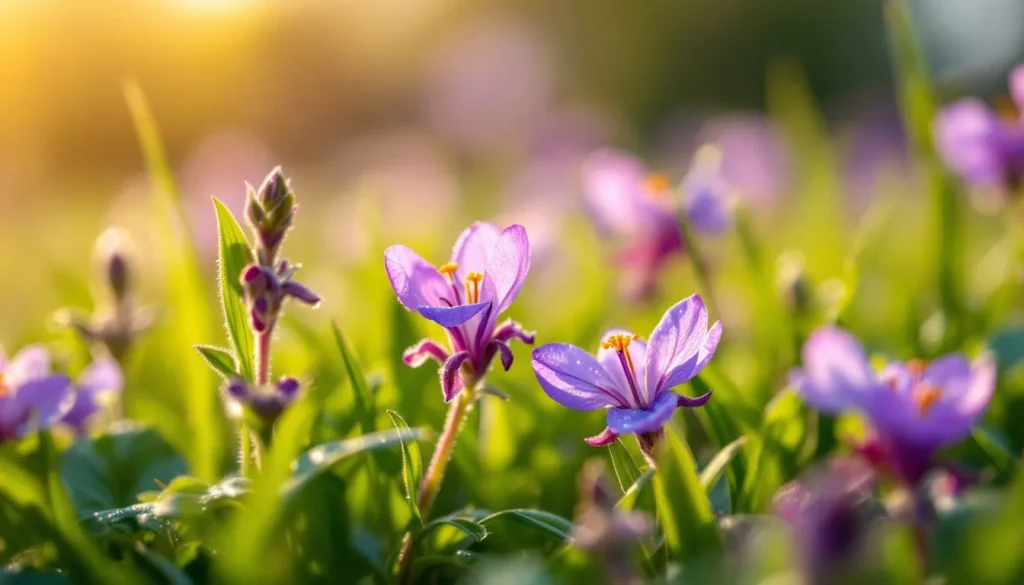
By the HMNDP Editorial Team. Last reviewed: June 2026.
Quick answer: what is the weed with purple flowers in your lawn?
A weed with purple flowers in a U.S. lawn is most often henbit (Lamium amplexicaule) or purple deadnettle (Lamium purpureum), two square-stemmed winter annuals that bloom in early spring. Creeping charlie (Glechoma hederacea), wild violet (Viola sororia), and bugleweed (Ajuga reptans) are the other common culprits. Identify it by flower shape, stem shape, and whether it mats or stands upright.
Most of these are harmless and some are edible or valuable to bees, so removal is optional. If you do want them gone, the method depends on the species, because a few resist common weed killers. The diagnostic below gets you to the right plant fast.
Identify your purple weed in 3 questions
You can narrow a purple-flowering lawn weed to one or two species by answering three questions about its flower shape, stem, and growth habit. This decision path is faster than scrolling a photo gallery because each answer eliminates whole groups. Look closely at one plant, ideally while it is blooming in spring.
- What shape is the flower? Tube-shaped or two-lipped (like a tiny snapdragon) points to the mint family: henbit, purple deadnettle, creeping charlie, or bugleweed. Five rounded petals with a pansy face points to wild violet. Small clover-like puffs point to selfheal or purple clover relatives.
- Is the stem square or round? Roll the stem between your fingers. A square stem with four edges means a mint-family plant (henbit, deadnettle, creeping charlie, bugleweed, selfheal). A round stem means it is not a mint, which fits wild violet and most others.
- Does it mat across the ground or stand upright? A low mat that roots as it spreads points to creeping charlie, bugleweed, or wild violet. An upright clump 4 to 16 inches tall points to henbit or purple deadnettle.
Example: square stem plus upright growth plus tube flowers equals henbit or deadnettle. Square stem plus mat plus a vine-like spread plus a faint mint smell equals creeping charlie. Round stem plus heart-shaped leaves plus a pansy flower equals wild violet.
| If you see this | Most likely weed |
|---|---|
| Square stem, upright, clasping rounded leaves, pink-purple tube flowers | Henbit |
| Square stem, upright, stalked triangular top leaves tinged purple-red | Purple deadnettle |
| Square stem, creeping mat, scalloped round leaves, mint smell when crushed | Creeping charlie (ground ivy) |
| Round stem, heart-shaped leaves, five-petal pansy flower | Wild violet |
| Square stem, low rosette, glossy bronze leaves, blue-purple flower spike | Bugleweed (ajuga) |
The 12 most common weeds with purple flowers
These 12 purple-flowering weeds cover nearly every plant U.S. homeowners report in lawns and beds. Each entry gives the botanical name, life cycle, visual ID cues, and a one-line note on whether it spreads aggressively. Henbit, purple deadnettle, creeping charlie, and wild violet are the four you are most likely to find.
1. Henbit (Lamium amplexicaule)
Henbit is a winter annual in the mint family and the single most common small purple-flowered lawn weed across the U.S. It grows 4 to 12 inches tall on square stems, with rounded scalloped leaves that clasp the stem directly (no leaf stalk near the top) and pink-to-purple tube flowers in early spring. It dies back as heat arrives.
It thrives in thin, disturbed, or recently seeded turf. Because it is a winter annual, it germinates in fall, overwinters small, then blooms March to May. Pollinators visit it early when little else flowers.
2. Purple deadnettle (Lamium purpureum)
Purple deadnettle is henbit’s close cousin, also a square-stemmed winter annual in the mint family. The tell is the top leaves: they are triangular, stalked (petioled), overlapping like shingles, and often flushed purple-red, giving the plant top a purple haze. Flowers are similar pink-purple tubes. See the side-by-side below to separate the two.
3. Creeping charlie / ground ivy (Glechoma hederacea)
Creeping charlie and ground ivy are two names for the same perennial mint, Glechoma hederacea. It forms a dense creeping mat, roots at the nodes as it spreads, has scalloped round (kidney-shaped) leaves, small blue-purple tube flowers, and a distinct minty smell when crushed. It loves shade and damp soil and is one of the hardest lawn weeds to remove.
4. Wild violet (Viola sororia)
Wild violet is a tough perennial with round (not square) stems, heart-shaped leaves, and classic five-petal pansy-style purple flowers in spring. It grows from a thick rootstock and waxy leaves that shed many herbicides. Some homeowners keep it as a groundcover; others fight it for years because it resists normal weed killers.
5. Bugleweed / ajuga (Ajuga reptans)
Bugleweed, sold as the ornamental ajuga, escapes beds and spreads into lawns by runners. It is a low perennial mint with glossy bronze-green leaves in a flat rosette and upright spikes of blue-purple flowers in late spring. It mats quickly in shade and moist ground. Pretty in a border, invasive in turf.
6. Selfheal (Prunella vulgaris)
Selfheal is a low perennial mint with square stems, lance-shaped leaves, and a stubby club of purple-violet flowers. It tolerates close mowing, so it survives in lawns where taller weeds get cut down. It is native across much of North America and valued by bees.
7. Wild garlic and the purple-tinged alliums
Wild garlic (Allium vineale) sends up thin hollow tubular leaves with a strong onion smell and clusters that can show purple-pink. It grows from underground bulbs, which is why pulling rarely works. The onion odor when mowed is the giveaway.
8. Common mallow and musk mallow (Malva species)
Mallows have round-stemmed sprawling growth, rounded lobed leaves, and pinkish-purple five-petal flowers. Musk mallow (Malva moschata) shows brighter mauve. They favor disturbed ground and field edges more than dense lawn.
9. Forget-me-not and speedwell (small blue-purple flowers)
Several low weeds show tiny blue-to-purple flowers, including creeping speedwell (Veronica) and forget-me-not relatives. Speedwell forms small mats with scalloped leaves and four-petal flowers, often in early spring lawns.
10. Purple dead nettle look-alikes: spotted dead nettle (Lamium maculatum)
Spotted dead nettle is an ornamental Lamium with silver-marked leaves that escapes gardens. It looks like purple deadnettle but with a clear silver leaf blaze. It spreads in shade.
11. Purple loosestrife (Lythrum salicaria)
Purple loosestrife is a tall wetland invasive with showy spikes of magenta-purple flowers. It is listed as noxious in many U.S. states and is a problem near ponds and ditches, not typical turf. Report it to local authorities in regulated states rather than composting it.
12. Praxelis and Florida-specific purple weeds
In Florida and parts of the Gulf South, praxelis (Praxelis clematidea) and Florida pusley relatives produce small lavender-purple flower heads in lawns. Warm-climate weed mixes differ from northern lawns, so regional ID guides matter. Confirm with a local extension office if your weed does not match the northern species above.
Henbit vs purple deadnettle: how to tell them apart
Henbit and purple deadnettle are both square-stemmed mint-family winter annuals with pink-purple tube flowers, which is why they are constantly confused. The reliable difference is the upper leaves: henbit’s clasp the stem directly with no stalk and stay green, while purple deadnettle’s are stalked, triangular, overlapping, and flushed purple-red toward the top.
| Feature | Henbit (Lamium amplexicaule) | Purple deadnettle (Lamium purpureum) |
|---|---|---|
| Upper leaves | Clasp stem directly, no stalk | Stalked (petioled), triangular |
| Leaf color near top | Green | Flushed purple-red |
| Leaf shape | Rounded, scalloped, fan-like | Triangular to heart-shaped, pointed |
| Overall top look | Open, leaves spaced | Dense, shingled, purple haze |
| Life cycle | Winter annual | Winter annual |
Both are harmless, both feed early bees, and both die back in summer heat. For lawn purposes you can treat them the same way, so getting the ID exactly right matters more for foragers than for control.
Should you even remove it? Edibility and bee value
Many purple-flowering weeds are edible or valuable to pollinators, so removal is a choice, not a requirement. Henbit, purple deadnettle, wild violet, and creeping charlie are all edible in moderation, and henbit and deadnettle are among the first nectar sources for bees in early spring. Decide based on whether the plant is harming your lawn goals.
- Henbit and purple deadnettle: Young leaves and stems are edible raw or cooked, mild and slightly grassy. Both bloom early and feed bees and other pollinators when little else flowers.
- Wild violet: Flowers and young leaves are edible and high in vitamin C. The flowers are used as edible garnish.
- Creeping charlie: Historically used as a culinary and medicinal herb, though it can be toxic to horses in quantity, so keep it out of pasture.
- Bugleweed and selfheal: Selfheal is a traditional herb and a strong pollinator plant; ajuga is mainly ornamental.
Only forage from areas you know are free of herbicides, pesticides, and pet waste. If you plan to eat any of these, do not also spray them.
How to get rid of weeds with purple flowers
The right removal method depends on the species, because annuals pull easily while perennials regrow from roots or runners. Hand-pulling and good lawn density handle henbit and deadnettle, while creeping charlie and wild violet usually need a triclopyr-based broadleaf herbicide applied in fall. Match the method to the weed using the table below.
| Weed | Type | Best removal method | Best timing |
|---|---|---|---|
| Henbit | Winter annual | Hand-pull or selective broadleaf herbicide; thick turf prevents it | Fall (pre-emergent) or early spring before bloom |
| Purple deadnettle | Winter annual | Same as henbit; pulls easily when young | Fall or early spring |
| Creeping charlie | Perennial | Triclopyr-based herbicide; resists basic 2,4-D alone | Fall, when it moves sugars to roots |
| Wild violet | Perennial | Triclopyr; waxy leaves shed weaker products | Fall (most effective) or spring |
| Bugleweed | Perennial | Dig out runners; triclopyr for stubborn patches | Spring or fall |
| Wild garlic | Perennial bulb | Dig the bulbs; repeated treatment needed | Fall and spring |
For a step-by-step approach to manual and chemical control across species, see our guide on how to get rid of weeds. To avoid burning your turf, use a product designed to spare grass; our breakdown of the best weed killer that won’t kill grass compares selective options.
- Pull annuals while young. Henbit and deadnettle have shallow roots; pull or hoe them before they set seed in spring.
- Spot-treat perennials with the right active ingredient. For creeping charlie and wild violet, choose a selective broadleaf product containing triclopyr; basic lawn weed killers often fail on these.
- Treat in fall when possible. Perennials move energy to their roots in autumn, carrying herbicide down with it for a better kill.
- Repeat as needed. Violets and creeping charlie often need a second application a few weeks later.
Why regular weed killer won’t kill wild violets and creeping charlie
Wild violet and creeping charlie survive ordinary weed killer for two reasons: waxy, water-repelling leaf surfaces that shed spray, and tough perennial root and runner systems that regrow after the top dies. Standard broadleaf products built around 2,4-D alone often fail on them. A formula containing triclopyr, applied in fall, penetrates better and reaches the roots.
Apply on a calm, dry day above 50°F so the plant is actively growing. Add a spreader-sticker surfactant if the label allows, which helps spray cling to waxy leaves. Reapply after about two to three weeks if regrowth appears. Always follow the product label, which is the legal use instruction.
How to prevent purple weeds from coming back
The most durable defense against purple-flowering weeds is a thick, healthy lawn that crowds out seedlings before they establish. Dense turf, a higher mow height, and a properly timed pre-emergent stop most annuals like henbit and deadnettle from germinating in the first place. Prevention beats repeated spraying.
- Mow higher. Cutting cool-season grass at 3 to 3.5 inches shades the soil and suppresses weed germination.
- Thicken the turf. Overseed bare and thin spots in fall so weeds have no open ground to colonize.
- Time a pre-emergent. Apply pre-emergent in early fall to block winter annuals like henbit and deadnettle before they sprout.
- Fix the conditions. Creeping charlie and violets thrive in shade and damp soil; improve drainage and prune to add light.
For broader identification of other lawn invaders and ongoing maintenance, browse our lawn weeds library and the wider HMNDP learn hub.
Frequently Asked Questions
How do I identify a weed with purple flowers in my lawn?
Use three checks. First, note the flower shape: tube or two-lipped means a mint-family weed, a pansy face means wild violet. Second, roll the stem; square means mint family (henbit, deadnettle, creeping charlie). Third, see if it mats or stands upright. Square plus upright equals henbit or deadnettle; square plus creeping mat equals creeping charlie.
What is the most common weed with small purple flowers?
Henbit (Lamium amplexicaule) is the most common weed with small purple flowers in U.S. lawns. It is a winter annual in the mint family that grows 4 to 12 inches tall on square stems, with rounded clasping leaves and pink-purple tube flowers in early spring. Purple deadnettle, its close cousin, runs a close second and is often confused with it.
What is the difference between henbit and purple deadnettle?
The difference is the upper leaves. Henbit’s top leaves clasp the stem directly with no stalk and stay green. Purple deadnettle’s top leaves are stalked, triangular, overlapping like shingles, and flushed purple-red, giving the plant top a purple haze. Both are square-stemmed mint-family winter annuals with similar pink-purple tube flowers, so the leaf attachment is the reliable tell.
Is creeping charlie the same as ground ivy, and how do I get rid of it?
Yes. Creeping charlie and ground ivy are two names for the same perennial mint, Glechoma hederacea. It forms a creeping mat with scalloped round leaves and a minty smell. To remove it, use a selective broadleaf herbicide containing triclopyr applied in fall, when the plant moves energy to its roots. Basic 2,4-D-only products often fail, so a second application may be needed.
How do I kill weeds with purple flowers without damaging my grass?
Use a selective broadleaf herbicide, which targets broadleaf weeds while sparing lawn grass. Products containing triclopyr handle tough perennials like wild violet and creeping charlie. Apply on a calm, dry day above 50°F when weeds are actively growing, follow the label rate exactly, and avoid spraying on windy days to prevent drift onto desirable plants.
Why won’t regular weed killer kill my wild violets and creeping charlie?
Both have waxy leaf surfaces that repel spray and tough perennial roots or runners that regrow after the top dies. Standard products built around 2,4-D alone often fail. Switch to a formula containing triclopyr, apply it in fall when the plant sends energy to its roots, add a surfactant if the label allows, and reapply after two to three weeks.
Are weeds with purple flowers edible or good for bees?
Many are both. Henbit, purple deadnettle, and wild violet have edible young leaves and flowers, and henbit and deadnettle are among the first nectar sources for bees in early spring. Selfheal is a strong pollinator plant. Only forage from areas free of herbicides, pesticides, and pet waste, and never eat plants you have sprayed.
When do purple-flowering lawn weeds bloom and when should I treat them?
Winter annuals like henbit and purple deadnettle bloom from roughly March to May, then die in summer heat. Perennials like creeping charlie, wild violet, and bugleweed flower in spring to early summer. Treat annuals with a fall pre-emergent or pull them in early spring before seeding. Treat perennials with herbicide in fall, when they carry it down to the roots.