
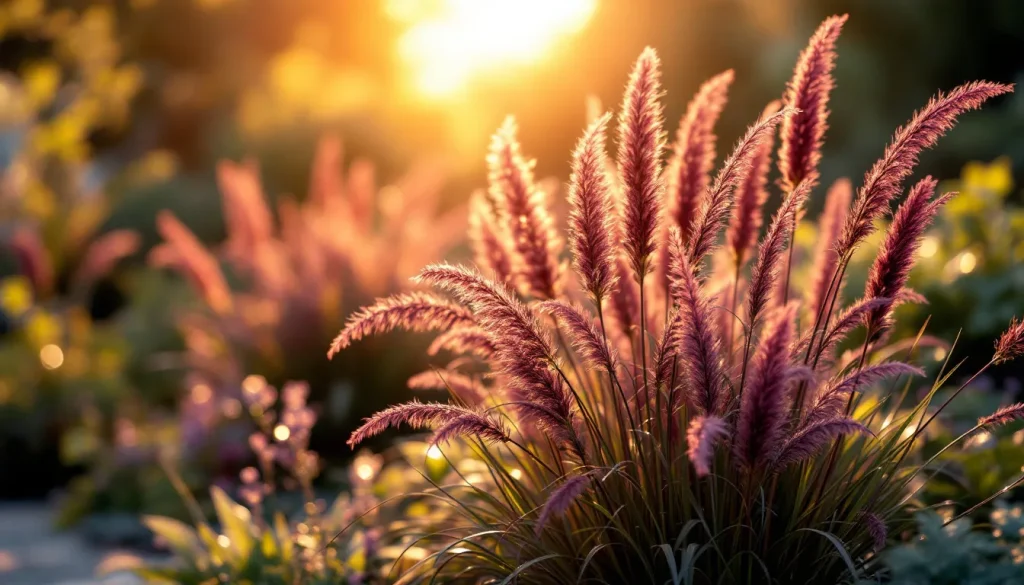
Purple fountain grass at a glance
Purple fountain grass (Pennisetum setaceum ‘Rubrum’, also sold as Pennisetum x advena ‘Rubrum’ and reclassified by botanists as Cenchrus setaceus ‘Rubrum’) is a clump-forming ornamental grass with burgundy foliage and arching rose-purple plumes. It grows 3 to 5 feet tall and 2 to 3 feet wide, thrives in full sun, and is winter-hardy only in USDA zones 9 to 11. Everywhere colder, gardeners grow it as an annual.
By the HMNDP Editorial Team. Last reviewed: June 2026.
The name confusion is real and worth settling first. Nurseries still label it Pennisetum setaceum ‘Rubrum’, some use Pennisetum x advena ‘Rubrum’, and current taxonomy (Kew, USDA PLANTS) places fountain grass in the genus Cenchrus. All three names point to the same burgundy cultivar. The label on the pot does not change the plant.
This plant is one of the most planted ornamental grasses in North America for one reason: color. The deep maroon blades hold their tone all season in full sun, and the plumes catch backlight at dawn and dusk. For broader context on the genus, see our overview of fountain grass varieties and care.
What purple fountain grass looks like and how big it gets
Purple fountain grass forms a dense, tidy clump of arching burgundy-to-maroon blades, topped from midsummer through fall by 8 to 12 inch nodding plumes in rose-red to purple that fade to tan. Mature size is typically 3 to 5 feet tall and 2 to 3 feet wide. It grows fast, reaching near-full size in a single season, which is why it works as an annual.
The foliage is the selling point. Unlike green fountain grass that needs the plumes to earn its place, ‘Rubrum’ carries the bed with color from the day you plant it. The blades are roughly half an inch wide and cascade in a fountain shape, the trait behind the common name.
| Trait | Detail |
|---|---|
| Foliage color | Burgundy to maroon, deepest in full sun |
| Plume color | Rose-red to purple, fading to tan by late fall |
| Mature height | 3 to 5 feet (including plumes) |
| Mature width | 2 to 3 feet |
| Growth rate | Fast; near-full size in one season |
| Habit | Dense, upright, clump-forming (no runners) |
Sun, water, and basic care
Purple fountain grass needs full sun (6 or more hours of direct light) for the richest burgundy color; in part shade the foliage turns muddy green. It is highly drought and heat tolerant once established, needs only well-drained soil, and asks for almost no maintenance during the growing season. Overwatering and shade are the two ways most people get it wrong.
- Light: Plant in full sun. Shade dulls the color and loosens the clump.
- Water: Water 1 to 2 times a week for the first 4 to 6 weeks to establish roots, then only during long dry spells. It is one of the better picks for low-water beds; see our guide to the best fertilizers for drought-prone gardens.
- Soil: Any well-drained soil. Soggy soil causes crown rot, the main killer of this plant.
- Feeding: Light feeders. A single spring application of a balanced fertilizer is plenty in the ground; see our 2026 plant fertilizer picks. Avoid heavy nitrogen, which floods foliage and weakens the plumes.
- Cutting back: If overwintered, cut the clump to 3 to 4 inches in late winter before new growth starts.
Hardiness zones: perennial or annual?
Purple fountain grass is a reliable perennial only in USDA zones 9, 10, and 11. In zones 8 and below it is grown as an annual and replaced each spring. It is technically a tender perennial, not a true annual, but in most of the United States the cost and effort of overwintering it rarely beats simply buying a new plant.
This is the verdict competitors dodge. Here is the honest math by zone.
| USDA Zone | Behaves as | Recommended approach |
|---|---|---|
| 9 to 11 | Perennial | Leave in ground; cut back in late winter |
| 8 | Borderline | May survive a mild winter with heavy mulch; treat as annual to be safe |
| 7 and colder | Annual | Replace yearly, or overwinter indoors if the plant has sentimental or design value |
Cost framing: A 1-gallon plant runs roughly $12 to $20 at most US garden centers (2026). Overwintering takes a frost-free space, a pot, monthly attention, and a survival rate that is far from guaranteed in cold zones. For most zone 7 and colder gardeners, buying fresh each spring is the cheaper, lower-risk choice. Overwinter only if you want to preserve a specific large specimen or save money across many plants.
How to overwinter purple fountain grass (step by step)
To overwinter purple fountain grass in zones 7 and colder, dig and pot the clump before the first frost, cut it back, and store it in a cool, dark, frost-free space such as a garage at 40 to 50 degrees Fahrenheit. Water just enough to keep the roots from drying out. Realistic survival is 50 to 70 percent done well, lower if the storage space freezes or stays warm.
Containers are easier than in-ground plants because the root ball is already potted. Follow these steps for either case.
- Time it: Act before the first hard frost, usually late October to mid-November depending on region.
- Dig and pot (in-ground plants): Lift the clump with a spade, keeping a generous root ball, and set it in a pot sized to the roots with well-drained potting mix.
- Cut back: Trim foliage to 4 to 6 inches so the plant puts no energy into top growth.
- Store cool and dark: Move it to an unheated garage, basement, or shed held at 40 to 50 degrees Fahrenheit. The plant goes dormant; it does not need light.
- Water sparingly: Once a month, give just enough water to keep the root ball from going bone dry. Wet soil in dormancy causes rot.
- Wake it in spring: About 4 to 6 weeks before your last frost, move it to a sunny window or warm spot and resume regular watering. Harden it off outdoors after frost danger passes.
Survival odds depend almost entirely on the storage temperature. A space that dips below freezing kills the crown; a warm space breaks dormancy too early and leaves a weak, etiolated plant. The 40 to 50 degree range is the target.
Is purple fountain grass invasive? The honest answer
The cultivar ‘Rubrum’ is widely considered sterile or nearly sterile, meaning it produces little to no viable seed and does not spread the way the straight species does. The invasive plant is Pennisetum setaceum (green fountain grass), which self-seeds aggressively. ‘Rubrum’ is the same species but a sterile selection, so the blanket warnings aimed at the species do not cleanly apply to the burgundy cultivar.
This distinction is the single biggest gap in existing coverage. Retail pages ignore the invasive issue; conservation groups condemn the species without separating the sterile cultivar. Both leave the buyer confused. Here is the reconciliation.
| Plant | Seeds? | Invasive status |
|---|---|---|
| Pennisetum setaceum (green species) | Yes, aggressively | Listed invasive/noxious in several states |
| Pennisetum setaceum ‘Rubrum’ (purple cultivar) | Little to none (effectively sterile) | Generally not the regulated form, but check local rules |
Where it matters legally: the species P. setaceum is regulated or discouraged in parts of California, Hawaii, Arizona, and other warm regions where it naturalizes. The California Invasive Plant Council rates green fountain grass as a moderate invasive. Conditional advice applies here: regulations target the seeding species, but cultivar exemptions vary by jurisdiction and can change, so confirm with your state agriculture department or the relevant agency before planting in zones 9 to 11 where it can persist year-round. In cold zones grown as an annual, the plant dies each winter and self-seeding is not a practical concern.
Our editorial take: ‘Rubrum’ is a low ecological risk in cold-winter regions and a manageable one in warm regions, but the responsible move in fire-prone or arid western states is to verify local listings before buying. For state-by-state plant rules generally, our learn hub tracks regulatory topics.
Growing purple fountain grass in pots and containers
Purple fountain grass is excellent in containers and is often grown that way precisely because pots make overwintering easy. Use a pot at least 14 to 16 inches wide with drainage holes, a well-drained potting mix, full sun, and slightly more frequent water than in-ground plants. As a thriller in mixed pots, pair it with trailing and filler plants for an instant designed look.
Containers dry out faster than beds, so the drought tolerance that defines this plant in the ground does not fully carry over to a pot. Check soil moisture every few days in summer heat.
- Pot size: 14 inches or wider; a 5-gallon nursery pot equivalent gives the clump room.
- Soil: Quality potting mix, not garden soil, for drainage.
- Water: Roughly twice a week in summer; daily in extreme heat for small pots.
- Fertilizer: A slow-release feed at planting plus a monthly liquid feed sustains color all season; our fertilizer guide for grasses covers ratios.
- Design partners: Sweet potato vine, calibrachoa, angelonia, or white euphorbia contrast well against the burgundy blades.
Frequently Asked Questions
Quick answers to the most common purple fountain grass questions, drawn from the sections above.