
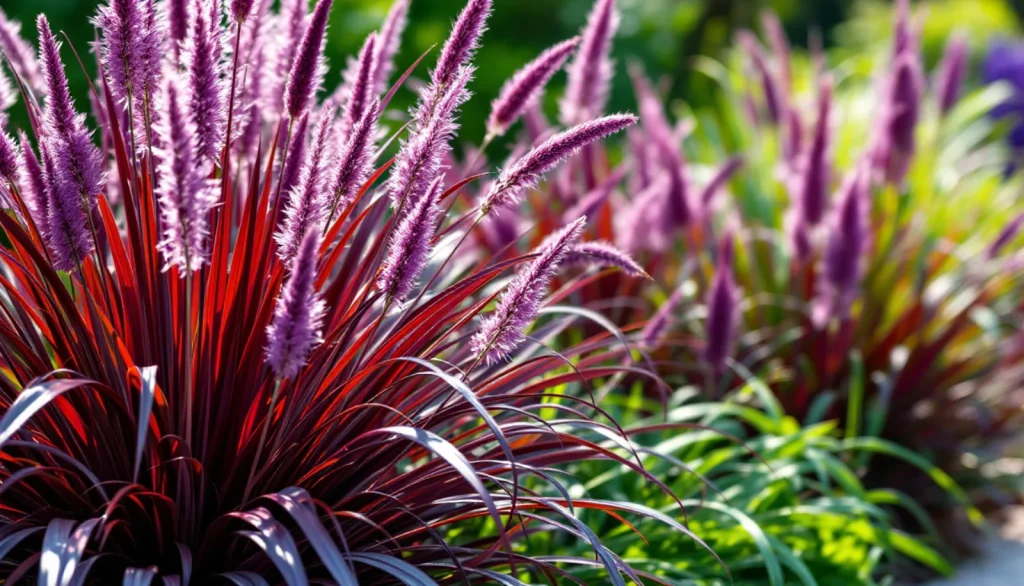
Fountain Grass: Purple vs Green, Care, and Invasive Caution
Fountain grass is the common name for ornamental Pennisetum grasses, and the single decision that matters before you plant is whether you are buying a tender purple type that dies at the first hard frost or a cold-hardy green type that returns for years. Purple fountain grass (Pennisetum setaceum ‘Rubrum’) survives winter only in USDA zones 9 to 10 and is grown as an annual everywhere colder, while hardy green species like Pennisetum alopecuroides come back in zones 5 to 9. There is a third thing nobody tells you at the garden center: the green species that purple ‘Rubrum’ descends from is a listed noxious weed in California, Arizona, and Hawaii, so what you plant and where you plant it carries real consequences.
Purple fountain grass vs green fountain grass: which one am I buying?
The split comes down to two different plants sold under one common name. Purple fountain grass is Pennisetum setaceum ‘Rubrum’, a tender cultivar hardy only to USDA zones 9 to 10, grown as a single-season annual in colder regions. Green hardy fountain grass is usually Pennisetum alopecuroides, perennial in zones 5 to 9, which gets a little larger each year it returns. Color tells you cold tolerance: burgundy foliage almost always means annual, green almost always means perennial.
Purple ‘Rubrum’ grows 3 to 5 feet tall and 2 to 4 feet wide, with burgundy-red foliage and fluffy purple bottlebrush plumes up to 12 inches long from July to October, per the Missouri Botanical Garden Plant Finder. It needs full sun to hold the deep color and turns greenish in shade.
Hardy Pennisetum alopecuroides forms green mounds 2 to 3 feet tall with reddish to coppery-tan plumes. The popular dwarf cultivar ‘Hameln’ stays 18 to 24 inches tall and wide, blooms about two weeks earlier than the species, and is hardy to zone 5 (often zone 4), per Gardenia and Monrovia.
| Feature | Purple fountain grass (P. setaceum ‘Rubrum’) | Hardy green fountain grass (P. alopecuroides) |
|---|---|---|
| Hardiness | USDA zones 9 to 10 (annual elsewhere) | USDA zones 5 to 9 (perennial) |
| Foliage color | Burgundy to deep purple | Green, tan in fall |
| Mature size | 3 to 5 ft tall, 2 to 4 ft wide | 2 to 3 ft (dwarf ‘Hameln’ 18 to 24 in) |
| Plume color | Burgundy-purple, to 12 in long | Reddish-purple to coppery tan |
| Reseeds? | ‘Rubrum’ rarely sets seed (near-sterile) | Can self-seed; some volunteers |
| Winter plan | Replace yearly or overwinter indoors | Cut back, returns from crown |
Is fountain grass a perennial or an annual?
It depends on the type and your zone. Purple fountain grass is a tender perennial that behaves as an annual in USDA zones 8 and colder because its roots do not survive a hard freeze, per Gardening Know How. In zones 9 to 11 it lives for years. Hardy green species such as Pennisetum alopecuroides are true perennials in zones 5 to 9, dying back each winter and regrowing from the crown in spring.
Check your USDA Plant Hardiness Zone on the 2023 revised map at planthardiness.ars.usda.gov before you buy. If you are in zone 8 or below and want a plant that returns, choose a green alopecuroides cultivar, not purple ‘Rubrum’. If you want the burgundy color and accept replanting, buy ‘Rubrum’ and treat it like an annual bedding plant.
The invasive caution garden centers skip
Green-flowered Pennisetum setaceum, the wild species, is a listed noxious weed in California, Arizona, and Hawaii, and you should not plant it in or near those states. It is native to northern Africa (Sudan, Ethiopia, Egypt) and spreads by wind, animals, and vehicles. After a fire it recolonizes fast, raises fuel loads, and crowds out native plants. Arizona added it to the state noxious weed list in 2020; California lists it under CCR Section 4500; Hawaii lists it under HAR 68.
The fire link is the reason it is regulated. The Hawaii Invasive Species Council assigns fountain grass a Weed Fire Risk Score of 0.99 (high), notes it escaped cultivation in Hawaii by 1914, and reports its seeds stay viable in soil up to 6 years. California’s invasive plant network reports the species now occurs across at least 11 counties after entering the Los Angeles area before 1917.
The good news for most buyers: purple ‘Rubrum’ is the near-sterile cultivar and rarely sets seed, which is why it is sold widely. The Missouri Botanical Garden and UF/IFAS both confirm ‘Rubrum’ rarely produces viable seed. Still, in warm climates buy only named sterile cultivars, skip any green-flowering volunteer seedlings, and if you garden in California, Arizona, or Hawaii, choose a native bunchgrass alternative to stay clear of the regulated species entirely. For broader low-water planting ideas, see our guide to drought-tolerant lawn alternatives.
How do I plant and care for fountain grass?
Fountain grass wants full sun, well-drained soil, and room to mound. Plant after your last frost in spring, give it at least 6 to 8 hours of direct sun, and space plants 1 to 4 feet apart depending on mature size (dwarf ‘Hameln’ at 1 to 2 feet, large purple types at 3 to 4 feet). Water regularly the first season to establish, then it is drought tolerant and needs only occasional deep watering.
- Pick a full-sun bed with well-drained soil; purple types lose color in shade.
- Plant after the last spring frost when night temperatures hold above 50 to 60 degrees F.
- Space by mature size: 1 to 2 ft for dwarf ‘Hameln’, 3 to 4 ft for purple ‘Rubrum’.
- Water weekly the first season, then cut to occasional deep soakings once established.
- Skip heavy feeding; a light spring feeding after new shoots appear is enough.
- For hardy perennial types, cut back to 4 to 6 inches in late winter or early spring.
Fountain grass is described as virtually pest-free by UF/IFAS, so most failures come from poor drainage, too much shade (which fades purple foliage), or planting a tender type where winter kills it. Match the plant to your zone first and the care is light. If you are integrating it into a wider bed, our yard design guide covers layout and plant pairing.
When and how do I cut back fountain grass?
Cut hardy perennial fountain grass back to 4 to 6 inches in late winter or early spring, just before new growth starts. Gather the foliage into a bundle, tie it, and cut with sharp shears or hedge clippers, per Gardening Know How. Leaving the dried foliage standing through winter protects the crown and adds cold-season interest, so spring is usually the better time than fall in colder zones.
Purple annual types do not need a cut-back unless you are overwintering them, because they are replaced each year. Wear gloves: the leaf edges are sharp and can cut skin.
Can I keep purple fountain grass over winter?
Yes, in two ways. Outdoors, purple fountain grass overwinters reliably only in zones 9 to 11; in zone 8 you can sometimes hold it with heavy protection. Indoors, dig the plant before the first frost, pot it, clip foliage to about 3 inches, and keep it in a cool sunny room watered just enough to stay barely moist, per Epic Gardening.
To overwinter outdoors in borderline zone 8, mulch heavily around the base with pine straw, shredded leaves, or wood mulch, pile 4 to 6 extra inches over the crown, and cover with frost cloth during cold snaps. Move potted plants back outside in spring once nights hold above 50 to 60 degrees F, acclimating to full sun over a week. For most gardeners in zone 7 and colder, buying fresh plants each spring is cheaper and more reliable than overwintering.
Is fountain grass the same as a lawn grass?
No. Fountain grass is an ornamental clumping grass grown as an accent or border plant, not a turf you mow and walk on. It forms standalone mounds with showy plumes and is used in beds, containers, and mass plantings, while turfgrasses like Bermuda, fescue, and Kentucky bluegrass spread to form a continuous walkable lawn. The two need completely different care.
If your goal is an actual lawn rather than an ornamental accent, start with our year-round grass maintenance schedule and the best fertilizer for grass instead. Fountain grass belongs in the flower bed, not the lawn.
Last reviewed: June 2026
HMNDP Editorial Team, reviewed by HMNDP turf and horticulture editors.
If you are deciding whether to plant the burgundy variety, our guide on overwintering purple fountain grass and its invasive status picks up exactly where the caution above leaves off. Gardeners weighing ornamentals that can escape the bed will also find our breakdown of native versus invasive honeysuckle a useful companion read.
Frequently asked questions
Is fountain grass a perennial or an annual?
It depends on the type and your zone. Purple fountain grass (Pennisetum setaceum ‘Rubrum’) is a tender perennial hardy only to USDA zones 9 to 10, so it is grown as an annual in colder regions because its roots die in a hard freeze. Hardy green species like Pennisetum alopecuroides are true perennials in zones 5 to 9, returning each spring from the crown.
What is the difference between purple and green fountain grass?
Color signals cold tolerance. Purple fountain grass is Pennisetum setaceum ‘Rubrum’, hardy only to zones 9 to 10 and grown as an annual elsewhere, reaching 3 to 5 feet with burgundy plumes. Green fountain grass is usually Pennisetum alopecuroides, a perennial in zones 5 to 9 that grows 2 to 3 feet and returns yearly. Burgundy almost always means annual.
Is fountain grass invasive?
The wild green species Pennisetum setaceum is a listed noxious weed in California, Arizona (added 2020), and Hawaii because it spreads by seed, raises fire fuel loads, and crowds out natives. The purple ‘Rubrum’ cultivar sold at garden centers is near-sterile and rarely sets seed, so it is widely sold, but in those states choose a native bunchgrass to avoid the regulated species.
How do you cut back fountain grass?
Cut hardy perennial fountain grass to 4 to 6 inches in late winter or early spring, right before new growth. Gather the foliage into a bundle, tie it, and cut with sharp shears or hedge clippers. Leaving the dried foliage standing through winter protects the crown, so spring is usually better than fall in cold zones. Annual purple types do not need a cut-back.
Can purple fountain grass survive winter?
Outdoors, purple fountain grass overwinters reliably only in zones 9 to 11, and sometimes in zone 8 with heavy mulch and frost cloth. To save it indoors, dig and pot it before the first frost, clip foliage to about 3 inches, and keep it in a cool sunny room watered just barely moist. In zone 7 and colder, buying fresh plants each spring is usually cheaper and more reliable.
How tall does fountain grass get?
It varies by type. Purple fountain grass (Pennisetum setaceum ‘Rubrum’) grows 3 to 5 feet tall and 2 to 4 feet wide. Hardy green Pennisetum alopecuroides forms mounds 2 to 3 feet tall, while the popular dwarf cultivar ‘Hameln’ stays 18 to 24 inches tall and wide. Check the cultivar tag, then space plants 1 to 4 feet apart by mature size.
Is fountain grass the same as lawn grass?
No. Fountain grass is an ornamental clumping grass grown as an accent or border in beds and containers, with showy plumes you do not mow or walk on. Turfgrasses like Bermuda, fescue, and Kentucky bluegrass spread to form a continuous walkable lawn. The two are different plants with different care, and fountain grass belongs in the flower bed.
How do you plant and care for fountain grass?
Plant after the last spring frost in full sun (6 to 8 hours) with well-drained soil, spacing 1 to 4 feet apart by mature size. Water weekly the first season to establish, then it is drought tolerant and needs only occasional deep watering. Skip heavy feeding. Purple types fade in shade, and most failures trace to poor drainage or planting a tender type where winter kills it.