
By the HMNDP Editorial Team, independent reporting on lawn care, landscaping, and the green-industry business.
Last reviewed: June 2026
What is an arborist?
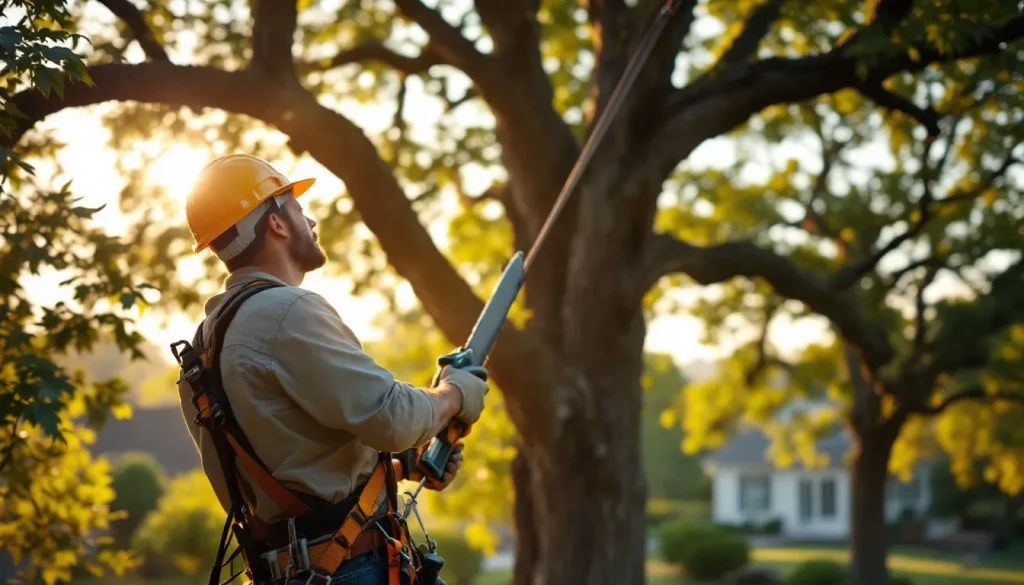
An arborist is a trained professional in arboriculture, the cultivation, management, and study of individual trees, shrubs, vines, and other woody plants. Arborists diagnose tree health, prune for structure and safety, assess risk, treat pests and disease, and remove hazardous trees. Unlike a general landscaper, an arborist focuses on the long-term biology and structural integrity of woody plants, not lawns or beds.
The word comes from the Latin arbor, meaning tree. In practice, the term covers a range of roles: a consulting arborist who writes reports, a climbing arborist who works in the canopy, and a municipal arborist who manages a city’s tree inventory.
Arborists work on the health of a tree across its full life, from planting and young-tree training to mature-tree maintenance and eventual removal. That whole-life view is the core distinction from crews that only cut and haul.
Arboriculture: the field behind the job
Arboriculture is the science and practice of caring for individual trees and woody plants. It draws on plant biology, soil science, structural mechanics, and pathology. An arborist applies arboriculture the way a doctor applies medicine: diagnosing problems, prescribing treatment, and performing procedures such as pruning, cabling, or removal.
The discipline is distinct from forestry, which manages forests as ecosystems and timber resources at scale. Arboriculture concentrates on the single tree, often in a yard, park, street, or commercial property where each tree has individual value and risk.
Modern arboriculture relies on published standards. In the United States, the ANSI A300 standards define proper pruning, cabling, and tree-care practice, and the ANSI Z133 safety standard governs how the work is performed. Reputable arborists follow both.
What services do arborists perform?
Arborists perform tree care across the full life of a tree: pruning, health diagnosis, pest and disease treatment, risk assessment, cabling and bracing, large-tree management, planting, and tree removal. Many also write consulting reports for property sales, construction permits, insurance claims, and legal disputes. The common thread is technical judgment about tree biology and structure.
| Service | What it involves | Typical reason to call |
|---|---|---|
| Structural pruning | Removing or shortening branches per ANSI A300 to improve form and reduce failure risk | Young-tree training, clearance, storm prep |
| Tree risk assessment | Evaluating likelihood of failure and consequences, often using the TRAQ method | Leaning trees, cracks, near structures |
| Pest and disease treatment | Diagnosis plus targeted treatment for issues like borers, scale, or fungal decay | Dieback, discoloration, pest sightings |
| Cabling and bracing | Installing hardware to support weak unions on large trees | Co-dominant stems, valuable mature trees |
| Tree removal | Controlled felling or sectional dismantling of dead or hazardous trees | Dead, dying, or unsafe trees |
| Consulting reports | Written appraisals, health assessments, construction-impact plans | Real estate, permits, disputes, insurance |
Large-tree management is where the difference shows most. Working safely in a 60-foot canopy near power lines and roofs takes rigging skill, climbing certification, and standards knowledge that go well beyond chainsaw operation. For an overview of when and how removals are handled, see our explainer on tree cutting and removal practices.
Arborist vs. tree service vs. landscaper
An arborist is a credentialed tree-care professional trained in arboriculture; a “tree service” is a business that may or may not employ certified arborists; a landscaper designs and maintains lawns, beds, and hardscapes. The safest hires carry ISA certification, proof of insurance, and follow ANSI standards. Uncertified “tree guys” may be cheaper but riskier.
| ISA Certified Arborist | General tree service | Landscaper | |
|---|---|---|---|
| Core focus | Tree health, structure, risk | Cutting and removal | Lawns, beds, hardscape |
| Required credential | ISA exam plus experience | None required | None required for trees |
| Follows ANSI A300/Z133 | Yes, expected | Sometimes | Rarely |
| Can diagnose disease | Yes | Limited | Limited |
| Best for | Health, safety, valuable trees | Straightforward removals | Yard upkeep, planting beds |
Red flags of an uncertified operator include no proof of liability and workers’ compensation insurance, door-to-door solicitation after storms, demands for full payment upfront, and a willingness to “top” your tree. Topping (cutting main branches back to stubs) violates ANSI A300 and ISA guidance because it causes decay and weak regrowth. A genuine arborist will refuse to top a healthy tree.
For context on how a large, standards-driven operator runs tree care at scale, see our profile of Davey Tree, the employee-owned tree and landscape company.
What does it mean to be an ISA Certified Arborist?
An ISA Certified Arborist has passed the International Society of Arboriculture exam and documented at least three years of full-time tree-care experience (or a degree in a related field plus less experience). The credential requires renewal every three years through 30 continuing education units (CEUs). It signals tested knowledge of tree biology, pruning, diagnosis, and safety.
ISA certification is not a government license; it is a voluntary professional credential issued by the International Society of Arboriculture. It is the most widely recognized standard in North American tree care and the one most commonly named on business listings and review sites.
There are several distinct ISA credentials, and they are not interchangeable. Knowing the difference helps you match the credential to the job.
| Credential | What it covers | When it matters |
|---|---|---|
| ISA Certified Arborist | Core tree biology, care, and safety; 3+ years experience plus exam | General tree-care and pruning work |
| TRAQ (Tree Risk Assessment Qualification) | Standardized method for assessing tree failure risk | Hazard trees, liability, near structures |
| Certified Arborist Municipal Specialist | Public tree management and policy | City, HOA, and right-of-way trees |
| Board Certified Master Arborist (BCMA) | Highest ISA level; broad expertise and exam | Complex consulting, appraisals, expert testimony |
A Board Certified Master Arborist is the top ISA tier and held by a small fraction of certified arborists. For a high-value tree, a construction project, or a legal dispute, a BCMA or a TRAQ-qualified arborist is often worth the higher fee.
How to find and verify a certified arborist near you
To find a certified arborist, search the International Society of Arboriculture’s free “Find an Arborist” directory at treesaregood.org by ZIP code, then verify any candidate’s certification number directly on the ISA site. Cross-check reviews on Google and Yelp, confirm current liability and workers’ compensation insurance, and ask for references on similar trees.
- Search the ISA directory at treesaregood.org or ask candidates for their certification number.
- Verify the number on the ISA “Verify a Credential” tool to confirm it is active and current.
- Request a certificate of insurance naming both liability and workers’ compensation coverage.
- Ask whether the work will follow ANSI A300 pruning standards and Z133 safety standards.
- Get two or three written estimates that describe scope, not just a lump sum.
- Check that the estimate does not include topping a healthy tree, which is a credibility red flag.
Local framing matters because tree species, pests, and permit rules vary by region. In dense markets such as Los Angeles, you will find many listings competing on “best arborist near me,” so credential verification is the fastest way to filter quality. To recognize what you are looking at in your own yard, our guide to common tree types is a useful starting point.
How much does an arborist cost?
In the United States, a consulting arborist often charges roughly $50 to $200 per hour, and a written tree-health or risk assessment commonly runs about $150 to $500 depending on scope. Hands-on work is usually priced per job: routine pruning frequently falls around $300 to $700 per tree, while removal of a large tree can range from about $1,000 to $3,000 or more. These are general ranges and vary by region, tree size, and access.
| Service | Typical US range (2026) | What drives the price |
|---|---|---|
| Consultation / hourly rate | $50 to $200 per hour | Credential level, region, BCMA premium |
| Written assessment / report | $150 to $500 | Report depth, number of trees, legal use |
| Routine pruning (per tree) | $300 to $700 | Tree height, access, debris removal |
| Large tree removal | $1,000 to $3,000+ | Height, proximity to structures, rigging |
| Emergency / storm work | Premium pricing | After-hours, hazard, equipment needs |
Prices can run higher in high-cost metros and for trees near power lines or buildings, where rigging and traffic control add labor. Treat any quote far below these ranges with caution; it can signal a lack of insurance, which leaves you exposed if a worker is injured on your property. Figures here are illustrative ranges and can vary by market and individual provider.
How do you become an arborist?
To become an arborist, most people start with an entry-level tree-care or groundworker job, learn climbing and equipment under experienced crews, and accumulate the three years of experience needed to sit the ISA Certified Arborist exam. A two- or four-year degree in arboriculture, urban forestry, or horticulture can shorten the experience requirement. Ongoing CEUs keep the credential active.
- Take an entry-level role: groundworker, tree climber trainee, or crew member.
- Build skills in climbing, rigging, chainsaw safety, and tree identification.
- Accumulate about three years of full-time tree-care experience.
- Study tree biology, pruning, diagnosis, and safety, then pass the ISA Certified Arborist exam.
- Maintain certification with 30 CEUs every three years.
- Specialize over time with TRAQ, municipal, or Board Certified Master Arborist credentials.
Career listings on sites like Indeed show common titles including tree climber, climbing arborist, crew leader, and operations manager. The path can move from field climbing into supervision, consulting, or running a business. To keep current on green-industry hiring and standards, our industry news hub tracks the sector.
What is the average arborist salary?
In the United States, arborist pay commonly falls in the range of about $40,000 to $65,000 per year for working arborists, with entry-level climbers often starting lower and experienced or specialized arborists earning more. Consulting arborists, Board Certified Master Arborists, and business owners can earn well above that range. Pay varies by region, certification, and whether the role is field, supervisory, or consulting.
Hourly field work in many markets sits roughly in the high teens to high twenties per hour for less experienced workers, rising with certification and responsibility. Specialized risk assessment and expert-witness consulting command the highest rates. These figures are general estimates and shift with local labor markets and demand after major storms.
When should you hire an arborist instead of doing tree work yourself?
Hire an arborist whenever tree work involves height, power lines, large limbs, signs of disease or decay, or a tree near a structure. DIY is reasonable only for small, ground-level pruning of young trees with hand tools. Anything requiring a ladder, chainsaw at height, or climbing carries serious injury and liability risk and belongs with a certified, insured professional.
Call an arborist promptly for leaning trees, large dead branches, cracks in the trunk, root or soil heaving, fungal growth at the base, or sudden canopy dieback. These can signal failure risk that a trained eye assesses far better than guesswork.
The financial logic favors professionals for anything significant: a single dropped limb on a roof or vehicle, or an uninsured injury on your property, can cost far more than the assessment fee. For deeper how-to material across tree and lawn care, browse the HMNDP learn library.
Frequently Asked Questions
What is an arborist and what do they do?
An arborist is a professional trained in arboriculture, the care of individual trees and woody plants. They diagnose tree health, prune for structure and safety, assess failure risk, treat pests and disease, install support cables, and remove hazardous trees. Many also write consulting reports for sales, permits, and disputes. Their focus is the long-term biology and structural integrity of each tree.
What is the difference between an arborist and a tree service or landscaper?
An arborist is a credentialed tree-care specialist trained in arboriculture and ANSI standards. A “tree service” is a business that cuts and removes trees but may not employ certified staff. A landscaper handles lawns, beds, and hardscapes, not tree biology. For health diagnosis, risk, or valuable trees, hire an ISA Certified Arborist; for simple removals, a reputable insured tree service may suffice.
What does it mean to be an ISA Certified Arborist?
An ISA Certified Arborist has passed the International Society of Arboriculture exam and documented at least three years of full-time tree-care experience. The credential requires 30 continuing education units every three years to stay active. It is a voluntary professional certification, not a government license, and is the most recognized tree-care credential in North America for verifying competence in biology, pruning, and safety.
How do I find and verify a certified arborist near me?
Search the International Society of Arboriculture’s free directory at treesaregood.org by ZIP code, or ask candidates for their certification number. Verify that number on the ISA credential-check tool to confirm it is active. Then request a certificate of insurance covering liability and workers’ compensation, check Google and Yelp reviews, and confirm the work follows ANSI A300 and Z133 standards.
How much does an arborist cost?
In the United States, consulting arborists often charge about $50 to $200 per hour, and a written assessment commonly runs $150 to $500. Routine pruning frequently costs around $300 to $700 per tree, while large tree removal ranges from roughly $1,000 to $3,000 or more. Prices vary by region, tree size, and access, and run higher near power lines or structures. These are general illustrative ranges.
How do you become an arborist?
Most arborists start in entry-level tree-care or groundworker roles, learn climbing and equipment, and build about three years of experience to qualify for the ISA Certified Arborist exam. A degree in arboriculture, urban forestry, or horticulture can reduce the experience needed. Certification then requires 30 continuing education units every three years, and arborists can specialize later with TRAQ or Master Arborist credentials.
What is the average arborist salary?
In the United States, working arborists commonly earn about $40,000 to $65,000 per year, with entry-level climbers starting lower and experienced or specialized arborists earning more. Consulting arborists, Board Certified Master Arborists, and business owners can earn well above that range. Pay depends on region, certification level, and whether the role is field, supervisory, or consulting. These figures are general estimates.
When should you hire an arborist instead of doing tree work yourself?
Hire an arborist whenever work involves height, power lines, large limbs, disease or decay signs, or a tree near a structure. DIY is reasonable only for small, ground-level pruning of young trees with hand tools. Climbing or running a chainsaw at height carries serious injury and liability risk. Call promptly for leaning trees, trunk cracks, root heaving, or sudden canopy dieback.