
Bifenthrin Insecticide: Uses, Safety, and Application
Bifenthrin insecticide is a synthetic pyrethroid that kills more than 75 insect species on contact and by ingestion, and it stays active for weeks to months because it binds tightly to soil and surfaces. The EPA first registered it in 1985, and there are now over 600 bifenthrin products sold in the United States, from lawn granules to professional liquid concentrates. It controls ants, ticks, fleas, mosquitoes, grubs, caterpillars, and many turf and ornamental pests, but it is very highly toxic to bees and fish, so where and when you spray it matters as much as how much.
What is bifenthrin and how does it work?
Bifenthrin is a Type I non-cyano pyrethroid, a manmade version of the natural insect-killing compounds (pyrethrins) found in chrysanthemum flowers. It is an IRAC Group 3 insecticide, meaning it is a sodium channel modulator. According to the National Pesticide Information Center (NPIC), it interferes with the nervous system of insects when they eat or touch it, keeping sodium channels open and causing nerve hyperexcitation, paralysis, and death.
It works by both contact and ingestion, so an insect does not have to feed on a treated surface to be affected. NPIC notes bifenthrin is more toxic to insects than to people, partly because insects have lower body temperatures and smaller body size. It is a residual product, which means a single application keeps killing for days to weeks after the spray dries.
What does bifenthrin kill?
Bifenthrin is a broad-spectrum insecticide labeled for indoor, outdoor, and landscape use, including lawns, shrubs, and ornamental plants. NPIC reports it is applied to more than 14 million acres nationwide to protect food crops, and product labels list control of ants (including fire ants and carpenter ants), ticks, fleas, mosquitoes, and a wide range of turf and garden pests. It is a common choice for long-lasting outdoor perimeter and yard treatments.
On lawns, applicators reach for it against surface-feeding and foliage-feeding pests such as chinch bugs, sod webworms, armyworms, billbugs, and caterpillars like bagworms on arborvitae. It has weaker performance on deep subsurface white grubs, where a systemic such as imidacloprid is the usual pick. The table below maps common lawn and yard targets to the right active ingredient.
| Pest problem | Best-fit active | Why |
|---|---|---|
| Surface insects (chinch bugs, sod webworms, armyworms, fleas, ticks) | Bifenthrin | Strong contact kill plus long surface residual |
| Perimeter and ant control around the home | Bifenthrin | Binds to masonry and soil, very stable in sunlight |
| Subsurface white grubs | Imidacloprid | Systemic, moves into roots where grubs feed |
| Fast knockdown of wasps and hornets | Permethrin | Quicker knockdown, lower cost, shorter residual |
How long does bifenthrin last?
Bifenthrin lasts longer than most lawn insecticides because it resists breakdown by sunlight and binds to soil instead of washing away. As a general rule, outdoor treatments hold for roughly 4 to 8 weeks before reapplication, and indoor treatments can last up to 12 weeks. Many product labels and lawn-care suppliers cite outdoor residual of up to 90 days for granular formulations.
The persistence shows up in lab data. NPIC’s technical fact sheet reports an aerobic soil half-life of 97 to 250 days depending on soil type, with field dissipation studies ranging from 122 to 345 days, and aqueous photolysis half-lives of 276 to 416 days. It is immobile in soils high in silt, clay, and organic matter and has only low mobility in sandy soil. That stability is why it controls pests for months, and also why it persists in the environment.
Is bifenthrin safe for people, pets, and bees?
Bifenthrin is considered low-risk to people and pets once it has dried on the treated surface, but it is very highly toxic to bees and to fish, and cats are unusually sensitive to it. The label signal word ranges from Caution to Danger depending on concentration, and the most concentrated products are Restricted Use Pesticides sold only to certified applicators. Read your specific label, because toxicity and re-entry rules vary by formulation.
In people, skin contact can cause tingling, itching, burning, or numbness at the contact site that usually fades within 48 hours, per NPIC. The EPA classifies bifenthrin as a Group C possible human carcinogen, a rating based on tumors in mice. For pets, exposure may cause single-episode vomiting or diarrhea, reduced activity, ear twitching, paw flicking, and drooling. Cats metabolize pyrethroids poorly, so the Pet Poison Helpline flags them as especially vulnerable.
| Exposure concern | Toxicity level | Source detail |
|---|---|---|
| Honey bees | Very highly toxic | Contact LD50 about 0.01462 micrograms per bee (NPIC technical) |
| Fish and aquatic life | Very highly toxic | Rainbow trout LC50 about 0.10 ppb; bluegill about 0.18 ppb |
| Cats | Sensitive | Poor pyrethroid metabolism (Pet Poison Helpline) |
| Dogs and people | Low risk once dry | Rat oral LD50 about 53 to 210 mg/kg (NPIC technical) |
| Birds | Low toxicity | NPIC general fact sheet |
To reduce exposure, keep people and pets off the treated area until it is fully dry. Many product Q&A pages and suppliers advise about 30 minutes to 1 hour of dry time indoors and 4 to 6 hours outdoors, and the EPA suggests applying when no rain is expected for 24 hours. Never spray near ponds, streams, storm drains, or flowering plants where bees are foraging. If a pet shows tremors, vomiting, or breathing trouble, call a veterinarian or the Pet Poison Helpline. For broader product context, see our guide to lawn care products every pro keeps on the truck.
Liquid vs granular bifenthrin: which should you use?
Liquid bifenthrin gives faster knockdown and more even surface coverage, while granules carry the active down into the soil and tend to last longer. Liquid concentrates also cover far more square footage per dollar, which is why many lawn operators have shifted toward liquid for foliage and surface pests and reserve granules for soil-dwelling targets. Match the form to where the pest lives.
| Factor | Liquid (SC or EC) | Granular |
|---|---|---|
| Knockdown speed | Faster | Slower |
| Surface coverage | Even, strong on foliage and hardscape | Limited surface contact |
| Outdoor residual | About 30 days | About 2 to 4 months |
| Cost per 1,000 sq ft | Lower | Higher |
| Best for | Surface and foliage pests, perimeter | Soil-dwelling pests, watered-in control |
How do you apply bifenthrin on a lawn?
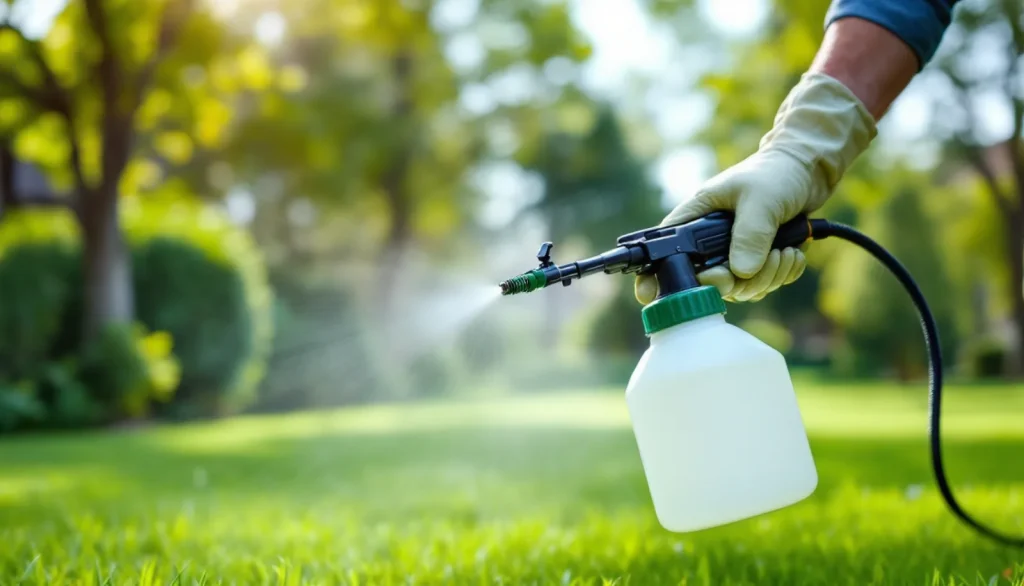
Apply liquid bifenthrin with a calibrated pump or battery sprayer for even coverage, mixing the concentrate with water at the label rate per 1,000 square feet. Typical lawn dilution runs about 0.18 to 0.25 fluid ounces per gallon per 1,000 square feet for most pests, up to roughly 1 fluid ounce for heavier pressure, but always follow your exact product label, which is the legal application rule. Knowing your turf area first prevents over-application.
- Measure the treatment area. Our guide on how to measure lawn square footage shows how to get an accurate number.
- Read the label and confirm the rate, target pests, and any re-entry interval for your formulation.
- Mix the concentrate in a pump or battery sprayer (avoid hose-end sprayers, which apply unevenly).
- Wear long sleeves, gloves, and eye protection, and treat when bees are not active and rain is not expected for 24 hours.
- Apply uniformly across the measured area; for granules, water in lightly per the label so the active reaches the soil.
- Keep people and pets off until dry, then store the concentrate in its original labeled container.
Is bifenthrin restricted or banned anywhere?
In the United States, the most concentrated bifenthrin products are classified as Restricted Use Pesticides and sold only to certified applicators, while lower-concentration consumer products remain available to the general public. The European Union, by contrast, banned bifenthrin for agricultural use in July 2019, keeping a narrow approval for treated wood preservation. Rules differ by country and by state, so applicator licensing requirements vary.
Many states require a license for commercial turf and ornamental pesticide work, often under a category like Turf and Ornamental (3A in many states). Our explainer on the pesticide applicator license category 3A covers the cross-state framework. Because bifenthrin is an IRAC Group 3 active, rotating it with a different mode of action between treatments reduces the risk of insects developing resistance.
The bottom line on bifenthrin
Bifenthrin is one of the most-used residual insecticides in the United States for good reason: it kills a broad range of surface and yard pests on contact and keeps working for weeks to months. The trade-off is real environmental toxicity to bees and fish and the need to keep cats and other pets clear until it dries. Used at the label rate, away from water and pollinators, and rotated with another mode of action, it is an effective tool in a wider pest and lawn program. See our lawn care treatment guide for how insect control fits the full season.
Last reviewed: June 2026
HMNDP Editorial Team, reviewed by HMNDP turf and horticulture editors.
Frequently asked questions
What does bifenthrin kill?
Bifenthrin is a broad-spectrum insecticide labeled for ants (including fire and carpenter ants), ticks, fleas, mosquitoes, and many turf pests like chinch bugs, sod webworms, armyworms, and caterpillars. NPIC reports it is applied to more than 14 million acres of food crops nationwide. It is weaker on deep white grubs, where imidacloprid is the usual pick.
Is bifenthrin safe for pets?
Bifenthrin is low-risk for dogs once it dries, but cats are unusually sensitive because they metabolize pyrethroids poorly. Keep pets off treated areas until dry, roughly 30 minutes to 1 hour indoors and 4 to 6 hours outdoors. Exposed pets may vomit, drool, twitch, or flick paws. Call a veterinarian or the Pet Poison Helpline if symptoms appear.
How long does bifenthrin last?
Outdoor bifenthrin treatments generally hold for 4 to 8 weeks, and indoor treatments up to 12 weeks, with granular products often cited at up to 90 days. NPIC’s technical fact sheet reports an aerobic soil half-life of 97 to 250 days. It resists sunlight breakdown and binds tightly to soil, which is why it controls pests for so long.
Is bifenthrin toxic to bees?
Yes. NPIC classifies bifenthrin as very highly toxic to bees, with a contact LD50 near 0.01462 micrograms per bee. Never apply it to flowering plants where bees are foraging, and treat when pollinators are not active, such as early morning or evening. It is also very highly toxic to fish, so keep it away from ponds, streams, and storm drains.
Is bifenthrin a restricted use pesticide?
The most concentrated bifenthrin products are classified by the EPA as Restricted Use Pesticides, sold only to certified applicators, while lower-concentration consumer products stay available to the general public. The label signal word ranges from Caution to Danger depending on concentration. The European Union banned bifenthrin for agricultural use in July 2019.
How do you apply bifenthrin on a lawn?
Mix liquid bifenthrin in a calibrated pump or battery sprayer at the label rate, often about 0.18 to 0.25 fluid ounces per gallon per 1,000 square feet for most pests. Measure the area first, wear gloves and eye protection, avoid hose-end sprayers, and apply when no rain is expected for 24 hours. Always follow the exact product label, which is the legal rule.
What is the difference between liquid and granular bifenthrin?
Liquid bifenthrin gives faster knockdown, even surface coverage, and more square footage per dollar, lasting about 30 days outdoors. Granular bifenthrin carries the active into the soil and lasts longer, about 2 to 4 months, making it better for soil-dwelling pests you water in. Use liquid for surface and foliage pests and perimeter treatments.
Is bifenthrin a carcinogen?
The EPA classifies bifenthrin as a Group C possible human carcinogen, a rating based on tumors observed in mice studies. NPIC notes the animal evidence does not provide persuasive proof of a compound-related effect in humans. To limit exposure, follow the label, wear protective clothing, and keep people off treated areas until the spray has dried.