
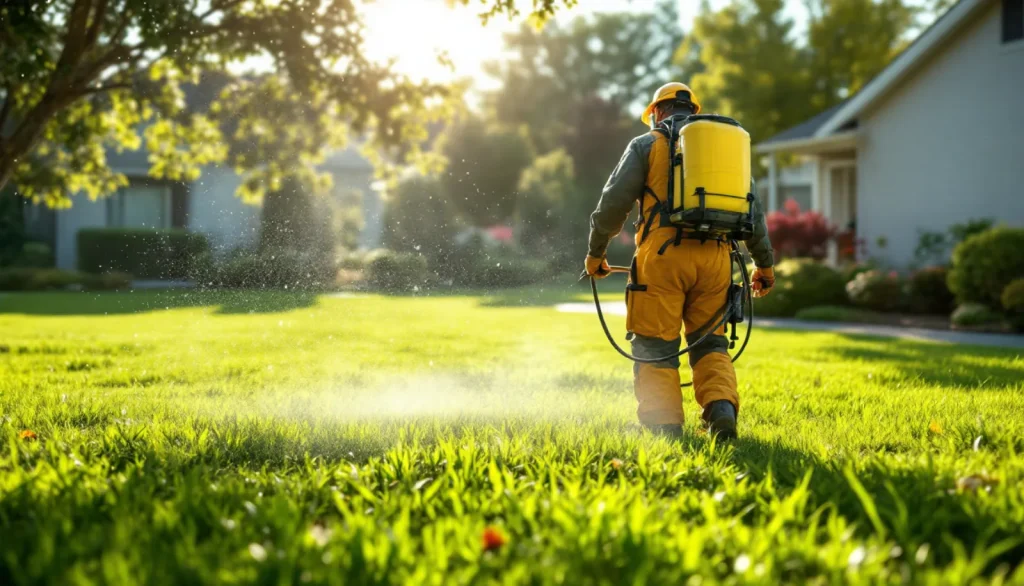
A pesticide applicator license category 3A is the credential every commercial chemical applicator working on turf and ornamentals in the United States needs. All 50 states administer some version of Category 3A (Ornamental and Turf Pest Control) under FIFRA Section 11 authority and EPA’s Certification of Pesticide Applicators (CPA) rule. The exam content, fees, renewal cycles, and CEU requirements vary state by state, but the core competencies are consistent. Here is what the license covers, what the exam tests, and how the rules differ across the major lawn-care markets.
The short version
- Category 3A covers commercial pesticide application to turf and ornamentals (lawns, trees, shrubs, perennial beds, athletic fields, golf courses).
- All 50 states require a 3A or state-equivalent license for commercial chemical application; homeowner DIY use is exempt.
- Exam content covers pest ID, label compliance, mixing and loading, calibration, PPE, and environmental safety.
- CEU requirements typically run 3 to 5 hours per renewal cycle (cycles range from 1 to 5 years by state).
- Exam fees run $50 to $150, license fees $75 to $300 annually.
- Reciprocity exists between most states but is not automatic; verify before working across state lines.
What the license covers
Category 3A (in some states 3, 3OT, or 3O depending on local nomenclature) authorizes commercial application of EPA-registered pesticides to ornamental plants and turfgrass. The legal definition typically includes lawns, landscape beds, trees, shrubs, perennials, athletic fields, golf course turf and ornamentals, cemeteries, parks, and similar sites. It does not cover agricultural crops (Category 1A), structural pest control (Category 7), right-of-way (Category 6), aquatic (Category 5), or seed treatment (Category 4) work, each of which has its own credential.
The “commercial” piece is critical. The federal CPA rule and the corresponding state laws apply Category 3A licensing to anyone applying restricted-use pesticides (RUPs) for compensation, plus anyone applying any pesticide commercially in most states (a more expansive trigger than the federal floor). A homeowner spraying their own yard with a consumer-grade product from a big-box store does not need a 3A license. A landscape contractor applying the same product to a client’s yard for fee does.
Most states bundle Category 3A with a higher-level commercial applicator credential that covers business licensure (the company-level license), a designated qualified supervisor (the named individual who holds the technical credential), and registered technician roles (employees working under direct supervision of the supervisor). Florida, Texas, California, New York, and Illinois all run multi-tier structures of this kind.
Exam content and structure
Category 3A exams typically have two parts: a Core exam covering general pesticide safety, label law, and environmental considerations (the same Core all categories share within a state), and a Category 3A-specific exam covering turf and ornamental pest biology, identification, and management.
Core exam content (40 to 100 questions, depending on state) covers FIFRA basics, EPA labeling requirements, pesticide chemistry and modes of action, formulations and adjuvants, application equipment and calibration, mixing and loading safety, personal protective equipment (PPE), worker protection standard (WPS) compliance, environmental hazards (drift, runoff, groundwater contamination, pollinator protection), endangered species protection, spill response, transportation requirements (DOT placarding for restricted-use), storage and disposal, and recordkeeping. Most state Core exams require a passing score of 70 percent.
Category 3A-specific exam content (40 to 80 questions) covers turfgrass species identification (cool-season vs warm-season), common turf diseases (brown patch, dollar spot, large patch, gray leaf spot, snow mold), turf insects (white grubs, billbugs, chinch bugs, sod webworms, fire ants), turf weeds (annual bluegrass, dandelion, crabgrass, sedges), ornamental pests (scale, mites, aphids, lace bugs, borers, fungal diseases), herbicide modes of action (preemergence vs postemergence, selective vs nonselective), turf fertility basics, calibration math (gallons per 1,000 sq ft, pounds active per acre), and integrated pest management (IPM) principles. See our herbicide guide, turf disease coverage, and professional applicator playbook for trade-side reference material.
Calibration math is where most candidates lose points. Typical exam questions ask things like: a sprayer is calibrated to deliver 1.0 gallon per 1,000 sq ft and the label calls for 1.5 fluid ounces per 1,000 sq ft, how many ounces of product do you put in a 100-gallon tank? (Answer: 150 fl oz, or about 1.17 gallons.) Practice problems from your state extension service are the best preparation.
How the rules differ by state
Florida runs a particularly structured Category 3 (“Ornamental and Turf”) under the Florida Department of Agriculture and Consumer Services (FDACS). Exam includes Core plus Category 3, $150 exam fee, four-year renewal cycle, 4 CEUs required per cycle (2 Core, 2 in-category). Florida also has a separate Limited Lawn and Ornamental (LLO) tier for smaller operators that requires fewer CEUs but covers a narrower product list.
Texas administers Category 3A under the Texas Department of Agriculture (TDA). Exam is Core (50 questions) plus Category 3A (40 questions), $75 exam fee, $150 annual license fee, annual renewal, 15 CEUs required over a five-year cycle (5 General, 10 in-category). Texas reciprocates with most contiguous states.
California runs Qualified Applicator License (QAL) and Qualified Applicator Certificate (QAC) under the Department of Pesticide Regulation (DPR). Category B is the closest analog to 3A (Landscape Maintenance Pest Control). Exam includes Laws and Regulations plus Category B, $150 to $250 exam fees, two-year renewal cycle, 20 hours of continuing education required per cycle (4 laws and regs, 16 other). California is notably stricter than most states on documentation and CEU verification.
New York DEC administers Category 3A under Article 33 of Environmental Conservation Law. Exam is Core plus Category 3A, $100 exam fee, three-year renewal, 12 CEUs per cycle. New York’s recent neonicotinoid ban has driven heavy uptake of replacement-chemistry CEU courses.
Illinois IDA administers a similar structure, $75 exam, three-year cycle, 12 CEUs. Ohio ODA runs Category 8 (Turf) and 9 (Ornamental Plant and Shade Tree) separately, with a combined commercial pesticide license trigger. Pennsylvania DEP runs Category 7 (Ornamental and Shade Tree) and 18 (Turf and Ornamental) under the Pesticide Control Act.
What applicators should do
For first-time applicants, the process is consistent: identify your state’s regulatory agency (department of agriculture in most states, department of environmental conservation or department of pesticide regulation in others), order the study materials (every state publishes a Core manual and a Category 3A manual through the cooperative extension service), schedule the exam, pass with 70 percent or better in both Core and Category, pay the license fee, and start practicing.
For renewals, track CEU credits carefully. Every state requires CEUs at specific intervals, and missed deadlines can require retaking the exam. The cheapest CEU paths are usually trade-association webinars (NALP, NYSTA, FNGLA, Texas Turf Association, etc.) and state extension service field days. Most cost $20 to $75 per credit.
For multi-state operators, get reciprocity sorted before opening a new market. Most states reciprocate Core exams but not category-specific exams, which means you usually have to retake the 3A exam in any new state. Document your existing licenses and reach out to the target state’s regulatory agency early.
By the numbers
| State | License fee (annual) | Renewal cycle | CEUs required |
|---|---|---|---|
| Florida (Cat 3) | $150 | 4 years | 4 (2 Core + 2 in-cat) |
| Texas (Cat 3A) | $150 | Annual (5-year CEU cycle) | 15 over 5 years |
| California (QAL Cat B) | $160 | 2 years | 20 hours |
| New York (Cat 3A) | $100 | 3 years | 12 |
| Illinois (Turf and Ornamental) | $75 | 3 years | 12 |
| Ohio (Cat 8 and 9) | $70 | 3 years | 5 per category |
| Pennsylvania (Cat 18) | $50 | 3 years | 10 |
| Georgia (Cat 24) | $90 | 5 years | 5 |
Background and context
Federal authority for pesticide applicator certification comes from FIFRA Section 11 and the EPA’s Certification of Pesticide Applicators (CPA) rule, which was substantially updated in 2017 (effective 2024 for most categories) to require stricter training, lower the minimum age, tighten supervision requirements, and harmonize the Core competency list across states. The CPA rule sets the floor; states implement and can go stricter. EPA Region offices oversee state plan approval and reciprocity verification.
The structure dates back to the original 1972 FIFRA amendments that created the certified applicator system. Before then, RUP application was essentially unregulated. The category system (1A agricultural, 2 forest, 3 ornamental and turf, 4 seed, 5 aquatic, 6 right-of-way, 7 structural, and so on) was finalized in the 1970s and has held steady ever since, with minor renumbering by state.
Industry employment in licensed Category 3A applicators is significant: NALP estimates roughly 280,000 certified turf and ornamental applicators work in the US lawn and landscape trade, plus another 90,000 in golf course management. That credential base is the bottleneck for new-applicator hiring at TruGreen, BrightView, Davey, and the entire mid-market lawn-care segment. See our TruGreen coverage and BrightView acquisitions coverage for the operator-side picture.
FAQ
Do I need a 3A license to apply organic products?
If the product is registered as a pesticide (which most organic herbicides, insecticides, and fungicides are under FIFRA), and you are applying it commercially, yes. The “organic” label does not exempt the product from FIFRA. Exempt minimum-risk products under 25(b) are the main exception.
How long does it take to get licensed?
Typical timeline is 2 to 6 months from start to license in hand. Study time runs 40 to 80 hours for someone new to the trade. Exam scheduling is the bottleneck in some states (Florida and California can run 4 to 8 weeks out).
What happens if my license lapses?
Most states allow a 30 to 90 day grace period after expiration with a late fee. Beyond that, you typically have to retake the exams. Continue to practice unlicensed and you face civil penalties of $1,000 to $5,000 per violation in most states.
Can a technician apply pesticides under my supervision without their own license?
In most states, yes, under specific “registered technician” or “commercial applicator trainee” rules. The technician must be registered with the state agency, must work under direct supervision of a licensed applicator, and typically must complete annual training. Rules vary; New York and California are stricter than most.
Bottom line
The Category 3A license is non-negotiable infrastructure for any commercial turf and ornamental applicator in the US. The exam is fair, the study materials are public, and the CEU requirements are manageable for any working professional. The states with the strictest rules (California, New York, Florida) are also the largest lawn-care markets, so getting the credential right pays back quickly. See our regulatory pillar for the full pesticide compliance picture, the New York neonicotinoid ban for one of the biggest 2026 chemistry shifts, and the professional lawn fertilizer guide for the operational playbook on running a label-compliant turf program.