
People ask how old are trees when they want a number for the specific tree in their own yard, not a record-holder in California. You can get a close estimate of a standing tree’s age without cutting it or hiring anyone, using one measurement and a species growth factor. This guide gives you the complete, sourced growth-factor table from the International Society of Arboriculture method, three worked examples, and a plain breakdown of every aging method so you know which one fits your situation and how far to trust the result.
The short version
- Estimate a living tree’s age with one formula: diameter at breast height (DBH, in inches) multiplied by a species growth factor equals approximate age in years. This is the International Society of Arboriculture (ISA) method.
- Measure circumference at 4.5 feet above ground, divide by 3.14 (pi) to get diameter, then multiply by the growth factor for your species from the table below.
- White oak growth factor is 5, red oak is 4, red maple is 4.5, silver maple is 3, American elm is 4. Most species fall between 2 and 8.
- Counting rings on a stump or core is the most accurate method (one ring per year in temperate species), but it requires a cut or an increment borer core.
- The growth-factor estimate is an approximation. Soil, water, climate, and competition shift real growth rates, so treat the number as a range, not a birthday.
How old are trees, and how do you estimate the age of one in your yard?
For a standing tree you do not want to cut, the practical answer comes from the ISA growth-factor formula: measure the trunk diameter at breast height in inches, then multiply by a number tied to the species. The result is the estimated age in years. A 14-inch white oak (growth factor 5) lands near 70 years. The method trades precision for the fact that the tree keeps living, which is the trade most homeowners want.
Step-by-step: the non-destructive growth-factor method
This is the only accurate way to estimate age without wounding the tree. It needs a tape measure, the tree’s species, and a calculator. According to the International Society of Arboriculture, the steps run as follows, and the estimate works best on forest-grown rather than heavily pruned urban trees.
- Wrap a tape measure around the trunk at 4.5 feet above the ground (breast height). Record the circumference in inches.
- Divide the circumference by pi (3.14) to get the diameter at breast height. Example: a 41-inch circumference divided by 3.14 equals about 13 inches of diameter.
- Identify the tree species. The growth factor changes with species, so this step controls accuracy.
- Find the species growth factor in the table below.
- Multiply diameter (inches) by the growth factor. That product is the estimated age in years.
The species growth factor table (verified)
This is the complete growth-factor table tied to the ISA method, with the same values published by university and municipal tree programs including Purdue University and the Forest Preserve District of Will County. Multiply a species factor by the tree’s diameter at breast height in inches to estimate age. A smaller factor means a faster-growing species; a larger factor means slower growth and an older tree at the same size.
| Species | Growth factor | Species | Growth factor |
|---|---|---|---|
| Cottonwood | 2 | Norway spruce | 5 |
| Quaking aspen | 2 | Black cherry | 5 |
| Black willow | 2 | White ash | 5 |
| Basswood | 3 | White oak | 5 |
| Box elder | 3 | White pine | 5 |
| Silver maple | 3 | White birch | 5 |
| Pin oak | 3 | Black maple | 5 |
| Honeylocust | 3 | Douglas fir | 5 |
| Tulip tree | 3 | Red pine (Norway pine) | 5.5 |
| Littleleaf linden | 3 | Sugar maple | 5.5 |
| River birch | 3.5 | American beech | 6 |
| Scotch pine | 3.5 | Shingle oak | 6 |
| American elm | 4 | Dogwood | 7 |
| American sycamore | 4 | Redbud | 7 |
| Green ash | 4 | Ironwood | 7 |
| Northern red oak | 4 | Shagbark hickory | 7.5 |
| Scarlet oak | 4 | White fir | 7.5 |
| Sweetgum | 4 | Common horsechestnut | 8 |
| European beech | 4 | Black walnut | 4.5 |
| Red maple | 4.5 | Austrian pine | 4.5 |
| Norway maple | 4.5 | Colorado blue spruce | 4.5 |
Source: International Society of Arboriculture growth-factor method, as republished by Purdue University and the Forest Preserve District of Will County. The ISA notes that growth rates respond strongly to water availability, climate, soil, root stress, and competition for light, so use the result as an estimate.
Worked examples you can copy
Three real calculations show how the same trunk size produces very different ages depending on species. Each starts from a measured circumference, converts to diameter, then applies the species factor. Run the same three steps on your own tree and you will land inside the right range.
- White oak, 40-inch circumference. 40 divided by 3.14 equals about 12.7 inches diameter. 12.7 times growth factor 5 equals about 64 years old.
- Red maple, 30-inch circumference. 30 divided by 3.14 equals about 9.6 inches diameter. 9.6 times growth factor 4.5 equals about 43 years old.
- Silver maple, 50-inch circumference. 50 divided by 3.14 equals about 15.9 inches diameter. 15.9 times growth factor 3 equals about 48 years old.
Notice the silver maple is physically larger than the white oak yet younger, because silver maple grows faster. That species gap is the whole reason you cannot eyeball tree age from trunk size alone.
Every method to determine a tree’s age, ranked by accuracy
Four methods cover almost every case. Ring counting is the most accurate but needs a cut or a core. The growth-factor formula is the best non-destructive estimate. Known planting records beat both when they exist. The right choice depends on whether the tree is standing, already cut, or documented.
1. Counting growth rings (most accurate)
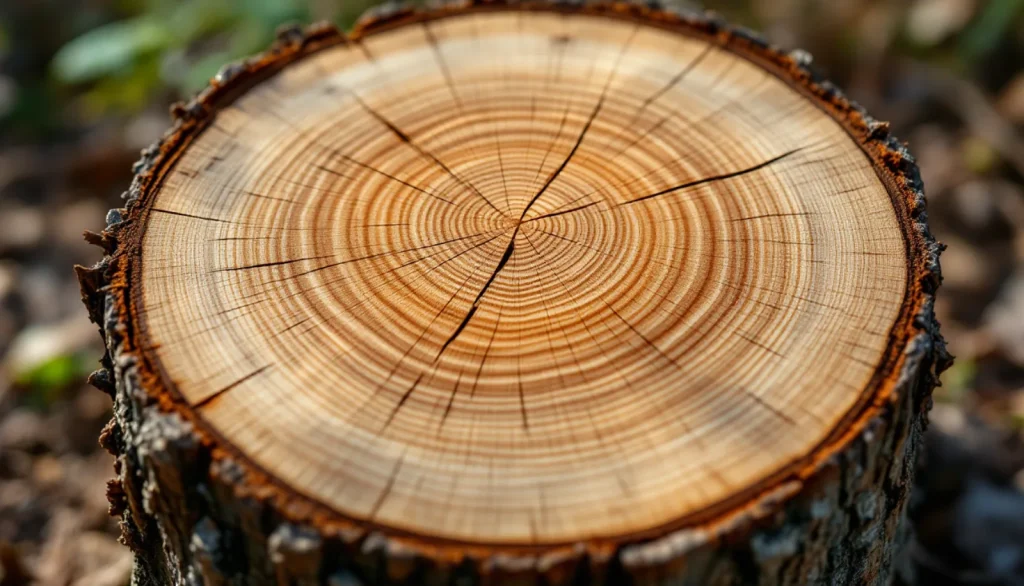
In temperate and boreal species, a tree adds one ring per year: light, fast spring earlywood followed by darker, denser summer latewood. Count rings from the center outward on a stump and each ring equals roughly one year. Per NIST, this is the most reliable method, though a single tree can occasionally add or skip a ring, so a count from one trunk can read slightly off.
2. Increment borer coring (accurate, non-lethal)
When a tree is standing and you need real precision, dendrochronologists use an increment borer: a T-shaped hollow drill that extracts a pencil-thin core about 5 millimeters wide, ideally crossing every ring. NIST describes the wound as minimal, and the tree heals over it. Counting rings on the core gives a near-exact age without felling the tree. This is the professional standard for living-tree dating.
3. The growth-factor formula (best no-tools-needed estimate)
The diameter-times-growth-factor method above needs only a tape measure and the species. It is the right call for a homeowner who wants a number today and will not cut or drill the tree. Accuracy is low to moderate and slips as trees age, because young trees grow fast and mature trees slow down, so a single average factor cannot track that curve perfectly.
4. Known planting and historical records
If the tree was planted on a documented date, an old photo, a nursery receipt, a subdivision build year, or a city tree-planting record beats every estimate. Cross-dating, the technique where dendrochronologists compare core patterns across many trees in one area, is how science pins exact years; for a backyard tree, a dated photo is your version of that.
How accurate is a tree age estimate?
Ring and core counts are accurate to within a year or two for most temperate species. The growth-factor formula is an approximation that can swing wide, because soil, water, climate, and competition all bend real growth rates, and the same species grows differently in a forest versus an open lawn. Treat the calculator number as a range of roughly plus or minus 20 percent, not a fixed age.
How old can trees actually get?
Far older than most people guess. The oldest verified living tree is Methuselah, a Great Basin bristlecone pine in California’s White Mountains, dated to about 4,850 years by ring counting; the USDA confirms it as likely the oldest known living organism. The oldest measured tree overall was Prometheus, a bristlecone pine cut in 1964 that showed 4,862 rings, per NIST. Backyard hardwoods rarely pass 200 to 300 years.
Related HMNDP guides
Aging a tree is one piece of caring for it. If you are measuring trunk diameter, you are already comfortable with a tape measure, so these tools and guides pair naturally with the work above.
- Plant fertilizer outdoor guide: NPK for perennials, trees, and shrubs
- How to measure lawn square footage accurately
- Yard design in 2026: layout, plant selection, hardscape
- How to find a reputable landscaper
- Learn: lawn care, fertilizer, and landscape basics
Sources and references
- International Society of Arboriculture growth-factor method (DBH times growth factor): https://www.isa-arbor.com
- Purdue University tree growth factor reference, via Forest Preserve District of Will County: https://www.reconnectwithnature.org/news-events/the-buzz/how-to-tell-how-old-a-tree-is-without-cutting-it-down
- NIST, How Do You Measure the Age of a Tree (rings, increment borer, cross-dating, Prometheus): https://www.nist.gov/how-do-you-measure-it/how-do-you-measure-age-tree
- USDA, Methuselah bristlecone pine, oldest living organism: https://www.usda.gov/about-usda/news/blog/methuselah-bristlecone-pine-thought-be-oldest-living-organism-earth
Last reviewed: June 2026. Byline: HMNDP Editorial Team, reviewed by HMNDP horticulture editors.
Frequently asked questions
How do you tell the age of a tree without cutting it down?
Measure the trunk circumference at 4.5 feet above the ground, divide by 3.14 to get the diameter in inches, then multiply by your species growth factor from the ISA table. A 13-inch white oak times growth factor 5 is about 65 years. It is an estimate, not an exact age, but it never harms the tree.
What is the growth factor for a tree, and where do the numbers come from?
A growth factor is a species number you multiply by trunk diameter in inches to estimate age. The International Society of Arboriculture set the values, republished by Purdue University and tree programs. White oak is 5, red oak is 4, red maple is 4.5, silver maple is 3. Smaller factors mean faster-growing species.
How accurate is a tree age calculator?
A growth-factor calculator gives a good estimate, not a precise age. Accuracy is low to moderate and drops as trees get older, because young trees grow fast and mature trees slow down while the formula uses one average factor. Soil, water, climate, and competition all shift real growth, so treat the result as a range.
Does every tree ring equal one year?
In temperate and boreal species, yes, one ring per year: light spring earlywood plus darker summer latewood. A tree can occasionally add a ring in a year that turns wet, or skip one in drought, so a count from a single trunk can read slightly off. Dendrochronologists cross-date many trees to fix exact years.
What is the oldest tree in the world?
The oldest verified living tree is Methuselah, a Great Basin bristlecone pine in California dated to about 4,850 years by ring counting, which the USDA calls likely the oldest known living organism. The oldest measured tree overall was Prometheus, cut in 1964 with 4,862 rings. Backyard hardwoods rarely pass 200 to 300 years.
How do professionals age a living tree precisely?
They use an increment borer, a T-shaped hollow drill that pulls a pencil-thin core about 5 millimeters wide crossing every ring. Counting the rings on that core gives a near-exact age, and NIST notes the small wound heals over. It is the professional standard for dating a tree without cutting it down.