
By the HMNDP Editorial Team. Last reviewed: June 2026.
What counts as a white flower (and the 3 groups people mean)
White flowers are blooms with petals that read as white or near-white, ranging from pure snow-white to cream, ivory, and blush. The term covers three different populations that search engines blend together: white garden flowers you plant on purpose (roses, hydrangeas, peonies), white wildflowers and lawn weeds you did not plant (clover, chickweed, daisy fleabane), and white cut flowers used at weddings (calla lily, ranunculus, baby’s breath).
Which group you want changes the answer. If you are choosing plants, jump to the garden list below. If you are trying to name something spreading through your grass, skip to the lawn ID section. If you are planning an event, see the wedding flowers section.
White symbolizes purity, innocence, and new beginnings in most Western traditions, which is why it dominates weddings and christenings. White flowers also carry sympathy and remembrance meaning, which is why white lilies and chrysanthemums appear at funerals across many cultures.
Quick-scan comparison table: 20 white-flowering plants
This table lets you compare the most-planted white flowers by size, bloom window, USDA hardiness zone, sun need, and life cycle without reading 20 paragraphs. Use it to shortlist by your zone and light before reading the detailed entries. Zones follow the 2023 USDA Plant Hardiness Zone Map. “Perennial” means it returns yearly in its zone; “annual” means one season.
| Common name | Botanical name | Mature size | Bloom season | USDA zones | Sun | Life cycle |
|---|---|---|---|---|---|---|
| White rose | Rosa ‘Iceberg’ | 3-4 ft | Late spring-fall | 4-9 | Full sun | Perennial (shrub) |
| Calla lily | Zantedeschia aethiopica | 1-3 ft | Summer | 8-10 | Full to part sun | Perennial |
| Peace lily | Spathiphyllum wallisii | 1-4 ft | Spring-summer | 10-12 (indoor) | Shade | Perennial |
| Panicle hydrangea | Hydrangea paniculata | 6-8 ft | Summer-fall | 3-8 | Full to part sun | Perennial (shrub) |
| Moth orchid | Phalaenopsis spp. | 1-2 ft | Winter-spring | 10-12 (indoor) | Bright indirect | Perennial |
| Peony | Paeonia lactiflora | 2-3 ft | Late spring | 3-8 | Full sun | Perennial |
| Hellebore | Helleborus niger | 1 ft | Winter-early spring | 3-8 | Part to full shade | Perennial |
| White tulip | Tulipa ‘Purissima’ | 1-1.5 ft | Mid-spring | 3-8 | Full sun | Perennial (bulb) |
| Shasta daisy | Leucanthemum x superbum | 2-3 ft | Summer | 5-9 | Full sun | Perennial |
| Gardenia | Gardenia jasminoides | 3-6 ft | Late spring-summer | 8-11 | Full to part sun | Perennial (shrub) |
| Star jasmine | Trachelospermum jasminoides | 3-6 ft vine | Late spring | 8-10 | Full to part sun | Perennial (vine) |
| Southern magnolia | Magnolia grandiflora | 60-80 ft | Late spring-summer | 7-9 | Full to part sun | Perennial (tree) |
| Snowdrop | Galanthus nivalis | 3-6 in | Late winter | 3-7 | Part shade | Perennial (bulb) |
| Lily of the valley | Convallaria majalis | 6-12 in | Late spring | 2-7 | Shade | Perennial |
| Sweet alyssum | Lobularia maritima | 3-6 in | Spring-fall | 5-9 (annual) | Full sun | Annual |
| Baby’s breath | Gypsophila paniculata | 2-3 ft | Summer | 3-9 | Full sun | Perennial |
| Anemone | Anemone coronaria | 1-1.5 ft | Spring | 7-10 | Full to part sun | Perennial (bulb) |
| White cosmos | Cosmos bipinnatus | 2-4 ft | Summer-fall | 2-11 (annual) | Full sun | Annual |
| Candytuft | Iberis sempervirens | 6-12 in | Spring | 3-8 | Full sun | Perennial |
| Ranunculus | Ranunculus asiaticus | 1-2 ft | Spring | 8-10 | Full sun | Perennial (bulb) |
18 classic white garden flowers (with care basics)
These are the white flowers most home gardeners plant in beds, borders, and containers. Each entry gives the botanical name, bloom season, sun and soil, hardiness zone, and one concrete care fact (spacing, mature size, fragrance, or deer resistance). Photos should sit beside each name so you can match a bloom to its ID at a glance.
1. White rose (Rosa, e.g. ‘Iceberg’)
The white rose is the classic bed and hedge shrub for zones 4-9, blooming late spring through fall in full sun and well-drained soil. ‘Iceberg’ is a floribunda reaching 3-4 feet with clusters of pure-white blooms and light disease resistance. Space plants 2-3 feet apart. Roses are not deer-resistant. Symbolizes purity and new love.
2. Calla lily (Zantedeschia aethiopica)
The calla lily produces a sculptural white spathe on a 1-3 foot stem, blooming in summer in zones 8-10 (grown as a lifted bulb or annual in colder areas). It likes moist, rich soil and full to part sun. Elegant and long-lasting as a cut flower, which is why it is a wedding staple. All parts are toxic to pets if eaten.
3. Peace lily (Spathiphyllum wallisii)
The peace lily is a shade-loving houseplant with a white spathe, thriving in bright indirect light indoors (outdoors only in zones 10-12). It tolerates low light better than almost any flowering plant and signals thirst by drooping, then recovers after watering. Keep soil evenly moist. Popular for offices and low-light rooms.
4. Panicle hydrangea (Hydrangea paniculata)
Panicle hydrangea is the hardiest white hydrangea, cold-tolerant to zone 3 and blooming summer into fall with cone-shaped white flower heads that age to pink. It reaches 6-8 feet and takes full to part sun, unlike shade-preferring bigleaf types. ‘Limelight’ is the best-known cultivar. Blooms on new wood, so prune in late winter.
5. Moth orchid (Phalaenopsis)
The moth orchid is the easiest white orchid for beginners, flowering for two to four months in winter and spring in bright indirect indoor light. Water weekly by soaking the bark and draining fully; never let roots sit in water. Hardy outdoors only in zones 10-12. White Phalaenopsis is a top wedding and gift flower.
6. Peony (Paeonia lactiflora)
The white peony delivers large, fragrant, full blooms in late spring across zones 3-8 in full sun and rich, well-drained soil. Plants reach 2-3 feet and can live 50 years or more once established. ‘Festiva Maxima’ is a classic white with crimson flecks. Plant eyes no deeper than 2 inches or blooming fails. Deer tend to avoid it.
7. Hellebore (Helleborus niger)
The Christmas rose is a shade perennial that blooms in the dead of winter and early spring, zones 3-8, with nodding white cups. It reaches about 1 foot and prefers part to full shade in moist, humus-rich soil. Evergreen foliage and strong deer resistance make it valuable. All parts are toxic if eaten.
8. White tulip (Tulipa ‘Purissima’)
White tulips bloom mid-spring in zones 3-8, planted as fall bulbs in full sun and well-drained soil. ‘Purissima’ (White Emperor) is an early, reliable pure-white type reaching 1-1.5 feet. Plant bulbs 6-8 inches deep in October or November. Tulips often act like annuals in warm zones and are not deer-resistant.
9. Shasta daisy (Leucanthemum x superbum)
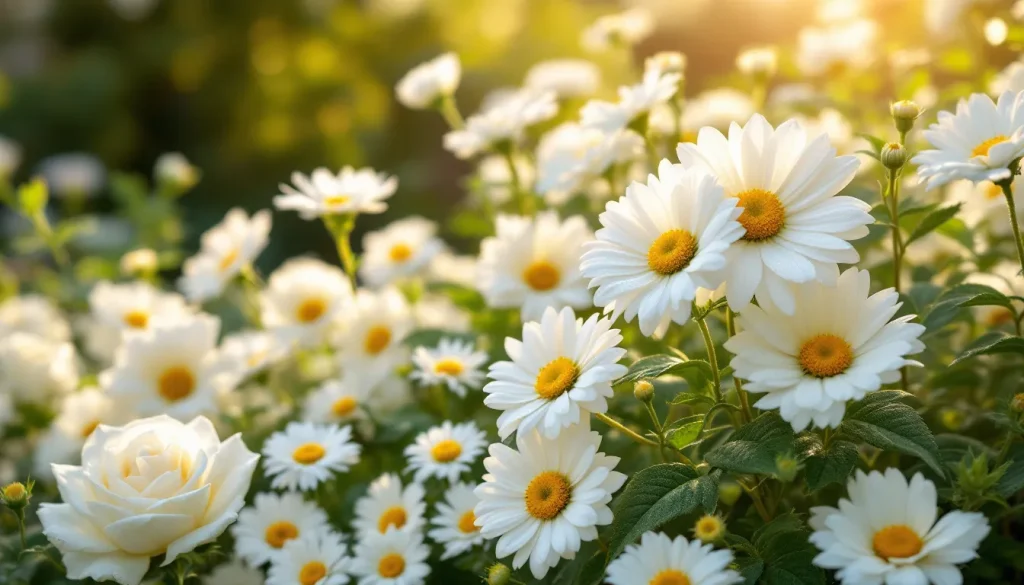
The Shasta daisy is the classic white-petaled, yellow-centered summer perennial for zones 5-9, thriving in full sun and average well-drained soil. It reaches 2-3 feet and blooms for weeks if deadheaded. Space 1-2 feet apart. A reliable cut flower and pollinator magnet. See the yellow-center section below for lookalikes.
10. Gardenia (Gardenia jasminoides)
Gardenia is prized for intensely fragrant, waxy white blooms in late spring and summer, zones 8-11, in full to part sun and acidic, moist soil. It reaches 3-6 feet as a shrub. Gardenias are fussy about drainage and cold; yellowing leaves usually signal high soil pH. A signature wedding-corsage flower for its scent.
11. Star jasmine (Trachelospermum jasminoides)
Star jasmine is a fragrant evergreen climbing vine with pinwheel white flowers in late spring, zones 8-10, in full to part sun. It climbs 3-6 feet (more with support) and works as a fence cover or ground cover. The scent carries at dusk, making it a favorite for moon gardens and patios.
12. Southern magnolia (Magnolia grandiflora)
Southern magnolia is an evergreen tree with dinner-plate-sized fragrant white flowers in late spring and summer, zones 7-9. It grows 60-80 feet with glossy leaves, so site it where it has room. Blooms have a creamy-white color with a lemon scent. A landscape anchor rather than a bed plant.
13. Baby’s breath (Gypsophila paniculata)
Baby’s breath forms an airy cloud of tiny white flowers in summer, zones 3-9, in full sun and alkaline, well-drained soil. It reaches 2-3 feet and is the classic filler in bouquets. Note that it is considered invasive in parts of the northern US and Canada, so check local guidance before planting.
14. White anemone (Anemone coronaria)
The white poppy anemone blooms in spring with white petals around a dark center, zones 7-10, in full to part sun and well-drained soil. It grows 1-1.5 feet from a corm soaked before planting. A popular wedding flower for its clean white-and-black contrast. Related fall-blooming Japanese anemones extend the season.
15. White cosmos (Cosmos bipinnatus)
White cosmos is an easy annual that blooms summer into fall from seed sown after frost, in full sun and lean soil (rich soil reduces flowers). It reaches 2-4 feet with white, yellow-centered daisy-like blooms. It self-sows freely and feeds pollinators. ‘Purity’ is the standard white cultivar.
16. Candytuft (Iberis sempervirens)
Candytuft is a low, spreading evergreen perennial that carpets in white flower clusters in spring, zones 3-8, in full sun and well-drained soil. It reaches 6-12 inches and works as edging or ground cover over walls. Shear after bloom to keep it dense. Reliable and low-maintenance.
17. Ranunculus (Ranunculus asiaticus)
White ranunculus produces rose-like, many-petaled spring blooms from fall-planted corms, zones 8-10 (lift or plant in spring in colder zones). It reaches 1-2 feet in full sun and well-drained soil. Long vase life makes it a bridal-bouquet favorite. Soak corms before planting for faster sprouting.
18. Sweet alyssum (Lobularia maritima)
Sweet alyssum is a low, honey-scented annual that blooms spring through fall in full sun, grown across zones 5-9 as an annual carpet. It reaches only 3-6 inches, making it ideal for edging, containers, and gaps between pavers. It reseeds and attracts beneficial insects. See the small-flowers section below.
Small (little) white flowers, named
Small white flowers are compact-blooming plants under about 1 foot with tiny individual flowers, often used as edging, ground cover, or bouquet filler. The most-searched named types are sweet alyssum, baby’s breath, snowdrop, lily of the valley, and candytuft. These answer the high-volume “little white flowers” and “tiny white flowers” queries that galleries skip.
- Sweet alyssum (Lobularia maritima): honey-scented carpet, 3-6 in, spring-fall annual.
- Baby’s breath (Gypsophila paniculata): airy sprays, classic filler, summer perennial.
- Snowdrop (Galanthus nivalis): nodding bells, 3-6 in, late winter, zones 3-7.
- Lily of the valley (Convallaria majalis): fragrant bells, shade spreader, zones 2-7 (toxic if eaten).
- Candytuft (Iberis sempervirens): white flower cushions, evergreen edging.
- Snow-in-summer (Cerastium tomentosum): silver-leaved ground cover, star-shaped white flowers.
White flowers with a yellow center
White flowers with a yellow center are blooms with white ray petals surrounding a golden or yellow disk, the classic “daisy” shape. The most common named types are the Shasta daisy, oxeye daisy, white cosmos, chamomile, and the fried-egg-shaped magnolia relatives. This is a distinct high-volume search that competitors leave unanswered.
| Common name | Botanical name | Where you see it |
|---|---|---|
| Shasta daisy | Leucanthemum x superbum | Garden beds, borders |
| Oxeye daisy | Leucanthemum vulgare | Wild meadows, roadsides (weedy) |
| White cosmos | Cosmos bipinnatus ‘Purity’ | Cutting gardens, annuals |
| German chamomile | Matricaria chamomilla | Herb gardens, tea |
| Feverfew | Tanacetum parthenium | Cottage gardens |
| Daisy fleabane | Erigeron annuus | Lawns, fields (wild) |
If your yellow-centered white flower is short, unplanted, and spreading in a lawn or field, it is more likely oxeye daisy or daisy fleabane than a garden Shasta. See the lawn ID section next.
How to identify the tiny white flowers in your lawn
Tiny white flowers spreading through a lawn are usually weeds or wildflowers you did not plant, not garden flowers. The four most common culprits in North American turf are white clover, chickweed, daisy fleabane, and wild violet (white forms). Identify by flower shape, leaf shape, and growth habit, not just color. HMNDP covers these in depth in the invasive weeds with white flowers guide.
| Weed | Botanical name | Tell-tale sign |
|---|---|---|
| White clover | Trifolium repens | Round white puff-ball heads, three-leaf clover foliage, low mat |
| Common chickweed | Stellaria media | Tiny 5-petal stars (look like 10), oval leaves, cool-season sprawl |
| Daisy fleabane | Erigeron annuus | Small white-yellow daisies on tall thin stems |
| Hairy bittercress | Cardamine hirsuta | Tiny white flower clusters, seed pods that fling seeds |
White clover is the single most common. It fixes nitrogen and many homeowners now keep it on purpose. If the white flowers sit on a creeping mat with three-part leaves, it is almost certainly clover. Persistent lawn weeds often signal thin turf or poor soil, so it helps to review your grass type and soil type before reaching for herbicide. On slopes, a spreading white-flowered ground cover can also double as protection against soil erosion.
White flowers by growing condition
Match your white flower to your site: shade, full sun, containers, or ground cover. Choosing by condition first prevents most planting failures, because a full-sun peony will sulk in shade and a hellebore will scorch in sun. Use the groupings below to shortlist before buying.
- Best for shade: hellebore, lily of the valley, peace lily (indoor), astilbe (white), white bleeding heart.
- Best for full sun: Shasta daisy, white rose, peony, baby’s breath, candytuft, cosmos.
- Best for containers: sweet alyssum, white petunia, moth orchid, calla lily, gardenia.
- Best ground cover: candytuft, snow-in-summer, sweet alyssum, star jasmine (trained flat), white clover.
- Best for moon gardens (glow at dusk): gardenia, star jasmine, white cosmos, moonflower, Casa Blanca lily.
Bloom season: white flowers by spring, summer, and fall
White flowers can bloom in any season, so pairing early, mid, and late bloomers keeps a white garden going from late winter to frost. Snowdrops and hellebores open first, peonies and tulips carry spring, roses and hydrangeas hold summer, and panicle hydrangea and Japanese anemone finish in fall. Plan a succession using the list below.
- Late winter/early spring: snowdrop, hellebore.
- Mid to late spring: white tulip, peony, lily of the valley, candytuft, ranunculus, magnolia.
- Summer: white rose, Shasta daisy, gardenia, calla lily, baby’s breath, cosmos.
- Fall: panicle hydrangea (aging blooms), Japanese anemone, late cosmos.
Best white flowers for weddings and bouquets
The best white wedding flowers combine long vase life, clean color, and low petal-drop. Florists most often reach for calla lily, white ranunculus, garden roses, peonies, stock, lisianthus, and baby’s breath as filler. These are chosen for how they hold up cut, which is a different question from how they grow in your yard.
| Flower | Vase life | Role in bouquet |
|---|---|---|
| White calla lily | 7-10 days | Structural focal |
| Garden rose | 5-7 days | Lush focal |
| Peony | 5-7 days | Full, romantic focal (late spring only) |
| Ranunculus | 7-10 days | Layered mid-size |
| Lisianthus | 7-14 days | Rose-like filler |
| Baby’s breath | 5-14 days | Airy filler |
Peonies are the most season-limited: fresh white peonies are realistic only for late-spring and early-summer weddings in most regions.
Frequently Asked Questions
What are the most popular white flowers to plant in a garden?
The most-planted white garden flowers are white roses, hydrangeas, peonies, Shasta daisies, tulips, and gardenias. For low-maintenance color, sweet alyssum, candytuft, and cosmos are top picks. Choose by your USDA zone and light: peonies and daisies want full sun (zones 3-9), while hellebores and lily of the valley prefer shade. Mix early, summer, and fall bloomers for continuous white through the season.
What are small (little) white flowers called?
Common small white flowers include sweet alyssum (Lobularia maritima), baby’s breath (Gypsophila paniculata), snowdrop (Galanthus nivalis), lily of the valley (Convallaria majalis), and candytuft (Iberis sempervirens). Most stay under 1 foot and work as edging, ground cover, or bouquet filler. If the tiny white flowers are spreading uninvited across a lawn, they are more likely weeds such as clover or chickweed.
What white flowers have a yellow center?
White flowers with a yellow center are the classic daisy shape: white ray petals around a golden disk. Named examples include the Shasta daisy (Leucanthemum x superbum), oxeye daisy (Leucanthemum vulgare), white cosmos, German chamomile, feverfew, and daisy fleabane. Garden Shasta daisies are tall and planted; short yellow-centered white flowers spreading in fields or lawns are usually wild oxeye daisy or fleabane.
What is the name of the tiny white flowers growing in my lawn?
Tiny white flowers in a lawn are usually white clover (Trifolium repens), chickweed (Stellaria media), daisy fleabane, or hairy bittercress. White clover is the most common, showing round puff-ball heads over three-leaf foliage on a low creeping mat. Identify by leaf and flower shape, not color alone. Persistent lawn weeds often signal thin turf or compacted soil worth correcting first.
What do white flowers symbolize or mean?
White flowers most often symbolize purity, innocence, and new beginnings, which is why they dominate weddings and christenings. They also carry sympathy, remembrance, and peace, so white lilies and chrysanthemums are common at funerals in many cultures. Specific meanings shift by flower: a white rose means purity and honor, lily of the valley means returning happiness, and a white orchid means elegance and respect.
Which white flowers bloom in spring vs summer vs fall?
Spring white flowers include snowdrop, hellebore, white tulip, peony, and lily of the valley. Summer brings white roses, Shasta daisies, gardenia, calla lily, and baby’s breath. Fall features panicle hydrangea (blooms age on the shrub) and Japanese anemone. Planting one flower from each window gives a white garden that flowers from late winter through the first frost with no gaps.
What white flowers grow best in shade?
The best shade-tolerant white flowers are hellebore (Helleborus niger), lily of the valley, white astilbe, white bleeding heart, and, indoors, the peace lily. Hellebore even blooms in winter shade in zones 3-8, while lily of the valley spreads as a fragrant shade ground cover. Most prefer moist, humus-rich soil. Sun-lovers like peonies and roses will bloom poorly in deep shade.
What are the best white flowers for a wedding bouquet?
Top white wedding flowers are calla lily, garden roses, peonies, ranunculus, lisianthus, and baby’s breath for filler. They are chosen for long vase life (often 7 days or more) and clean color that resists browning. Peonies are limited to late spring and early summer weddings in most regions, so calla lily and ranunculus are more reliable year-round choices.