
By the HMNDP Editorial Team, independent reporting on lawn care, landscaping, and the green industry.
Last reviewed: June 2026
The main types of trees, explained fast
The main types of trees split into two big groups: deciduous (broadleaf) trees that drop their leaves each fall, like maples and oaks, and coniferous (evergreen) trees that keep needles or scales year round, like pines and spruces. Botanists further sort trees by hardwood versus softwood and angiosperm versus gymnosperm. Most trees you will meet in the United States fit one of these buckets.
Scientists have described roughly 73,000 tree species worldwide, according to a 2022 study in the journal PNAS. You do not need all of them. You need a mental model and a handful of common species, which is exactly what this list gives you.
Below you get the four-axis classification framework first, then a plain identification path, then a comparison table of named species with scientific names. That order matters: category before name is how you actually recognize a tree in your own yard.
The four ways trees get classified (the mental model)
Trees are grouped along four overlapping axes: leaf behavior (deciduous vs evergreen), leaf shape (broadleaf vs needle-leaf), wood structure (hardwood vs softwood), and reproduction (angiosperm vs gymnosperm). These axes mostly line up, but not perfectly. Learning the four together explains why a “softwood” pine and a “hardwood” oak differ, and why the words overlap.
Deciduous vs coniferous
Deciduous trees shed all their leaves in one season, usually fall, and regrow them in spring. Coniferous trees are cone-bearing and typically evergreen, holding needles or scales through winter. Maples, oaks, and birches are deciduous. Pines, spruces, and firs are coniferous. A few conifers, like the bald cypress (Taxodium distichum), break the rule and drop needles in fall.
Broadleaf vs needle-leaf
Broadleaf trees have flat, wide leaf blades with a branching vein network, like a maple or oak leaf. Needle-leaf trees have thin needles (pines, spruces) or flat scales (cedars, junipers). Broadleaf usually means deciduous in cold US zones, but many broadleaf trees in the South, like the southern magnolia (Magnolia grandiflora), stay evergreen.
Hardwood vs softwood
Hardwood and softwood describe the tree’s botanical group, not actual wood hardness. Hardwoods are broadleaf, flowering trees (oak, maple, cherry). Softwoods are conifers (pine, fir, spruce). The names mislead: balsa is a hardwood softer than pine, and yew is a softwood harder than many hardwoods. Use the terms as group labels, not toughness ratings.
Angiosperm vs gymnosperm
Angiosperms are flowering trees that produce seeds inside a fruit or shell, including nearly all broadleaf hardwoods. Gymnosperms produce naked seeds, usually in cones, and cover most conifers. This is the deepest botanical split. In practice, if a tree flowers and fruits, it is an angiosperm; if it cones, it is almost always a gymnosperm.
How to identify a type of tree in 5 steps
To identify a tree, work through five clues in order: leaf shape, leaf arrangement, bark texture, fruit or seed, and overall silhouette. No single clue is decisive, but two or three together usually name the tree. This path turns “some tree in my yard” into a species. It is the step top listicles skip entirely.
- Leaf shape: Broad and flat, or needle and scale? Lobed (oak, maple), toothed (birch, beech), or smooth-edged? Simple (one blade) or compound (many leaflets on one stalk, like ash or walnut)?
- Leaf arrangement: Opposite (two leaves per node) points to maple, ash, dogwood. Alternate (staggered) points to oak, birch, elm. The mnemonic “MAD-Cap Horse” covers most opposite trees: Maple, Ash, Dogwood, Caprifoliaceae, Horse chestnut.
- Bark: Smooth gray (beech), peeling white (paper birch), deeply furrowed (mature oak), or shaggy (shagbark hickory). Bark is your best winter clue when leaves are gone.
- Fruit or seed: Acorns mean oak. Winged samaras (helicopter seeds) mean maple or ash. Cones mean a conifer. Nuts, berries, or pods each narrow the field fast.
- Silhouette and size: A wide spreading crown (oak), a triangular spire (spruce), a weeping form (some willows), or a columnar shape all help confirm a guess from a distance.
Free apps like iNaturalist and Leafsnap can confirm a photo ID, but the five clues above teach you to name a tree without a phone. Cross-check with a regional field guide from your state extension service for local accuracy.
Common types of trees with names and scientific names
These are common US trees grouped by family, each with its common and scientific (Latin) name, plus a quick description of leaf, size, and appearance. Scientific names matter because common names shift by region: “sycamore” means different trees in the US and UK. The table after the groups puts the key identifiers side by side.
Maple group
Maples are opposite-leaved deciduous hardwoods known for lobed leaves and paired winged seeds (samaras). Three dominate US yards and forests. Red maple (Acer rubrum) grows 40 to 60 feet with red fall color. Silver maple (Acer saccharinum) is faster and weaker-wooded with silvery leaf undersides. Sugar maple (Acer saccharum) yields maple syrup and blazing orange fall color.
Oak group
Oaks are alternate-leaved hardwoods that produce acorns, split into red oaks (pointed leaf lobes) and white oaks (rounded lobes). Northern red oak (Quercus rubra) reaches 60 to 75 feet and grows fast. White oak (Quercus alba) is long-lived with rounded lobes and pale bark. Live oak (Quercus virginiana) is an evergreen Southern species with a huge spreading crown.
Beech
American beech (Fagus grandifolia) is a deciduous hardwood with smooth gray bark, oval toothed leaves, and small triangular nuts (beechnuts). It grows 50 to 70 feet, holds coppery dead leaves through winter (a trait called marcescence), and casts dense shade. The smooth bark is often the fastest way to name it in the woods.
Birch
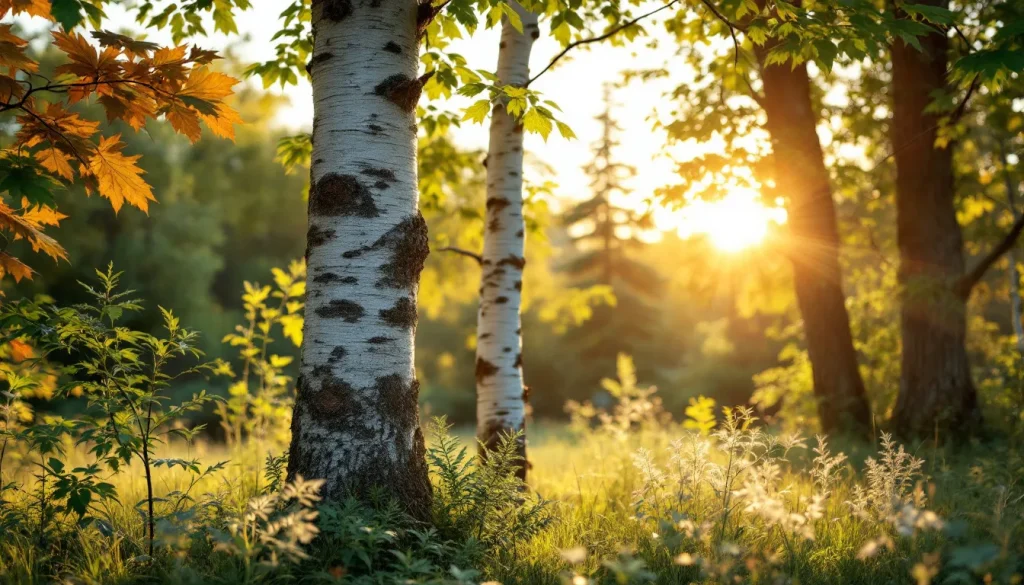
Birches are slender deciduous hardwoods famous for papery, often light-colored peeling bark. Paper birch (Betula papyrifera) has bright white peeling bark and grows 50 to 70 feet in northern states. River birch (Betula nigra) has cinnamon-brown curling bark and tolerates wet soil, making it a common landscape pick in the South and Midwest.
Pine and other conifers
Conifers are cone-bearing softwoods, usually evergreen, with needles or scales. Eastern white pine (Pinus strobus) has soft needles in bundles of five and reaches 80 feet. Colorado blue spruce (Picea pungens) has stiff blue-gray needles and a classic triangular shape. Eastern red cedar (Juniperus virginiana) has scale leaves and blue berry-like cones.
Named tree species list (quick reference)
Here is a numbered, scannable list of 20 common US tree species with scientific names, useful when you want a name fast. It pairs with the comparison table below for identifiers. Species are widely planted or native across US climate zones, from USDA Hardiness Zone 3 in the far north to Zone 9 in the deep South.
- Red maple (Acer rubrum)
- Silver maple (Acer saccharinum)
- Sugar maple (Acer saccharum)
- Northern red oak (Quercus rubra)
- White oak (Quercus alba)
- Live oak (Quercus virginiana)
- American beech (Fagus grandifolia)
- Paper birch (Betula papyrifera)
- River birch (Betula nigra)
- Eastern white pine (Pinus strobus)
- Colorado blue spruce (Picea pungens)
- Eastern red cedar (Juniperus virginiana)
- American sycamore (Platanus occidentalis)
- Tulip tree (Liriodendron tulipifera)
- Eastern redbud (Cercis canadensis)
- Flowering dogwood (Cornus florida)
- American elm (Ulmus americana)
- Shagbark hickory (Carya ovata)
- Black walnut (Juglans nigra)
- Southern magnolia (Magnolia grandiflora)
Comparison table: identify trees by leaf, bark, and fruit
This table maps common tree types to their key identifiers so you can match a tree by sight. Read across from the tree you suspect, or scan a column (for example, “fruit/seed”) to narrow from a clue you already have. It answers the dominant “types of trees with pictures and names” intent in structured text.
| Tree (scientific name) | Type | Leaf | Bark | Fruit/Seed | Mature height |
|---|---|---|---|---|---|
| Red maple (Acer rubrum) | Deciduous hardwood | 3-5 lobes, red stems, opposite | Gray, smooth to ridged | Paired winged samaras | 40-60 ft |
| Sugar maple (Acer saccharum) | Deciduous hardwood | 5 lobes, smooth edges | Gray-brown, furrowed | Winged samaras | 60-75 ft |
| White oak (Quercus alba) | Deciduous hardwood | Rounded lobes, alternate | Light gray, flaky | Acorns | 50-80 ft |
| Northern red oak (Quercus rubra) | Deciduous hardwood | Pointed lobes, alternate | Dark, ridged | Acorns | 60-75 ft |
| American beech (Fagus grandifolia) | Deciduous hardwood | Oval, toothed | Smooth silver-gray | Triangular beechnuts | 50-70 ft |
| Paper birch (Betula papyrifera) | Deciduous hardwood | Oval, doubly toothed | White, peeling | Small winged nutlets | 50-70 ft |
| Eastern white pine (Pinus strobus) | Coniferous softwood | Soft needles in 5s | Gray-brown, furrowed | Long slender cones | 50-80 ft |
| Colorado blue spruce (Picea pungens) | Coniferous softwood | Stiff blue-gray needles | Gray, scaly | Papery hanging cones | 50-75 ft |
| Flowering dogwood (Cornus florida) | Deciduous hardwood | Oval, opposite, curved veins | Blocky “alligator” plates | Red berry-like drupes | 15-30 ft |
Types of trees by US region and climate zone
Which trees you see depends on your USDA Hardiness Zone and native range, which run from Zone 3 (Minnesota, northern Maine) to Zone 9 (Florida, coastal Texas). Northern forests favor sugar maple, paper birch, and white pine. Southern zones favor live oak, southern magnolia, and bald cypress. Matching a tree to its expected range is a strong identification shortcut.
Regional native ranges also guide planting. The USDA and state extension services publish native tree lists by zone, and picking a native species usually means less watering and fewer pest problems. For groundcover planning around trees, see our guides on types of grass and how ground conditions relate to types of erosion on planted slopes.
| Region / Zone | Common native trees |
|---|---|
| Northeast / Zones 3-6 | Sugar maple, American beech, paper birch, eastern white pine |
| Southeast / Zones 7-9 | Live oak, southern magnolia, bald cypress, flowering dogwood |
| Midwest / Zones 4-6 | Northern red oak, shagbark hickory, American elm, river birch |
| West / Zones 5-9 | Colorado blue spruce, ponderosa pine, quaking aspen, coast live oak |
Choosing the right tree for your landscape
Match the tree to the space before the species. A tree that reaches 70 feet is wrong under power lines or beside a foundation. Small ornamentals like eastern redbud (Cercis canadensis) or flowering dogwood (Cornus florida) suit tight yards at 15 to 30 feet. Shade trees like oaks and maples need room to spread, often 30 feet or more from the house.
Consider four factors: mature size, sun and soil needs, root behavior, and mess (fruit, seed pods, dropped limbs). Silver maple grows fast but has weak wood and aggressive roots, so many US municipalities discourage it near sidewalks. For deeper species profiles, see our references on types of tree and common tree names.
Frequently Asked Questions
What are the main types of trees?
The main types of trees are deciduous (broadleaf) trees that drop their leaves each fall, such as maples and oaks, and coniferous (evergreen) trees that keep needles year round, such as pines and spruces. Trees are also grouped as hardwood (flowering broadleaf) versus softwood (conifer), and as angiosperm (seeds in fruit) versus gymnosperm (seeds in cones).
What is the difference between deciduous and coniferous trees?
Deciduous trees shed all their leaves in one season, usually fall, and regrow them in spring; maples, oaks, and birches are examples. Coniferous trees are cone-bearing and typically evergreen, keeping needles or scales through winter; pines, spruces, and firs are examples. A few conifers, like bald cypress, are exceptions and drop their needles in autumn.
How do you identify a type of tree?
Identify a tree by working through five clues: leaf shape (broad or needle, lobed or toothed), leaf arrangement (opposite or alternate), bark texture, fruit or seed (acorns mean oak, cones mean conifer, winged samaras mean maple), and overall silhouette. Two or three clues together usually name the species. Apps like iNaturalist can confirm a photo ID.
What are examples of trees with their scientific names?
Common examples include red maple (Acer rubrum), sugar maple (Acer saccharum), white oak (Quercus alba), northern red oak (Quercus rubra), American beech (Fagus grandifolia), paper birch (Betula papyrifera), eastern white pine (Pinus strobus), and flowering dogwood (Cornus florida). Scientific names matter because common names vary by region and can point to different trees.
What is the difference between hardwood and softwood trees?
Hardwood and softwood describe botanical groups, not actual wood hardness. Hardwoods are broadleaf flowering trees like oak, maple, and cherry. Softwoods are conifers like pine, fir, and spruce. The labels can mislead: balsa is a hardwood softer than many pines, and yew is a softwood harder than several hardwoods, so treat them as group names.
How many types of trees are there in the world?
Scientists estimate roughly 73,000 tree species exist worldwide, according to a 2022 study published in the journal PNAS. About 9,000 of those species may still be undiscovered. The United States alone has more than 1,000 native tree species. For everyday identification, learning a few dozen common local species covers most trees you will encounter.
What are the most common types of trees?
The most common US trees include maples (red, silver, sugar), oaks (red and white groups), American beech, birches, and conifers like eastern white pine and Colorado blue spruce. Maples and oaks are among the most widely planted street and yard trees in the United States because of their shade, fall color, and adaptability across climate zones.
What are the different types of trees with pictures and names?
Trees with names fall into groups by leaf, bark, and fruit: maples (paired winged seeds), oaks (acorns), beech (smooth gray bark), birch (peeling bark), and pines (needles and cones). The comparison table in this guide maps each named species to its identifiers, which serves the same visual matching purpose as a picture-and-name chart in structured, searchable text.