
By the HMNDP Editorial Team, independent reporting on lawn care, landscaping, and the green-industry business.
Last reviewed: June 2026
What tree and stump removal costs together
Tree and stump removal together typically runs $500 to $3,000 for a single tree, depending on trunk diameter, tree height, access, and stump size. The tree-felling portion is usually the larger line item. Stump grinding is often quoted separately at roughly $2 to $5 per inch of stump diameter, with a common $75 to $150 minimum. Large or hazardous trees push totals well past $3,000.
Price is driven mostly by size and risk, not by the word “removal.” A 25-foot ornamental near an open lawn is a fraction of the cost of a 70-foot oak leaning over a roof. The table below shows typical U.S. ranges for the combined job. Treat these as planning figures, not quotes, because rates vary by region, season, and site conditions.
| Tree size (height / trunk diameter) | Tree removal (felling) | Stump grinding add-on | Typical combined total |
|---|---|---|---|
| Small (under 30 ft / up to 12 in) | $200 to $500 | $75 to $150 | $300 to $650 |
| Medium (30 to 60 ft / 12 to 24 in) | $500 to $1,200 | $100 to $250 | $600 to $1,450 |
| Large (60 to 80 ft / 24 to 36 in) | $1,200 to $2,500 | $200 to $400 | $1,400 to $2,900 |
| Very large / hazardous (80 ft+ / 36 in+) | $2,500 to $5,000+ | $300 to $600+ | $2,800 to $5,600+ |
Add-ons that raise the price: crane access, proximity to power lines or structures, permits (many cities require one for protected species), and hauling the logs off-site. If you keep the wood or chips, some crews discount the haul-away fee.
Tree removal service: what felling the tree actually involves
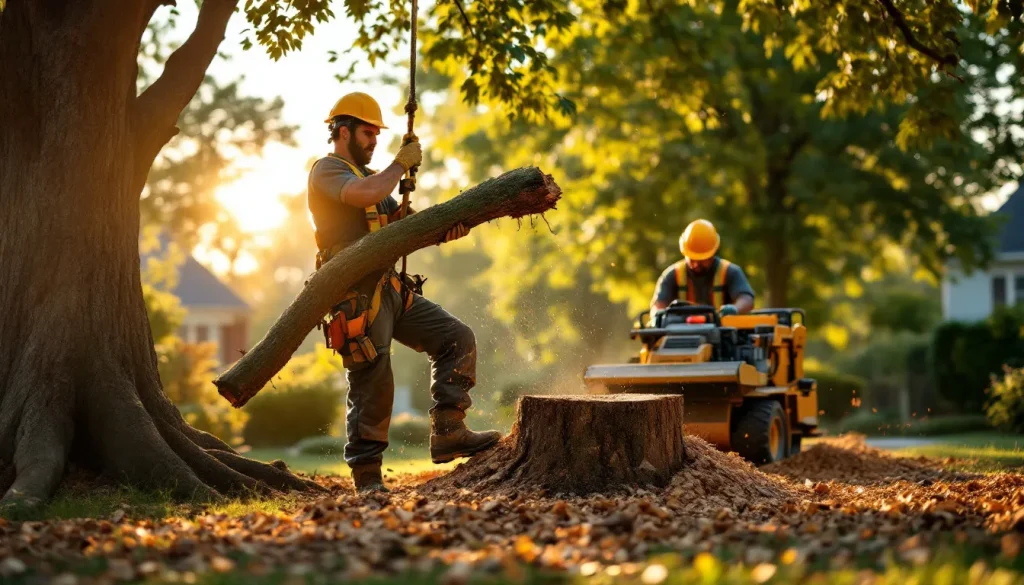
A tree removal service cuts down and dismantles the standing tree, then clears the debris. On tight lots, an arborist climbs or uses a bucket truck to take the tree down in sections (a technical process called rigging) so limbs do not hit the house, fence, or neighbor’s yard. Open-lot trees can sometimes be felled in one drop.
The crew’s real work is controlled dismantling, not just cutting. Professional tree care means roping limbs down, protecting turf and hardscape, and running the wood through a chipper. Ask whether the quote includes the stump, because in many quotes the felling stops at ground level and the stump is a separate line item.
For a deeper look at the felling side of the job, see our guide to tree cutting techniques and safe felling.
Stump grinding vs. stump removal: the distinction that changes your bill
Stump grinding shaves the stump down to 4 to 12 inches below grade using a rotating cutting wheel, leaving the root system in the ground. Full stump removal (stump extraction) pulls out the stump and major roots with a backhoe or by hand digging. Grinding is faster, cheaper, and less invasive. Full removal costs more and tears up a larger area, but clears the ground for building or replanting.
This is the single decision that most drives cost and outcome, and no ranking page lays it out clearly. Grinding is the default choice for most homeowners because it is quicker and gentler on the surrounding lawn. Full extraction is the right call only when the roots themselves are the problem.
| Factor | Stump grinding | Full stump removal (extraction) |
|---|---|---|
| What’s left | Roots stay in ground, decay over years | Stump and major roots gone |
| Relative cost | Lower ($2 to $5 per inch) | 2 to 4x higher |
| Time on site | 15 to 60 minutes per stump | Half day or more for large stumps |
| Site disruption | Minimal, small hole | Large hole, torn-up soil |
| Best for | Cosmetics, mowing, most yards | New construction, replanting same spot, foundation clearance |
Should you grind the stump, fully remove it, or leave it?
Grind the stump if you want the eyesore gone and plan to mow, plant grass, or lay new turf nearby. Fully remove it if you are building a patio, pouring a foundation, or replanting a tree in the exact spot, because leftover roots block digging and can regrow suckers. Leave it only if it is far from use and you accept slow natural decay (5 to 10 years).
Use this quick logic. Grinding wins on cost and speed for the vast majority of residential jobs. Extraction is worth the premium when a shallow root network would interfere with construction, irrigation lines, or a new planting. Leaving the stump makes sense only in a wooded back corner where nobody cares.
- Grind if the goal is aesthetics, mowing, or nearby replanting of grass.
- Extract if you are pouring concrete, building, or replanting a tree in the same hole.
- Leave if the stump is remote and you can wait years for decay.
The buried costs nobody quotes: chips, roots, and the hole
After grinding, you are left with a pile of wood chips mixed with soil, a hole, and roots still underground. Most quotes do not spell out who deals with these. Grinding produces chip volume roughly double the stump size, and the standard practice is to backfill the hole with those chips, then top with soil. Hauling chips away is usually an extra charge.
Answer these three questions before you sign. First, the chips: confirm whether the crew backfills, spreads, or hauls them, and whether haul-away costs more. Second, the roots: after grinding, roots decay in place over 3 to 7 years and can be planted over with grass, but not with a new tree in the same spot. Third, the hole: grinding chips settle over months, so plan to top up with topsoil after the first heavy rain.
One practical note. Fresh wood chips pull nitrogen from soil as they break down, so if you spread them as mulch, keep them away from young plants or add nitrogen. Our piece on lawn care timing and soil moisture covers why fresh organic matter and wet ground interact the way they do.
Tree trimming, pruning, and hazardous tree removal
A full-service tree care company does more than removal. Tree trimming and pruning shape and thin a healthy tree to reduce weight, improve structure, and clear structures or power lines, and cost far less than removal ($150 to $700 per tree). Hazardous or dangerous tree removal covers dead, leaning, storm-damaged, or diseased trees that threaten people or property, and commands a premium because of the added risk.
Not every tree needs to come down. If the trunk is sound and the problem is a few heavy limbs, expert pruning may solve it for a fraction of removal cost. Bring in a professional when a tree leans suddenly, drops large limbs, shows fungal conks at the base, or has visible cracks, because these are hazard signals.
Safety, eco-friendly claims, and landscape restoration
Safe tree and stump removal depends on trained crews, proper rigging, and personal protective equipment, not on marketing language. The tree-care industry is high-risk work, so verify a provider’s methods rather than trusting “eco-friendly” or “100% safe” claims at face value. Ask what happens to the wood (chipped and reused, or landfilled) and whether they restore the site afterward.
Eco-friendly, in practice, means chipping brush for reuse as mulch, grinding rather than chemically killing stumps, and protecting surrounding turf and beds. After the job, landscape restoration puts the site back together: filling the hole, reseeding or laying sod, and cleaning debris. Confirm restoration is included or quoted, because a bare hole and rutted lawn are common leftovers.
Large employee-owned operators like Davey Tree built their reputation partly on standardized safety and restoration practices, a useful benchmark when you compare a local crew.
How to choose a licensed and insured service (works in any market)
To vet any tree and stump removal service, confirm liability and workers’ compensation insurance, look for an ISA Certified Arborist on staff, get 2 to 3 itemized written quotes, and check that the stump, cleanup, and hole are named in the scope. Avoid door-to-door solicitors, demands for large cash deposits, and quotes with no proof of insurance. This checklist applies whether you are in West Palm Beach or anywhere else.
Local providers in Palm Beach County and South Florida market heavily on “professional” and “expert” language, but the proof is in credentials and paperwork. Use the list below to compare providers apples to apples.
- Insurance: ask for a certificate showing general liability and workers’ compensation. Without it, you can be liable for an injury on your property.
- Certification: an ISA (International Society of Arboriculture) Certified Arborist signals trained judgment, especially for hazardous trees.
- Written, itemized quote: felling, stump grinding, chip and log haul-away, and hole backfill should each appear as a line.
- Local license and permits: many municipalities require a permit for protected or large trees. A legitimate crew knows the local rule.
- Red flags: pressure to pay all cash upfront, no physical address, no insurance proof, or a quote scribbled on the spot with no scope.
For the environmental angle on removals and replanting decisions, our coverage of the turf and vegetation rebate programs shows how some regions incentivize what you plant back.
Frequently Asked Questions
How much does tree and stump removal cost together?
Together, tree and stump removal usually costs $500 to $3,000 for a single tree, with felling as the larger portion and stump grinding added at roughly $2 to $5 per inch of stump diameter (often a $75 to $150 minimum). Large or hazardous trees over 80 feet can exceed $5,000. Access, permits, and log haul-away raise the total.
What is the difference between stump grinding and stump removal?
Stump grinding shaves the stump 4 to 12 inches below grade with a cutting wheel and leaves the roots to decay in place. Full stump removal (extraction) digs out the stump and major roots, usually with machinery. Grinding is cheaper, faster, and less disruptive. Extraction costs 2 to 4 times more but clears the ground for building or replanting.
Is stump removal included in the price of tree removal?
Often not. Many tree removal quotes stop at ground level and list stump grinding or removal as a separate line item. Always confirm in writing whether the stump is included, and whether that means grinding or full extraction. Ask the same about hauling logs and chips, since those are commonly billed separately too.
Should I grind the stump or have it fully removed?
Grind the stump for most residential cases: it is cheaper, faster, and gentler on your lawn, and works fine if you plan to mow or plant grass. Choose full removal when you are building, pouring concrete, or replanting a tree in the same spot, because leftover roots block digging and can send up new suckers.
How long does it take to remove a tree and its stump?
A typical single-tree job takes a few hours to a full day. Felling and dismantling a medium tree often runs 2 to 4 hours; stump grinding adds 15 to 60 minutes per stump. Large, hazardous, or crane-access trees can take a full day or more. Weather, access, and cleanup all affect the timeline.
What happens to the roots and wood chips after stump grinding?
After grinding, the roots stay in the ground and decay naturally over 3 to 7 years. The grinder produces a pile of wood chips mixed with soil, roughly double the stump’s volume. The standard practice is to backfill the hole with those chips and top with soil. Hauling chips off-site is usually an extra charge you should confirm upfront.
Do I need to fill the hole after stump removal?
Usually yes. Grinding leaves a depression that is typically backfilled with the wood chips and topped with soil. Chips settle over months, so plan to add topsoil after the first heavy rain and reseed or lay sod. Full extraction leaves a larger hole that needs clean fill soil, not just chips, before you can replant or level it.
How do I choose a licensed and insured tree and stump removal service near me?
Confirm general liability and workers’ compensation insurance with a certificate, look for an ISA Certified Arborist, and get 2 to 3 itemized written quotes that name felling, stump work, cleanup, and hole backfill. Verify local permit knowledge for protected trees. Avoid door-to-door solicitors, all-cash upfront demands, and any provider that cannot show proof of insurance.