
By the HMNDP Editorial Team. Last reviewed: June 2026.
What black rubber mulch actually is
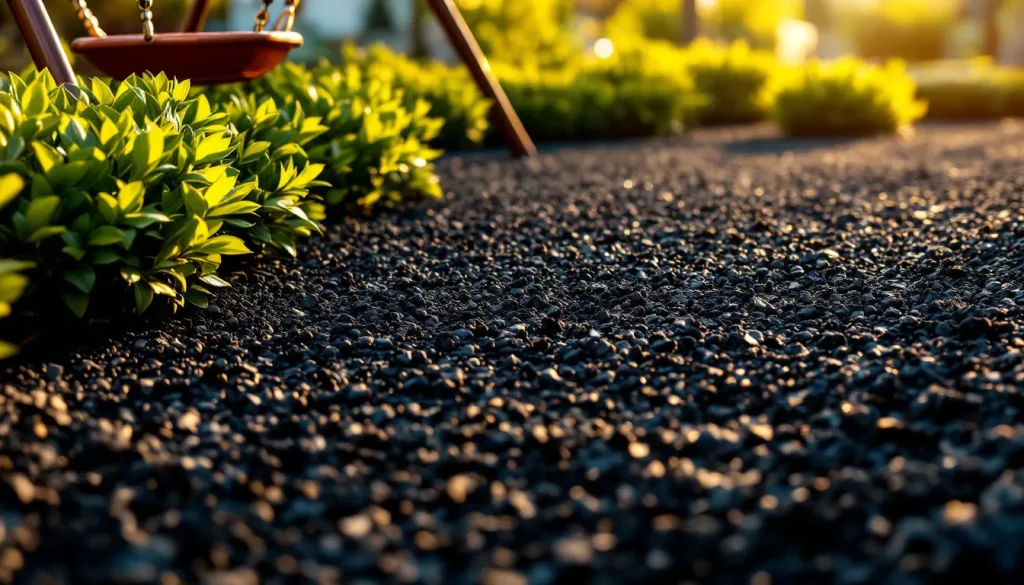
Black rubber mulch is ground-up recycled tire rubber, dyed black and used as a ground cover for playgrounds and landscaping beds. One ton diverts roughly 60 to 100 scrap tires from landfills. It comes in two shapes: nuggets (chunky, wood-mulch look) and shreds (thinner strands). It does not rot, so it stays put for years instead of breaking down each season.
The rubber is sourced from end-of-life tires, then cleaned and processed. Most consumer products are marketed as “100% recycled” and “wire-free,” meaning the steel belting has been magnetically removed. Always confirm wire-free on the label, since stray wire is the most common quality complaint.
Compared to dyed black wood mulch, the rubber version trades soil benefit for longevity. It is heavier per bag, denser underfoot, and does not feed the soil. For a broader look at how the material behaves across uses, see our overview of rubber mulch as a landscaping material.
Where black rubber mulch is used: playgrounds and beds
Black rubber mulch has two main jobs: cushioning play areas and covering landscape beds. On playgrounds it acts as a fall-protection surface, absorbing impact under swings and climbers. In garden beds and around trees or shrubs, it works as a long-lasting decorative cover that suppresses weeds. It performs best in ornamental and high-traffic areas, not around edible plants.
For play areas, depth is a safety spec, not a preference. The US Consumer Product Safety Commission (CPSC) Public Playground Safety Handbook lists loose-fill rubber at about 6 inches of depth to protect against falls up to roughly 10 to 13 feet, depending on the product’s tested critical fall height. Landscaping beds need far less, typically 2 to 3 inches.
If a play surface is your goal, our guide to choosing playground mulch compares rubber against engineered wood fiber and poured surfaces on cost and accessibility.
How long black rubber mulch lasts
Black rubber mulch typically lasts 10 to 12 years or longer, versus wood mulch that most homeowners replace every 1 to 2 years. Because rubber does not decompose, the main aging factors are color fade and scatter, not rot. Many manufacturers back the color with a limited warranty of 10 to 12 years. That lifespan is the single biggest driver of its long-run cost case.
The tradeoff: because it never breaks down, it also never disappears. If you change your landscaping in year 4, you are removing every piece by hand or rake, not tilling it in.
Low maintenance and pest resistance
Rubber mulch is low maintenance because it does not decompose, does not need annual topping up, and does not attract wood-eating insects. It sheds the yearly labor and re-buy cost of organic mulch. It also gives termites and carpenter ants nothing to eat, since those pests target cellulose in wood, not rubber. That makes it a common choice against home foundations where wood mulch is discouraged.
Maintenance is not zero. Leaves and debris still collect on top and may need blowing or raking. Weed seeds can germinate in accumulated surface debris over time, so a landscape fabric underlayment helps the weed barrier last.
Color retention: does black rubber mulch fade?
Black rubber mulch is coated with a colorfast pigment engineered to resist UV fade, and quality products hold color for around 10 to 12 years. Black is generally the most fade-resistant color because dark pigments mask minor UV degradation better than red or brown. Cheaper or uncoated product can gray faster. Compare that with dyed wood mulch, which usually fades within a single season.
Weed suppression
A 2 to 3 inch layer of black rubber mulch blocks sunlight and suppresses most weeds, and because rubber does not break into a seedbed, it stays a barrier for years. Wood mulch decomposes into organic matter that weed seeds happily root in, which is why it needs replacing. For best results, lay landscape fabric underneath so windblown seed cannot reach soil through the gaps.
Real cost per square foot: the math competitors skip
Black rubber mulch runs roughly $0.40 to $0.90 per square foot at a 2 inch landscaping depth, and $1.20 to $2.50 per square foot at a 6 inch playground depth, based on typical 2026 retail pricing of $8 to $14 per 0.8 cubic foot bag. Bulk by the cubic yard is cheaper per unit but adds delivery. Below is the coverage most product pages never quantify.
Coverage rule: one cubic foot covers about 6 square feet at 2 inches deep, or about 4 square feet at 3 inches. A standard 0.8 cubic foot bag covers roughly 4.8 square feet at 2 inches. One cubic yard (27 cubic feet) covers about 160 square feet at 2 inches, or about 54 square feet at 6 inches for play areas.
| Area to cover | Depth | 0.8 cu ft bags needed | Cubic yards |
|---|---|---|---|
| 100 sq ft (bed) | 2 in | ~21 bags | ~0.62 yd |
| 200 sq ft (bed) | 3 in | ~63 bags | ~1.85 yd |
| 200 sq ft (play area) | 6 in | ~125 bags | ~3.7 yd |
Break-even vs wood mulch over 10 years
Rubber mulch usually breaks even against wood mulch somewhere between years 4 and 7, then saves money after. The reason is re-buy frequency: wood is cheaper up front but you pay again every 1 to 2 years. Rubber is a single large payment that amortizes across a decade. Here is a worked example for a 200 square foot bed at 2 to 3 inches deep.
| Option | Up-front cost | Replacements over 10 yrs | 10-year total |
|---|---|---|---|
| Black rubber mulch | ~$250 to $500 | $0 (10 to 12 yr life) | ~$250 to $500 |
| Dyed wood mulch | ~$60 to $90 | Re-buy every ~1.5 yrs | ~$420 to $630 |
The math flips in rubber’s favor mainly when you value the material long enough to reach payback and you do not plan to redesign the bed. Actual figures vary by region, product quality, and delivery, so treat these as planning ranges, not quotes. Labor to install and remove is not included and can favor wood, which is lighter to handle.
Is black rubber mulch safe? A straight answer
Black rubber mulch is widely used and generally considered safe for landscaping, and IPEMA-certified products meet playground safety standards, but three honest caveats apply: it retains heat and can get hot on sunny playgrounds, it can leach trace zinc and other tire compounds into soil over time, and new product may give off a rubber odor in hot weather. It is not recommended around edible plants.
Heat and burn risk. Rubber absorbs solar heat and surface temperatures on dark rubber can climb well above air temperature on hot, sunny days, a real burn concern for bare feet and hands on playgrounds. Light-colored surfaces, shade, and testing the surface before play reduce risk.
Chemical leaching and VOCs. Tire rubber contains zinc, and studies have measured zinc and other compounds leaching in small amounts under weathering. The US Environmental Protection Agency and CDC/ATSDR studied recycled tire crumb (2019 Federal Research Action Plan) and reported that measured exposures were low, while noting data gaps. That is reassuring, not a clean bill of health, which is why many gardeners keep it away from vegetables.
Certification to look for. For play areas, look for IPEMA certification and a stated critical fall height, plus ASTM F1292 (impact attenuation) and ASTM F2075 (specification for engineered wood fiber, referenced in the sector). IPEMA certification is the clearest third-party signal that a rubber play product was tested to recognized standards.
Honest pros and cons of black rubber mulch
Black rubber mulch wins on longevity, low maintenance, pest resistance, and playground cushioning, and loses on soil health, heat, removal difficulty, and scatter. Unlike product pages that list only upsides, the balanced view below is what decides whether it fits your project. It is a strong pick for play areas and ornamental beds, and a poor pick near vegetables.
| Pros | Cons |
|---|---|
| Lasts 10 to 12+ years, no annual re-buy | Adds no nutrients or organic matter to soil |
| Does not attract termites or carpenter ants | Hard to remove later (every piece by hand) |
| Colorfast black, minimal fade | Can float and scatter in heavy rain or on slopes |
| Good fall cushioning for playgrounds | Retains heat, can get hot in direct sun |
| Strong weed suppression at 2 to 3 in | Not ideal near vegetables (leaching concern) |
Buying black rubber mulch: bags vs bulk
Black rubber mulch sells in 0.8 cubic foot bags at home centers and by the cubic yard in bulk from suppliers. Bags suit beds under about 200 square feet and cost more per unit but need no delivery. Bulk by the yard is cheaper per cubic foot and better for playgrounds or large areas, but adds a delivery fee. Match the format to your square footage and depth.
Before ordering, calculate volume: square footage times depth in feet equals cubic feet, then divide by 27 for cubic yards. Confirm the product is wire-free, states an IPEMA certification if it is for play, and lists a color warranty. To go deeper on materials and methods, browse the HMNDP learn hub.
If you decide organic mulch suits your beds better, it helps to weigh the look alongside the material: our guide to choosing between black, brown, and red mulch covers how dyed products hold their color and whether the dyes are safe, and if you lean warmer, this walkthrough on picking and measuring brown mulch shows how much you actually need.
Frequently Asked Questions
Is black rubber mulch safe for playgrounds and gardens?
Black rubber mulch is generally considered safe and is widely used, and IPEMA-certified products meet recognized playground standards. Caveats: it retains heat and can get hot in sun, may leach trace zinc over time, and can emit a rubber odor when new. EPA and CDC/ATSDR studied tire crumb (2019) and found low measured exposures with data gaps. Most gardeners avoid it near vegetables.
How much does black rubber mulch cost per square foot?
Black rubber mulch runs roughly $0.40 to $0.90 per square foot at a 2 inch landscaping depth, and about $1.20 to $2.50 per square foot at a 6 inch playground depth, based on 2026 bag pricing of $8 to $14 per 0.8 cubic foot. Bulk by the cubic yard costs less per unit but adds delivery. Regional pricing and product quality shift these ranges.
How long does black rubber mulch last?
Black rubber mulch typically lasts 10 to 12 years or more because it does not decompose, and many manufacturers back the color with a 10 to 12 year limited warranty. Wood mulch, by contrast, usually needs replacing every 1 to 2 years. The main aging signs are gradual color fade and scatter, not rot, so it stays functional far longer than organic mulch.
Black rubber mulch vs wood mulch: which is better?
Rubber mulch is better for longevity, low maintenance, and playground cushioning; wood mulch is better for soil health and easy removal. Rubber lasts 10 to 12+ years with no re-buy but adds no nutrients and retains heat. Wood feeds the soil and costs less up front but needs annual replacement. Choose rubber for play areas and ornamental beds, wood near edibles and changing designs.
What are the pros and cons of black rubber mulch?
Pros: 10 to 12+ year lifespan, no annual re-buy, strong weed suppression, colorfast black, resists termites and carpenter ants, and cushions playground falls. Cons: adds no soil nutrients, hard to remove later, can float and scatter in heavy rain, retains heat in direct sun, and is not recommended near vegetables due to leaching concerns. It fits play areas and ornamental beds best.
Does black rubber mulch fade or lose its color?
Black rubber mulch is coated with UV-resistant pigment and quality products hold color for about 10 to 12 years, often backed by warranty. Black is the most fade-resistant color because dark pigment masks minor UV degradation. Cheaper or uncoated product can gray sooner. Either way it far outlasts dyed wood mulch, which typically fades within a single season and needs re-dyeing or replacement.
How many bags of rubber mulch do I need and how deep?
Use 2 to 3 inches for landscaping beds and about 6 inches for playgrounds (per CPSC guidance). One 0.8 cubic foot bag covers roughly 4.8 square feet at 2 inches. A 100 square foot bed at 2 inches needs about 21 bags; a 200 square foot play area at 6 inches needs about 125 bags. For large areas, order by the cubic yard instead.
Does black rubber mulch attract bugs, termites, or carpenter ants?
No. Black rubber mulch does not attract termites or carpenter ants because those insects eat cellulose in wood, and rubber contains none. That makes it a common choice against home foundations where wood mulch is discouraged. It is not a pesticide, so ants may still nest in soil beneath it, but the mulch itself gives wood-eating pests nothing to feed on.