
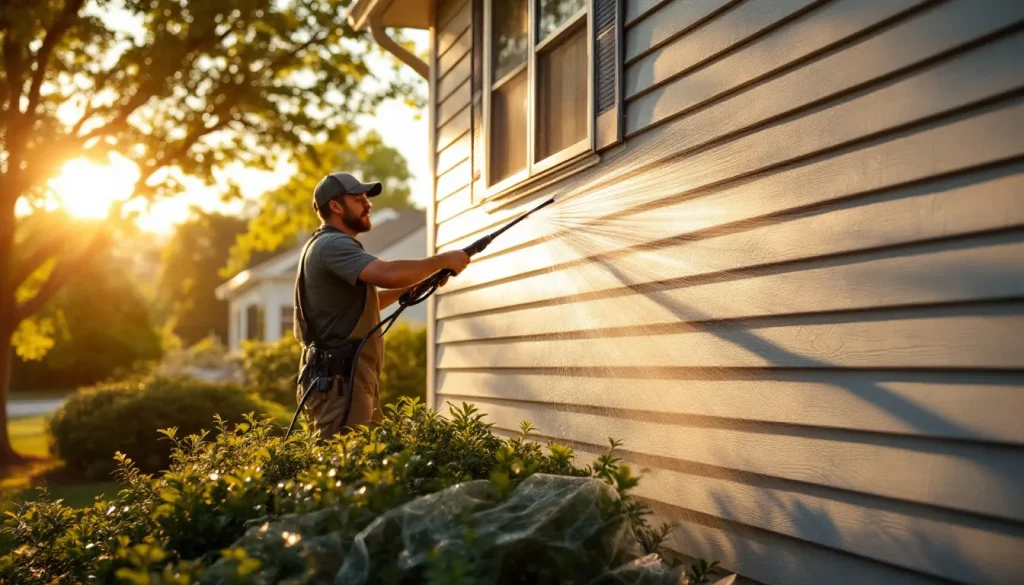
Pressure washing siding: the safe way to clean vinyl yourself
By the HMNDP Editorial Team, independent reporting on lawn care, landscaping, and the green-industry business.
Last reviewed: June 2026
Pressure washing siding cleans dirt, mold, and mildew off your home, but the biggest mistake first-timers make is using too much pressure. Most vinyl siding manufacturers and the Vinyl Siding Institute (VSI) recommend low-pressure cleaning, often called soft washing, because high PSI can force water behind the panels and may void your warranty. Clean with a wide nozzle, a cleaning solution, and patience, not raw force.
Below is exactly how to do it safely, what PSI and nozzle to use, a mixable cleaning recipe, and what it costs to rent a machine versus hiring a pro.
Soft washing vs pressure washing: the warranty gap nobody explains
Soft washing uses low pressure (roughly 100 to 500 PSI, close to garden-hose force) plus a cleaning solution that kills mold and mildew chemically. Pressure washing relies on high PSI to blast grime off. For vinyl and aluminum siding, soft washing is the method most manufacturers actually endorse, and it is the safer default for a first-timer.
Here is the detail competitors skip: many vinyl siding warranties (brands such as CertainTeed, Ply Gem, and Mastic publish cleaning guidance) warn that damage from improper cleaning is not covered. Driving water up under the panel laps can trap moisture in the wall, feed hidden mold, and rot sheathing. The chemistry does the cleaning. The water only rinses.
Rule of thumb: if you can clean it with solution and a soft-bristle brush, do that first. Reach for a machine only for height and rinsing speed, and keep the pressure down.
How much PSI to use to pressure wash vinyl siding
DIY guides commonly cite a 2,500 to 3,000 PSI gas pressure washer for siding, and that machine is fine to own. The trick is that you do not apply all of it. Use a wide-angle nozzle and stand back so the pressure hitting the vinyl stays low. Effective surface pressure for vinyl should feel closer to a firm hose than a cutting jet.
An electric washer in the 1,300 to 1,900 PSI range is often plenty for a single-story vinyl home and is much harder to damage siding with. Save 3,000 PSI gas power for concrete, not for the wall of your house.
How different siding materials handle pressure
Not all siding tolerates the same treatment. Vinyl and fiber cement are forgiving with a wide nozzle and distance. Aluminum dents and oxidizes, so keep pressure low. Wood can splinter, and old stucco can chip or let water in through hairline cracks. Match the method to the material below.
| Siding material | Recommended approach | Watch out for |
|---|---|---|
| Vinyl | Soft wash or low pressure, 25 to 40 degree tip | Water behind laps, warranty limits |
| Aluminum | Low pressure only, soft solution | Denting, chalky oxidation streaks |
| Wood / cedar | Soft wash, wide fan, keep distance | Splintering, raised grain, paint loss |
| Fiber cement (Hardie) | Low to moderate pressure, wide tip | Forcing water into joints and seams |
| Stucco | Soft wash, gentle rinse | Chipping, water intrusion through cracks |
Nozzle tip, distance, and angle so water stays out of the wall
Technique prevents more damage than any PSI number. On vinyl, use a 25-degree (green) or 40-degree (white) nozzle tip. Never use the 0-degree (red) or 15-degree (yellow) tip on siding, those cut and gouge. Start with the widest tip and only narrow it if grime resists.
Keep the nozzle 2 to 3 feet from the wall to begin, then move closer only if needed, and never within about 12 inches. Spray at a slight downward angle so water runs down over the laps the way rain does.
The single most important rule: never spray upward under the panel laps. Vinyl and aluminum overlap like shingles, and an upward jet drives water straight behind the siding. Work top to bottom in sections, and let gravity carry runoff down.
DIY cleaning solution recipe (bleach and vinegar ratios)
The solution does the real work on mold and mildew, so mix it right and give it dwell time. Two proven options: a diluted bleach mix for heavy mold, or a vinegar mix for light mildew and greener cleaning. Wet and rinse nearby plants first, because runoff can burn foliage.
| Job | Recipe | Dwell time |
|---|---|---|
| Mold and mildew (heavy) | 1 gallon water + 1 quart 6% sodium hypochlorite bleach + a squirt of dish soap | 5 to 10 minutes, do not let it dry |
| Light mildew / greener option | 70% water + 30% white vinegar (or full 30% cleaning vinegar for stubborn spots) | 5 to 10 minutes |
| Oxygen-bleach alternative | Sodium percarbonate mixed per label (safer for plants) | 10 to 15 minutes |
Apply low, work up, then rinse high to low so streaks do not set. Cover outdoor lights and outlets, and rinse landscaping again when you finish. For a deeper look at surfactants and detergents, see our guide to pressure washing chemicals.
Step-by-step: how to pressure wash vinyl siding
Work in shade on a mild day, one section at a time, and keep the wall wet with solution before you rinse. This sequence keeps water moving down and out.
- Close windows, cover outlets and fixtures, and move or wet down plants and mulch beds.
- Attach a 25 or 40 degree tip and test on a low, hidden section first.
- Apply cleaning solution from the bottom up using a soft-wash setting or pump sprayer.
- Let it dwell 5 to 10 minutes. Scrub stubborn mold with a soft-bristle brush on a pole.
- Rinse top to bottom at a slight downward angle, staying 2 to 3 feet back.
- Never aim up under the laps. Move steadily so you do not linger on one spot.
- Do a final low-to-high inspection rinse, then re-rinse plants and hardscape.
Best time of year and weather to pressure wash siding
Spring and fall are ideal for pressure washing siding. Aim for an overcast day between about 50 and 80 degrees Fahrenheit. Cool, shaded conditions keep your cleaning solution from evaporating before it can work, which is the main reason streaks appear.
Avoid extreme heat, direct midday sun, freezing temperatures, and windy days that blow spray and chemicals off target. Give the wall a full sunny day afterward to dry, especially before painting or sealing.
Gas vs electric pressure washer for siding
Electric washers are lighter, quieter, and gentler, which makes them the safer pick for a first-timer on vinyl. Gas washers deliver more flow and reach for tall or heavily soiled homes but demand more control. For most single-story vinyl houses, electric is enough.
| Factor | Electric | Gas |
|---|---|---|
| Typical PSI | 1,300 to 2,000 | 2,500 to 3,300 |
| Best for | Vinyl, single story, beginners | Tall or very dirty homes |
| Damage risk on vinyl | Lower | Higher if misused |
| Cost to buy | $100 to $250 | $300 to $600+ |
Cost to power wash a house: DIY rental vs hiring a pro
Doing it yourself runs roughly $60 to $150 including a one-day machine rental and chemicals. Hiring a pro to soft wash a full house typically costs $250 to $600, or about $0.20 to $0.60 per square foot, with larger two-story homes reaching $600 to $900 or more.
| Option | Typical cost | Includes |
|---|---|---|
| DIY rental | $40 to $100/day machine + $20 to $30 solution | Your time, ladders, cleanup |
| Pro soft wash (average home) | $250 to $600 | Labor, equipment, chemicals, safety |
| Pro (large / two-story) | $600 to $900+ | Height work, more surface area |
| Per square foot | $0.20 to $0.60 | Common pro pricing basis |
DIY makes sense on a low, single-story home you can reach safely. Hire out anything tall or steep, since ladder work with a live wand is where injuries happen. For regional numbers, see our breakdown of how much pressure washing costs, and if you plan to clean flatwork too, our driveway pressure washing guide covers the higher pressure that concrete can take. Homeowners weighing this as a side hustle can read our notes on running a pressure washing business.
Frequently Asked Questions
How much PSI should I use to pressure wash vinyl siding?
Use the lowest pressure that cleans. An electric washer at 1,300 to 1,900 PSI is plenty for most vinyl. Gas machines rated 2,500 to 3,000 PSI work only if you use a wide 25 or 40 degree tip and stand 2 to 3 feet back so the actual surface pressure stays low. The cleaning solution, not the PSI, removes mold.
Can pressure washing damage or void the warranty on my vinyl siding?
It can. Many vinyl siding manufacturers, including brands like CertainTeed and Ply Gem, publish cleaning guidance and warn that damage from improper cleaning is not covered. High pressure or spraying upward under the laps can force water behind panels, trap moisture, and cause hidden mold or rot. Check your specific warranty and favor low-pressure soft washing.
Should I pressure wash or soft wash my siding?
Soft wash is safer for vinyl, aluminum, wood, and stucco. Soft washing uses low pressure (about 100 to 500 PSI) plus a mold-killing solution, which is what most manufacturers recommend. Reserve higher pressure for durable surfaces like concrete driveways. For siding, let the chemistry clean and use water only to rinse from top to bottom.
What is the best cleaning solution for pressure washing siding?
For heavy mold, mix 1 gallon of water with 1 quart of 6% bleach and a squirt of dish soap. For light mildew, use 70% water to 30% white vinegar. Sodium percarbonate (oxygen bleach) is a plant-safer option. Let any solution dwell 5 to 10 minutes without drying, and wet nearby plants before and after.
How much does it cost to power wash the exterior of a house?
Hiring a pro to soft wash a house usually costs $250 to $600, or about $0.20 to $0.60 per square foot, with large two-story homes reaching $600 to $900 or more. Doing it yourself runs roughly $60 to $150, including a one-day machine rental of $40 to $100 plus cleaning solution.
What is the best time of year and weather to pressure wash siding?
Spring and fall are best. Aim for an overcast day between about 50 and 80 degrees Fahrenheit. Cool, shaded conditions stop your solution from drying too fast and streaking. Avoid extreme heat, direct midday sun, freezing temperatures, and windy days. Allow a dry, sunny day afterward, especially if you plan to paint.
What nozzle tip and distance keep water out of the siding?
Use a 25 degree (green) or 40 degree (white) nozzle on vinyl, never the 0 degree (red) or 15 degree (yellow). Start 2 to 3 feet from the wall and stay at least 12 inches away. Spray at a slight downward angle, follow the laps, and never aim upward underneath them.
Do I need to pressure wash siding before painting it?
Yes, cleaning first helps paint adhere. Soft wash the siding to remove dirt, chalk, mold, and mildew, then let it dry fully, often a full sunny day or 24 hours, before priming or painting. Skipping this step traps contaminants under the new coat and can cause peeling. Keep pressure low so you do not drive water behind panels.