
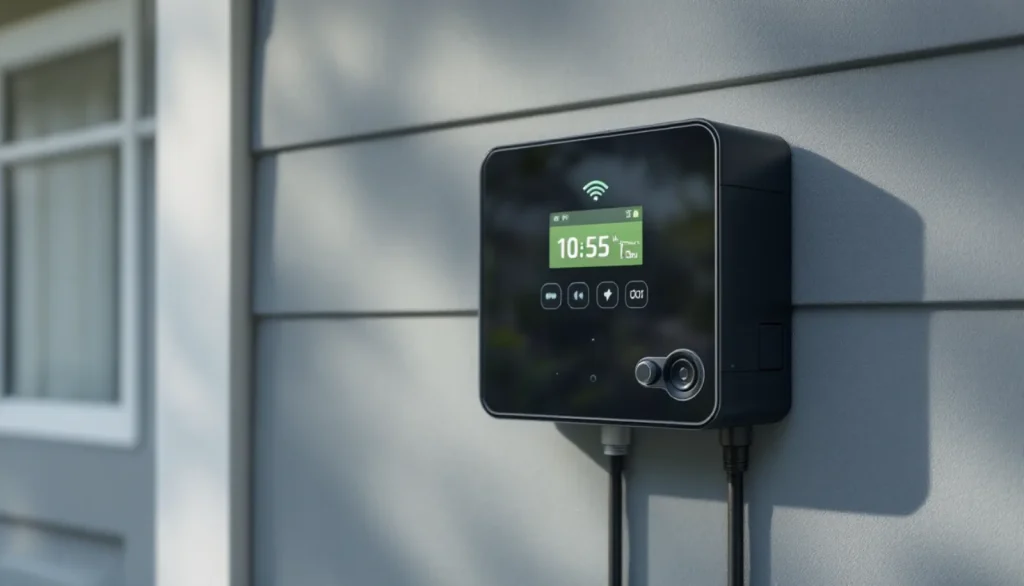
The EPA WaterSense smart irrigation partnership is the credential that quietly separates the irrigation contractor who gets pro-tier distributor pricing, utility rebate flow, and approved-contractor status on state turf-conversion programs from the one who does not. WaterSense is voluntary, free to join, and run by the U.S. Environmental Protection Agency, but the downstream economics for a certified Smart Irrigation Partner have turned it into a near-requirement for irrigation specialists serving the western drought states by mid-2026.
The short version
- EPA WaterSense is a voluntary public-private partnership administered by the U.S. EPA, launched in 2006 and significantly updated for smart irrigation in 2024 and 2025.
- Smart Irrigation Partners get manufacturer rebates, distributor pro-tier pricing, utility-program inclusion, and EPA-branded marketing materials.
- WaterSense-labeled smart controllers (Rachio 3, Hunter Hydrawise HC and Pro-HC, Rain Bird ESP-TM2 with LNK, Toro EVO with smart connect) cut outdoor water use by 30 to 50 percent in independent field trials.
- California, Nevada, Arizona, and Colorado utility rebate programs now require WaterSense-labeled controllers for the smart irrigation rebate tier.
- Certification path is a written exam through a partner certifying organization (IA, NGWA, ASIC), then annual EPA partner renewal.
What the partnership actually is
WaterSense is a labeling and partnership program run by the EPA Office of Water. It labels products (toilets, showerheads, faucets, irrigation controllers) and certifies professionals. The professional side runs through three certifying organizations: the Irrigation Association (IA), the National Ground Water Association (NGWA), and the American Society of Irrigation Consultants (ASIC). Each runs its own exam pathway, but all roll up into the same EPA Smart Irrigation Partner designation.
The professional certification pathways are Irrigation System Designer, Irrigation System Installer, Irrigation System Auditor, and the catch-all Smart Irrigation Partner that combines all three. To become a WaterSense Irrigation Partner, a contractor needs at least one certified professional on staff plus a signed partnership agreement with the EPA committing to install WaterSense-labeled products and report water savings annually.
Why pro-tier distributors care
Ewing, SiteOne, Horizon, and the regional irrigation distributors run pro-tier pricing books that they only show to contractors who can prove sustained volume in smart irrigation product categories. WaterSense Irrigation Partner status is one of the simplest filters they apply. A contractor who can show partner status, an annual savings report, and a track record of installing labeled controllers gets pricing on Rachio 3, Hunter Hydrawise Pro-HC, Rain Bird ESP-TM2 with LNK module, and Toro EVO that is 15 to 28 percent below the rate card.
That delta matters. A residential smart controller swap-out job runs $450 to $850 installed in the western drought markets. The labeled controller hardware is $180 to $320 of that ticket. A 20 percent discount on the hardware drops $36 to $64 to the contractor’s bottom line per install, which on a 200-install year is real money.
Why the utility programs care
Western water utilities have moved aggressively over the past three years to make WaterSense-labeled controllers the gating product for their smart irrigation rebate tier. The Las Vegas Valley Water District, Denver Water, Salt Lake City Public Utilities, Tucson Water, the Metropolitan Water District of Southern California, and the San Diego County Water Authority all currently require a WaterSense label for the top rebate amount. The labeling matters because EPA testing confirms that the controller will use weather and soil-moisture data to actually reduce runtime, rather than just being a wifi-connected version of a dumb timer.
For the contractor, that means installing a labeled product is the difference between the homeowner getting $100 back and getting $250 to $400 back. That rebate delta sells the job. Operators who have built a smart irrigation practice around WaterSense-labeled hardware close at significantly higher rates than operators who default to whatever the distributor put on the shelf.
By the numbers
| Item | Detail |
|---|---|
| Program administrator | U.S. EPA Office of Water |
| Launched | 2006 |
| Major smart irrigation update | 2024 controller specification revision |
| Independent field-trial water savings | 30 to 50 percent outdoor reduction |
| Certifying organizations | Irrigation Association, NGWA, ASIC |
| Annual partner renewal | Required, with water-savings reporting |
| Top labeled controllers (2026) | Rachio 3, Hunter Hydrawise HC/Pro-HC, Rain Bird ESP-TM2 with LNK, Toro EVO with Smart Connect |
| Distributor pro-tier discount range | 15 to 28 percent below rate card |
What contractors should do
The path to becoming a WaterSense Irrigation Partner is straightforward. Identify the lead designer or installer on the crew. Enroll them in the Irrigation Association’s WaterSense-certified course for either the Designer, Installer, or Auditor track. The IA course runs roughly 16 to 24 hours of content with a proctored exam. Cost is $400 to $750 depending on track and member status. Once the certification is in hand, complete the EPA partnership agreement and file the first annual report.
The first annual report is the piece that trips up new partners. EPA wants installed product counts, estimated water savings, and a methodology note. Operators should build the reporting into the CRM from day one. Most modern field service software (ServicePro, Aspire, RealGreen) has a custom-field path for tracking labeled product installs that feeds directly into the annual EPA submission.
For homeowners on the buyer side, the practical move is to ask the contractor for proof of WaterSense partner status before signing a smart controller install contract. Pair that with our coverage of drip irrigation installation, the drought-tolerant lawn alternatives playbook, and the California turf rebate mechanics. Operators expanding into Nevada should review the Nevada turf replacement program, which now references WaterSense partnership in its approved-contractor language.
Background: why the 2024 controller spec update matters
EPA finalized a substantial revision to the WaterSense Specification for Weather-Based Irrigation Controllers in 2024, with a follow-on technical clarification in 2025. The revision tightened the irrigation adequacy and irrigation excess metrics, added soil-moisture-based controllers as a separately specified product class, and stiffened the cybersecurity and data-privacy expectations for cloud-connected controllers. The cybersecurity piece was driven partly by Department of Homeland Security guidance to critical-infrastructure-adjacent vendors and partly by the Rain Bird ESP-Me security disclosure cycle that ran through 2023.
The result is that the 2026 generation of labeled controllers is meaningfully better than the 2020 generation on both water performance and security. Contractors who certified five years ago should refresh on the updated spec before the next annual partner renewal cycle.
FAQ
Is WaterSense the same as Energy Star?
Different program, similar idea. Energy Star is run by EPA and DOE for energy efficiency. WaterSense is EPA-only and is water-specific. A product can carry both labels (some clothes washers do), but the certifications and product categories are distinct.
Does my state require WaterSense?
No state requires WaterSense outright, but California, Nevada, Arizona, Utah, and Colorado all use it as the gating standard for top-tier utility rebates. Texas and Florida are moving toward similar gating language in their state water plans.
Can a sole proprietor become a WaterSense Partner?
Yes. The partnership is open to firms of any size, including single-person LLCs. The certification has to be carried by an individual, which for a sole proprietor is the owner.
How long does the certification take?
Plan on 6 to 10 weeks from enrollment to certified Smart Irrigation Partner status. The IA course runs in either an in-person or asynchronous online format, and the EPA partnership review adds 2 to 3 weeks after the exam.
Do I need to recertify every year?
The IA certification has its own continuing education cycle (typically 3 years). The EPA partner agreement renews annually with a water savings report. The two cycles run independently.
How the labeled controllers actually perform
Independent field trials run by the Irrigation Association and several university extension services have measured real outdoor water reductions in the 30 to 50 percent range when a properly programmed WaterSense-labeled controller replaces a standard time-clock controller. The variation inside that band tracks closely to whether the homeowner or contractor actually programs the soil and plant profile correctly. A labeled controller installed and left on default settings still cuts water use, but only by about 12 to 18 percent. A labeled controller programmed with accurate plant material, soil type, sprinkler head precipitation rate, and microclimate data hits the upper end of the 30 to 50 percent band consistently.
That gap is where the certified Smart Irrigation Partner earns the premium. A certified installer walks through the property zone by zone, measures precipitation rates on each station, identifies plant material and soil type, and enters the data into the controller. That commissioning step typically takes 45 to 90 minutes per property and is what converts a labeled controller from a 15 percent reduction to a 40 percent reduction. Distributors and utilities both know this, which is why both groups have moved toward gating their best pricing and rebates on partner status rather than just on product purchase.
Bottom line
WaterSense partnership is not flashy, but it has become the unspoken credential that gets a contractor pro-tier hardware pricing, top utility rebate flow, and approved-contractor placement on the state turf programs that now drive the western irrigation business. The cost of getting in is one staff certification plus an annual EPA renewal. The return is paid back inside the first year of focused smart irrigation work. For more on the underlying market shift, see our coverage of the US landscaping market and the regulatory landscape as a whole.