
By the HMNDP Editorial Team. Last reviewed: June 2026.
What a mulch blower is and what it does
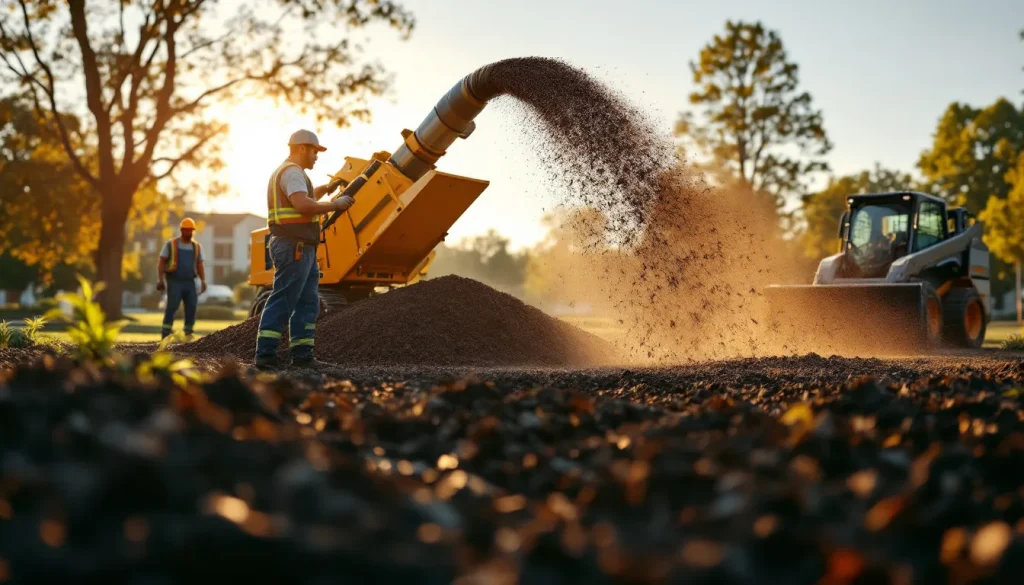
A mulch blower is a machine that pneumatically propels mulch, bark, compost, or aggregate through a flexible hose and places it exactly where you point the nozzle. A blower fan and metered feed system push material up to 200 feet from a towable or truck-mounted unit, so a two- or three-person crew can install mulch on beds, slopes, and hard-to-reach areas without wheelbarrows.
The category has one dominant name: FINN Corporation, whose Material Blower (MB) series, including the MB50, defined the segment. Competing platforms come from Express Blower and Peterson. Machines are rated by capacity in cubic yards and by hose diameter, commonly a 4-inch hose on mid-size units.
The economics are the reason the machine exists. A hand crew moves 2 to 4 cubic yards of mulch per person per hour. A blower crew moves 15 to 60 yards per hour depending on machine class, which is where the labor savings on large jobs come from. If you are still choosing the material itself, our guides to the best mulch by type and best mulch for flower beds pair naturally with the install method below.
Mulch blower cost: rent, buy, or hire (the unit economics)
A mulch blower costs roughly $400 to $600 per day or $1,500 to $2,000 per week to rent, $40,000 to $150,000-plus to buy new, and $50 to $100 per cubic yard to hire as a professional blow-in service (labor and equipment, with material sometimes separate). The right path depends on how many yards you install per year, not on the sticker price alone. The table below sets the ranges; treat them as 2026 U.S. estimates that vary by region and access.
| Path | Typical cost (2026 U.S. estimates) | What it includes | Best when |
|---|---|---|---|
| Rent (towable, ~1.5 yd) | $400–$600/day; $1,500–$2,000/week; $4,000–$5,000/month; plus delivery ~$100–$250 | Machine only; you supply crew, material, and a skid steer to feed it | Seasonal or one-off large jobs |
| Hire a blow-in service | $50–$100/yd installed (equipment + labor); material often billed separately at $30–$60/yd | Turnkey crew, machine, and often material | Occasional jobs, no crew or equipment |
| Buy used (towable) | $20,000–$60,000 | Ownership; you carry maintenance and storage | Steady annual volume, tight capital |
| Buy new (towable to truck-mounted) | $40,000–$150,000+ | Ownership, warranty, latest metering controls | High, sustained annual volume |
| Buy new (full blower truck) | $150,000–$400,000+ | Truck, blower, and remote-control system integrated | Dedicated blow-in service businesses |
Blow-in service pricing per cubic yard is where buyers get surprised. Always confirm whether the quote is labor-and-equipment only or all-in with material, because a $75-per-yard number means very different things in each case. On a 40-yard job that is a $1,200 swing.
Rental delivery and pickup fees, fuel, and a damage waiver can add $150 to $400 to a “day rate.” Build those into any comparison so the rental line item is honest against the buy and hire lines.
Rent vs. buy vs. hire: a decision framework by yards per year
Match the path to your annual installed volume. Under about 150 cubic yards per year, hiring a blow-in service is usually cheapest because you avoid rental minimums and ownership overhead. Between roughly 150 and 1,000 yards, renting wins. Above about 1,000 to 1,500 sustained yards per year, buying starts to pay back within one to three seasons. The table quantifies the crossover.
| Annual installed volume | Recommended path | Why |
|---|---|---|
| Under ~150 yd/year | Hire a blow-in service | No rental minimums, no storage, no maintenance; you pay only for yards placed |
| ~150–1,000 yd/year | Rent by the day or week | Access to a $40k+ machine without owning it; ideal for spring and fall pushes |
| ~1,000–1,500 yd/year | Rent heavily, model a purchase | Rental spend approaches a used-machine price; run the payback math |
| Over ~1,500 yd/year sustained | Buy (used first, then new) | Ownership cost per yard drops well below rental and service rates |
Here is the labor-vs-machine math on a single 40-yard job, using loaded labor at $45 per crew-hour. By hand, a three-person crew moving about 3 yards per person-hour installs 40 yards in roughly 9 hours: about $1,215 in labor. With a rented blower fed by a skid steer, the same crew installs at 20 yards per hour, finishing in 2 hours: about $270 in labor plus a $500 day rate plus $150 delivery, near $920 total. The blower is cheaper and faster past roughly 20 to 25 yards.
The payback case for buying: a landscaper renting 40 weeks-worth of machine time at $1,750 per week spends $70,000 a year, which exceeds a clean used towable unit. At that volume, ownership converts rental cash into an asset within a single season, before counting the higher-margin blow-in work you can now sell to others.
How many cubic yards a mulch blower installs per hour
Productivity scales with machine class. A small towable unit with a 4-inch hose installs roughly 10 to 25 cubic yards per hour. Mid-size truck-mounted machines reach 30 to 60 yards per hour. Large dedicated blower trucks such as the Express Blower TM-45 can exceed 50 to 70 yards per hour on open sites. Compare that to 2 to 4 yards per person-hour by hand and the throughput case is clear.
| Machine class | Typical throughput | Hose | Crew |
|---|---|---|---|
| Hand crew (baseline) | 2–4 yd/hour per person | Wheelbarrow | 2–4 |
| Towable blower (~1.5 yd) | 10–25 yd/hour | 4 in, up to 200 ft | 2–3 |
| Mid truck-mounted (e.g., FINN MB series) | 30–60 yd/hour | 4–5 in, 150–300 ft | 2–3 |
| Large blower truck (Express Blower, Peterson) | 50–70+ yd/hour | 5 in, 200+ ft | 2 |
Real-world output runs below the peak numbers because of setup, repositioning, and material reloading. Sites with long carry distances, tight access, or many small beds favor the blower most, since the hose reaches where a wheelbarrow struggles. Open commercial grounds let the bigger machines run near their rated ceiling.
Size the machine to the job. A 15-yard residential job does not need a blower truck; a 300-yard commercial install should never be done by hand. The volume-to-machine match is the single biggest driver of unit cost.
The machine landscape: FINN vs. Express Blower vs. Peterson
Three manufacturers define the mulch and material blower market. FINN Corporation is the category leader with its Material Blower (MB) series, including the MB50, spanning towable and truck-mounted units. Express Blower builds high-throughput truck-integrated systems. Peterson (part of the Astec group historically) offers heavy blower trucks for large-volume contractors. The table compares them head to head.
| Platform | Configuration | Typical capacity / throughput | Hose / reach | Indicative price | Best fit |
|---|---|---|---|---|---|
| FINN MB series (incl. MB50) | Towable and truck-mounted | Up to ~50–60 yd/hour | 4 in, up to 200 ft | $40k–$150k+ | Landscapers scaling into blow-in work |
| Express Blower (TM-45, EB-60) | Truck-mounted, remote-controlled | ~50–70+ yd/hour | 5 in, 200+ ft | $150k–$350k+ (complete truck) | Dedicated blow-in service fleets |
| Peterson blower trucks | Truck-mounted, high volume | High, site-dependent | 5 in, long reach | $200k–$400k+ | Erosion control and large civil jobs |
For most landscaping and property-management buyers, the practical choice is a FINN MB-series unit, towable if you need flexibility across trucks or truck-mounted if you run a dedicated rig. Express Blower and Peterson make sense once blow-in becomes a core revenue line rather than an occasional service.
Towable vs. truck-mounted configurations
Towable mulch blowers mount on a trailer you pull behind a pickup, keeping the entry price low and letting you swap tow vehicles. Truck-mounted units integrate the blower with a dump or chip body, so one vehicle carries material and blows it, cutting reload trips. Towable suits contractors testing the service; truck-mounted suits steady, high-volume operators.
| Factor | Towable | Truck-mounted |
|---|---|---|
| Entry cost | Lower ($20k used to $90k new) | Higher ($90k to $400k+) |
| Material capacity | Limited to hopper; needs a skid steer to feed | Integrated body carries yards of material |
| Reload trips | More frequent | Fewer; carries and blows in one rig |
| Flexibility | Tow with any capable truck | Dedicated vehicle |
| Best for | Occasional and mid-volume jobs | Daily, high-volume blow-in work |
How a mulch blower works and how to reduce material waste
A mulch blower works by feeding material from a hopper into an airstream generated by a blower fan, which carries it through a 4-inch hose to the nozzle. The operator controls flow and aims the discharge, building an even layer. Reducing waste comes down to steady feed, correct nozzle distance, and matching air pressure to the material so you place mulch instead of scattering it.
Run the crew as a system. The blow-in workflow below is the standard mechanical mulch installation loop used on commercial jobs.
- Stage material near the machine and load the hopper (a skid steer or Bobcat keeps a towable unit fed continuously).
- Set the machine within hose reach of the beds, up to 200 feet, and lay out the hose to the farthest point first.
- Start the feed at a moderate rate and dial pressure to the material so mulch lands rather than bounces.
- The nozzle operator moves methodically, keeping the hose end 2 to 4 feet above the bed for even depth.
- Work back toward the machine, coiling hose as you go, and refill the hopper before it empties to avoid air-only gaps.
- Blow a light finish pass to feather edges and cover thin spots.
Waste-cutting tactics: keep the nozzle close to reduce drift, blow with the wind rather than into it, mask adjacent hardscape, and use a finer material for the top layer where appearance matters. For vegetable beds where material choice affects the crop, our best mulch for vegetable gardens guide covers what to load and what to avoid.
Materials beyond mulch a bark or material blower can handle
A material blower is not limited to shredded mulch. The same machine pneumatically places bark, compost, soil blends, playground safety fiber, and many aggregates, which is why manufacturers call the FINN MB line “Material Blowers” rather than mulch-only units. Material type changes the settings: heavier or wetter material needs more air and a slower feed, while dry bark blows fast and light.
| Material | Blows well? | Notes |
|---|---|---|
| Shredded hardwood mulch | Yes | Standard use; consistent flow |
| Bark (fine to medium) | Yes | Light and fast; the original bark-blower application |
| Compost / soil blends | Yes, with tuning | Heavier and moist; slow feed, more air |
| Aggregate (small stone, pea gravel) | Yes, machine-dependent | Abrasive; confirm the machine is rated for it |
| Wet or clumping material | Marginal | Can bridge in the hopper; screen first |
Aggregate and compost work opens the machine to erosion control, green-roof, and playground jobs, which is part of why owning pencils out at volume. Always confirm the manufacturer rating before running abrasive stone through a unit built for organic mulch.
Where to rent a mulch blower near you
National equipment-rental chains stock mulch and bark blowers seasonally. Sunbelt Rentals lists a 1.5-cubic-yard bark blower available across many U.S. branches, and United Rentals and Herc Rentals carry comparable units in some markets. Availability is regional and peaks in spring and fall, so reserve early. Local landscape-supply yards and independent rental houses are the other reliable source.
When you call, confirm five things: capacity in cubic yards, hose diameter and total reach, whether delivery and pickup are included, whether a skid steer to feed the hopper is available, and the day, week, and month rates so you can spot the crossover to renting long or buying. For sourcing material and adjacent equipment, our roundup of pro lawn-care distributors and supply stores is a useful starting point, and the broader HMNDP guides hub covers related install methods.
Frequently Asked Questions
How much does it cost to rent a mulch blower per day or per week?
A towable mulch or bark blower around 1.5 cubic yards typically rents for about $400 to $600 per day and $1,500 to $2,000 per week from national suppliers in 2026, with monthly rates near $4,000 to $5,000. Add roughly $100 to $250 for delivery and pickup, plus fuel and any damage waiver. Rates vary by region, season, and machine size.
How much does professional mulch blowing cost per cubic yard?
Professional blow-in service usually costs about $50 to $100 per cubic yard for equipment and labor, with material sometimes billed separately at $30 to $60 per yard. All-in quotes that include material can run $65 to $125 per yard. Always confirm whether the per-yard price includes the mulch, since that single detail can swing a 40-yard job by more than $1,000.
Is it cheaper to rent a mulch blower, buy one, or hire a service?
It depends on annual installed volume. Under about 150 cubic yards per year, hiring a blow-in service is usually cheapest. From roughly 150 to 1,000 yards, renting wins. Above about 1,500 sustained yards per year, buying (used first) drops your cost per yard below rental and service rates and can pay back within one to three seasons.
How does a mulch blower work?
A mulch blower feeds material from a hopper into a high-volume airstream produced by a blower fan, then carries it through a flexible 4-inch hose to a nozzle the operator aims. The operator controls feed rate and air pressure to place an even layer up to 200 feet from a towable or truck-mounted machine. A skid steer often keeps a towable unit’s hopper filled.
How many cubic yards of mulch can a blower install per hour?
A small towable blower installs about 10 to 25 cubic yards per hour, mid-size truck-mounted machines like the FINN MB series reach 30 to 60 yards per hour, and large blower trucks such as the Express Blower TM-45 can exceed 50 to 70 yards per hour. By comparison, a hand crew moves only 2 to 4 yards per person per hour. Setup and reloading lower real-world output.
How far can a mulch blower shoot mulch from the truck or hose?
Most mulch and bark blowers reach up to 200 feet through a standard flexible hose, commonly 4 inches in diameter on mid-size units and 5 inches on larger trucks. With extension hose, some machines reach 300 feet or more. The long reach is the main advantage over wheelbarrows, letting a crew place mulch on slopes, islands, and areas trucks cannot access.
What sizes and types of mulch blowers are available?
Mulch blowers come in two main configurations: towable trailer units and truck-mounted systems. Towable machines around 1.5 cubic yards are lower-cost and flexible, though they need a skid steer to feed them. Truck-mounted units, including FINN MB-series, Express Blower, and Peterson platforms, integrate material carrying with blowing for higher throughput. Capacity is rated in cubic yards; throughput ranges from 10 to 70-plus yards per hour.
How much does it cost to buy a new or used mulch blower?
A used towable mulch blower typically runs about $20,000 to $60,000, while new towable-to-truck-mounted units range from roughly $40,000 to $150,000-plus. A complete dedicated blower truck (Express Blower or Peterson class) can cost $150,000 to $400,000 or more. Buying generally pencils out above about 1,500 installed cubic yards per year, where ownership cost per yard falls below rental and service rates.