
By the HMNDP Editorial Team, independent reporting on lawn care, landscaping, water, and the green-industry business.
Last reviewed: June 2026
How to mulch around trees the right way
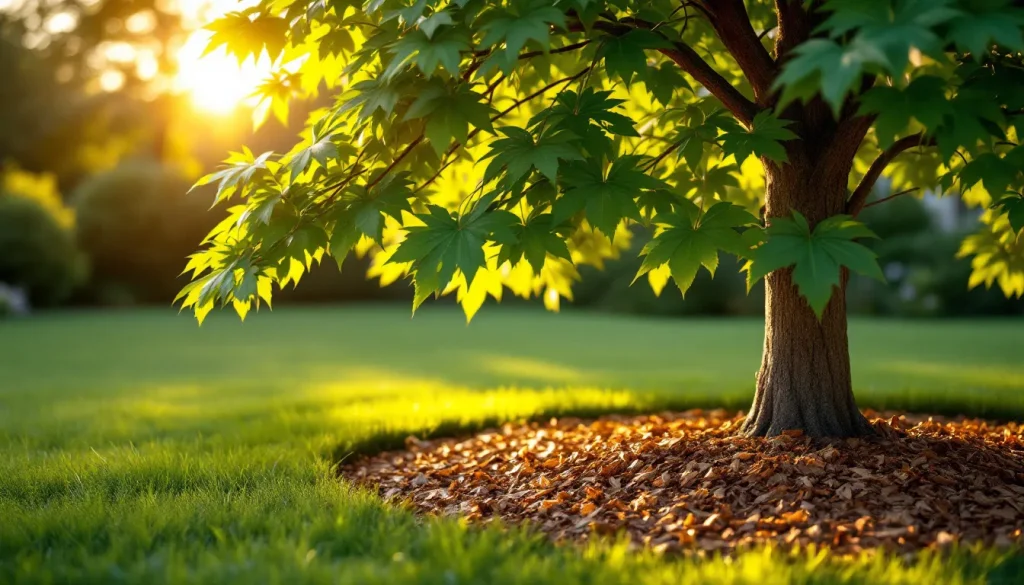
Mulch around trees in a flat, wide donut: 2 to 4 inches deep, pulled back 3 to 6 inches from the trunk so the bark and root flare stay exposed, spread out toward the drip line. Use organic wood chips, shredded hardwood, or bark. Never pile mulch against the trunk in a cone, the shape arborists call a mulch volcano.
That single sentence fixes most tree-mulch mistakes. The details below cover depth, width, how many bags to buy, which mulch to use, what to avoid, and how to undo a volcano you already built.
Quick reference at a glance
| Element | Do this |
|---|---|
| Depth | 2 to 4 inches (3 to 4 in for coarse chips, closer to 2 in for fine) |
| Trunk gap | Keep mulch 3 to 6 inches off the bark, root flare visible |
| Width | Out to the drip line if you can, minimum 3-foot ring on young trees |
| Shape | Flat donut, never a cone or volcano |
| Best types | Wood chips, shredded hardwood, bark, leaf mold, pine straw |
| Avoid | Fresh chips on the trunk, dyed mulch on young trees, rubber, thick stone |
| Refresh | Top up once a year, usually spring, only back to 3 inches total |
Find the root flare before you spread anything
The root flare is where the trunk widens and turns into roots at the soil line. It should always be visible, like the ankle where your leg meets your foot. Finding and protecting the flare is the single most important rule of tree mulching, and most homeowner guides bury it. If you can see the flare, you almost cannot build a volcano.
Run a simple test. Stand back and look at the base of the trunk. If it plunges straight into the ground or into a mound of mulch like a telephone pole into the dirt, the flare is buried and the tree is at risk. A healthy base looks flared, not columnar.
Before mulching a new tree, gently brush soil and nursery potting mix away until you find the top of the first main root. That level is your target soil surface. Mulch goes around it, not over it. Buried flares stay wet, invite bark rot, and encourage stem-girdling roots that slowly choke the trunk over years.
How deep should mulch be around trees
Apply 2 to 4 inches of organic mulch around trees. Three inches is the reliable middle for most yards. Coarse, chunky wood chips can go 3 to 4 inches because air moves through them. Fine, shredded, or composted material should stay near 2 inches because it packs down and holds too much water when piled deep.
Depth matters more than most people think. Under 2 inches does little for moisture or weeds and breaks down fast. Over 4 inches starves roots of oxygen, keeps the surface soggy, and pushes worms and roots up into the mulch layer where they dry out.
Measure the total layer, not the fresh top-up. If 2 inches of old mulch already sits there, add only 1 inch to reach 3. Yearly full bags on top of old bags are how a tidy ring becomes a suffocating mound.
Keep mulch off the trunk: donut, not volcano
Leave a 3 to 6 inch gap of bare soil between the mulch and the trunk. Mulch touching bark traps moisture against living tissue, softens the bark, and invites fungal rot, insects, and rodents that gnaw the base under cover. The correct profile is a donut with an open center, thick at the outside and tapering to nothing at the trunk.
A mulch volcano is the opposite: mulch heaped high and cone-shaped against the trunk. It looks neat in a parking lot and it is one of the most common ways homeowners and even hired crews slowly kill trees. The tree may look fine for three to five years, then decline as girdling roots and bark decay set in.
How far out should mulch extend around the trunk
Spread mulch as wide as you reasonably can, ideally out to the drip line, the circle on the ground under the outer tips of the branches. That is where most feeder roots live. A wider ring feeds more of the root zone and, just as important, keeps the mower and string trimmer away from the bark.
For young trees, a minimum 3-foot-diameter ring is a good floor, and 4 to 6 feet is better. For established trees, work outward year by year as far as your landscape allows. More mulched area and less turf competing at the base is almost always better for the tree.
Where to put it: cover the soil over the roots, not the trunk. Think of a wide, flat pancake centered on the tree with a hole cut out for the trunk.
How much mulch to buy around a tree (with a calculator)
To find how much mulch you need at a 3-inch depth, square the ring diameter in feet and multiply by 0.2 to get cubic feet. Divide by 2 for standard 2-cubic-foot bags, or by 27 for cubic yards. Example: a 6-foot ring needs about 7 cubic feet, roughly 4 bags. The table below does the math for common sizes.
| Ring diameter | Cubic feet at 3 in | 2 cu ft bags | Cubic yards |
|---|---|---|---|
| 3 ft | 1.8 | 1 | 0.07 |
| 4 ft | 3.1 | 2 | 0.12 |
| 5 ft | 4.9 | 3 | 0.18 |
| 6 ft | 7.1 | 4 | 0.26 |
| 8 ft | 12.6 | 7 | 0.47 |
| 10 ft | 19.6 | 10 | 0.73 |
| 12 ft | 28.3 | 14 | 1.05 |
The formula (cubic feet = diameter squared × 0.2) assumes a filled circle at 3 inches. For a 2-inch layer multiply the result by 0.67; for 4 inches multiply by 1.33. If you are mulching a ring around a mature trunk and leaving the center bare, you will use slightly less than the table shows.
Bagged versus bulk is a cost and volume question. Roughly 13.5 standard bags equal one cubic yard, so anything past about a 10-foot ring is usually cheaper delivered in bulk. For pricing and how the two compare, see our breakdown of how much mulch costs and the conversion in how many cubic feet are in a yard of mulch. If a supplier quotes by weight, our note on how much a yard of mulch weighs helps you sanity-check the load.
Best type of mulch to put around trees
The best mulch for trees is coarse organic material: arborist wood chips, shredded hardwood, or bark. These mimic the forest floor, break down into soil food, hold air, and resist washing away. Organic mulch that decomposes is a feature, not a flaw, because it feeds soil life the tree depends on.
| Mulch type | Good for trees? | Notes |
|---|---|---|
| Arborist wood chips (mixed bark, wood, leaves) | Best | Free from tree services, great structure, feeds soil |
| Shredded hardwood | Very good | Knits together on slopes, widely sold in bags |
| Bark nuggets / shredded bark | Good | Slow to break down, nuggets can float in heavy rain |
| Pine straw | Good | Light, airy, easy to spread, common in the Southeast |
| Leaf mold / composted leaves | Good | Excellent soil builder, apply thinner (about 2 in) |
| Dyed mulch | Use caution | Fine on established beds; avoid heavy use on young trees |
| Rubber mulch | Avoid | No soil benefit, holds heat, can leach compounds |
| Stone / rock | Avoid near trunks | Radiates heat, no soil food, hard to remove later |
What to avoid, and the warning signs
Skip rubber mulch and stone right up against the trunk of a tree. Rubber adds nothing to the soil and traps heat; stone and rock radiate warmth into the root zone, which stresses roots in summer and offers no organic matter. Both are common in low-maintenance designs and both work against a growing tree.
Watch out for sour or anaerobic mulch. Fresh mulch stored in a large wet pile can go anaerobic and smell like vinegar, ammonia, sulfur, or silage. That mulch is acidic enough to scorch plants. If a load smells sharp and sour instead of woody and earthy, spread it in a thin layer to air out for a few days before it touches any plant.
Dyed mulches are mostly a cosmetic and sourcing concern. The bigger risk is the wood source rather than the color. On mature bed edges dyed mulch is generally fine; around young, thin-barked trees, plain natural chips are the safer default.
Fresh versus composted wood chips
Fresh, uncomposted wood chips are safe as a surface mulch around trees as long as they stay on top of the soil and off the trunk. The old worry that fresh chips rob nitrogen only applies to the thin boundary where mulch meets soil, and it does not reach established tree roots below. Do not till fresh chips into the soil, and do not pile them against bark.
Composted or aged chips break down faster and look darker, which some homeowners prefer. Either works for trees. If you are top-dressing a vegetable bed or seedlings, lean toward composted material; for a tree ring, free fresh arborist chips are hard to beat.
Mulching newly planted versus established trees
New trees need the mulch discipline most. After planting, water in well, confirm the root flare sits at or slightly above the surrounding soil, then ring the tree with 2 to 3 inches of mulch out to at least 3 feet, trunk kept clear. Newly planted trees dry out fast, so this ring is doing real work in the first two summers.
Established trees benefit from the same donut, just wider. Their feeder roots extend well past the canopy, so expanding the mulched area outward reduces mower damage and turf competition where it matters. During dry stretches, a good mulch ring is one of the cheapest defenses a tree has; pair it with the deep-watering habits in our guide on how to prepare for a drought.
How to fix a mulch volcano (step by step)
If mulch is mounded against your tree in a cone, you can fix it in an afternoon, and doing so may reverse years of slow decline. The goal is to expose the root flare, thin the layer back to 2 to 3 inches, and check for roots that have started circling the trunk. Work gently near the bark.
- Diagnose it. If the trunk enters the mulch like a pole with no visible flare, it is a volcano. Note whether the mound is against bark or just too deep.
- Pull the mulch back with your hands or a light rake, moving it outward to widen the ring. Do not gouge the bark.
- Excavate down to the root flare. Remove mulch and any excess soil until you see the top of the first main roots and the trunk widening.
- Inspect for damage. Look for soft, dark, or peeling bark at the old mulch line, and for stem-girdling roots that circle or press into the trunk.
- Address circling roots. Small adventitious or girdling roots can often be cut cleanly back to their origin. If large roots are wrapped around the trunk, consult a certified arborist before cutting.
- Reset the depth. Spread the reclaimed mulch into a flat 2 to 3 inch donut, trunk clear by 3 to 6 inches, and let the flare dry and breathe.
Do not expect the tree to green up overnight. Exposing the flare stops ongoing harm; recovery depends on how long the bark stayed buried. Catching it early gives the best odds.
When and how often to reapply mulch
Refresh mulch around trees about once a year, usually in spring, and only enough to bring the layer back to roughly 3 inches. Organic mulch is supposed to break down, so topping up is normal. The mistake is adding a full new layer every season on top of the old, which quietly builds a mound.
Before adding anything, rake and fluff the existing mulch to break up any matted crust and measure what is already there. Pull it back off the trunk while you are at it. In many yards you need far less new mulch than you think, sometimes none, just a rake and a redistribution.
Benefits of mulching around trees
A proper mulch ring conserves soil moisture, suppresses weeds, moderates soil temperature, and builds soil as it decomposes. It also creates a no-mow buffer that prevents the mower and string trimmer wounds that are a leading cause of young-tree death. These are the same reasons forests keep their own floor covered in leaf litter.
- Moisture: a 3-inch layer slows evaporation and can meaningfully cut watering during dry spells.
- Weeds: mulch blocks light to weed seeds so fewer sprout, and the ones that do pull out easily.
- Temperature: it insulates roots against summer heat and winter freeze-thaw swings.
- Soil health: as chips decompose they feed earthworms, fungi, and microbes that improve structure.
- Trunk protection: a mulched ring keeps machinery away from the bark.
Mulch around trees: pros and cons
Done correctly, mulch is one of the highest-value, lowest-cost things you can do for a tree. The downsides come almost entirely from doing it wrong: too deep, too close, or the wrong material. The table separates the two.
| Pros (done right) | Cons (done wrong) |
|---|---|
| Retains soil moisture, less watering | Piled on the trunk, rots bark and invites pests |
| Suppresses weeds and turf competition | Too deep (4 in plus), starves roots of oxygen |
| Moderates soil temperature | Buried flare leads to stem-girdling roots |
| Builds soil and feeds soil life | Sour or anaerobic mulch can scorch plants |
| Protects the trunk from mowers | Rubber or stone adds heat, no soil benefit |
Frequently Asked Questions
How much mulch do I need around a tree?
At a 3-inch depth, square the ring diameter in feet and multiply by 0.2 to get cubic feet, then divide by 2 for standard bags. A 6-foot ring needs about 7 cubic feet, roughly 4 bags; a 10-foot ring needs about 20 cubic feet, or 10 bags. Above a 10-foot ring, bulk mulch by the cubic yard is usually cheaper than bags.
How deep should mulch be around trees?
Apply 2 to 4 inches of organic mulch, with 3 inches a safe target for most yards. Use the deeper end (3 to 4 inches) for coarse wood chips and the shallower end (about 2 inches) for fine or composted material that packs down. Measure the total layer including old mulch, and never exceed 4 inches, which suffocates roots.
Should mulch touch the tree trunk?
No. Keep mulch 3 to 6 inches away from the trunk so the bark and root flare stay exposed and dry. Mulch against bark traps moisture, softens the bark, and invites rot, insects, and rodents. The correct shape is a flat donut with an open center, not a cone piled up against the trunk.
What is a mulch volcano and why is it bad for trees?
A mulch volcano is mulch heaped in a cone against the trunk, burying the root flare. It traps moisture against the bark, promotes rot and insects, and encourages stem-girdling roots that circle and choke the trunk over several years. Trees often look fine for three to five years, then decline. Pull the mulch back into a flat donut to fix it.
How far out from the trunk should mulch extend?
Spread mulch as wide as you can, ideally out to the drip line under the branch tips where most feeder roots grow. For young trees, use at least a 3-foot-diameter ring, and 4 to 6 feet is better. For established trees, extend the ring outward over time. A wider ring feeds more roots and keeps mowers away from the bark.
What is the best type of mulch to put around trees?
Coarse organic mulch is best: arborist wood chips, shredded hardwood, or bark. These hold air, resist washing away, and break down into soil food. Pine straw and leaf mold also work well. Avoid rubber mulch and stone near the trunk, since they add no soil benefit and radiate heat into the root zone.
Is mulch around trees good or bad?
Mulch is very good for trees when applied correctly and harmful only when done wrong. A flat 2 to 4 inch donut kept off the trunk retains moisture, suppresses weeds, moderates temperature, and builds soil. The damage comes from piling mulch on the trunk, going deeper than 4 inches, or using rubber or stone against the bark.
How often should I replace mulch around trees?
Refresh mulch about once a year, usually in spring, and only enough to return the layer to roughly 3 inches. Because organic mulch is meant to decompose, topping up is normal, but do not add a full new layer over the old one every season. Rake and fluff the existing mulch first and measure before adding more.