
By the HMNDP Editorial Team, independent reporting on lawn care, landscaping, and the green-industry business.
Last reviewed: June 2026
What is maiden grass?
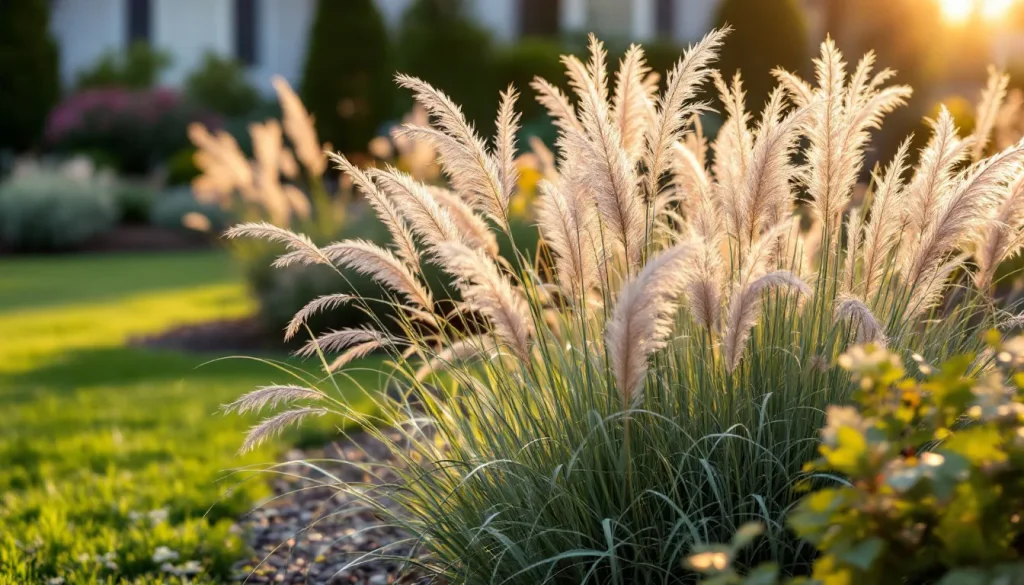
Maiden grass is the common name for Miscanthus sinensis, a clumping ornamental grass grown across USDA zones 5 to 9 for its arching silver-green blades and feathery late-summer plumes. The most-sold form is the cultivar ‘Gracillimus’. It reaches 6 to 8 feet tall and 3 to 6 feet wide, thrives in full sun, and holds tan winter interest into spring.
Gardeners use it for borders, privacy screens, foundation plantings, accents, and large containers. It is fast-growing, drought-tolerant once established, and generally deer resistant.
One point most retail listings skip: Miscanthus sinensis is on invasive-species watch or restriction lists in several US states. That legal and ecological question is covered in full below, because it should shape whether you plant it and which cultivar you choose.
Botanical identity and common names
Maiden grass is Miscanthus sinensis, a warm-season perennial grass in the family Poaceae, native to eastern Asia. In the nursery trade, “maiden grass” most often points to the fine-bladed cultivar ‘Gracillimus’, though the name is used loosely for several M. sinensis selections. It is a clumping grass, not a runner.
The plant carries several interchangeable common names that confuse buyers:
- Chinese Silver Grass: the most literal translation-style name for the species.
- Maiden Hair Grass: a spelling variant of maiden grass, unrelated to the maidenhair fern.
- Eulalia: an older trade and botanical name still seen on plant tags and in extension literature.
All four names can refer to the same species. When you shop, look for the Latin binomial and the cultivar in single quotes (for example, Miscanthus sinensis ‘Gracillimus’) so you know exactly what you are buying.
Mature size and growth habit
Maiden grass forms a dense, upright, vase-shaped clump 6 to 8 feet tall in bloom and roughly 3 to 6 feet wide, depending on cultivar and age. The foliage is fine-textured, silver-green, and arching, with a distinct pale midrib on each blade. It clumps and expands slowly from the crown rather than running through the garden.
Because it is a clumping grass, it will not send out underground runners the way some spreading grasses do. The clump widens gradually each year and can be divided to control size. Plume height sits above the foliage, so the flowering stems push the overall profile toward the top of that 6-to-8-foot range in late summer.
Growth rate is fast. A one-gallon plant set in spring often reaches 4 to 6 feet by its first fall in warm zones, and full mature size by year two or three.
Hardiness zones, sun, soil, and water
Maiden grass grows reliably in USDA hardiness zones 5 through 9, needs full sun (at least 6 hours daily), and adapts to most well-drained soils. It is drought-tolerant once established but grows fastest with regular water in its first season. Poor drainage and deep shade are its two main enemies.
| Requirement | Detail |
|---|---|
| USDA zones | 5 to 9 (some cultivars edge into zone 4 with protection) |
| Light | Full sun, minimum 6 hours; flops and thins in shade |
| Soil | Adaptable: clay, loam, or sandy, as long as it drains; tolerates poor and moderately dry soils |
| pH | Wide tolerance, roughly 5.5 to 7.5 |
| Water (year 1) | Weekly deep watering to establish roots |
| Water (established) | Drought-tolerant; occasional deep water in extended dry spells |
Salt tolerance is moderate, so it can work in coastal-adjacent plantings where a spreading turf like Bahia grass or Bermuda grass would be used for lawns rather than accents.
Bloom, fall color, and winter interest
Maiden grass blooms in late summer to early fall, sending up feathery plumes that open coppery-pink or red-bronze and fade to silver-white. As temperatures drop, the foliage shifts to gold, burgundy, or tan, and the plumes and blades hold their shape through winter, giving structure and movement to the dormant garden until you cut it back.
The plumes (technically inflorescences) sit 1 to 2 feet above the foliage and catch backlight well, which is why designers place maiden grass where morning or evening sun can hit it. In colder zones (5 and 6), bloom can arrive later or be lighter in a cool, short summer, one common reason a plant “won’t bloom” (see troubleshooting below).
Winter interest is a genuine selling point. The tan clump and bleached plumes stand through snow and wind, then get removed in late winter. That standing seed head is also part of the invasiveness story, because those seeds can be viable and wind-dispersed in many cultivars.
Is maiden grass invasive? The question retailers skip
Maiden grass (Miscanthus sinensis) is considered invasive or is regulated in several US states, and it self-seeds into natural areas in parts of the Mid-Atlantic, Southeast, and Midwest. The straight species and many cultivars produce viable, wind-blown seed. Some sterile or low-seed cultivars reduce the risk, but “maiden grass” as a category is not guaranteed sterile.
This is the single most important thing to check before planting, and it is the point most nursery and plant-database pages leave out. Miscanthus sinensis escapes cultivation, forms dense stands along roadsides and forest edges, and can crowd out native vegetation. It also adds fuel load in fire-prone regions.
Regulatory status varies by state and changes over time, so treat the list below as a prompt to verify locally, not as legal advice. Status can depend on your state and, in some cases, county.
| State (examples) | Typical status of Miscanthus sinensis |
|---|---|
| Massachusetts | Prohibited/banned from sale as of recent state invasive-plant rules |
| Connecticut | Listed as invasive; sale may be restricted |
| New York | Regulated invasive in state rule tiers |
| Wisconsin | Listed/regulated under the state invasive species rule (NR 40) |
| Virginia, Tennessee, Missouri, others | Flagged as invasive or “watch” by state agencies or extension programs |
What to do with this: before you buy, search your state department of agriculture or land-grant extension (for example, your state’s “invasive plant list” plus “Miscanthus sinensis”). If it is prohibited where you live, do not plant it, and choose a native alternative from the section below. If it is legal but flagged, choose a sterile or low-seed cultivar and deadhead the plumes before seed matures.
Is ‘Gracillimus’ sterile, and does it self-seed?
‘Gracillimus’ is often described as low-seed or shy to set viable seed in cooler climates, but it is not reliably sterile. In warm regions with long growing seasons, ‘Gracillimus’ and similar cultivars can produce viable seed that spreads. Do not treat any Miscanthus sinensis cultivar as guaranteed non-seeding unless the grower documents true sterility.
Seed viability depends heavily on climate and season length. The same cultivar that rarely seeds in Minnesota may seed freely in North Carolina. If you want the maiden grass look with far lower ecological risk, two paths work: pick a documented sterile cultivar, or cut off the plumes in fall before seed drops (which also removes the winter interest, a real trade-off).
Sterile and low-seed cultivars vs native alternatives
If maiden grass is legal but flagged in your area, you have two responsible routes: a low-seed or sterile Miscanthus selection, or a native warm-season grass that gives similar height, texture, and plumes without the invasiveness concern. Native switchgrass and little bluestem are the two most common substitutes.
| Alternative | Type | Height | Why choose it |
|---|---|---|---|
| Miscanthus ‘Gracillimus’ | Cultivar, low-seed in cool zones | 6 to 8 ft | Classic maiden grass look; deadhead in warm zones |
| Switchgrass (Panicum virgatum) | US native | 3 to 6 ft | Upright, airy plumes, strong fall color, non-invasive native |
| Little bluestem (Schizachyrium scoparium) | US native | 2 to 4 ft | Blue-green summer, copper winter, tough and drought-hardy |
| Prairie dropseed (Sporobolus heterolepis) | US native | 2 to 3 ft | Fine fountain form, fragrant plumes, tidy clump |
Native grasses also support regional insects and birds, which straight Miscanthus does not to the same degree. For a low-maintenance, no-seed accent with year-round consistency, some homeowners even pair beds with artificial grass surfaces and use native clumping grasses as the living accent.
Maiden grass vs pampas grass
Maiden grass (Miscanthus sinensis) and pampas grass (Cortaderia selloana) are different plants that buyers constantly confuse. Maiden grass is smaller, hardy to zone 5, clumps politely, and has fine arching blades. Pampas grass is larger, cold-tender (roughly zones 7 to 11), has huge cotton-candy plumes, and razor-edged leaves. Both can be invasive in the wrong region.
| Feature | Maiden grass (Miscanthus sinensis) | Pampas grass (Cortaderia selloana) |
|---|---|---|
| Mature height | 6 to 8 ft | 8 to 12 ft |
| Hardiness zones | 5 to 9 | 7 to 11 (cold-tender) |
| Plume | Feathery, coppery-pink to silver, slender | Large, dense, white or pink “duster” |
| Foliage | Fine, arching, soft-edged | Coarse, sharp, saw-toothed edges |
| Habit | Clumping | Clumping but massive; can seed aggressively |
| Invasiveness | Regulated in some Northeast/Midwest states | Banned or invasive in parts of CA, TX, HI, Southeast |
Rule of thumb: if you are north of zone 7 and want a manageable 6-to-8-foot grass, maiden grass fits. If you want a towering plume specimen and live in a mild climate, that is pampas grass, but check its invasive status too, especially in California and the Gulf states.
Best maiden grass varieties
The best maiden grass variety depends on the size, plume color, and foliage you want. ‘Gracillimus’ is the tall classic; ‘Morning Light’ is a refined variegated form; ‘Adagio’ is the compact choice; ‘Variegatus’ and ‘Zebrinus’ add cream stripes or horizontal gold bands. Use the table to match a cultivar to your bed size and zone.
| Cultivar | Height | Zones | Foliage | Plume / notes |
|---|---|---|---|---|
| ‘Gracillimus’ | 6 to 8 ft | 5 to 9 | Fine silver-green, narrow | Coppery plume; the classic maiden grass; low-seed in cool zones |
| ‘Morning Light’ | 5 to 6 ft | 5 to 9 | Fine white-edged variegation, silvery overall | Reddish plume; refined, often lower-seed; top pick for smaller yards |
| ‘Adagio’ | 3 to 4 ft | 5 to 9 | Fine gray-green | Pink-to-cream plume; compact, best for tight borders and containers |
| ‘Variegatus’ | 5 to 7 ft | 5 to 9 | Bold cream-and-green vertical stripes | Bright, may need staking; softer stems can flop |
| ‘Zebrinus’ | 6 to 8 ft | 5 to 9 | Green with horizontal gold bands | “Zebra grass”; striking novelty; can flop without full sun |
For most home gardeners in zones 5 to 9, ‘Morning Light’ and ‘Adagio’ are the easiest to place because they stay in scale and tend to hold upright. Reserve the tall ‘Gracillimus’, ‘Variegatus’, and ‘Zebrinus’ for spots with true full sun and room to spread 4 feet or more.
How to plant maiden grass and spacing
Plant maiden grass in spring or early fall in full sun, spacing plants 3 to 6 feet apart (center to center) for accents, or 2.5 to 3 feet apart for a solid privacy screen. Dig a hole as deep as the root ball and twice as wide, set the crown at soil level, backfill, and water deeply. It establishes fast in warm soil.
- Choose a full-sun site with well-drained soil and room for a 4-to-6-foot-wide mature clump.
- Water the potted plant first, then dig a hole the same depth as the root ball and about twice as wide.
- Loosen circling roots, set the plant so the crown sits at or just above grade, and backfill with native soil.
- For a screen or hedge, space clumps 2.5 to 3 feet apart so they knit together; for specimens, 4 to 6 feet apart.
- Water deeply and mulch 2 to 3 inches, keeping mulch off the crown.
- Water weekly through the first growing season, then taper as roots establish.
Spring planting gives the longest establishment window before winter, which matters most in zones 5 and 6.
Pruning, division, and winter care
Cut maiden grass back to about 6 inches in late winter or very early spring, before new green growth emerges. Every 3 to 4 years, divide the clump to rejuvenate it and control size. These two tasks are the entire maintenance calendar for an established plant, aside from first-year watering.
To cut back, tie the clump into a bundle with rope or a bungee, then shear it with hedge shears, a string trimmer, or a hand saw for old woody crowns. Bundling keeps the debris contained and speeds cleanup. Do this before spring growth so you avoid clipping fresh blades.
Division: older clumps die out in the center, leaving a bare donut. In early spring, dig the clump, split it with a sharp spade or saw into fist-sized divisions with roots and shoots, discard the dead center, and replant. Division rejuvenates vigor and gives you free plants.
Pests, disease, and deer resistance
Maiden grass has few pest and disease problems and is generally deer resistant. The main issues are miscanthus mealybug and occasional rust or leaf-spot fungus in humid, crowded plantings. Good air circulation, full sun, and not overcrowding clumps prevent most trouble. Deer usually leave the coarse foliage alone.
Miscanthus mealybug lives inside the stems and can stunt growth; badly affected clumps are best dug and destroyed rather than treated. Rust and leaf spot are cosmetic in most seasons and rarely need spraying. Because the plant is low-input, it pairs well with lower-maintenance landscapes, including yards that mix living beds with artificial grass installation for the lawn areas.
Troubleshooting: flopping, not blooming, and dying maiden grass
The three most common maiden grass complaints are flopping (opening in the middle), failure to bloom, and browning or dieback. Nearly all trace back to too little sun, too much nitrogen or water, or an aging clump that needs division. Fix the cause rather than the symptom.
| Problem | Likely cause | Fix |
|---|---|---|
| Flopping / open center | Too little sun, too much water or nitrogen, or an old clump | Move to full sun, cut back on feeding/irrigation, or divide the clump |
| Not blooming | Shade, cool short season, or a very young plant | Ensure 6+ hours sun; in zones 5 to 6 expect later, lighter bloom; be patient in year 1 |
| Browning / dieback in center | Aging clump dying out from the middle | Divide every 3 to 4 years and replant vigorous outer sections |
| Yellowing, soggy base | Poor drainage or overwatering | Improve drainage; water deeply but infrequently once established |
If a plant flops every year despite full sun, the cultivar matters: tall ‘Gracillimus’, ‘Variegatus’, and ‘Zebrinus’ are more flop-prone than compact ‘Adagio’ or upright ‘Morning Light’. Staking with a hidden ring or a linked-stake grid in early summer holds a tall clump upright without visible supports.
Where and how to buy maiden grass
Maiden grass is sold at independent garden centers, big-box nurseries, and mail-order plant retailers, usually as one-gallon or three-gallon container plants in spring. Buy by cultivar name in single quotes, confirm the zone on the tag, and check your state’s invasive-plant status before purchasing. Larger three-gallon plants give faster screening results.
Shop in spring for the best selection and the longest establishment window. A one-gallon plant costs less and catches up within a season or two; a three-gallon plant gives an instant 3-to-4-foot presence. For a privacy screen, buy enough plants to space 2.5 to 3 feet apart along the run. If your state prohibits Miscanthus sinensis, ask the retailer for a native alternative such as switchgrass or little bluestem instead.
Frequently Asked Questions
Is maiden grass invasive?
Maiden grass (Miscanthus sinensis) is considered invasive or regulated in several US states, including parts of the Northeast and Midwest, and it self-seeds into natural areas in warmer regions. The straight species and many cultivars set viable, wind-blown seed. Check your state’s invasive-plant list before planting, choose a documented sterile or low-seed cultivar, or select a native alternative.
What is the difference between maiden grass and pampas grass?
Maiden grass (Miscanthus sinensis) is smaller at 6 to 8 feet, hardy to zone 5, with fine soft-edged blades and slender coppery plumes. Pampas grass (Cortaderia selloana) grows 8 to 12 feet, is cold-tender to about zone 7, and has huge dense white or pink plumes plus sharp saw-edged leaves. They are different species that buyers often confuse.
What are the best maiden grass varieties?
Top maiden grass cultivars are ‘Gracillimus’ (the tall 6-to-8-foot classic), ‘Morning Light’ (refined variegated, 5 to 6 feet), ‘Adagio’ (compact, 3 to 4 feet), ‘Variegatus’ (bold cream stripes), and ‘Zebrinus’ (horizontal gold bands, “zebra grass”). For smaller yards choose ‘Morning Light’ or ‘Adagio’, which stay in scale and resist flopping better than the taller forms.
How tall and wide does maiden grass get?
Maiden grass typically reaches 6 to 8 feet tall in bloom and 3 to 6 feet wide as a clumping, vase-shaped grass, though size varies by cultivar. Compact ‘Adagio’ stays near 3 to 4 feet, while ‘Gracillimus’ and ‘Zebrinus’ hit the top of the range. The flowering plumes rise 1 to 2 feet above the foliage in late summer.
When and how do you cut back maiden grass?
Cut maiden grass back to about 6 inches in late winter or very early spring, before new growth emerges. Tie the clump into a bundle with rope or a bungee cord, then shear it with hedge shears, a string trimmer, or a hand saw for old woody crowns. Bundling first keeps debris contained and makes cleanup fast.
What growing zones does maiden grass tolerate?
Maiden grass is hardy in USDA hardiness zones 5 through 9, with some cultivars edging into zone 4 with winter protection. It needs full sun (at least 6 hours daily) and well-drained soil across that range. In cooler zones 5 and 6, expect later or lighter blooming during short, cool summers.
How far apart should you plant maiden grass?
Space maiden grass 3 to 6 feet apart (center to center) for specimen or accent plantings, matching the mature clump width. For a solid privacy screen or hedge, tighten spacing to 2.5 to 3 feet so the clumps knit together within a season or two. Wider spacing keeps individual plants distinct; tighter spacing creates a fuller wall.
Is maiden grass (Gracillimus) sterile, and does it self-seed?
‘Gracillimus’ is often described as low-seed and is shy to set viable seed in cooler climates, but it is not reliably sterile. In warm, long-season regions it can produce viable seed that spreads. Do not treat any Miscanthus sinensis cultivar as guaranteed non-seeding unless the grower documents true sterility. Deadheading plumes in fall reduces spread.