
By the HMNDP Editorial Team, independent reporting on lawn care, landscaping, and the green industry.
Last reviewed: June 2026
What liquid copper fungicide is
Liquid copper fungicide is a preventive spray that uses fixed copper, most often copper octanoate (also called copper soap), to control fungal and bacterial plant diseases. Copper ions disrupt enzyme systems in fungal spores and bacteria on the plant surface, stopping them before they infect. It is a contact protectant, not a systemic cure, so it works only where the spray lands.
The active ingredient matters. Most home garden liquids list copper octanoate at 0.08 percent to 10 percent metallic copper equivalent. Older or agricultural products may use copper hydroxide, copper sulfate, or copper oxychloride, which are stronger but carry higher phytotoxicity risk.
Because copper sits on the leaf surface, rain and new growth reduce coverage over time. That is why reapplication every 7 to 10 days during disease pressure is standard, not optional. For a broader look at copper chemistry and soil accumulation, see our copper fungicide mix and soil safety guide.
Diseases liquid copper fungicide controls (and the ones it does not)
Liquid copper fungicide controls bacterial and many fungal diseases when applied before or at the first sign of infection. It suppresses bacterial leaf spot, fire blight, early and late tomato blight, downy mildew, anthracnose, peach leaf curl, citrus greasy spot, and walnut blight. It is preventive, so it protects healthy tissue rather than healing infected tissue.
Copper is weaker on true powdery mildew and offers little control of rusts. Sulfur or a systemic product usually outperforms copper on powdery mildew. Copper cannot reverse damage already visible on a leaf, and it will not clear soilborne root rots.
| Disease | Copper effectiveness | Better alternative if weak |
|---|---|---|
| Bacterial leaf spot | Strong (few other options) | Copper is the standard |
| Fire blight | Good (dormant and bloom) | Streptomycin (commercial only) |
| Early / late blight (tomato) | Good preventive | Chlorothalonil rotation |
| Downy mildew | Good preventive | Rotate to avoid resistance |
| Anthracnose, peach leaf curl | Strong (dormant timing) | Copper is the standard |
| Powdery mildew | Weak to moderate | Sulfur or potassium bicarbonate |
| Rusts | Weak | Systemic fungicide |
To match a product to your exact diagnosis, our fungicide for plants disease-matching guide lays out the decision tree.
Mix ratio for liquid copper fungicide per gallon (brand-by-brand)
The mix ratio for liquid copper fungicide is typically 0.5 to 4 tablespoons of concentrate per gallon of water, depending on the brand and target disease. Read the label, because metallic copper concentration varies widely between products. Dormant sprays and bacterial diseases usually call for the higher end of the range, while light foliar prevention uses the lower end.
| Product (concentrate) | General foliar rate | Heavy / dormant rate |
|---|---|---|
| Southern Ag Liquid Copper Fungicide | 1 to 2 tbsp per gallon | 3 to 4 tbsp per gallon |
| Monterey Liqui-Cop | 1 to 3 tbsp per gallon | Up to 4 tbsp per gallon |
| Bonide Liquid Copper (Captain Jack’s) | 0.5 to 2 tbsp per gallon | Up to 4 tbsp per gallon |
These figures are typical label ranges as of 2026. Always confirm against the label printed on your specific bottle, since manufacturers periodically revise concentrations. When in doubt, start at the lower rate to reduce phytotoxicity risk, then increase only if disease pressure is high.
How to use liquid copper fungicide on plants
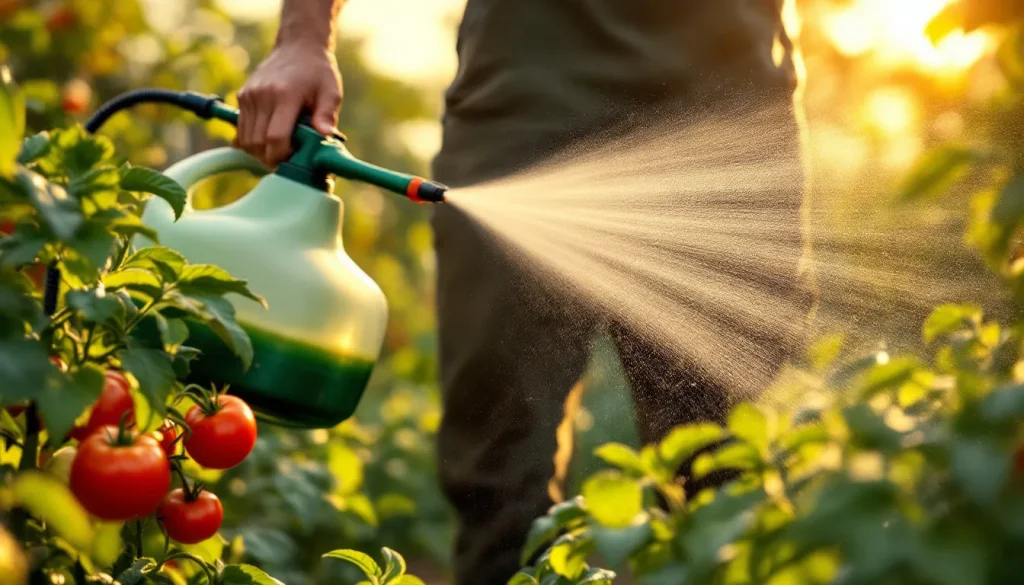
To use liquid copper fungicide, dilute the concentrate at the label rate, load a hose-end or tank sprayer, and coat all leaf surfaces including the undersides until wet but not dripping. Spray in the early morning or evening when temperatures are moderate and no rain is expected for 12 to 24 hours. Reapply every 7 to 10 days while disease pressure lasts.
- Shake the concentrate well and measure the correct tablespoons per gallon for your product and disease.
- Mix into water in a clean tank sprayer or pre-calibrated hose-end sprayer. Ready-to-spray (RTS) bottles attach straight to the hose with no measuring.
- Spray upper and lower leaf surfaces, stems, and developing fruit for full coverage.
- Avoid drift onto ponds and pollinator plants, since copper is toxic to fish and aquatic life.
- Triple-rinse equipment after use to prevent corrosion and residue buildup.
Concentrate vs ready-to-spray vs ready-to-use: cost per use
Concentrate is the cheapest per gallon and best for large gardens or repeat seasons, ready-to-spray (RTS) trades some cost for hose-end convenience, and ready-to-use (RTU) trigger bottles cost the most per ounce but suit a few potted plants. Choose format by garden size, not by shelf price alone.
| Format | Best for | Relative cost per use |
|---|---|---|
| Concentrate (pint / quart) | Orchards, vegetable rows, repeat seasons | Lowest |
| Ready-to-spray (hose-end) | Medium gardens, no measuring wanted | Medium |
| Ready-to-use (trigger spray) | A few pots, tomatoes, spot treatment | Highest |
On active ingredient, copper octanoate (copper soap) is gentler on foliage than copper hydroxide or copper sulfate at equivalent metallic copper, which is why home garden liquids favor it. Copper hydroxide and copper sulfate deliver more punch per ounce but raise phytotoxicity and soil-loading risk.
Dormant and growing season timing
Copper timing splits into two windows. Apply dormant sprays in late fall after leaf drop and again in late winter before bud break to hit overwintering spores of peach leaf curl, fire blight, and anthracnose. During the growing season, apply at the first sign of disease and repeat every 7 to 10 days, backing off in high heat.
- Dormant (fall and late winter): peach leaf curl, fire blight, walnut blight, anthracnose on fruit trees.
- Early growing season: bacterial leaf spot and downy mildew as leaves emerge.
- Active disease: tomato blight and citrus disease at first symptoms, then every 7 to 10 days.
Copper works alongside a full-season plan. For diseases copper handles poorly, a systemic fungicide comparison shows where an absorbed product fits better.
Copper phytotoxicity and safety limits
Liquid copper fungicide can injure plants (phytotoxicity) when applied in heat, on wet foliage, or too frequently. Avoid spraying above roughly 85 degrees Fahrenheit or when leaves stay wet for long periods, since both conditions increase copper uptake and cause leaf spotting, russeting, or defoliation. Copper-sensitive plants and cool wet spring conditions raise the risk further.
Copper is a heavy metal that accumulates in soil, where it can harm earthworms and microbes over years of heavy use. Rotate copper with other chemistries and avoid drenching the same beds season after season. Runoff is toxic to fish, so keep spray away from water features.
Observe re-entry and pre-harvest intervals. Many labels allow re-entry once the spray dries and permit harvest up to 1 day before picking, but intervals vary by crop and product, so confirm on your label. Wear gloves and eye protection when mixing concentrate.
Safety for vegetables and organic gardening
Many liquid copper fungicides are OMRI Listed and approved for organic gardening on vegetables, fruit, citrus, tomatoes, flowers, and ornamentals. Copper octanoate products from Bonide, Monterey, and Southern Ag commonly carry the OMRI seal. Organic approval does not mean unlimited use, since copper still accumulates in soil and can burn foliage if overapplied.
Wash harvested produce before eating, and follow the label pre-harvest interval for each crop. Organic certification for a product covers the ingredient, not careless application, so the same temperature and frequency limits apply.
Where to buy liquid copper fungicide
You can buy liquid copper fungicide on Amazon, at garden centers like Ace Hardware and independent nurseries, at farm stores such as Tractor Supply, and directly from manufacturers Bonide, Monterey, and Southern Ag. Amazon carries the widest brand and format selection, while local garden centers let you match a product to a diagnosed disease with staff help.
Expect concentrate pints to run roughly 12 to 25 US dollars as of 2026, with RTS and RTU bottles priced higher per ounce. Buy concentrate for value on larger jobs, and check that the label lists your target crop and disease before purchase. A dilute foliar feed like a liquid lawn fertilizer is unrelated to copper and should never be tank-mixed without label clearance.
Frequently Asked Questions
What is liquid copper fungicide and how does it work?
Liquid copper fungicide is a preventive spray using fixed copper, usually copper octanoate (copper soap), to control fungal and bacterial plant diseases. Copper ions released on the leaf surface disrupt spore and bacterial enzymes, stopping infection before it starts. It is a contact protectant, not a systemic cure, so it only protects tissue the spray actually covers and needs reapplication after rain.
What is the mix ratio for liquid copper fungicide per gallon?
The typical mix ratio is 0.5 to 4 tablespoons of concentrate per gallon of water, depending on the brand and disease. Southern Ag and Monterey often run 1 to 3 tablespoons per gallon for foliar use and up to 4 for dormant or bacterial sprays. Bonide can start near 0.5 tablespoon. Always confirm the rate on your specific product label before mixing.
How do you use liquid copper fungicide on plants?
Dilute the concentrate at the label rate, load a hose-end or tank sprayer, and coat all leaf surfaces including undersides until wet but not dripping. Spray in early morning or evening when temperatures are moderate and no rain is expected for 12 to 24 hours. Reapply every 7 to 10 days during disease pressure, and rinse equipment after each use.
What diseases does liquid copper fungicide control?
Liquid copper fungicide controls bacterial leaf spot, fire blight, early and late tomato blight, downy mildew, anthracnose, peach leaf curl, and citrus greasy spot when applied preventively. It is weak on powdery mildew and rusts, where sulfur or a systemic product works better. Copper cannot cure visible infections or clear soilborne root rots, so timing before symptoms matters most.
Is liquid copper fungicide safe for vegetables and organic gardening?
Many liquid copper fungicides are OMRI Listed and approved for organic gardening on vegetables, fruit, citrus, tomatoes, and ornamentals. Bonide, Monterey, and Southern Ag copper octanoate products commonly carry the OMRI seal. Organic approval does not remove limits: copper accumulates in soil, can burn foliage in heat, and each crop has a pre-harvest interval. Wash produce and follow the label.
How often can you apply liquid copper fungicide?
Apply liquid copper fungicide every 7 to 10 days while disease pressure lasts, since rain and new growth erode coverage. Add dormant sprays in late fall and late winter for overwintering diseases like peach leaf curl. Avoid overapplication, because copper accumulates in soil and repeated heavy use can injure foliage and harm earthworms and soil microbes over time.
Can liquid copper fungicide harm plants (phytotoxicity)?
Yes, copper can cause phytotoxicity, showing as leaf spotting, russeting, or defoliation, especially when applied above roughly 85 degrees Fahrenheit, on wet foliage, or too frequently. Cool wet spring conditions and copper-sensitive plants raise the risk. Start at the lower label rate, spray in mild conditions, and rotate chemistries to limit both leaf injury and copper buildup in the soil.
Where can you buy liquid copper fungicide?
You can buy liquid copper fungicide on Amazon, at garden centers such as Ace Hardware and independent nurseries, at farm stores like Tractor Supply, and directly from Bonide, Monterey, and Southern Ag. Amazon has the widest format range, from concentrate to ready-to-spray and ready-to-use. Concentrate pints commonly cost 12 to 25 US dollars as of 2026 and offer the lowest cost per use.