
By the HMNDP Editorial Team, independent reporting on lawn care, landscaping, water, and the green-industry business.
Last reviewed: June 2026
What lawn fungus is
Lawn fungus is the visible result of pathogenic fungi infecting your turf, attacking grass blades, stems, crowns, and roots. Most lawn diseases (brown patch, dollar spot, red thread, and others) are fungal, not insect or nutrient problems. The fungus feeds on living grass tissue, killing it in patches, rings, or spots. It spreads through spores carried by wind, water, mowers, and shoes.
The fungi that cause these diseases live in almost every lawn already. Grass usually keeps them in check. Disease appears only when weather and lawn-care mistakes tip the balance in the fungus’s favor.
That distinction matters for treatment. You are rarely fighting an invasion from outside. You are removing the conditions that let a resident organism overrun the grass. That is why watering and mowing changes often work better than a spray.
What lawn fungus looks like
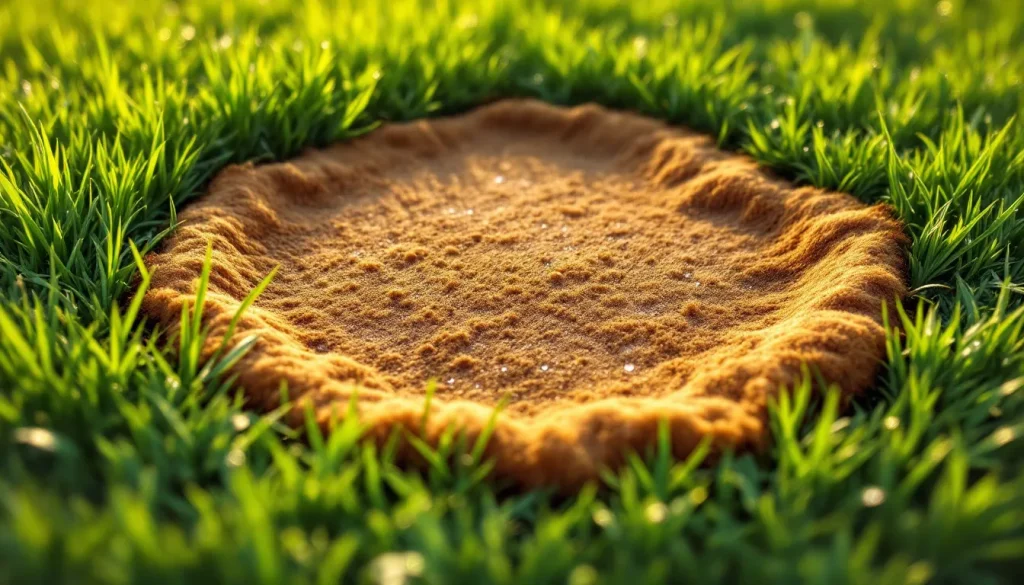
Lawn fungus looks like discolored patches that appear over days, not a single day. Watch for tan, brown, straw-colored, or yellow areas, circular rings or arcs, small spots on individual blades, a slimy or greasy look in heat, or a white, pink, gray, or orange coating on the grass. The pattern (shape, edge, and color) is the single best clue to which disease you have.
Healthy grass browns evenly from drought or dormancy. Fungus browns in shapes: circles, crescents, irregular blotches, or a fine web of threads. If the dead area has a defined edge or a ring, suspect disease.
Look closely at individual blades in early morning while dew is present. Many fungi are easiest to see then. You may find fine white threads (mycelium), rust-colored dust that rubs off on your fingers, small reddish threads at the blade tips, or dark spots with colored borders.
Pattern beats color for identification. Two diseases can both look brown, but one makes a 6-inch circle and another makes a scattered speckle. The next section turns those patterns into a diagnosis.
The symptom-to-disease-to-action path (self-diagnosis)
Most guides list diseases and list fixes but never connect the two, so you still cannot tell what you have or whether you need a fungicide. Use this path instead. Start with the pattern you see, match it to the likely disease, then read the action column to decide between a cultural fix and a spray. Confirm with the season and grass type before you buy anything.
| What you see | Likely disease | Typical season / trigger | First action | Fungicide needed? |
|---|---|---|---|---|
| Circular tan patches 6 inches to several feet, often with a darker smoke ring at the edge | Brown patch | Hot, humid nights above 70 F | Stop evening watering, cut nitrogen | Only if it keeps spreading |
| Silver-dollar-size bleached spots that merge; hourglass lesions on blades | Dollar spot | Warm days, cool dewy nights, low nitrogen | Feed lightly, water deep and early | Sometimes, if widespread |
| Pink or red thread-like strands binding blade tips, ragged patches | Red thread | Cool, wet spring and fall; low fertility | Apply nitrogen, improve airflow | Rarely |
| White or gray powder dusting the blades, mostly in shade | Powdery mildew | Shady, humid, poor airflow | Prune for light and air, mow higher | Rarely |
| Orange or yellow dust that rubs off on shoes and fingers | Rust | Late summer, slow-growing turf | Fertilize and water to push growth | Rarely |
| Matted gray, white, or pink patches after snow melts | Snow mold | Late winter under snow or leaves | Rake to dry it out, wait for growth | Rarely, preventive only |
| Fast-collapsing greasy, water-soaked streaks in extreme heat | Pythium blight | Hot nights, soggy soil, poor drainage | Stop watering, fix drainage now | Often, acts fast |
| Dark green or dead ring of grass, sometimes mushrooms on the arc | Fairy ring | Buried organic matter, old roots | Aerate and water the ring deeply | Usually not effective |
The decision rule is simple. If the disease is on the low-risk end (red thread, rust, powdery mildew, most snow mold), fix the cultural cause and the grass usually recovers without chemicals. If it spreads fast or threatens to kill large areas (pythium, aggressive brown patch, widespread dollar spot), a fungicide buys time while you correct the conditions.
Two look-alikes trip up homeowners. Circular brown areas can be grub damage rather than fungus. If the turf peels back like carpet and you find white C-shaped larvae, it is grubs, and a fungicide will do nothing. Mushrooms popping up are usually a sign of decaying wood underground, not always a lawn disease. Our guide to mushrooms in a lawn explains when they matter and when to ignore them.
Named common lawn diseases
Eight fungal diseases cause the large majority of home-lawn problems in North America. Each favors a specific temperature range and grass type, which is why season and location narrow the list quickly. Cool-season grasses (fescue, ryegrass, Kentucky bluegrass) and warm-season grasses (Bermuda, zoysia, St. Augustine) get partly different diseases.
- Brown patch: Circular tan patches in hot, humid weather. Common on tall fescue and St. Augustine. Caused by Rhizoctonia solani.
- Dollar spot: Small bleached spots the size of a coin. Worst on low-nitrogen lawns with heavy dew. Caused by Clarireedia species.
- Red thread: Pink-red threads on blade tips in cool, wet weather. A fertility problem as much as a disease. Caused by Laetisaria fuciformis.
- Powdery mildew: White dust in shade, mostly on Kentucky bluegrass. More cosmetic than deadly.
- Rust: Orange spore dust in late summer, common on ryegrass and slow-growing turf.
- Snow mold: Matted patches revealed at snowmelt. Gray snow mold and pink snow mold differ in severity, with pink able to kill crowns.
- Pythium blight (damping-off): The fastest and most destructive. Kills seedlings and mature turf overnight in hot, wet conditions.
- Fairy ring: Rings of dark grass, dead grass, or mushrooms fed by organic matter breaking down in the soil.
If your problem is one persistent tan circle rather than a whole-lawn issue, our detailed breakdown of brown patches in a lawn walks through causes and repair step by step.
What causes lawn fungus
Lawn fungus is caused by moisture, temperature, and lawn-care habits that favor the fungi already living in your soil. The three biggest triggers are water sitting on the grass too long, prolonged leaf wetness from night watering or poor drainage, and stress from mowing too low or feeding at the wrong time. Weather sets the stage; your maintenance decides whether disease breaks out.
Overwatering is the leading avoidable cause. Grass that stays wet for more than 10 to 12 hours gives spores the moisture they need to germinate and enter the blade. Watering at night, or watering daily in short bursts, keeps the canopy wet exactly when fungi are active.
Poor drainage and compacted soil hold water at the root zone and starve grass of oxygen, weakening it. High humidity and warm nights (many diseases wake up when nights stay above 65 to 70 F) accelerate spore growth. Thick thatch, the dead layer above the soil, traps moisture and harbors fungi.
Fertilizer timing cuts both ways. Too much fast-release nitrogen pushes soft, lush growth that brown patch and pythium love. Too little nitrogen invites dollar spot and red thread. Balance, not maximum feeding, protects the lawn.
How to prevent lawn fungus with cultural practices
You prevent lawn fungus by keeping grass dry, uncompacted, and moderately fed. Cultural practices (how you water, mow, aerate, and fertilize) prevent far more disease than any spray, because they remove the moisture and stress that fungi need. Get these six habits right and most lawns never need a fungicide.
- Water deep and infrequent, early in the day. Apply about 1 inch per week in one or two soakings rather than daily sprinkles. Water between 4 a.m. and 9 a.m. so blades dry by midday. Never water in the evening.
- Mow at the right height and keep blades sharp. Most cool-season grasses do best at 3 to 4 inches. Never remove more than one-third of the blade at once. A dull blade shreds grass and opens wounds for infection.
- Aerate compacted soil once a year. Core aeration in spring or fall relieves compaction, improves drainage, and gets oxygen to roots.
- Dethatch when thatch tops half an inch. Removing the trapped, moist dead layer takes away fungal habitat.
- Fertilize on a balanced schedule. Follow a soil test, favor slow-release nitrogen, and avoid heavy feeding in peak heat when disease pressure is highest.
- Improve airflow and light. Prune overhanging branches and thin shrubs so sun and wind dry the turf. Shade and stagnant air are a fungus greenhouse.
Note that these same conditions favor other lawn invaders. Damp, shaded, compacted ground that grows fungus also grows moss, so if you see green mats spreading, our guide to getting rid of moss in a lawn targets the same root causes.
How to treat lawn fungus and when to use a fungicide
Treat lawn fungus by first correcting the cause, then applying a fungicide only if the disease is spreading fast or killing large areas. For slow, cosmetic diseases (red thread, rust, powdery mildew), cultural fixes alone usually cure it. For aggressive diseases (pythium, severe brown patch), a fungicide stops active spread while the grass recovers. Match the product to the disease.
Before you spray, confirm it is actually fungus and not drought, dog urine, grubs, or fertilizer burn. Fungicides do nothing against those, and applying them anyway wastes money and stresses the lawn.
Fungicides come in two modes. Contact fungicides sit on the blade surface and protect for 7 to 14 days; they are good for prevention. Systemic fungicides move into the plant and can stop an active infection for up to 3 to 4 weeks. Read the label for the specific disease and grass type.
| Active ingredient | Type | Best against | Notes |
|---|---|---|---|
| Azoxystrobin | Systemic | Brown patch, dollar spot, pythium, rust | Broad-spectrum, longer control |
| Propiconazole | Systemic | Brown patch, dollar spot, snow mold, red thread | Common in home products |
| Myclobutanil | Systemic | Rust, dollar spot, powdery mildew | Widely sold to homeowners |
| Chlorothalonil | Contact | Broad prevention across many diseases | Protective, not curative; reapply often |
Apply at the first clear signs, follow the label rate exactly, and water it in or leave it on the blade as the product directs. Rotate between two different active-ingredient classes across the season so the fungus does not build resistance. Most labels allow reapplication every 14 to 28 days during active disease pressure.
Grass usually recovers on its own once conditions improve. Fungus kills the visible blade but often spares the crown and roots, so healthy turf fills back in over a few weeks of good weather and correct watering. Reseed only bare spots that stay dead after a month.
Frequently Asked Questions
What does lawn fungus look like?
Lawn fungus looks like discolored patches in defined shapes: tan or brown circles, rings, small bleached spots, or a white, pink, gray, or orange coating on the blades. Unlike even drought browning, disease appears in patterns with distinct edges. Check in early morning dew for fine white threads, rust-colored dust, or spotted blades, which confirm a fungal problem.
What causes lawn fungus?
Lawn fungus is caused by moisture and stress that favor fungi already in the soil. The main triggers are overwatering, watering at night, poor drainage, high humidity, warm nights above 65 to 70 F, thick thatch, and unbalanced fertilizing. Weather creates the risk, but lawn-care habits decide whether disease actually breaks out. Correcting those habits prevents most outbreaks.
How do I get rid of lawn fungus?
Get rid of lawn fungus by first removing the cause: stop night watering, water deep and early, mow higher with a sharp blade, aerate, and balance fertilizer. For slow diseases these steps alone cure it. For fast-spreading disease like pythium or severe brown patch, add a systemic fungicide matched to the disease while conditions improve and the grass recovers.
What is the best lawn fungus treatment or fungicide?
The best treatment depends on the disease. Azoxystrobin and propiconazole are broad-spectrum systemic options covering brown patch and dollar spot. Myclobutanil handles rust and powdery mildew. Chlorothalonil is a contact product for prevention. There is no single best fungicide; match the active ingredient to your diagnosed disease, follow label rates, and rotate classes to avoid resistance.
Will lawn fungus go away on its own?
Lawn fungus often goes away on its own once the weather that triggered it passes and you correct watering. Cosmetic diseases like red thread, rust, and powdery mildew usually clear without chemicals. Aggressive diseases like pythium blight can kill large areas before conditions change, so those may need a fungicide. When in doubt, fix the cultural cause first and watch for a week.
Can grass recover and grow back after a fungus?
Yes, grass usually recovers after a fungus. Most lawn diseases kill the visible blade but spare the crown and roots, so healthy turf fills back in over a few weeks of good weather and proper care. Support recovery with deep morning watering, balanced feeding, and correct mowing. Reseed only bare patches that stay dead after about a month.
When and how often should I apply fungicide to my lawn?
Apply fungicide at the first clear signs of active disease, not on a healthy lawn. Contact products protect for 7 to 14 days; systemic products last 3 to 4 weeks. Most labels allow reapplication every 14 to 28 days during disease pressure. Rotate two different active-ingredient classes across the season to prevent resistance, and always follow the label rate.
Does overwatering or watering at night cause lawn fungus?
Yes, overwatering and night watering are leading causes of lawn fungus. Grass that stays wet more than 10 to 12 hours gives spores the moisture they need to infect blades. Evening watering leaves the canopy wet all night when fungi are most active. Water deep and infrequent, once or twice a week, early in the morning so blades dry by midday.