
By HMNDP Editorial Team, independent reporting on lawn care, landscaping, fertilizer, water, and the green-industry business.
Last reviewed: June 2026
What grubs in lawn actually are
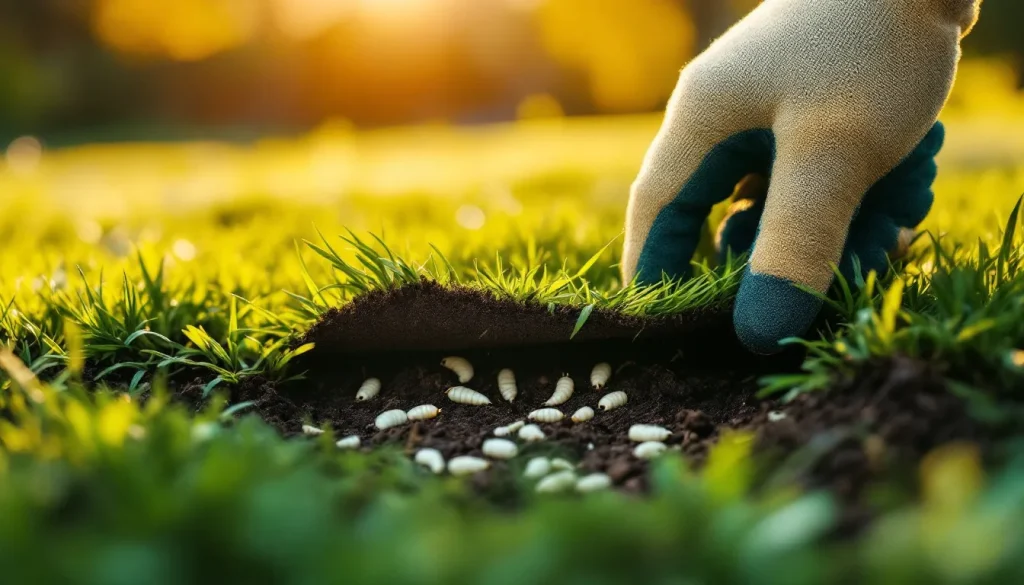
Grubs in lawn are the white, C-shaped larvae of scarab beetles, and they eat grass roots from below the soil surface. The most common U.S. species are Japanese beetle, masked chafer (annual white grub), June beetle (May beetle), European chafer, and the slightly different billbug larva. They are cream-colored with a tan or orange head and visible legs near the front, usually 1/4 to 1 inch long.
You will almost always find them curled into a “C” when you dig. They live in the top 1 to 3 inches of soil during their feeding stage and chew through the fibrous root system that holds turf together.
Not every grub demands action. A handful in a healthy lawn is normal. The question is always how many per square foot, which is covered below in the grub control protocol.
Signs and symptoms of grubs in your lawn
The clearest signs of grubs in lawn are irregular brown or dead patches that appear in late summer to early fall, turf that feels spongy or springy underfoot, and grass that lifts up like loose carpet because the roots are gone. A second tell is animals digging: skunks, raccoons, birds, and moles tearing up sections at night to eat the grubs.
Grub damage looks different from drought or disease in three ways:
- Pattern: patches are irregular and expand over weeks, not sharp circles (which suggest fungal disease).
- Texture: the turf feels loose and spongy, like walking on a thin mattress.
- Timing: damage peaks in late August through October when larvae are largest and feeding hardest.
If your brown areas are sharp rings or appear in hot, dry spells without spongy turf, you may be looking at a different problem. Compare against the patterns in our guide to brown patches in lawn before you spend money on grub products.
The pull-up turf test to confirm grubs
To confirm grubs, do the pull-up test: grab a section of affected turf and tug. If it peels back like a loose rug with little or no root resistance, grubs have eaten the roots. Then cut and fold back a 1-foot-by-1-foot square of sod about 2 to 3 inches deep at the edge of a damaged patch and count the white larvae in the soil and root zone.
Sample where green grass meets brown, not dead center. Larvae move to find food, so the active edge gives the truest count. Check three or four spots across the lawn, because grubs cluster and one reading can mislead you.
How many grubs is too many: the damage threshold
The action threshold for most U.S. lawns is 5 to 10 grubs per square foot. Below 5, a healthy, well-watered lawn usually outgrows the feeding without treatment. At 6 to 9 per square foot, treat if the lawn is stressed or irrigated. Above 10 per square foot, treat regardless of lawn health, because root loss will likely outpace recovery.
The threshold shifts with grass type and vigor. Use this as a working guide:
| Grubs per sq ft | Healthy, irrigated lawn | Stressed or dry lawn |
|---|---|---|
| 0 to 4 | Monitor, no treatment | Monitor, water deeply |
| 5 to 9 | Treat if damage is visible | Treat now |
| 10 or more | Treat now | Treat now |
Billbug larvae have a higher tolerance threshold (often 1 per square inch in the crown zone) because they feed differently. That is one reason species identification matters, covered next.
Which beetle do you have: species identification
Identifying the species matters because it changes the optimal product and the correct nematode. Look at two things: the raster pattern (the arrangement of tiny hairs on the underside of the grub’s rear tip) and the adult beetle you see flying in early summer. Japanese beetle adults are metallic green with copper wings; June beetles are large and reddish-brown; masked chafer adults are tan.
| Species | Life cycle | Adult flight (U.S.) | Best nematode |
|---|---|---|---|
| Japanese beetle | 1 year | June to August | Heterorhabditis bacteriophora |
| Masked chafer (annual white grub) | 1 year | June to July | Heterorhabditis bacteriophora |
| June/May beetle | 2 to 3 years | May to June | Heterorhabditis bacteriophora |
| European chafer | 1 year | June to July | Heterorhabditis bacteriophora |
| Billbug | 1 to 2 years | Spring (weevils, walk) | Steinernema carpocapsae |
Billbugs are weevils, not scarabs. Their larvae are legless and live near the crown, so the standard scarab nematode (Heterorhabditis bacteriophora) underperforms against them. If your “grubs” have no legs and you find sawdust-like frass at the soil line, you likely have billbugs and should choose Steinernema carpocapsae instead.
Grub life cycle and seasonal timing
Most lawn grubs run a one-year cycle. Adult beetles lay eggs in mid-summer (roughly late June through July in much of the U.S.). Eggs hatch into small larvae that feed heavily in late summer and early fall (August through October), then burrow deep to overwinter. They return to feed briefly in spring before pupating into adults.
Timing drives everything. Tiny new larvae in August are easy to kill. Large, mature larvae in October, and the deep overwintered grubs of early spring, are far harder to kill and have already done their damage. This is why “what month is it” is the first question, answered in the decision tree below.
The June decision tree: preventer or curative right now
The single most confusing question is “it is summer, what do I actually buy today?” Here is the answer by month for a typical U.S. one-year-cycle grub. A preventer stops eggs and young larvae before damage. A curative kills larvae that are already feeding. Match the calendar to the product.
- April to May: Too late for last year’s grubs (already pupating) and too early for preventers. Do nothing chemical. Repair spring damage by overseeding and watering.
- Early to mid June: Apply a preventer (chlorantraniliprole or imidacloprid) now. This is the prime preventive window before eggs hatch. Water it in.
- July: Last good window for a preventer (imidacloprid). Chlorantraniliprole works best applied earlier, so by July lean toward imidacloprid.
- August to mid September: Skip preventers. If you confirm 5 or more grubs per square foot, apply a curative (carbaryl or trichlorfon) to kill active young larvae. This is the curative window.
- Late September to October: Curatives lose effectiveness as grubs grow large. Treat only at high counts and expect partial results. Plan recovery instead.
- November to March: Grubs are deep and dormant. No treatment works. Wait for the June preventer window.
For most homeowners reading this in late June, the answer is: apply a chlorantraniliprole preventer this week and water it in. You are right on time.
How to get rid of grubs fast: curative insecticides
To kill active grubs fast, use a curative insecticide labeled for grubs: carbaryl (Sevin) or trichlorfon (Dylox). These are the only two widely available actives that reliably knock down larvae already feeding in the soil. Apply in late summer when larvae are small, mow first, irrigate the lawn before applying, then water the product in with about 1/2 inch of water immediately.
Trichlorfon is generally the faster-acting of the two and is often the go-to rescue treatment, with knockdown in 1 to 3 days. Carbaryl works but can be slower and is harder on beneficial insects and earthworms. Neither should be applied to flowering weeds where bees forage; mow off blooms first.
Preventers like imidacloprid and chlorantraniliprole do not work as rescue treatments on large fall grubs. Do not reach for a “GrubEx” type preventer in October expecting a fast kill; it is the wrong tool for that month.
Grub preventer vs grub killer: the key distinction
A grub preventer kills eggs and very young larvae and must be applied before or during egg-hatch (roughly June to July). A grub killer (curative) kills larvae already feeding and is applied when you confirm an active infestation (August to September). Using a preventer on a fall infestation wastes money; using a curative as a “just in case” in June is overkill and often ineffective on eggs.
| Factor | Preventer | Curative (killer) |
|---|---|---|
| Common actives | Chlorantraniliprole, imidacloprid | Trichlorfon, carbaryl |
| Best timing | June to July | August to September |
| Target stage | Eggs, young larvae | Active feeding larvae |
| Typical control rate | 75 to 90%+ when timed right | 60 to 80% on small larvae |
| Use when | You had grubs last year or want insurance | You confirmed 5 to 10+ per sq ft now |
Preventive products and when to apply
The two main preventive actives are chlorantraniliprole (the active in many GrubEx-branded products) and imidacloprid (in many season-long grub products). Chlorantraniliprole has the longest application window and the lowest toxicity to bees, so apply it in spring to early summer, ideally April through June. Imidacloprid is applied a bit later, roughly June to mid-July, just before egg-hatch.
Both are systemic: the grass takes them up, and young larvae die when they feed. Both require watering in with about 1/2 inch of water within 24 hours to move the product into the root zone where grubs feed. A preventer left dry on the blades does little.
Choose chlorantraniliprole if you plan ahead in spring or worry about pollinators. Choose imidacloprid if you are deciding in late June or July, since it tolerates the later window better.
Natural and organic grub control
Chemical-free control of grubs relies on three tools: beneficial nematodes, milky spore, and Bacillus thuringiensis galleriae (Btg). Effectiveness varies widely, so set expectations honestly. Nematodes are the most reliable organic option when applied to moist soil in the right window; milky spore is the least consistent and slowest.
| Method | How it works | Honest efficacy | Cost (approx) |
|---|---|---|---|
| Beneficial nematodes (H. bacteriophora) | Microscopic worms infect grubs | 50 to 80% if applied to moist soil, dusk, late summer; product must be alive | $20 to $40 per application |
| Bacillus thuringiensis galleriae (Btg) | Bacterial toxin ingested by grubs | Moderate on young larvae; multiple apps needed | $25 to $45 |
| Milky spore (Paenibacillus popilliae) | Bacterial disease of Japanese beetle grubs | Documented as inconsistent; 1 to 3 years to establish, Japanese beetle only, poor in cool northern soils | $50 to $90 upfront |
Two cautions. Nematode viability is fragile: buy from a supplier with cold-chain shipping, use before the expiration date, store cool, and apply in the evening to moist soil because UV and dryness kill them quickly. Milky spore only targets Japanese beetle grubs, not chafers or June beetles, and university trials have repeatedly shown unreliable, slow establishment, so do not rely on it as your only line of defense.
Will grubs go away on their own?
Sometimes. If your count is under 5 grubs per square foot and the lawn is healthy and irrigated, the turf can outgrow the root feeding and you may never need to treat. Grubs also have a natural cycle: larvae mature into beetles and leave the soil. But a confirmed count of 10 or more per square foot will not resolve before it kills visible patches, so waiting is a gamble at high counts.
The smart move is to count, not guess. Low count plus healthy lawn equals monitor. High count or visible spongy damage equals treat. Distinguishing grub damage from weed pressure or drought also matters, since the wrong diagnosis wastes a season.
Watering after grub treatment
Watering is part of the treatment, not optional. After applying any preventer (chlorantraniliprole, imidacloprid) or curative (trichlorfon, carbaryl), water the lawn with about 1/2 inch of water within 24 hours to move the active down to the root zone where grubs feed. For nematodes, keep the soil moist for the first 1 to 2 weeks so the worms survive and spread.
Skipping the watering-in step is the most common reason a correctly chosen product fails. The chemical sitting on dry grass blades never reaches the grubs three inches down.
Repairing your lawn after grub damage
After grubs are controlled, repair the dead patches by raking out loose dead turf, loosening the top 1/2 inch of soil, spreading quality grass seed matched to your lawn, topdressing lightly with compost, and keeping the area consistently moist until germination. Cool-season grasses recover best when reseeded in early fall (September); warm-season grasses recover in late spring to early summer.
A realistic recovery timeline:
- Days 0 to 3: Treat or confirm grubs are dead. Pull up and remove loose dead sod.
- Day 3 to 7: Rake, loosen soil, seed, topdress, and begin light daily watering.
- Days 7 to 21: Seed germinates (cool-season 7 to 21 days). Keep the surface damp, never soggy.
- Weeks 3 to 8: Reduce watering frequency, increase depth. First mow once seedlings reach about 3 inches.
- Weeks 8 to 12: Lawn knits together. Apply a starter or balanced fertilizer per label.
Reseed only after the grubs are dead. New seedling roots are the exact food surviving grubs want, so timing repair after control (not before) protects your investment. For broader recovery and ongoing care steps, see the HMNDP lawn care learning hub.
Frequently Asked Questions
What are the signs of grubs in your lawn?
Signs of grubs include irregular brown or dead patches that grow over weeks, turf that feels spongy or springy underfoot, and grass that pulls up like loose carpet because the roots are eaten. Animal digging is a strong secondary clue: skunks, raccoons, birds, and moles tear up turf at night to eat the grubs. Damage usually peaks from late August through October.
How do I confirm I have grubs, and how many is too many?
Cut and fold back a 1-foot square of sod about 2 to 3 inches deep at the edge of a damaged patch, then count the white C-shaped larvae. Sample three or four spots. The action threshold is 5 to 10 grubs per square foot: under 5 a healthy lawn usually recovers, 5 to 9 warrants treatment if stressed, and 10 or more needs treatment regardless.
How do I get rid of grubs in my lawn fast?
Use a curative insecticide labeled for grubs, trichlorfon (Dylox) or carbaryl (Sevin), in late summer when larvae are small. Mow first, irrigate beforehand, apply per the label, then water in with about 1/2 inch of water immediately. Trichlorfon usually acts fastest, with knockdown in 1 to 3 days. Preventers like GrubEx do not work as fast rescue treatments on large fall grubs.
What is the best time of year to treat for lawn grubs?
For preventers, apply chlorantraniliprole in April through June or imidacloprid in June through mid-July, before eggs hatch. For curatives, treat in August to mid-September when young larvae are feeding and easiest to kill. November through March no treatment works because grubs are deep and dormant. If you are reading this in late June, a preventer applied now is well timed.
What is the difference between a grub preventer and a grub killer?
A grub preventer (chlorantraniliprole or imidacloprid) kills eggs and young larvae and must be applied in June to July before damage starts. A grub killer or curative (trichlorfon or carbaryl) kills larvae already feeding and is applied in August to September after you confirm an active infestation. Using a preventer on a fall infestation wastes money, and a curative in June is usually ineffective on eggs.
What kills grubs naturally without chemicals?
Beneficial nematodes (Heterorhabditis bacteriophora) are the most reliable organic option, killing 50 to 80% of grubs when applied alive to moist soil at dusk in late summer. Bacillus thuringiensis galleriae works on young larvae over multiple applications. Milky spore targets only Japanese beetle grubs and has documented inconsistency, taking 1 to 3 years to establish and performing poorly in cool northern soils, so do not rely on it alone.
Will grubs go away on their own or do I have to treat?
Below 5 grubs per square foot in a healthy, irrigated lawn, the turf can often outgrow the feeding and you may never need to treat. Larvae also mature into beetles and leave the soil naturally. But at 10 or more per square foot, the damage will not resolve before it kills visible patches, so waiting at high counts is a gamble. Count first, then decide.
How do I repair a lawn after grub damage?
Rake out loose dead turf, loosen the top 1/2 inch of soil, spread grass seed matched to your lawn, topdress lightly with compost, and keep the area moist until germination. Reseed cool-season grasses in early fall and warm-season grasses in late spring. Always repair after the grubs are dead, because new seedling roots are exactly what surviving grubs eat.