
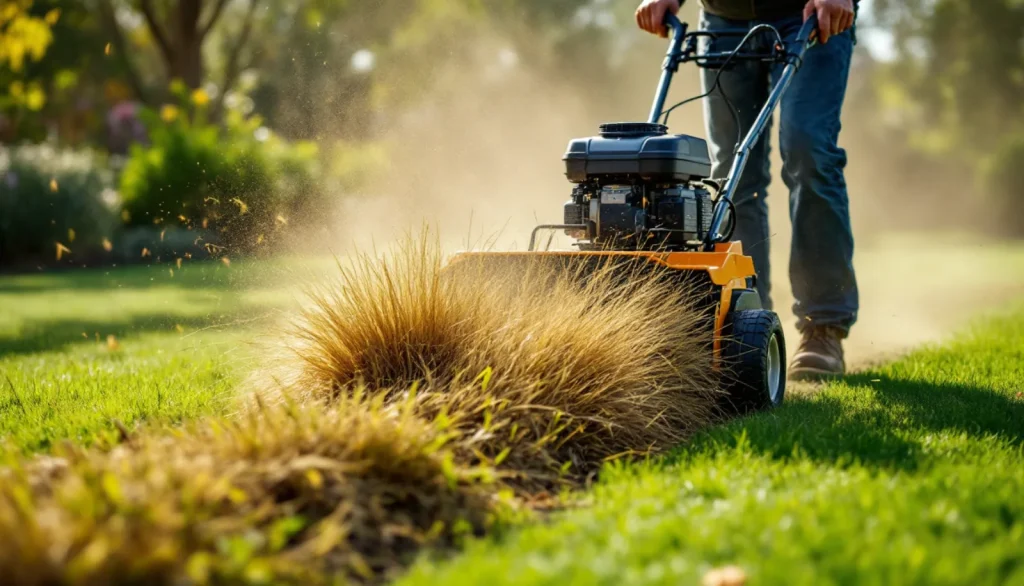
Lawn Dethatcher: Types, When to Dethatch, and How To
A lawn dethatcher is the tool you reach for only when the thatch layer (the spongy mat of dead stems and roots between the green blades and the soil) passes half an inch thick. Below that, thatch is healthy and you leave it alone. Above it, water, fertilizer, and air stop reaching the root zone, and you have three machine choices: a manual thatch rake for small lawns, a powered walk-behind dethatcher for medium yards, or a tow-behind unit pulled by a riding mower for an acre or more. This guide covers how to pick between them, when to run them by grass type, and when renting beats buying.
Do you even need a dethatcher? Measure the thatch first
Dethatch only if the thatch layer is thicker than half an inch. A thin layer under half an inch is beneficial: it insulates the crown, holds moisture, and cushions traffic. Cut a wedge of turf with a garden trowel or spade, pull it up, and measure the brown spongy band between the green grass and the soil with a ruler. Over half an inch means dethatch. Over one inch usually signals a longer-term problem.
Pennington’s turf guidance puts the beneficial threshold at “less than 1/2-inch thick” and flags layers past one inch as a barrier to water and nutrients. Turfgrass specialists at the University of Missouri warn that ripping out an overly thick mat in one pass tears the living plants, so a one-inch-plus layer is best reduced over two seasons rather than one aggressive session.
Thatch is not the same as grass clippings. Clippings are mostly water and break down within days. Thatch is the slow-to-decay tissue (lignin-rich stems, crowns, and roots) that builds when grass grows faster than soil microbes can digest the dead material, a problem worsened by heavy nitrogen, overwatering, and compacted or clay soils.
Which grasses build thatch, and which barely do
Grasses that spread by rhizomes or stolons build thatch fast and need attention yearly or every two to three years. Bunch-type grasses build thatch slowly, if ever, and many lawns of those species never need a dethatcher. Knowing your grass tells you whether this is a recurring chore or a once-a-decade event.
| Grass type | Growth habit | Thatch tendency | Typical dethatch interval |
|---|---|---|---|
| Kentucky bluegrass | Cool-season, rhizomatous | High | Every 1 to 3 years |
| Creeping bentgrass / creeping fescue | Cool-season, spreading | High | Every 1 to 2 years |
| Bermudagrass | Warm-season, stolons and rhizomes | High | Yearly to every 2 years |
| Zoysiagrass | Warm-season, stolons and rhizomes | High | Yearly to every 2 years |
| St. Augustinegrass | Warm-season, stolons | Moderate to high | Every 1 to 3 years |
| Tall fescue | Cool-season, bunch-type | Low | Rarely, if ever |
| Perennial ryegrass | Cool-season, bunch-type | Low | Rarely, if ever |
Clay and compacted soils push these intervals shorter because slow drainage and low microbial activity let thatch pile up faster. A Kentucky bluegrass lawn on heavy clay may need a dethatcher every year, while the same grass on loose loam can stretch to three. Tall fescue and perennial ryegrass lawns often go five years or more, and many never qualify.
When to dethatch: timing by grass type
Dethatch when your grass is actively growing and can recover fast, never when it is dormant, drought-stressed, or freshly fertilized. Cool-season lawns get dethatched in late summer to early fall (roughly August into September). Warm-season lawns get dethatched after spring green-up as they enter early-summer peak growth (late spring into early summer).
The reason is recovery. Dethatching wounds the turf and exposes soil. Run it during the grass’s strongest growth window and the lawn knits back within two to four weeks. Run it during dormancy or heat stress and the open wounds dry out, weeds colonize the bare soil, and the lawn can fail to bounce back. The University of California IPM program and Pennington both anchor the warm-season window to spring green-up and the cool-season window to late summer.
Soil temperature is a more reliable trigger than the calendar, since it tracks actual root activity rather than air swings. Warm-season grasses green up and grow hardest once soil holds above roughly 65 degrees Fahrenheit; cool-season grasses do their fall recovery growth as soil settles back into the 50s and 60s. Our explainer on soil temperature for lawn timing shows how to read it before you commit to a dethatching date.
Manual rake vs power dethatcher vs tow-behind vs verticutter
Match the tool to lawn size and thatch severity. A manual thatch rake handles small lawns and light buildup for under $50. A powered walk-behind dethatcher clears medium lawns and moderate thatch. A tow-behind unit covers an acre or more behind a riding mower. A verticutter or power rake is the heavy corrective machine for thatch already past an inch, and that is usually a rental or a pro call.
| Tool | Best for | Thatch level | Typical buy price (2026) | Effort |
|---|---|---|---|---|
| Manual thatch rake | Small lawns, spot work | Light, up to about 1/2 inch | About $44 | High, all by hand |
| Powered walk-behind dethatcher (electric or gas) | Small to medium lawns | Light to moderate | About $140 | Low, push like a mower |
| Tow-behind dethatcher | Large lawns, an acre or more | Light to moderate | About $150 to $400 (attachment near $160) | Low, ride and pull |
| Verticutter / power rake | Severe neglect, corrective | Heavy, over 1/2 inch | Gas units roughly $1,500 to $2,500 | Low to run, easy to over-cut |
The distinction that trips up buyers: a dethatcher is a light-duty tool for thatch up to half an inch, while a power rake (with rotating blades or flails) is a heavy-duty machine that removes thatch past half an inch and can pull up to four times more material per pass, per Bob Vila’s testing. A verticutter uses vertical blades that slice straight down through a thick mat. Powered dethatchers and tow-behinds use spring tines that comb material up rather than cutting it out.
Electric walk-behind models run quieter and need no fuel or oil; gas models hit harder on dense thatch and larger areas. For most homeowners with a thatch reading just over half an inch, a powered walk-behind or a rented unit does the job without the over-aggressive risk a power rake carries in untrained hands.
Rent or buy? Run the math on frequency
Rent if you dethatch once every two or three years, which describes most residential lawns. Buy if you dethatch yearly (thatch-prone grass on clay) or maintain several properties. Renting a walk-behind dethatcher or power rake runs roughly $65 to $125 per day from Home Depot or United Rentals, so two or three rentals can equal the cost of owning an entry walk-behind unit.
Professional dethatching runs about $0.08 to $0.16 per square foot, with most single-visit jobs landing between $65 and $165 nationally and a 5,000-square-foot lawn taking one to three hours, per LawnStarter’s 2026 cost data. Regional totals range from about $58 to $133 in Dothan, Alabama to $70 to $200 in New York City. If you only cross the half-inch threshold every few years, paying a pro or renting almost always beats buying.
- Check frequency: yearly need favors buying, every-few-years favors renting.
- Measure the lawn so you can compare per-square-foot pro pricing against rental day rates. Our guide on how to measure lawn square footage gives you the number.
- For a one-inch-plus mat needing a power rake, rent or hire rather than buy a $1,500-plus machine for a single corrective pass.
- If you also dethatch other lawns or do it as a side business, a $150 tow-behind attachment can pay back in a few seasons.
How to dethatch a lawn, step by step
Dethatch when the grass is actively growing and the soil is lightly moist, not soggy and not bone dry. Mow to about half the normal height first, do not fertilize beforehand, and set any powered unit to cut no deeper than half an inch into the soil. Then make your passes, clear the debris, and follow with overseeding or aeration where it helps.
- Mow the lawn to roughly half its usual height so the tines reach the thatch, not just the leaf blades.
- Flag sprinkler heads, shallow irrigation lines, and buried utilities before running any powered or tow-behind unit.
- Set blade or tine depth to no deeper than half an inch into the soil. For a rental, ask the agency to adjust spacing and depth for your grass type.
- Make passes in one direction, then a second set at a 90-degree angle to lift thatch evenly.
- Rake the pulled thatch into rows or piles and bag or compost it. The volume often surprises first-timers.
- Overseed bare or thin areas right away; the cleared surface gives far better seed-to-soil contact.
- Apply a balanced or starter fertilizer (higher phosphorus if overseeding) and water consistently for two to three weeks.
Expect visible recovery within two to four weeks when you dethatch in the correct window with steady watering. New growth comes in denser and greener as water and nutrients reach roots that the thatch mat was blocking.
Dethatching vs aerating: which comes first
Dethatching and aerating solve different problems and are best done in that order. Dethatching removes the surface mat of dead tissue; aerating pulls soil cores to relieve compaction below. Dethatch first so the aerator reaches clean soil, then aerate to open channels for water, air, and roots. Many lawns benefit from both in the same active-growth window, especially on clay.
If your real issue is compaction (puddling, hard ground, thin turf in traffic lanes) rather than a thick mat, the aerator is the right first tool. Our guide to aerating your lawn covers core versus spike aeration and timing. Aeration also speeds thatch breakdown over time by mixing soil into the layer and boosting the microbes that digest it, which can stretch the interval between dethatching jobs.
For lawns that need broader rehab (bare spots, compaction, and thatch together), sequence the work across the season rather than stacking every wound at once. Pair this with a full grass maintenance schedule built around cool-season versus warm-season timing so dethatching, aeration, feeding, and overseeding land in the right months.
Last reviewed: June 2026
HMNDP Editorial Team, reviewed by HMNDP turf and horticulture editors.
Frequently asked questions
When should I dethatch my lawn?
Dethatch when the grass is actively growing and the thatch layer is thicker than half an inch. Cool-season grasses (Kentucky bluegrass, fescue) get dethatched in late summer to early fall, roughly August into September. Warm-season grasses (Bermuda, Zoysia) get dethatched after spring green-up as they enter early-summer peak growth. Never dethatch dormant or drought-stressed turf.
What is the difference between a power rake and a dethatcher?
A dethatcher is a light-duty tool for thatch up to half an inch, using spring tines that comb dead material up. A power rake is a heavy-duty machine with rotating blades or flails that aggressively removes thatch past half an inch and can pull up to four times more material per pass. Use the dethatcher for annual upkeep and the power rake only for corrective work on neglected lawns.
How thick should thatch be before I dethatch?
Dethatch only when the thatch layer measures more than half an inch thick. A thinner layer is beneficial because it holds moisture and cushions the crown. Cut a wedge of turf with a trowel, pull it up, and measure the brown spongy band between the green grass and the soil with a ruler. A layer past one inch usually signals a longer-term problem and should be reduced over two seasons.
Should I rent or buy a dethatcher?
Rent if you dethatch once every two or three years, which fits most residential lawns. Renting a walk-behind dethatcher or power rake runs roughly $65 to $125 per day. Buy if you dethatch yearly, which usually means thatch-prone grass on clay, or if you maintain several lawns. An entry walk-behind unit costs about $140 and a tow-behind attachment near $160.
Does dethatching kill grass?
Dethatching can damage grass if done at the wrong time or too aggressively. Running a dethatcher on dormant, drought-stressed, or freshly fertilized turf exposes the lawn to bare-soil weeds and dried-out wounds it may not recover from. Done in the correct active-growth window with steady watering, the lawn knits back within two to four weeks and comes in denser and greener.
How often should I dethatch my lawn?
Most residential lawns need dethatching every two to three years. Thatch-prone grasses like Kentucky bluegrass, Bermudagrass, and Zoysiagrass may need it yearly, especially on clay soil. Bunch-type grasses such as tall fescue and perennial ryegrass build thatch slowly and often go five years or more, with many lawns never needing a dethatcher at all.
Should I dethatch or aerate first?
Dethatch first, then aerate. Dethatching removes the surface mat of dead tissue so the aerator reaches clean soil, and aeration then pulls cores that open channels for water, air, and roots. The two solve different problems: dethatching clears thatch, aeration relieves compaction. Many lawns benefit from both in the same active-growth window, especially on heavy clay soils.