
Soil Temperature: How to Measure It and Key Thresholds
Soil temperature, the reading taken about two inches below the surface, is the single number that controls when crabgrass germinates, when grass seed sprouts, when warm-season turf greens up, and when grub control works. Air temperature lies to you in spring. Soil holds heat differently, warms slower, and tells you the truth about what is happening at the root zone. This guide gives you the threshold table for every major lawn decision, plus how to read soil temp correctly so you act on the right day instead of the calendar.
The soil temperature threshold table for lawn jobs
Most lawn timing decisions trigger at a specific soil temperature measured at the 0 to 2 inch depth and held for several consecutive days. The table below pulls the working thresholds from university extension turf programs. Use it as your trigger sheet: when your local soil temp crosses a row and stays there, act on that job.
| Lawn job | Soil temp trigger (0 to 2 in) | Why this number | Source |
|---|---|---|---|
| Crabgrass pre-emergent (apply before) | 50 to 55 F, rising | Herbicide must be down before seeds wake; 80% of crabgrass germinates at 60 to 70 F | Michigan State Extension |
| Cool-season seed (Kentucky bluegrass, tall fescue, perennial ryegrass) | 50 to 65 F | Germination window for cool-season species | UMN / Barenbrug |
| Warm-season green-up (Bermuda, zoysia) | ~65 F | Stolons break dormancy and push green as soil reaches mid-60s | What Grass Is This |
| Warm-season seed (Bermuda, zoysia, St. Augustine, centipede) | 65 to 85 F | Bermuda 65 to 85, zoysia 70 to 85, St. Augustine over 80, centipede 70 to 80 | Percy’s / extension data |
| Preventive grub control (imidacloprid, chlorantraniliprole) | Apply before/at egg hatch, soil over 60 F (June to mid-July most regions) | Product must sit in soil before young grubs feed near surface | UMass / UConn Extension |
The pattern across every row: a threshold plus persistence. A single warm afternoon does not count. Extension programs want the reading to hold for three to five consecutive days before you treat it as real, because soil temp swings less than air but still dips after a cold front.
How to measure soil temp the right way
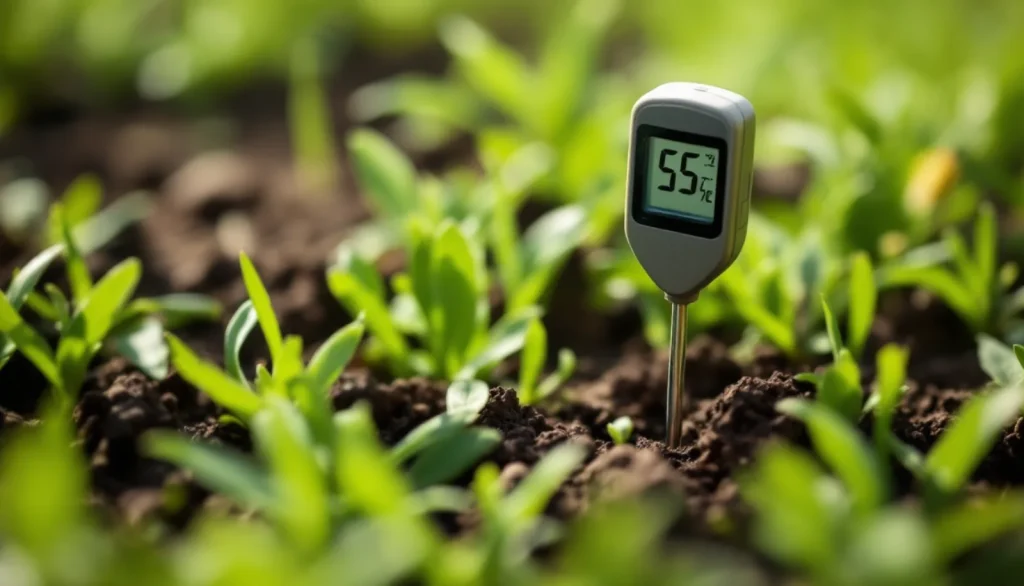
Push a soil thermometer two to three inches into the turf, in the same spot, at mid-morning (roughly 8 to 10 a.m.), and read it for three to five consecutive days. Two inches is the standard depth because that is where grass seed germinates and most crabgrass seed sits. Mid-morning avoids the overnight low and the afternoon sun spike, so you get a representative daily number instead of an outlier.
- Buy a soil or compost thermometer with a probe of at least three inches. A meat thermometer works in a pinch but reads slower.
- Pick a spot in full sun on flat, open turf. Shaded and north-facing areas run cooler and will lag the rest of the lawn by days.
- Insert the probe two inches deep, wait 60 to 90 seconds for the reading to settle, and record it.
- Take the reading at the same time each morning for three to five days. Watch the trend, not one number.
- Compare against the threshold table above and act when the soil temp crosses and holds the trigger.
If you do not own a thermometer, two backups work. Growing degree days (GDD) track accumulated heat: under the base 50 F model, crabgrass germination starts near 130 to 200 GDD, and Michigan State puts the pre-emergent window at 250 to 500 GDD on a base 32 F model. Phenology is the low-tech version: forsythia in full bloom roughly signals soil in the 55 F range, the cue many growers use to time crabgrass preventer.
Where to find soil temperature for your area
You do not always need a probe. Free tools publish near-real-time soil temperature by ZIP code or station. Greencast by Syngenta maps daily soil temperature nationally, and several lawn sites (soiltemps.com, whatgrassisthis.com) pull the same station data by ZIP. Your state land-grant university extension or mesonet (for example, the Arizona Meteorological Network, AZMET) also reports soil temps at standard depths.
Treat published maps as a starting point, then confirm with a probe in your own yard. Local readings vary with soil type, slope, shade, and irrigation. A sandy, south-facing lawn can run several degrees ahead of a clay, shaded one a block away, which is why a regional map alone can miss your crabgrass window by a week.
Crabgrass pre-emergent and the 55 F rule
Apply crabgrass pre-emergent when soil temp at the 0 to 2 inch depth is rising through 50 to 55 F and before it reaches 60 F. The herbicide forms a barrier that stops seedlings as they emerge, so it has to be in place before germination. Michigan State Extension notes 80 percent of crabgrass germinates once soil holds 60 to 70 F, so the 55 F reading is your last clean window.
Miss the window and the pre-emergent barrier goes down after seeds have already sprouted, which wastes the application. In warmer regions a split program helps: a first application near 50 to 55 F and a second six to eight weeks later as soil climbs toward 65 to 70 F, which extends the barrier through the full germination flush. For the full weed-timing picture, see our year-round grass maintenance schedule.
Seeding by soil temperature, cool-season vs warm-season
Seed cool-season grasses when soil temp sits 50 to 65 F, and warm-season grasses when it holds 65 to 85 F. Cool-season species (Kentucky bluegrass, tall fescue, perennial ryegrass) hit that band in early fall and mid-spring, which is why fall is the prime seeding window across the north. Warm-season seed (Bermuda, zoysia) needs late spring into early summer once the soil clears 65 F.
Seeding below the threshold is the most common spring mistake. Cool soil leaves seed sitting, prone to rot and washout, while you assume it failed. The fix is patience: wait for the soil temp to hold the floor for several days, then sow. If you are filling thin or damaged turf, pair the timing with our guide on how to make grass grow in bare spots, and for tough shade or compacted ground see getting grass to grow where it will not.
Warm-season green-up and grub timing
Warm-season turf greens up as soil temp approaches 65 F, and preventive grub control goes down before egg hatch when soil clears 60 F, typically June into mid-July. Bermuda and zoysia break dormancy from the stolons outward once the root zone warms into the mid-60s, so do not panic-fertilize brown turf in early spring. Wait for the soil signal.
For grubs, preventives like imidacloprid and chlorantraniliprole work by sitting in the soil before young grubs feed near the surface, so timing them to egg hatch (soil over 60 F, early summer) matters more than reacting to damage. UMass and UConn turf programs note that late-fall or winter applications fail because grubs are not feeding near the surface and roots cannot take up the product. Curative products are a separate, later decision once you see active feeding damage.
Soil temperature vs air temperature
Soil temperature matters more than air temperature for every lawn decision, and it lags air temp because soil stores and releases heat slowly. A 70 F afternoon in March does not mean the root zone is ready; soil two inches down may still read in the 40s. This lag is exactly why calendar-based lawn schedules miss, and why the soil reading is the trigger that actually correlates with germination, green-up, and insect activity.
The practical takeaway: stop watching the forecast for lawn timing and start watching the ground. A 12 dollar soil thermometer (see our 2026 lawn care cost breakdown for where dollars actually move outcomes) turns guesswork into a dated decision you can defend.
Quick answers
The recurring questions all reduce to one rule: read soil temp at two inches, mid-morning, for several days, then match it to the job. Crabgrass preventer goes down at 50 to 55 F. Cool-season seed wants 50 to 65 F. Warm-season green-up and seeding start near 65 F. Preventive grub control times to soil over 60 F before egg hatch. Persistence beats any single reading.
Last reviewed: June 2026
HMNDP Editorial Team, reviewed by HMNDP turf and horticulture editors.
Frequently asked questions
What is the ideal soil temperature for grass?
It depends on grass type. Cool-season grasses (Kentucky bluegrass, tall fescue, perennial ryegrass) germinate at 50 to 65 F soil temperature measured two inches deep. Warm-season grasses need warmer soil: Bermuda 65 to 85 F, zoysia 70 to 85 F, St. Augustine over 80 F, centipede 70 to 80 F. Read at the 2 inch depth and hold for several days.
How do I check soil temperature?
Push a soil thermometer two to three inches into the turf in full sun, wait 60 to 90 seconds, and read it at mid-morning (8 to 10 a.m.). Take the reading at the same spot and time for three to five consecutive days and watch the trend. Mid-morning avoids the overnight low and the afternoon sun spike, giving you a representative daily soil temp.
At what soil temperature should I apply crabgrass pre-emergent?
Apply crabgrass pre-emergent when soil temperature at the 0 to 2 inch depth is rising through 50 to 55 F and before it reaches 60 F. The herbicide must form a barrier before seeds germinate. Michigan State Extension notes 80 percent of crabgrass germinates once soil holds 60 to 70 F, so the 55 F reading is your last clean application window.
What soil temperature does grass seed germinate at?
Cool-season grass seed germinates when soil temperature holds 50 to 65 F at the two-inch depth, which happens in early fall and mid-spring across the north. Warm-season seed needs 65 to 85 F, reached in late spring into early summer. Seeding below the threshold leaves seed sitting in cold soil, prone to rot and washout, so wait for the soil temp to hold.
What is the difference between soil temperature and air temperature for lawns?
Soil temperature matters more than air temperature because it tracks the root zone where seeds germinate and insects feed. Soil lags air temp because it stores and releases heat slowly. A 70 F afternoon in March can sit over a root zone still in the 40s, which is why calendar schedules miss and the soil reading is the trigger that correlates with lawn activity.
When should I apply grub control based on soil temperature?
Apply preventive grub control (imidacloprid, chlorantraniliprole) before or at egg hatch when soil temperature clears 60 F, typically June into mid-July in most regions. The product sits in the soil before young grubs feed near the surface. UMass and UConn turf programs note late-fall and winter applications fail because grubs are not feeding near the surface and roots cannot take up the product.
What soil temperature does Bermuda grass green up at?
Warm-season turf like Bermuda and zoysia greens up as soil temperature approaches 65 F at the two-inch depth. Green-up starts from the stolons and works outward once the root zone warms into the mid-60s. Do not panic-fertilize brown turf in early spring before the soil signal; the grass is still dormant and waiting on warmth, not nutrients.
Where can I find the soil temperature for my area?
Free tools publish near-real-time soil temperature by ZIP code, including Greencast by Syngenta and lawn sites like soiltemps.com and whatgrassisthis.com that pull station data. Your state land-grant extension or mesonet (for example AZMET in Arizona) also reports soil temps at standard depths. Confirm a map reading with a probe in your own yard, since soil type, slope, and shade shift it.