
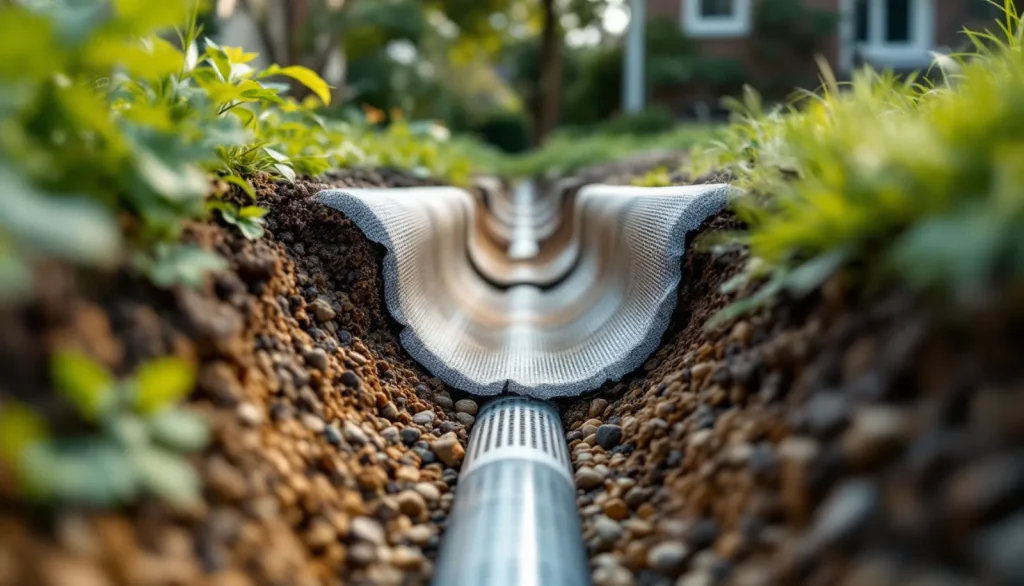
To make a french drain, dig a trench 18 to 24 inches deep and 9 to 12 inches wide that slopes at least 1 percent (1 inch of drop for every 10 feet), line it with nonwoven filter fabric, lay 3 inches of washed gravel, set a 4-inch perforated pipe with the holes facing down, cover with more gravel, fold the fabric over the top, and run the pipe to an outlet lower than where you started. Call 811 before you dig.
That is the short version. The part most guides skip is that the same trench drains very differently depending on your soil, and that the gravel you backfill with matters as much as the pipe. This guide gives you the specs, the install order, a real cost breakdown for doing it yourself versus hiring out, and the soil-specific changes that decide whether the drain still works in three years.
What you need before you start
A french drain needs four things: a clear low point to send water to, a perforated pipe, washed drainage gravel, and nonwoven filter fabric. The pipe is almost always 4-inch diameter for residential yards, in rigid PVC or flexible corrugated. You also need to call 811 at least two to three business days ahead so utilities mark gas, water, electric, and cable lines.
| Item | Spec | Why it matters |
|---|---|---|
| Perforated pipe | 4 in diameter, holes down; 6 to 8 in for high water tables | Carries collected water to the outlet |
| Drainage gravel | Washed, 3/4 in to 1-1/2 in, angular | Lets water move to the pipe without packing tight |
| Filter fabric | Nonwoven, 4 to 6 oz | Blocks silt while letting water pass; woven fabric traps water |
| Outlet | Daylight, dry well, or catch basin, lower than the start | Gravity does all the work; no low outlet means no drainage |
Skip washed gravel and use dirty crushed stone, and the fines wash into the pipe and clog it. If you can only get crushed stone, buy pipe pre-wrapped in a filter sock to keep particles out of the perforations. Use angular gravel, not round pea gravel, so the voids stay open under load.
How deep should a french drain be?
For a typical yard drainage problem, dig 18 to 24 inches deep and 9 to 12 inches wide. Shallow curtain drains that only catch surface runoff can run 8 to 15 inches. A drain protecting a foundation must sit at or below the footing, often 24 to 48 inches. In cold climates, place the pipe below the frost line, which can mean 36 inches or more, so it does not freeze and fail seasonally.
Width follows the size of the problem. A minor wet spot drains fine in a 6-inch-wide trench; a yard that floods after every storm wants the full 9 to 12 inches so the gravel can hold and move more water. Add 3 to 4 inches of depth beyond your target so there is room for the gravel bed under the pipe.
The slope rule that makes or breaks it
A french drain needs a minimum slope of 1 percent, which is 1 inch of fall for every 10 feet of pipe. That is the same as 1/8 inch per foot. Near a foundation, aim for a bit more than 1 percent. Without that consistent downhill grade, water sits in the pipe, silt settles, and the drain stops working no matter how good the materials are.
Check grade as you dig, not after. Run a string line from the start to the outlet, hang a line level on it, and measure down to the trench bottom every few feet. The bottom of the trench, not the ground surface, is what has to keep dropping. This is the single step DIYers rush and regret.
How to make a french drain, step by step
Mark the route from the wet area to a lower outlet, call 811, then dig to grade, line with fabric, bed gravel, lay pipe holes-down, cover with gravel, fold the fabric over, and cap. Work from the outlet back so you always have somewhere for water to go while you work. Most 50-foot yard drains take one to three weekends by hand.
- Plan the route and outlet. Start in or just uphill of the wet area and end at a point that sits lower and sends water away from your house and your neighbor’s property.
- Call 811. Wait for the locate marks before you put a shovel in the ground. This is free and required.
- Dig the trench. 18 to 24 inches deep, 9 to 12 inches wide, holding at least a 1 percent slope the whole way. Check grade with a string line and line level as you go.
- Line with nonwoven fabric. Lay 4 to 6 oz nonwoven fabric along the trench with enough overhang on both sides to wrap over the top later.
- Add the gravel bed. Pour and level 3 inches of washed gravel along the bottom so the pipe sits on stone, not soil.
- Lay the pipe, holes down. Set the 4-inch perforated pipe on the bed with the perforations pointed down, toward the 4 and 8 o’clock positions. Slope it toward the outlet and connect sections.
- Cover with gravel. Add gravel over the pipe until you are within about 3 to 4 inches of the surface.
- Wrap the fabric. Fold the fabric overhang across the top of the gravel so soil cannot wash down into it.
- Cap the trench. Top with soil, sod, mulch, or decorative stone. For a fully buried drain, keep the gravel and a thin soil cap; for a surface-collecting drain, leave gravel exposed at grade.
Does a french drain need a pipe?
Yes for almost every real drainage job. A gravel-only trench (the old-style french drain) clogs with sediment far faster, and pipe-free systems can lose 60 to 70 percent of their capacity within three years. A 4-inch perforated pipe carries far more water than gravel voids alone and is cheap insurance. Skip the pipe only on very short, light surface-runoff trenches.
For heavily saturated ground or a high water table, step up to 6-inch or 8-inch pipe. Rigid PVC with drilled holes lasts longer than thin corrugated pipe; corrugated is faster to install and fine for low-traffic yard runs.
Match the drain to your soil type
This is where most french drains succeed or fail, and where most guides stay silent. Clay, sand, and loam each move water at different rates, so the same trench performs differently in each. Clay barely lets water infiltrate and demands changes to the standard recipe. Sandy soil drains freely but pushes fines through fabric. Loam is the easy case. Read your soil before you copy a generic spec.
| Soil type | How it drains | What to change |
|---|---|---|
| Clay | Very slow infiltration; rock backfill can hold water with nowhere to go | Go deeper (18 to 24 in minimum) and wider (12 in). Consider concrete sand or coarse sand around the pipe instead of only rock so silt does not pack the voids. A reliable daylight outlet is non-negotiable since the surrounding clay will not absorb overflow. |
| Sandy | Drains fast; water moves freely to the pipe | Fabric filtration matters most here because fine sand migrates through cheap or woven fabric and silts the pipe. Use quality nonwoven 4 to 6 oz fabric, and a sock-wrapped pipe is cheap protection. |
| Loam | Balanced infiltration; the easiest case | Standard build works: 18 to 24 in deep, washed 3/4 in gravel, 4 in pipe, nonwoven fabric, 1 percent slope. |
To check your soil fast, dig a hole 12 inches deep, fill it with water, let it drain, fill it again, and time the drop. If it empties in a few hours you have decent drainage; if water still sits a day later you have heavy clay and should plan for the deeper, sand-backfilled version with a guaranteed outlet. If you are unsure, our guide on grass on compacted and poorly draining soil covers the same soil signals from the turf side.
French drain cost: DIY vs hiring a pro
A DIY exterior french drain runs roughly $5 to $12 per linear foot in materials, so a 50-foot run costs about $500 to $1,500 plus a trencher rental of $200 to $400 per day. Hiring a pro for exterior yard drains runs $10 to $35 per linear foot, putting a typical 100-foot job at $2,800 to $6,500. Doing it yourself saves 40 to 60 percent on labor in exchange for one to three weekends of digging.
| Scenario | Cost | Notes |
|---|---|---|
| DIY materials (exterior) | $5 to $12 per linear foot | Pipe, washed gravel, nonwoven fabric |
| DIY 50-foot run (total) | $500 to $1,500 | Plus trencher rental $200 to $400/day |
| Pro exterior yard drain | $10 to $35 per linear foot | Higher with hardscape crossings or deep trenches |
| Pro 100-foot exterior job | $2,800 to $6,500 | Varies by depth, soil, and access |
| Interior basement perimeter | $40 to $85 per linear foot | Best left to licensed waterproofers |
Exterior yard drains are a feasible DIY project. Interior basement french drains require cutting concrete and often a sump pump, so hire a licensed waterproofing contractor for those. If you decide to hire out, our checklist on how to vet a drainage and landscape contractor covers the license, insurance, and reference questions to ask first, and our 2026 lawn and landscape cost benchmarks put the quote in context.
Where does the water go?
The drain has to end somewhere lower than it starts and away from your house and your neighbor. Common outlets are a daylight point on a downhill slope, a dry well that lets water soak into the ground, or a catch basin tied to an approved storm outlet. The discharge point must follow local code; some municipalities require a permit and restrict where you can send runoff.
In clay soils a dry well often underperforms because the surrounding ground will not absorb the water, so a daylight outlet on a slope is the safer choice. Never run the outlet onto a neighbor’s lot; that is the fastest way to a code complaint or a lawsuit.
How long do french drains last?
A properly built exterior french drain lasts about 10 to 20 years; interior systems run 30 to 40. The biggest lifespan drivers are pipe material and fabric quality. PVC pipe with nonwoven fabric can last 40 to 50 years, while thin corrugated pipe with light fabric often needs cleaning or replacement at 15 to 25 years. Clogging from silt, not pipe failure, is what usually ends them early.
Keep it working by checking the inlet and outlet every few months and flushing the pipe once a year to clear debris. Avoid planting trees with aggressive roots near the line. The washed-gravel and nonwoven-fabric choices you make on day one are what decide whether you are at the long or short end of that range.
Common mistakes to avoid
Most failed french drains trace back to a handful of errors: not enough slope, the wrong gravel, pipe holes facing up, no outlet, or skipping the 811 call. Each one is cheap to get right during the build and expensive to fix after the trench is backfilled. Walk the list before you cover anything.
- Too little slope. Below 1 percent, water and silt sit in the pipe. Re-check grade before backfilling.
- Pipe holes up. Perforations go down (4 and 8 o’clock) so the pipe fills from the bottom and drains by gravity.
- Dirty or round gravel. Use washed, angular 3/4 to 1-1/2 inch stone so voids stay open and fines do not clog the pipe.
- Wrong fabric. Use nonwoven 4 to 6 oz; woven fabric traps water instead of passing it.
- No real outlet. The end must be lower than the start and legal to discharge into.
- Ignoring soil. A clay yard needs the deeper, sand-backfilled build, not the generic one.
If surface pooling is your real problem rather than subsurface water, a planted basin may solve it with less digging; compare approaches in our guide to building a backyard rain garden that manages runoff.
Last reviewed: June 2026. By the HMNDP Editorial Team, reviewed by HMNDP turf and drainage editors. Slope, depth, permit, and discharge rules vary by site and municipality; confirm local code before you dig.
Frequently asked questions
How deep should a french drain be?
For a typical yard, dig 18 to 24 inches deep and 9 to 12 inches wide. Shallow curtain drains that catch only surface runoff can run 8 to 15 inches. A drain protecting a foundation sits at or below the footing, often 24 to 48 inches. In cold climates, place the pipe below the frost line, sometimes 36 inches or more, so it does not freeze.
Does a french drain need a pipe?
Yes for almost every real job. A gravel-only trench clogs with silt much faster, and pipe-free systems can lose 60 to 70 percent of capacity within three years. A 4-inch perforated pipe carries far more water than gravel voids alone. Step up to 6-inch or 8-inch pipe for high water tables. Skip the pipe only on very short, light surface-runoff trenches.
How long do french drains last?
A properly built exterior french drain lasts about 10 to 20 years, while interior systems run 30 to 40. PVC pipe with nonwoven fabric can reach 40 to 50 years; thin corrugated pipe with light fabric often needs cleaning or replacement at 15 to 25 years. Silt clogging, not pipe failure, usually ends them early, so flush the line once a year.
Where does the water from a french drain go?
The drain ends at a point lower than it starts, away from your house and your neighbor. Common outlets are a daylight point on a downhill slope, a dry well that lets water soak in, or a catch basin tied to an approved storm outlet. The discharge must follow local code; some municipalities require a permit and restrict where runoff can go.
Do french drains work in clay soil?
Yes, but not with a standard build. Clay barely absorbs water, so a generic rock-filled trench can hold moisture and clog within a year. In clay, dig deeper (18 to 24 inches minimum) and wider (12 inches), use concrete or coarse sand around the pipe instead of only rock, and rely on a reliable daylight outlet since the clay will not absorb overflow.
What slope does a french drain need?
A french drain needs a minimum slope of 1 percent, which is 1 inch of fall for every 10 feet of pipe, or 1/8 inch per foot. Near a foundation, aim for slightly more. Check grade on the trench bottom with a string line and line level as you dig, not after. Too little slope lets water and silt settle in the pipe and stops the drain.