
By the HMNDP Editorial Team | Last reviewed: June 2026
How is fertilizer made, in one paragraph
Fertilizer is made by pulling three primary nutrients (nitrogen, phosphorus, and potassium) out of air, natural gas, and mined rock, then reacting or blending them into solid granules or liquids. Nitrogen comes from natural gas through the Haber-Bosch process. Phosphorus comes from phosphate rock dissolved in acid. Potassium comes from mined potash. The finished product is dried, coated, and shaped into granules or prills.
That is the synthetic route, which makes most of the world’s fertilizer. Organic fertilizer takes a different path: it is made by composting, aging manure, or grinding animal byproducts like bone and blood. Both end up delivering the same nutrients to a plant root, but the manufacturing looks nothing alike. Below is the full process, from raw material to finished bag, plus the parts most guides leave out.
What fertilizer is made of: the NPK raw materials
Fertilizer is made of three primary nutrients labeled N-P-K on every bag: nitrogen (N), phosphorus (P), and potassium (K). The three numbers on a bag, such as 10-10-10, are the percentage by weight of each. These nutrients come from four core raw materials: ammonia (from natural gas), phosphoric acid and sulfuric acid (for phosphate), and potash (for potassium).
Each nutrient does a specific job. Nitrogen drives green leafy growth and is the reason lawns need frequent feeding. Phosphorus supports roots and flowering. Potassium helps a plant handle drought and disease. A homeowner adding a high-nitrogen product is doing at bag scale what a factory does at industrial scale, and our guide on how to add nitrogen to soil covers the lawn-level version.
| Nutrient | Symbol | Raw material source | Plant job |
|---|---|---|---|
| Nitrogen | N | Ammonia made from natural gas and air | Leaf and blade growth |
| Phosphorus | P | Phosphate rock dissolved in sulfuric acid | Roots and flowering |
| Potassium | K | Mined potash (potassium chloride) | Drought and disease resistance |
How nitrogen fertilizer is made from natural gas (Haber-Bosch)
Nitrogen fertilizer is made by combining nitrogen from the air with hydrogen from natural gas to form ammonia, using the Haber-Bosch process. The air is roughly 78% nitrogen gas, but plants cannot use it in that form. A plant needs it “fixed” into ammonia (NH3) first. A factory does this fixing at high heat and extreme pressure over an iron catalyst.
The process runs in two steps. First, steam methane reforming strips hydrogen out of natural gas (methane, CH4). Second, that hydrogen reacts with nitrogen from the air in the reaction N2 + 3H2 becomes 2NH3. This happens at about 400 to 450 degrees Celsius and 150 to 300 atmospheres of pressure, conditions strong enough to bend steel that is not built for it.
Fritz Haber demonstrated the reaction in 1909, and Carl Bosch scaled it into an industrial plant at BASF by 1913. The ammonia that comes out is the starting block for most nitrogen products: urea (46-0-0), ammonium nitrate, and ammonium sulfate. This is also why people say fertilizer is “made from natural gas.” Natural gas is both the raw feedstock for hydrogen and the fuel that heats the reactors.
How phosphate fertilizer is made: the wet process
Phosphate fertilizer is made by dissolving mined phosphate rock in sulfuric acid, a method called the wet process. The reaction produces phosphoric acid plus a gypsum byproduct. The phosphoric acid is then reacted with ammonia to make the two most common phosphate products: monoammonium phosphate (MAP, 11-52-0) and diammonium phosphate (DAP, 18-46-0).
The raw material is phosphate rock, mined heavily in Florida, Morocco, and China. Sulfuric acid is the workhorse chemical that breaks the rock apart. One catch of the wet process is the waste: it produces roughly five tons of a mildly radioactive byproduct called phosphogypsum for every ton of phosphoric acid, and that waste is stored in large stacks near plants.
There is also a “dry” or thermal route that heats phosphate rock in a furnace, but the wet process dominates commercial fertilizer because it is cheaper at scale. Nearly all the phosphate in a bag at a garden center started as rock dissolved in acid.
How potassium and potash are mined
Potassium fertilizer is not manufactured through a chemical reaction. It is mined. The raw material, potash, is potassium chloride (KCl), and it sits in underground salt deposits left behind by ancient dried-up seas. Miners either dig it out conventionally or dissolve it underground and pump the brine to the surface.
Saskatchewan, Canada holds the world’s largest reserves, and companies like Nutrien operate mines more than 1,000 meters deep there. Russia and Belarus are the other major producers. Once the ore reaches the surface, it is crushed, the potassium salt is separated from ordinary table salt through flotation, then dried and screened into granules. The most common product is muriate of potash (MOP, 0-0-60).
Because potash is essentially mined and purified rather than synthesized, it carries a much smaller energy footprint than nitrogen. The heavy energy cost of the industry lives almost entirely in the nitrogen side.
Two routes to finished granules: reaction versus direct granulation
Once the raw nutrients exist, a plant turns them into the hard granules you pour from a bag using one of two routes. The first route reacts chemicals together (for example ammonia plus phosphoric acid) and shapes the hot product directly. The second route takes finished nutrient powders and simply blends and binds them into granules without a new reaction.
- Chemical reaction route: Raw inputs like ammonia and phosphoric acid react in a vessel, producing a hot slurry that is then dried and shaped. This is how single-nutrient and complex products like DAP are made.
- Direct granulation route: Pre-made powders of N, P, and K are mixed to a target ratio, bound with a little water or steam, and rolled into granules. This is how many blended NPK products (like 10-10-10) are built.
The shaping itself happens two ways. In granulation, material tumbles in a rotating drum or pan and builds up in layers like a rolling snowball. In prilling, molten material is dropped from the top of a tall tower and solidifies into near-perfect spheres as it falls. Urea is often prilled; blended products are usually granulated.
Inside an industrial fertilizer plant: the full step-by-step
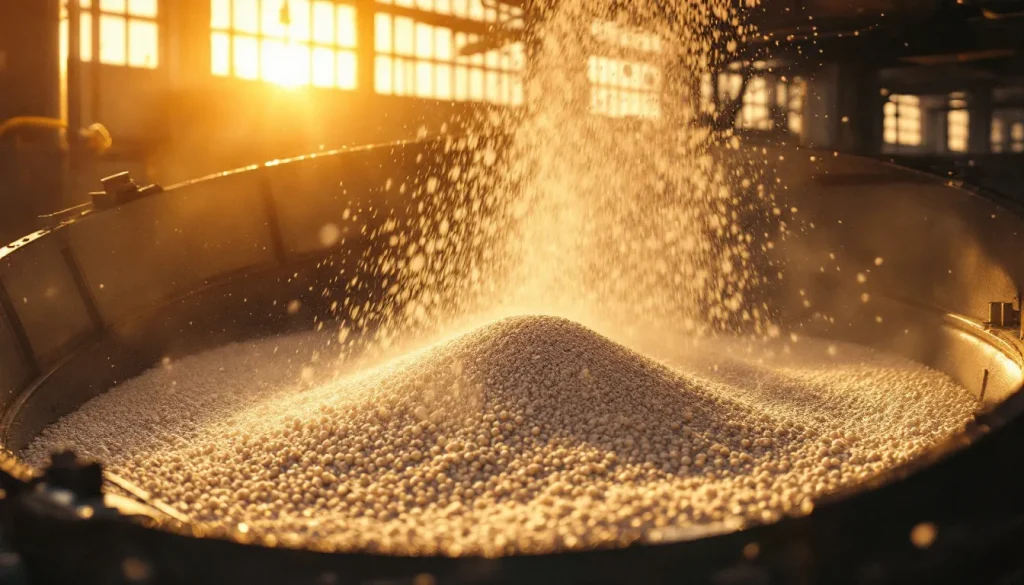
An industrial fertilizer plant runs raw materials through a fixed sequence: synthesize or source the nutrient, react or blend, granulate or prill, dry, cool, screen, and coat. The goal is a uniform, dust-free, free-flowing granule that spreads evenly and does not clump in storage. Here is the typical order for a granulated NPK product.
- Nutrient supply: Ammonia arrives from a Haber-Bosch unit, phosphoric acid from the wet process, and potash from a mine.
- Reaction or mixing: Inputs are combined to hit the target N-P-K ratio.
- Granulation: The mix tumbles in a rotating drum and grows into granules.
- Drying: A rotary dryer removes moisture so granules stay hard.
- Cooling and screening: Granules are cooled, then sieved. Oversized lumps are crushed and undersized fines are recycled back to the drum.
- Coating and bagging: A light coating reduces dust and caking, then the product is bagged or shipped in bulk.
The energy and climate cost of Haber-Bosch (the part most guides skip)
The Haber-Bosch process is one of the most energy-hungry industrial reactions on Earth. It consumes an estimated 1 to 2 percent of all global energy and around 3 to 5 percent of global natural gas supply every year. Making ammonia also produces roughly 1.8 to 2 percent of worldwide carbon dioxide emissions, which makes fertilizer a quietly large climate story.
The reason is physical. Forcing nitrogen and hydrogen to bond requires sustained high heat and pressure, and both the hydrogen feedstock and the process heat currently come from fossil natural gas. Making one ton of ammonia emits roughly 1.6 to 2 tons of CO2 through today’s standard route. Multiply that across roughly 180 million tons of ammonia produced a year and the footprint is national in scale.
This dependence is also why fertilizer prices spike when natural gas prices spike. When European gas prices surged in 2021 and 2022, several ammonia plants shut down because the gas cost more than the fertilizer was worth. It is a direct line from a gas pipeline to the price of a bag of lawn feed.
The counterweight is that this same process feeds an estimated half of the world’s population. Historian Vaclav Smil calculates that without synthetic nitrogen, roughly 4 billion people could not be fed on current farmland. Newer “green ammonia” plants aim to make the hydrogen from water using renewable electricity instead of gas, but they remain a small share of output as of 2026.
How organic fertilizer is made (from manure, bone, and blood)
Organic fertilizer is made by breaking down or grinding materials that were once alive, not by synthesizing chemicals. The main methods are composting plant and food waste, aging animal manure, and grinding slaughterhouse byproducts like bone and blood into meal. No Haber-Bosch reactor is involved, and no natural gas feedstock is needed.
Composting is controlled rot. Microbes eat a mix of “green” nitrogen-rich material (grass, food scraps, manure) and “brown” carbon-rich material (leaves, straw) in the presence of air. A working pile heats to 55 to 65 degrees Celsius from microbial activity, which kills weed seeds and pathogens. After weeks to months it becomes dark, crumbly compost. Recycling grass clippings back onto a lawn is a miniature version of this, and it reduces how much you feed and how many weeds you have to fight.
Animal byproducts become concentrated fertilizers. Bone meal is steamed, dried, and ground bone, typically around 3-15-0, and is a slow phosphorus source. Blood meal is dried animal blood, often near 12-0-0, and is one of the strongest natural nitrogen sources available. Fish emulsion is fish processing waste that has been digested and liquefied. Manure from cows, chickens, or horses is usually composted or aged first, because fresh manure can burn plants and carry pathogens.
Synthetic versus organic fertilizer: production compared
Synthetic and organic fertilizers both deliver N-P-K to plants, but they are made through opposite processes. Synthetic is manufactured in chemical plants from natural gas and mined rock, giving precise, fast-release nutrient ratios. Organic is produced by decomposing or grinding living matter, giving variable, slow-release nutrients plus soil-building organic matter. The table below compares them head to head.
| Factor | Synthetic fertilizer | Organic fertilizer |
|---|---|---|
| How it is made | Chemical reaction (Haber-Bosch, wet process) plus mining | Composting, aging manure, grinding bone and blood |
| Main raw material | Natural gas, phosphate rock, potash | Plant waste, animal manure, slaughterhouse byproducts |
| Nutrient precision | Exact, printed on the bag (e.g. 10-10-10) | Variable and often lower concentration |
| Release speed | Fast, water-soluble | Slow, as microbes break it down |
| Energy footprint | High (nitrogen especially) | Low, often a waste-recycling process |
| Soil effect | Feeds the plant, adds no organic matter | Feeds soil life and builds structure |
Neither is universally “better.” Synthetic products fix a fast, measured deficiency, which is why they dominate agriculture. Organic products build long-term soil health and recycle waste, which is why gardeners favor them. Healthier soil, in turn, tends to grow denser turf that crowds out problems like moss in a lawn.
How to make fertilizer at home
You can make effective fertilizer at home without any industrial equipment by composting kitchen and yard waste, brewing compost tea, or mulching with grass clippings. Home methods produce mild, slow-release organic fertilizer that is safe for lawns and gardens and costs almost nothing. They will not match the exact ratios of a bagged product, but they feed soil steadily.
- Compost pile: Layer green material (food scraps, grass) with brown material (dry leaves, cardboard), keep it damp, and turn it every week or two. Finished compost in 2 to 6 months.
- Compost tea: Steep a shovel of finished compost in a bucket of water for a day or two, then pour the liquid around plants for a quick, mild feed.
- Grasscycling: Leave mulched clippings on the lawn after mowing. They return nitrogen and can cut fertilizer needs by up to 25 percent.
- Kitchen boosters: Used coffee grounds add nitrogen and crushed eggshells add slow calcium when worked into soil or a compost pile.
One safety note: do not use fresh pet waste or raw manure straight on edible gardens, because it can carry pathogens. Compost it first at pile temperatures for several weeks. For more site-specific fixes and drainage projects that affect soil health, see our practical guide on how to build a French drain.
Frequently Asked Questions
What is fertilizer made of?
Fertilizer is made of three primary nutrients: nitrogen, phosphorus, and potassium, shown as the N-P-K numbers on a bag. Nitrogen comes from ammonia made out of natural gas and air. Phosphorus comes from phosphate rock dissolved in sulfuric acid. Potassium comes from mined potash. Organic fertilizers deliver the same nutrients from composted plants, manure, and ground bone or blood.
How is nitrogen fertilizer made from natural gas?
Nitrogen fertilizer is made by extracting hydrogen from natural gas through steam methane reforming, then combining that hydrogen with nitrogen from the air over an iron catalyst. This Haber-Bosch reaction runs at about 400 to 450 degrees Celsius and 150 to 300 atmospheres of pressure to form ammonia (NH3). The ammonia is then processed into products like urea and ammonium nitrate.
Is fertilizer made from poop or manure?
Some fertilizer is made from manure, but most commercial fertilizer is not. Synthetic products are made from natural gas and mined rock, not waste. Organic fertilizers, however, are frequently made from animal manure that has been composted or aged, plus byproducts like bone meal and blood meal. Treated human-waste “biosolids” are also processed into some commercial soil products.
How is fertilizer made from petroleum?
Fertilizer is not usually made from petroleum (crude oil) itself, but from natural gas, which is a related fossil fuel. Natural gas supplies the hydrogen needed to make ammonia in the Haber-Bosch process, and it also fuels the heat. Because gas and oil markets move together, people often describe nitrogen fertilizer loosely as a petroleum-based or fossil-fuel-based product.
What is the Haber-Bosch process and why does it matter for fertilizer?
The Haber-Bosch process is the industrial method that combines nitrogen from air with hydrogen from natural gas to make ammonia, the base of nearly all nitrogen fertilizer. It matters because it feeds an estimated half of the world’s population, yet it consumes 1 to 2 percent of global energy and produces roughly 1.8 percent of global carbon dioxide emissions.
What is the difference between synthetic and organic fertilizer production?
Synthetic fertilizer is manufactured through chemical reactions and mining, using natural gas, phosphate rock, and potash to make precise, fast-release nutrients. Organic fertilizer is produced by decomposing or grinding living matter, such as composting plant waste, aging manure, or milling bone and blood. Synthetic offers exact ratios; organic releases nutrients slowly and adds organic matter that builds soil structure.
How is phosphate fertilizer made (the wet process)?
Phosphate fertilizer is made through the wet process: mined phosphate rock is dissolved in sulfuric acid to produce phosphoric acid plus a gypsum byproduct. The phosphoric acid is then reacted with ammonia to form products like monoammonium phosphate (MAP) and diammonium phosphate (DAP). Phosphate rock is mined mainly in Florida, Morocco, and China.
How can you make fertilizer at home?
You can make fertilizer at home by composting kitchen scraps and yard waste, brewing compost tea, or leaving mulched grass clippings on the lawn. These produce mild, slow-release organic fertilizer for free. Coffee grounds add nitrogen and crushed eggshells add calcium. Avoid using fresh pet waste or raw manure on food crops until it has fully composted at pile temperatures.