
By the HMNDP Editorial Team. Last reviewed: June 2026.
Does gypsum for soil actually work?
Gypsum for soil works in two specific situations: sodic (sodium-affected) soil, where it displaces sodium and restores structure, and any soil that needs calcium or sulfur without a pH change. On ordinary non-sodic clay, gypsum does little on its own. Get a soil test first. The test decides whether a bag of gypsum is worth buying or a waste of money.
Gypsum is calcium sulfate dihydrate, chemical formula CaSO4·2H2O. It is a naturally occurring mineral, mined and also produced as a byproduct of flue-gas desulfurization at power plants (FGD gypsum). About 21 percent of its weight is calcium and 17 percent is sulfur.
The reason it gets oversold is that both effects, calcium supply and sodium removal, are real, so garden centers stretch them into claims gypsum cannot back up. This guide separates the two.
How much gypsum to add: rates by soil type
General maintenance rates for garden and lawn use run 20 to 40 lbs per 1,000 sq ft (roughly 1 to 2 tons per acre). Sodic-soil reclamation needs far more, often 2 to 5 tons per acre or higher, set by a gypsum-requirement lab test. Apply the lower end for calcium and sulfur supply, the higher end when a test confirms a sodium problem.
| Goal / soil condition | Rate per 1,000 sq ft | Rate per acre | Notes |
|---|---|---|---|
| Calcium or sulfur supply (general garden/lawn) | 20 to 40 lbs | 1 to 2 tons | Only if soil test shows a deficiency |
| Structure aid on clay (with organic matter) | 40 lbs | ~2 tons | Modest effect; pair with compost |
| Sodic soil, mild (ESP 6 to 10%) | 50 to 90 lbs | 2 to 4 tons | Split over one to two seasons |
| Sodic soil, severe (ESP over 15%) | 90 to 150+ lbs | 4 to 8+ tons | Follow lab gypsum-requirement value |
These are starting ranges. A lab that reports exchangeable sodium percentage (ESP) can calculate an exact gypsum requirement in tons per acre for reclamation. Do not exceed roughly 40 lbs per 1,000 sq ft per application on established lawns; split larger totals across the year.
Should you use gypsum? A soil-test decision framework
Use gypsum only when a soil test hits one of three triggers: exchangeable sodium percentage (ESP) at or above 6 percent, a calcium deficiency (often a Ca:Mg ratio below about 2:1), or sulfur below roughly 10 ppm. If none of these appear, gypsum will not meaningfully help, and your money is better spent on compost or fixing drainage.
| Soil test reading | What it means | Gypsum verdict |
|---|---|---|
| ESP 6% or higher (or SAR above ~13) | Sodic soil, sodium is degrading structure | Yes, at reclamation rate |
| Ca:Mg ratio below ~2:1, low calcium | Calcium shortage without needing more pH | Yes, at supply rate |
| Sulfur below ~10 ppm | Sulfur deficiency | Yes, at supply rate |
| Low pH (acidic), calcium low | Needs pH raised, not just calcium | No, use lime instead |
| Compacted non-sodic clay, pH fine | Physical compaction, sodium normal | No or minimal, add organic matter |
The ESP number is the single most decisive reading. Sodium wedged onto clay particles makes them disperse, sealing the soil. Calcium from gypsum kicks that sodium off the exchange sites so it can be leached away, and the clay re-aggregates. That is the one job gypsum does that nothing else does cheaply. Our guide to how to test soil pH covers getting a lab panel that reports these values.
Gypsum and heavy clay: what it can and cannot do
Gypsum breaks up clay only when sodium is the cause of the tightness. On sodic clay, it works well. On ordinary compacted clay with normal sodium, gypsum produces little to no lasting structural change on its own. The durable fix for non-sodic clay is organic matter (compost, mulch, cover crops), which feeds aggregation biologically.
This is where most marketing overpromises. The phrase “clay buster” implies gypsum loosens any dense soil. It does not. Reviews of trials on non-sodic clay show minimal infiltration gains from gypsum alone.
If your clay is simply packed and drains poorly, address the physical cause: reduce traffic, aerate, and add 2 to 4 inches of compost. See our deeper breakdown on managing heavy clay soil for the organic-matter approach. Combining gypsum with organic matter can help on borderline sodic clay, but the organic matter is doing most of the work.
Gypsum vs lime: they are not interchangeable
Lime raises soil pH; gypsum does not change pH. Both supply calcium, but that is where the overlap ends. Choose lime when soil is too acidic and needs the pH lifted. Choose gypsum when you want calcium or sulfur, or need to remove sodium, without touching pH. Using one for the other’s job wastes the amendment.
| Property | Gypsum (CaSO4·2H2O) | Lime (CaCO3) |
|---|---|---|
| Effect on pH | Neutral, no meaningful change | Raises pH (reduces acidity) |
| Supplies calcium | Yes (~21%) | Yes |
| Supplies sulfur | Yes (~17%) | No |
| Solubility | Moderately soluble, moves with water | Low solubility, stays near surface |
| Best for | Sodic soil, Ca/S supply at fixed pH | Acidic soil needing higher pH |
Because gypsum is far more soluble than lime, calcium from gypsum moves down into the root zone rather than sitting on top, which is why it works for leaching sodium out. That solubility is a feature for reclamation and irrelevant if your only problem is acidity.
How to apply gypsum: timing, method, and product form
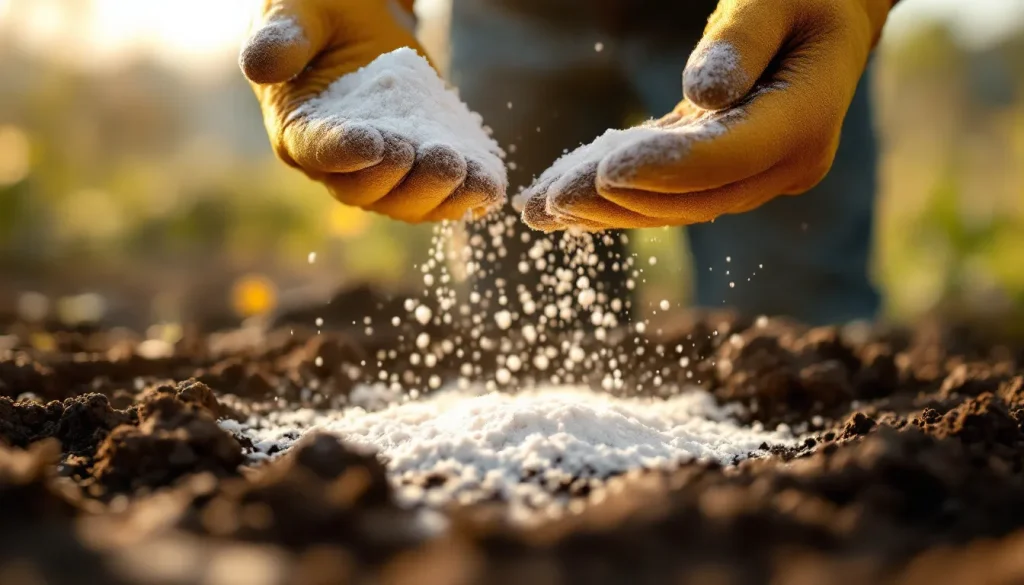
Apply gypsum in fall or early spring, spread evenly with a broadcast spreader, and water it in so it dissolves. For garden beds, incorporate it into the top 4 to 6 inches; for established lawns, surface-apply and irrigate. Pelletized gypsum flows through spreaders cleanly, while powdered dissolves faster but drifts. Expect months, not days, for visible results.
- Test first. Confirm ESP, calcium, or sulfur justifies the application. See choosing soil amendments by test result.
- Pick the form. Pelletized (granular) for even spreader coverage; powdered (agricultural) for fast dissolution and lowest cost per pound; pulverized for tilling into beds.
- Spread at the tested rate. Use a calibrated broadcast spreader for uniform coverage.
- Incorporate or water in. Till into beds, or on lawns apply about 0.5 inch of water to start dissolving it.
- For sodic reclamation, keep leaching. Sustained watering (with adequate drainage) carries displaced sodium below the root zone.
How long does gypsum take to work?
Gypsum starts dissolving within days of watering, but visible results take time. Calcium and sulfur become plant-available over a few weeks. Sodic-soil structural improvement is slower, often one full season to several years, because sodium has to be physically leached out. Gypsum is a multi-season project, not an overnight fix.
On sodic clay, plan for repeat applications and continued leaching across two to three years before structure is fully restored. Re-test the soil annually to track ESP dropping and to decide whether more gypsum is needed.
What gypsum cannot fix (and can you overdo it)
Gypsum cannot correct low pH, poor drainage in non-sodic soil, or nutrient shortages other than calcium and sulfur. It will not add nitrogen, phosphorus, potassium, or organic matter. Overapplying rarely burns plants because gypsum is low in salinity, but excess can throw off the calcium-to-magnesium balance and wastes money.
- Acidity: gypsum is pH-neutral. Use lime to raise pH.
- Drainage from compaction (non-sodic): aerate and add organic matter, not gypsum.
- Nutrient deficiencies: only calcium and sulfur come from gypsum; use a balanced fertilizer for N-P-K.
- Magnesium balance: heavy repeated gypsum can suppress magnesium availability, so re-test.
Gypsum is genuinely useful for the narrow set of problems it solves. It is not a general soil tonic. Match it to a test result and it earns its place; buy it on faith and it usually does nothing. For more on evidence-based lawn and soil practice, browse the HMNDP learn library.
Frequently Asked Questions
What does gypsum do for soil?
Gypsum (calcium sulfate, CaSO4·2H2O) supplies plant-available calcium and sulfur and displaces sodium in sodic soils, which restores structure and lets excess sodium leach away. It does not change soil pH. On non-sodic clay it has limited effect on its own. Its best-proven use is reclaiming sodium-affected or saline-sodic soil identified by a soil test.
How much gypsum should I add to clay soil (per 1,000 sq ft / per acre)?
For calcium or sulfur supply, apply 20 to 40 lbs per 1,000 sq ft (about 1 to 2 tons per acre). For sodic-soil reclamation, rates rise to 2 to 8 tons per acre based on a lab gypsum-requirement test tied to exchangeable sodium percentage. Split large totals across seasons and never exceed 40 lbs per 1,000 sq ft per application on lawns.
Will gypsum break up heavy clay soil?
Only if sodium is causing the tightness. On sodic clay, gypsum displaces sodium and the clay re-aggregates. On ordinary compacted clay with normal sodium, gypsum alone does little. The lasting fix for non-sodic clay is organic matter: add 2 to 4 inches of compost, aerate, and reduce traffic. Test for exchangeable sodium before assuming gypsum will help.
Does gypsum raise or lower soil pH?
Neither. Gypsum is pH-neutral and does not meaningfully change soil pH, which is exactly what makes it useful when you need calcium or sulfur but want to leave pH alone. If your soil is too acidic and needs a higher pH, use lime (calcium carbonate) instead. Confirm your pH with a soil test before choosing between them.
Gypsum vs lime: which one do I need?
Choose lime if your soil is acidic and needs a higher pH, since lime raises pH while supplying calcium. Choose gypsum if you need calcium or sulfur, or need to remove sodium, without changing pH. Both add calcium, but only lime shifts pH and only gypsum adds sulfur and leaches sodium. A soil test showing your pH and sodium level settles it.
When is the best time to apply gypsum?
Fall or early spring are best, when you can water it in and it has time to dissolve and act before peak growth. Spread evenly with a calibrated broadcast spreader, then incorporate into beds or irrigate lawns with about 0.5 inch of water. For sodic reclamation, apply ahead of a season with reliable leaching water and adequate drainage.
How long does gypsum take to work in soil?
Gypsum dissolves within days of watering, and calcium and sulfur become plant-available over a few weeks. Structural improvement on sodic soil is much slower, taking one season to several years as sodium leaches out of the root zone. Plan repeat applications and annual soil re-tests for reclamation projects rather than expecting fast visible change.
Can I use too much gypsum, and will it harm plants?
Overapplication rarely burns plants because gypsum has low salinity, but too much wastes money and can skew the calcium-to-magnesium balance, reducing magnesium availability. Stay within tested rates: up to 40 lbs per 1,000 sq ft per application for general use, and follow lab gypsum-requirement figures for reclamation. Re-test soil annually to confirm you are not overshooting.