
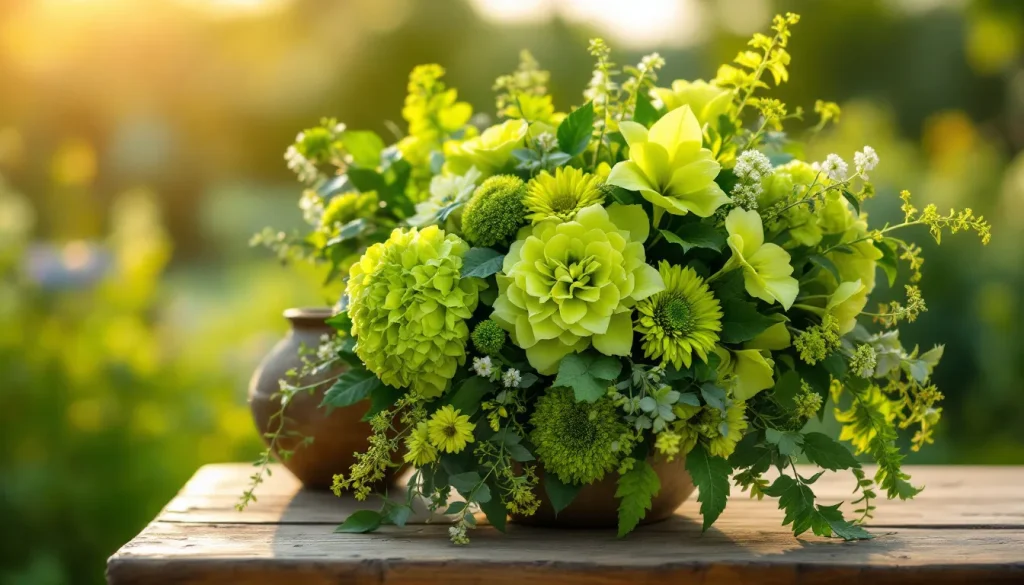
Green flowers, quickly
Green flowers are real, and many of them are naturally green with no dye involved: Bells of Ireland, Zinnia ‘Envy’, ‘Limelight’ hydrangea, Green Trick dianthus, and green Cymbidium orchids all grow their color. Others sold as “green,” including most green carnations and many green roses, are white flowers dyed green. Below are 20 green flowers with botanical names, growing zones, and honest sourcing notes.
By the HMNDP Editorial Team, independent reporting on lawn care, landscaping, and the green industry.
Last reviewed: June 2026.
Green reads as calm, fresh, and structural, which is why florists reach for it as filler and designers plant it to cool down hot color beds. It also carries meaning: hope, renewal, health, and good luck. The trick is knowing which greens you can grow yourself and which arrive from a dye vat, a distinction most guides skip.
The 20 best green flowers (common and botanical names)
These 20 green flowers cover garden perennials, cut-flower annuals, flowering shrubs, and florist staples. Each entry lists the botanical name, whether the color is natural or commonly dyed, and the practical growing data (USDA zone, sun, bloom time) that most green-flower lists leave out. Photos help with identification; the names below let you order or search the exact cultivar.
- Bells of Ireland (Moluccella laevis): Naturally green. The green “bells” are calyxes, not petals. Annual in zones 2-11, full sun, blooming mid to late summer on 2 to 3 foot spires. A vertical florist staple.
- Green Rose ‘Super Green’ / ‘Green Tea’ (Rosa hybrids): True green rose cultivars exist, but most “green roses” in shops are dyed white roses. Antique green types grow in zones 6-9, full sun, repeating through summer.
- Green Cymbidium Orchid (Cymbidium hybrids): Naturally green. Cool-growing orchids that flower late winter into spring. Hardy outdoors only in zones 9-10, grown as houseplants elsewhere. Long-lasting sprays favored for weddings.
- ‘Limelight’ Hydrangea (Hydrangea paniculata ‘Limelight’): Naturally green. Cone-shaped blooms open lime green in mid to late summer before aging to pink. Shrub for zones 3-9, full sun to part shade.
- ‘Annabelle’ Hydrangea (green stage) (Hydrangea arborescens ‘Annabelle’): Naturally green early and late. Big mophead blooms start green, turn white, then return to green as they dry. Zones 3-9, part shade.
- Green Button Pom ‘Kermit’ (Chrysanthemum ‘Kermit’): Naturally green. Dense, coin-sized buttons. Garden mums are hardy in zones 5-9, full sun, blooming late summer into fall. A wedding filler favorite.
- Green Spider Mum ‘Anastasia Green’ (Chrysanthemum): Naturally green. Long, tubular, spidery petals. Zone 5-9 hardiness like other garden mums, though mostly sold as cut stems year-round.
- Green Amaranthus ‘Viridis’ (Amaranthus caudatus ‘Viridis’): Naturally green. Draping, rope-like chartreuse tassels. Annual, full sun, blooming summer to frost, zones 2-11. Adds cascading movement.
- Green Trick Dianthus (Dianthus barbatus ‘Green Trick’): Naturally green. No visible petals, just fuzzy pompoms of green filaments. Grown as an annual or short-lived perennial in zones 5-9, full sun.
- Zinnia ‘Envy’ (Zinnia elegans ‘Envy’): Naturally green. Chartreuse semi-double blooms, easy from seed. Annual, full sun, blooming early summer to frost, zones 3-10.
- Green Hellebore (Helleborus foetidus): Naturally green. One of the few winter bloomers, flowering late winter to early spring in zones 5-9, part to full shade. Cup-shaped pale green flowers.
- ‘Snowball’ Viburnum (green stage) (Viburnum opulus ‘Roseum’): Naturally green. Round clusters emerge lime green in spring before whitening. Shrub, zones 3-8, full sun to part shade.
- Bupleurum (Bupleurum griffithii): Naturally green. Airy yellow-green umbels used as filler, much like a green baby’s breath. Annual, full sun, blooming summer, zones 3-9.
- ‘Green Goddess’ Calla Lily (Zantedeschia aethiopica ‘Green Goddess’): Naturally green. White spathe brushed with green edges. Zones 8-10 outdoors, or lifted rhizomes elsewhere, full sun to part shade, summer bloom.
- ‘Spring Green’ Tulip (Tulipa ‘Spring Green’): Naturally green. A viridiflora tulip with ivory petals and a green feathered stripe. Plant bulbs in fall for mid to late spring bloom, zones 3-8, full sun.
- Green Anthurium ‘Midori’ (Anthurium andraeanum ‘Midori’): Naturally green. Glossy, waxy green spathes. Tropical, hardy in zones 11-12 or grown as a houseplant, blooming nearly year-round.
- Lady’s Mantle (Alchemilla mollis): Naturally green. Frothy sprays of tiny chartreuse flowers. Perennial, zones 3-8, full sun to part shade, blooming early to midsummer. Excellent airy filler.
- ‘Lime Green’ Nicotiana (Nicotiana alata ‘Lime Green’): Naturally green. Star-shaped flowering tobacco blooms. Annual, full sun to part shade, blooming summer to frost, zones 10-11 (annual elsewhere).
- ‘Green Jewel’ Coneflower (Echinacea purpurea ‘Green Jewel’): Naturally green. Fragrant green daisy petals around a green cone. Perennial, zones 3-8, full sun, blooming summer.
- ‘Green Star’ Gladiolus (Gladiolus ‘Green Star’): Naturally green. Tall spikes of lime green blossoms. Plant corms in spring for summer bloom, zones 7-10 (lift corms in colder zones), full sun.
Are green flowers naturally green or dyed? The honest split
Both are common, and shops rarely tell you which is which. Naturally green flowers grow their pigment from chlorophyll or genetic mutation, so the color is even and lives in the plant. Dyed flowers are usually white blooms that drank floral dye through the stem, which pools unevenly and stains the water. Here is how the most-confused green flowers actually break down.
| Flower | Usually natural or dyed? | How to tell |
|---|---|---|
| Bells of Ireland, Zinnia ‘Envy’, ‘Limelight’ hydrangea, Green Trick dianthus, green mums, Cymbidium orchid | Naturally green | Even color into the stem; the plant grows this way |
| Green carnation (Dianthus caryophyllus) | Almost always dyed | White carnation dyed green; petal edges show the deepest color, stem water tints green |
| Green rose | Mixed (true cultivars exist, most retail stems are dyed) | Dyed roses show uneven streaks and a very saturated, unnatural emerald |
| Green gerbera daisy, green orchid sprays sold cheap | Often dyed | Blotchy color, dye visible where petals meet the center |
Neither option is wrong. Dyed green carnations are a tradition for St. Patrick’s Day and cost little. If you want a bloom you can grow again or one that photographs as a soft, natural green, choose from the naturally green list above.
Green flowers organized by shade
Green is not one color, and matching shade to a design matters more than matching flower type. Chartreuse pops against purple and burgundy, emerald reads formal and deep, and mint or pale green blends into white and blush palettes. Sorting green flowers by shade, which most guides never do, makes bouquet and bed planning much faster.
| Shade | Best green flowers | Design use |
|---|---|---|
| Bright chartreuse / lime | Zinnia ‘Envy’, ‘Limelight’ hydrangea, Amaranthus ‘Viridis’, Lady’s Mantle, ‘Green Star’ gladiolus | High-contrast pops beside purple, red, or orange |
| Deep / emerald green | Green Trick dianthus, ‘Kermit’ button poms, green Cymbidium, Anthurium ‘Midori’ | Formal, structural texture and focal weight |
| Pale / mint green | Bells of Ireland, green hellebore, Bupleurum, ‘Green Goddess’ calla | Soft blends into white, ivory, and blush |
| White-with-green | ‘Spring Green’ tulip, ‘Snowball’ viburnum (green stage), ‘Annabelle’ hydrangea | Bridges all-white and full-green arrangements |
What green flowers symbolize
Green flowers symbolize hope, renewal, health, good fortune, and youth across most Western floral traditions. The color ties to spring growth and fresh starts, which makes green blooms a common choice for new beginnings, recovery wishes, and good-luck gifting. The green carnation carries an extra, more specific history worth knowing before you gift one.
Renewal and rebirth are the strongest associations, because green signals new leaf growth. That makes green flowers fitting for graduations, new homes, new jobs, and get-well arrangements.
Good luck and prosperity attach to green in many cultures, which is why green blooms appear around St. Patrick’s Day and around wishes for financial or personal fortune.
The green carnation specifically became a symbol linked to Oscar Wilde and his circle in 1890s London, and it still reads as a marker of individuality. For a wider look at how bloom meanings work, see our guide to annual flowers and their meanings and how birth flowers by month assign symbolism.
Best green flowers for bouquets and centerpieces
The best green flowers for arrangements do one of two jobs: they add airy filler and texture, or they stand as a structural focal point. Florists lean on Bells of Ireland, Bupleurum, and Amaranthus for movement, and on green Cymbidium, Anthurium ‘Midori’, and green button poms for focal weight. Green also stretches a palette, letting one accent color read as intentional.
- Filler and texture: Bells of Ireland (vertical spires), Bupleurum (soft umbels), Lady’s Mantle (frothy sprays), Amaranthus ‘Viridis’ (trailing tassels).
- Focal blooms: Green Cymbidium orchid, Anthurium ‘Midori’, ‘Green Goddess’ calla, green spider mums.
- Rounded texture: Green Trick dianthus and ‘Kermit’ button poms add pompom shapes that hold up for a week or more.
- Wedding work: Green pairs cleanly with white and blush, so it is a low-risk choice for DIY bridal bouquets and centerpieces.
Green flowers you can grow, by USDA zone
Plenty of green flowers grow easily at home, split between annuals you sow each spring and perennials or shrubs that return for years. Annuals like Zinnia ‘Envy’ and Bells of Ireland give you cut stems in a single season across most of the country. Perennials and shrubs like ‘Limelight’ hydrangea and ‘Green Jewel’ coneflower reward a fixed planting spot in the right zone.
The split matters for planning: annuals cover cold zones as one-season plants, while perennials and shrubs need a zone match to survive winter. Feeding and soil health drive bloom quality either way; the same nutrition logic behind a lush green lawn applies to green flower beds.
| Green flower | Type | USDA zones | Sun | Bloom time |
|---|---|---|---|---|
| Bells of Ireland | Annual | 2-11 | Full sun | Mid to late summer |
| Zinnia ‘Envy’ | Annual | 3-10 | Full sun | Early summer to frost |
| Amaranthus ‘Viridis’ | Annual | 2-11 | Full sun | Summer to frost |
| Bupleurum | Annual | 3-9 | Full sun | Summer |
| Green Trick dianthus | Annual / short perennial | 5-9 | Full sun | Summer |
| Lady’s Mantle | Perennial | 3-8 | Full sun to part shade | Early to midsummer |
| ‘Green Jewel’ coneflower | Perennial | 3-8 | Full sun | Summer |
| Green hellebore | Perennial | 5-9 | Part to full shade | Late winter to spring |
| ‘Limelight’ hydrangea | Shrub | 3-9 | Full sun to part shade | Mid to late summer |
| ‘Annabelle’ hydrangea | Shrub | 3-9 | Part shade | Early to midsummer |
| ‘Snowball’ viburnum | Shrub | 3-8 | Full sun to part shade | Spring |
| ‘Spring Green’ tulip | Bulb | 3-8 | Full sun | Mid to late spring |
| ‘Green Star’ gladiolus | Corm | 7-10 (lift in colder zones) | Full sun | Summer |
Not every green plant is a flower you want to invite in. Some vigorous green bloomers self-sow hard, a reminder that the line between a wanted plant and a weed is about placement, a theme we cover in whether dandelions count as weeds.
When green flowers bloom and where to buy them
Green flowers bloom across three seasons: green hellebore and ‘Spring Green’ tulips in late winter to spring, most annuals and hydrangeas in summer, and green mums in fall. As cut stems, florist greens like Bells of Ireland, green orchids, and button poms are available year-round through wholesale supply chains. Buy seed, plants, or stems depending on your timeline.
- Seeds and plants: Garden centers and mail-order seed companies carry Zinnia ‘Envy’, Bells of Ireland, and Amaranthus ‘Viridis’ for spring sowing.
- Shrubs and perennials: Local nurseries stock ‘Limelight’ hydrangea and coneflower in spring and fall planting windows.
- Cut stems: Full-service florists, farmers markets in season, and grocery floral departments carry green mums, Bells of Ireland, and dyed green carnations.
- Weddings and bulk: Online wholesale flower sellers ship green Cymbidium, calla, and filler greens by the box, often to order two to three weeks ahead.
Frequently Asked Questions
Are there any naturally green flowers, or are they all dyed?
Many green flowers are naturally green with no dye. Bells of Ireland, Zinnia ‘Envy’, ‘Limelight’ hydrangea, Green Trick dianthus, green Cymbidium orchids, and green button mums all grow their color from chlorophyll or genetic mutation. Others sold as green, especially green carnations and many green roses, are white flowers dyed through the stem. Even color into the stem signals a naturally green bloom.
What are the names of common green flowers?
Common green flowers include Bells of Ireland (Moluccella laevis), Zinnia ‘Envy’, ‘Limelight’ hydrangea, Green Trick dianthus, green Cymbidium orchid, green button pom mums (‘Kermit’), Amaranthus ‘Viridis’, Bupleurum, green hellebore, ‘Green Goddess’ calla lily, ‘Spring Green’ tulip, and Lady’s Mantle. Green carnations are also common, though usually dyed rather than naturally green.
What do green flowers symbolize or mean?
Green flowers symbolize hope, renewal, health, good luck, and youth. The color ties to spring growth and fresh starts, so green blooms suit new beginnings, get-well wishes, and good-fortune gifting. Green also signals prosperity in many cultures, which is why it appears around St. Patrick’s Day. The green carnation carries an added association with individuality dating to 1890s London.
Which green flowers are best for bouquets and centerpieces?
For filler and texture, use Bells of Ireland, Bupleurum, Lady’s Mantle, and trailing Amaranthus ‘Viridis’. For focal blooms, use green Cymbidium orchids, Anthurium ‘Midori’, ‘Green Goddess’ calla, or green spider mums. Green Trick dianthus and ‘Kermit’ button poms add long-lasting pompom texture. Green pairs cleanly with white and blush, making it a reliable choice for DIY wedding work.
Are green roses and green carnations real or dyed?
Green carnations are almost always dyed white carnations, with the deepest color at the petal edges and dye that tints the vase water. Green roses are mixed: true green cultivars like the antique Rosa chinensis viridiflora exist and grow in zones 6-9, but most green roses in shops are dyed white roses showing uneven, unnaturally saturated streaks.
What green flowers can I grow in my own garden, and in which zones?
Grow Zinnia ‘Envy’, Bells of Ireland, and Amaranthus ‘Viridis’ as annuals in zones 2-11. For perennials and shrubs, plant ‘Green Jewel’ coneflower and Lady’s Mantle in zones 3-8, ‘Limelight’ hydrangea in zones 3-9, and green hellebore in zones 5-9. ‘Spring Green’ tulips (zones 3-8) and ‘Green Star’ gladiolus (zones 7-10) grow from bulbs and corms.
What are small or light green flowers called?
Small green flowers include green button pom mums (‘Kermit’), Green Trick dianthus, and Bupleurum. Light or pale green flowers include Bells of Ireland, green hellebore, ‘Green Goddess’ calla lily, and Lady’s Mantle’s frothy chartreuse sprays. Florists group airy small-flowered greens like Bupleurum and Lady’s Mantle as filler, similar in role to a green version of baby’s breath.
When do green flowers bloom and where can I buy them?
Green hellebore and ‘Spring Green’ tulips bloom late winter to spring, most annuals and hydrangeas in summer, and green mums in fall. As cut stems, Bells of Ireland, green orchids, and button poms are available year-round. Buy seeds and plants from garden centers, shrubs from nurseries, and cut stems from florists, farmers markets, or online wholesale sellers for weddings.