
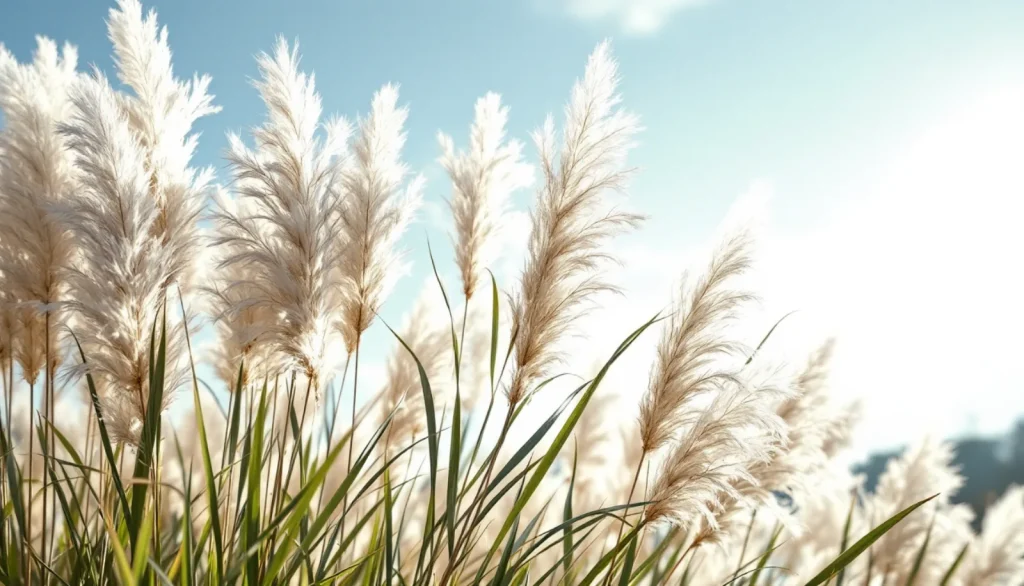
Pampas Grass: Care, Plumes, and Invasive Caution
Pampas grass (Cortaderia selloana) is a clumping ornamental grass hardy in USDA zones 7 to 10 that throws silvery, feather-shaped plumes 8 to 10 feet tall from late summer into winter. It is also a known invasive in parts of California and Hawaii, and one of its close relatives, Cortaderia jubata, is a far worse weed. This guide covers how to grow and cut it back, how to tell the two species apart, and where you should not plant either one.
The short version
- Cold-hardy in USDA zones 7 to 10, full sun, well-drained soil, drought-tolerant once established (roughly 3 months after planting).
- Plumes appear late summer through fall; female plants produce the broad, silky plumes most people want, so named cultivars are divided from female clumps, not grown from seed.
- Cut the whole clump back to 6 to 12 inches in late winter, just before new growth, wearing leather gloves, long sleeves, and long pants because the leaf edges are razor-sharp.
- Cortaderia selloana carries a Cal-IPC “High” invasive rating in California; each plume can release up to 100,000 wind-dispersed seeds. Its cousin Cortaderia jubata is the more aggressive weed because every plant is female and seeds without pollination.
- Dwarf cultivars like ‘Pumila’ top out around 4 to 6 feet and fit small yards far better than the 10-foot straight species.
What is pampas grass and where does it come from?
Pampas grass is Cortaderia selloana, a large perennial bunchgrass native to the river plains (the “pampas”) of Argentina, Brazil, and Chile. It forms a dense tussock of arching gray-green blades topped by tall creamy-white or pale-violet plumes. Gardeners plant it for structure, screening, and dried-flower harvest, not for lawns.
The plant is dioecious, meaning male and female flowers grow on separate plants. Female plumes are broad and full because silky hairs cover the tiny flowers; male plumes are thinner and less showy. That is why nurseries propagate named pampas grass by dividing female clumps rather than from seed, and why a plant labeled by cultivar name is almost always female.
What growing zones and conditions does pampas grass need?
Pampas grass grows best in USDA hardiness zones 7 through 10, in full sun, in well-drained soil. It needs at least six hours of direct sun a day for good plume production, tolerates poor soil, coastal salt spray, and drought, and asks for very little once established. In zone 6 it may survive with winter protection but plume display suffers.
Plant in late spring after your last frost so roots establish before summer heat. The mature straight species reaches 8 to 12 feet wide and tall, so space plants at least 6 feet apart (1 to 2 meters). Water deeply once or twice a week for the first three months; after that it generally lives on rainfall in most regions. Confirm your zone on the 2023 USDA Plant Hardiness Zone Map before buying. If you are matching plants to a tough microclimate, our notes on getting grass to grow where conditions fight you cover the same sun, soil, and slope logic for turf.
When do the plumes appear, and how do you dry them?
Plumes emerge in late summer and hold through fall and often into winter. They start creamy white or silver and stand a foot or two above the foliage. For dried arrangements, cut the plumes when they have just fully opened in fall, before they shatter, then hang them upside down in a warm, dry, dark space for one to two weeks.
Cutting plumes early, right as they open, keeps the seed heads from drying to the shatter point indoors and reduces shedding. Hairspray or a light fixative helps dried plumes hold together. Picking plumes before they mature also keeps seed off the ground outdoors, which matters in any region where the plant can escape (see the invasive section below).
How and when do you cut back pampas grass?
Cut the entire clump back to 6 to 12 inches above the ground in late winter to early spring, just before new growth pushes up. This clears dead, matted foliage, triggers vigorous regrowth, and gives a clean shape by midsummer. Wear leather gloves, long sleeves, and long pants: the blade edges cut skin like a serrated knife.
- Wait for late winter (often February in mild regions), before new green shoots emerge from the crown.
- Put on leather gloves, eye protection, long sleeves, and long pants. The leaf margins are serrated and sharp.
- Tie the clump into a tight bundle with rope or bungee cords so it cuts cleanly and the trimmings stay contained.
- Cut the bundle down to 6 to 12 inches with long-handled loppers, a hedge trimmer, or a pruning saw. A chainsaw handles very large, old clumps.
- Rake out loose dead material from inside the crown. Every three years or so, dig and remove about a third of the outer satellite clumps to thin an overgrown stand.
- Optional: scatter a handful of balanced fertilizer (8-8-8 or 10-10-10) around the base after cutting. Do not burn the stubble; burning weakens regrowth.
Do not burn the clump to clear it. Some homeowners try this; it produces weaker regrowth and is a fire risk, especially with dry grass in wildfire-prone zones. For California readers near the wildland interface, dense ornamental grass also intersects with Cal Fire defensible-space rules, which discourage flammable plantings close to structures.
Cortaderia jubata vs Cortaderia selloana: which one is the real problem?
Both species are invasive in California, but Cortaderia jubata (jubata grass, or purple pampas grass) is the more aggressive weed. Every jubata plant is female and sets seed by apomixis, producing thousands of viable seeds per plume without any pollination, so a single plant can colonize bare ground on its own. Cortaderia selloana needs separate male and female plants to seed, which slows its spread, though it still escapes.
Telling them apart matters because nurseries and roadsides mix them up. Use the table below, drawn from Pacific Horticulture and the California Invasive Plant Council.
| Trait | Cortaderia selloana (pampas grass) | Cortaderia jubata (jubata grass) |
|---|---|---|
| Mature plume color | Silvery white to pale violet | Deep rosy lavender when young, fading tan |
| Plume position | Held at or near the top of the arching leaves | Held 1 to 3 feet above the foliage on long stalks |
| Leaves | Somewhat slender, arc up to plume height | Slightly wider, sit well below the flower stalk |
| Reproduction | Dioecious: needs male and female plants to set seed | Apomictic: all female, seeds without pollination |
| Bloom timing (CA coast) | Late August into September | Late July through September (blooms first) |
| Cold and heat tolerance | Tolerates winter frost, intense sun, moderate drought | Less frost-tolerant; favors cool, foggy coastal sites |
| Native range | River plains of Argentina, Brazil, Chile | Andean mountains of Ecuador, Peru, Chile |
Is pampas grass invasive, and is it banned in California?
Cortaderia selloana holds a Cal-IPC invasive rating of “High” in California, where each plume can release up to 100,000 wind-dispersed seeds that travel on the wind, with stands documented producing millions of seeds a year. It is not banned statewide. A 1988 California bill that would have prohibited sale of jubata grass and other invasive exotics was vetoed by the governor, so neither species carries a statewide sales ban, though both are strongly discouraged.
The plant invades dunes, coastal bluffs, shrublands, marshes, riparian corridors, and disturbed ground along the California coast, Coast Ranges, Central Valley, Western Transverse Ranges, and Mojave Desert. The California Department of Fish and Wildlife lists pampas grass on its “Don’t Plant Me” roster. On Maui, every Cortaderia species present is treated as invasive. Backyard plantings act as seed sources for wildland infestations several miles away.
If you live in California, Oregon, Washington, or Hawaii, the responsible move is to skip both species and plant a native bunchgrass instead. California Fish and Wildlife recommends giant wildrye (Elymus condensatus), a California native that spreads slowly, holds green foliage year-round, feeds birds, and does not outcompete natives. In drier western yards, pairing native grasses with a turf-conversion plan can also qualify for rebates; see our guide to drought-tolerant lawn alternatives and the regional programs it tracks.
Which pampas grass should you plant in a small yard?
For small or suburban yards outside the invasive zones, choose a dwarf cultivar like Cortaderia selloana ‘Pumila’ (sold as Ivory Feathers and other trade names). ‘Pumila’ keeps foliage around 3 to 5 feet with plumes near 4 to 6 feet, versus the 8-to-10-foot straight species, and its compact footprint of roughly 4 feet wide fits a bed without swallowing it.
Dwarf cultivars are still female-propagated and still produce plumes from late summer into winter, so you keep the look on a manageable scale. Variegated forms such as ‘Silver Comet’ add striped foliage. Whatever you plant, give it full sun, well-drained soil, and the same late-winter cut-back. Before placing a large clump, measure the bed so the mature spread fits; our walkthrough on measuring your yard applies to planting beds as much as turf.
| Option | Mature size | Best for | Watch-outs |
|---|---|---|---|
| Straight species C. selloana | 8 to 12 ft tall and wide | Large screens, dried-plume harvest, big lots | Seeds heavily; avoid in CA/HI/PacNW |
| Dwarf ‘Pumila’ | Foliage 3 to 5 ft, plumes 4 to 6 ft | Small yards, foundation beds, containers | Still female-propagated; still invasive-zone restricted |
| Variegated ‘Silver Comet’ | 5 to 7 ft | Accent planting, striped foliage interest | Slower, pricier, same sun and drainage needs |
| Native substitute: giant wildrye | 4 to 9 ft | California and West Coast yards | Different look (no big silky plume) |
Pampas grass quick-reference card
Use this as a planting and care summary. Specifics vary by region and site, so confirm your hardiness zone and check your county or state invasive-plant list before buying.
| Factor | Guidance |
|---|---|
| USDA zones | 7 to 10 (6 with protection, reduced plume display) |
| Light | Full sun, 6+ hours daily |
| Soil | Well-drained; tolerates poor, sandy, salty soils |
| Spacing | 6 ft apart for the straight species; 3 to 4 ft for dwarfs |
| Plume season | Late summer into winter |
| Cut-back | Late winter, to 6 to 12 inches, with leather gloves |
| Invasive caution | High Cal-IPC rating; avoid in CA, HI, OR, WA |
Related coverage
- Drought-tolerant lawn alternatives and 2026 rebate programs
- Cal Fire defensible-space zones for California yards
- How to get grass to grow in tough spots
- Measure your yard square footage accurately
Last reviewed: June 2026
HMNDP Editorial Team, reviewed by HMNDP turf and horticulture editors.
Frequently asked questions
What zone does pampas grass grow in?
Pampas grass (Cortaderia selloana) is cold-hardy in USDA zones 7 to 10. It wants full sun, at least six hours daily, and well-drained soil. In zone 6 it can survive with winter protection, but plume display suffers. Plant in late spring after your last frost so roots establish before summer heat, and confirm your zone on the 2023 USDA map.
When should you cut back pampas grass?
Cut the whole clump back to 6 to 12 inches above the ground in late winter to early spring, just before new growth pushes up. This clears dead foliage and triggers vigorous regrowth. Wear leather gloves, long sleeves, and long pants, because the leaf edges are serrated and cut skin. Use loppers, a hedge trimmer, or a saw on large clumps.
Is pampas grass invasive?
Yes in parts of the West. Cortaderia selloana holds a Cal-IPC High invasive rating in California, where each plume can release up to 100,000 wind-dispersed seeds. It invades dunes, bluffs, riparian areas, and disturbed ground in California and Hawaii. Its relative Cortaderia jubata is worse: every plant is female and seeds without pollination, so one plant can spread on its own.
What is the difference between Cortaderia jubata and Cortaderia selloana?
Cortaderia selloana (pampas grass) is dioecious, needing male and female plants to set seed, with silvery-white plumes held near the leaf tops. Cortaderia jubata (jubata grass) is all-female and apomictic, seeding without pollination, with rosy-lavender plumes held one to three feet above the foliage. Jubata is the more aggressive weed and favors cool, foggy coastal sites.
Is pampas grass banned in California?
No, neither species is banned statewide. A 1988 California bill that would have prohibited sale of jubata grass and other invasive exotics was vetoed by the governor. Both species remain legal to sell but are strongly discouraged, and pampas grass appears on the California Department of Fish and Wildlife Don’t Plant Me list. On Maui, all Cortaderia species are treated as invasive.
How tall does dwarf pampas grass get?
Dwarf Cortaderia selloana ‘Pumila’ keeps foliage around 3 to 5 feet with plumes near 4 to 6 feet, versus 8 to 10 feet for the straight species. Its footprint runs roughly 4 feet wide, fitting suburban beds and large containers. It still produces silky creamy-white plumes from late summer into winter and takes the same full sun, drainage, and late-winter cut-back.
When do pampas grass plumes appear and how do you dry them?
Plumes emerge in late summer and hold through fall, often into winter. For dried arrangements, cut the plumes when they have just fully opened in fall, before they shatter, then hang them upside down in a warm, dry, dark space for one to two weeks. A light fixative helps them hold. Cutting early also keeps seed off the ground in invasive-prone regions.
Why are most pampas grass plants female?
Pampas grass is dioecious, so male and female flowers grow on separate plants. Female plumes are broad and silky because fine hairs cover the flowers, while male plumes are thinner and plainer. Since gardeners want the showy female plumes, nurseries propagate named cultivars by dividing female clumps rather than growing from seed, so a cultivar-labeled plant is almost always female.