
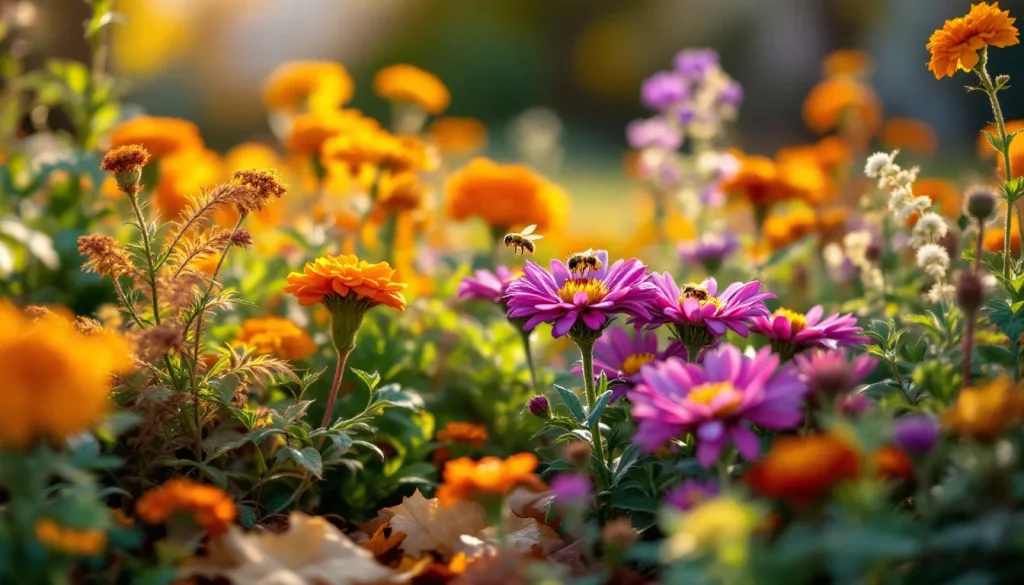
Fall flowers at a glance
Fall flowers fall into two groups that searchers constantly confuse: plants that are blooming now in September through November (mums, asters, sedum, Japanese anemone, toad lily) and plants you put in the ground now to bloom next spring (tulips, daffodils, alliums and other bulbs). This guide separates the two, then ranks 22 autumn bloomers by sun, zone, pollinator value, and vase life.
By the HMNDP Editorial Team, independent reporting on lawn care and landscaping. Author profile: HMNDP Editorial Team. Last reviewed: June 2026.
Fall flowers that bloom now vs. fall flowers you plant now
These are two different questions with two different answers. “Flowers that bloom in fall” means plants flowering in September, October, and November right now, like chrysanthemums and asters. “Flowers to plant in fall” usually means spring-blooming bulbs (tulips, daffodils, crocus) and hardy perennials you set out in cool soil so they root before winter and flower months later. Buying mums when you wanted tulip bulbs is the classic mix-up.
| Question | What you want | Examples | When it flowers |
|---|---|---|---|
| Flowers that bloom in fall | Plants in flower now | Mums, asters, sedum, Japanese anemone, toad lily, ornamental kale | Sept to hard frost |
| Flowers to plant in fall | Bulbs and perennials for later | Tulips, daffodils, alliums, peonies, spring crocus | Next spring (Mar to May) |
| Both at once | Late bloom now, more next year | Asters, sedum, goldenrod, peony divisions | Now and again next season |
If your goal is next spring’s color, our companion guide on fall flowers to plant covers bulb depth and timing. The list below is about what actually flowers during autumn.
Fall bloom calendar: September, October, November
“Fall” is not one national moment. In USDA zones 3 to 5, first frost often lands late September to mid-October, ending tender blooms early. In zones 8 to 10, many of these flowers hold into late November or December. Use the month you are actually in, not the calendar label, to decide what will still be showing color.
| Month | Peak bloomers | What is fading | Cold-zone note (3-5) |
|---|---|---|---|
| September | Asters, sedum, dahlias, zinnias, goldenrod, Joe Pye weed, roses | Late summer annuals | Prime month before frost |
| October | Chrysanthemums, Montauk daisy, toad lily, autumn crocus, ornamental kale, pansies | Dahlias, zinnias (frost-killed) | Mums, kale, pansies carry the show |
| November | Pansies, ornamental kale/cabbage, hardy cyclamen, late roses in warm zones | Most perennials dormant | Often bare; rely on cool-season fillers |
The 22 best fall flowers, ranked and labeled
Each entry below is tagged perennial (P) or annual (A), with color, light needs, hardiness zones, and one real growing note. Perennials return every year; annuals bloom one season and die at frost. This is the core list, built to cover garden planting first, with cut-flower picks flagged for arrangement use.
- Chrysanthemums (mums) (P/A): The canonical number-one fall flower, in gold, bronze, rust, purple, and white. Full sun, zones 5 to 9. Garden mums planted in spring overwinter reliably; the “hardy mums” sold in September are often root-bound and treated as annuals unless you plant them early and mulch heavily.
- Asters, New England and Michaelmas daisy (P): Purple, blue, pink, and magenta daisies covered in bees. Full sun, zones 3 to 8. Pinch stems back by half in early June for a shorter, denser plant; divide every 2 to 3 years to prevent a woody, bare center.
- Sedum / stonecrop, e.g. Autumn Joy (P): Fleshy foliage topped by broccoli-like flower heads that shift from pink to rust-red. Full sun, zones 3 to 9, very drought tolerant. Leave the dried heads standing through winter for structure and bird seed.
- Japanese / fall anemone (P): Elegant pink or white cups on wiry 2 to 4 foot stems. Part shade to full sun, zones 4 to 8. It spreads by runners and can colonize, so plant where roaming is welcome.
- Russian sage, Perovskia (P): Airy lavender-blue spikes over silver foliage from midsummer into October. Full sun, zones 4 to 9, thrives in poor dry soil. Cut it back hard to 6 inches in spring, not fall.
- Autumn crocus, Colchicum (P bulb): Leafless pink-purple goblets that erupt from bare soil in September and October. Full sun to part shade, zones 4 to 8. Every part is toxic if eaten, so keep away from pets and children.
- Toad lily, Tricyrtis (P): Orchid-like purple-spotted flowers that light up shade in October. Part to full shade, zones 4 to 8. Give it consistently moist soil; it sulks and browns in dry spots.
- Roses, reblooming types (P): Many shrub and Knock Out roses push a strong flush into September and October. Full sun, zones 4 to 9. Stop deadheading in early fall and let hips form to signal dormancy before frost.
- Goldenrod, Solidago (P): Brilliant yellow plumes that anchor the native fall palette. Full sun, zones 3 to 9. It does not cause hay fever (that is ragweed blooming at the same time), and it feeds late bees heavily.
- Helenium / sneezeweed (P): Warm daisies in red, orange, and gold. Full sun, zones 3 to 8, likes moist soil. Deadhead spent blooms to extend flowering into October.
- Dahlia (A / tender bulb): Show-stopping blooms from 2-inch pompons to dinner-plate size in nearly every color but true blue. Full sun, zones 8 to 11 in ground; elsewhere lift and store tubers after frost. A top cut flower (see the arrangement section).
- Black-eyed Susan, Rudbeckia (P/A): Golden petals with dark centers that bloom July into October. Full sun, zones 3 to 9. Leave seed heads for goldfinches through winter.
- Joe Pye weed, Eutrochium (P): Tall mauve-pink flower clusters on 5 to 7 foot native stems. Full sun to part shade, zones 3 to 9, prefers moist ground. A magnet for monarchs and swallowtails in late summer and early fall.
- Montauk / Nippon daisy (P): Crisp white daisies that peak in October when little else does. Full sun, zones 5 to 9. Cut back by half in early summer to keep it from flopping.
- Ornamental / flowering kale and cabbage (A): Not true flowers but rosettes of purple, pink, and cream that intensify as temperatures drop. Full sun, cool-season filler. Color deepens after the first light frost, and plants hold through November in most zones.
- Pansies and violas (A / short-lived P): Cool-season workhorses in every color, including near-black. Full sun to part shade. Planted in September, they bloom through fall and, in zones 6 and warmer, again in early spring.
- Celosia (A): Velvety plumes and brain-like “cockscomb” in hot red, orange, and magenta. Full sun. Excellent both in beds and as a long-lasting cut or dried flower.
- Zinnia (A): Bright, easy daisies that bloom until frost. Full sun. Keep cutting; the more you harvest, the more they produce, which makes them a budget wedding staple.
- Mexican sunflower, Tithonia (A): Vivid orange 3-inch blooms on 4 to 6 foot plants. Full sun, heat and drought tolerant. Butterflies swarm it right up to frost.
- Marigold (A): Dependable gold, orange, and rust that shrug off early cool nights. Full sun. Deadhead weekly for continuous color into October.
- Hardy cyclamen, Cyclamen hederifolium (P): Small pink or white shooting-star blooms in September and October, before the marbled leaves. Part to full shade, zones 5 to 9. Once established under trees it naturalizes for decades.
- Snapdragon (A / short-lived P): Spikes that revive in cool fall weather after a summer lull. Full sun to part shade, hardy to about 20 F. A premium cut flower with strong vertical line for arrangements.
Perennial vs. annual fall flowers: what comes back
Perennial fall flowers return every year from the same roots, so they are the smarter long-term investment: asters, sedum, Japanese anemone, Russian sage, goldenrod, helenium, Joe Pye weed, toad lily, Montauk daisy, roses, and hardy cyclamen. Annuals like zinnia, marigold, celosia, Tithonia, and ornamental kale give one intense season, then die at frost and need replanting.
Two common in-between cases trip people up. Chrysanthemums are perennial in zones 5 to 9 if planted in spring and mulched, but the potted mums sold in fall are usually treated as annuals. Dahlias are perennial only in zones 8 and warmer; colder gardeners dig and store the tubers. For flowers that carry color from June straight through, see our list of perennial flowers that bloom all summer.
Best fall flowers for full sun vs. shade
Most autumn bloomers want full sun, which is 6 or more hours of direct light. A smaller set tolerates or prefers shade, and matching the plant to the light is the single biggest factor in whether it actually flowers. Put a sun-lover in shade and you get leaves and few blooms; put a shade plant in blazing sun and it scorches.
| Light | Best fall flowers |
|---|---|
| Full sun (6+ hrs) | Mums, asters, sedum, Russian sage, goldenrod, helenium, dahlia, Montauk daisy, Tithonia, zinnia, marigold, celosia |
| Part sun / part shade | Japanese anemone, Joe Pye weed, roses (with 6 hrs), pansies, snapdragon, autumn crocus |
| Shade | Toad lily, hardy cyclamen, Japanese anemone (in hot climates) |
Fall flowers by USDA hardiness zone
Your zone and first-frost date decide how long the show lasts and which plants survive winter. Find your USDA zone (updated in the 2023 map) and your average first-frost date from your local extension office, then plan backward. Tender annuals stop the day frost hits; hardy perennials go dormant and return.
| Zone | Typical first frost | Reliable fall perennials | Season length |
|---|---|---|---|
| 3-4 | Mid-Sept to early Oct | Asters, sedum, goldenrod, helenium, rudbeckia | Short; front-load September |
| 5-6 | Early to late Oct | Mums, Japanese anemone, toad lily, Montauk daisy | Full classic fall |
| 7-8 | Late Oct to Nov | All of the above plus dahlias, roses, hardy cyclamen | Long; blooms into November |
| 9-10 | December or none | Roses, dahlias, pansies, snapdragons all winter | Cool-season, not frost-driven |
Cool-season care overlaps with lawn work this time of year. If you are reseeding thin turf alongside your beds, our guide to the best time to plant grass seed lines up with the same September soil-temperature window that pansies and kale prefer.
Best fall flowers for pollinators: bees and monarchs
Late-season nectar is a survival resource, not decoration. In September and October, migrating monarch butterflies fuel a 2,000-plus-mile trip to Mexico, and native bees stock up before dormancy. Native fall bloomers carry far more nectar and pollen than sterile double-flowered hybrids, so choose singles and natives to actually feed them.
The highest-value picks are native asters (especially New England aster), goldenrod, Joe Pye weed, and sedum, all of which swarm with bees on warm fall afternoons. Tithonia and single-flower zinnias pull in butterflies through frost. Avoid heavily doubled mums for pollinators; their packed petals hide the nectar and pollen. Grouping three or more of one plant, rather than singles, makes the patch easier for insects to find.
Best fall flowers for weddings and cut-flower arrangements
The floral and wedding crowd wants stems that last in a vase, not just plants that look good in a bed. Autumn delivers rich, warm-toned material: dahlias, chrysanthemums, celosia, zinnias, and amaranth in reds, oranges, golds, burgundies, and deep purples. Cut in the cool morning, strip submerged leaves, and recut stems underwater to extend life.
| Cut flower | Vase life | Fall colors | Arrangement role |
|---|---|---|---|
| Chrysanthemum | 2-3 weeks | Bronze, gold, rust, white | Long-lasting focal / filler |
| Dahlia | 4-6 days | Burgundy, peach, coral, cream | Show-stopping focal |
| Zinnia | 7-12 days | Orange, red, magenta, lime | Bright mid-layer |
| Celosia | 1-2 weeks (also dries) | Crimson, orange, gold | Texture and drama |
| Snapdragon | 7-10 days | Peach, white, burgundy | Vertical line / spike |
| Amaranth | 1-2 weeks (also dries) | Deep red, green trailing | Cascading accent |
For a cutting garden, plant zinnias, celosia, and snapdragons where you can harvest freely, since regular cutting increases production. Change vase water every two days and keep arrangements out of direct sun and away from ripening fruit, which releases ethylene gas and shortens bloom life.
How to identify fall flowers by sight
Quick visual cues separate the look-alikes. Mums form tight domed mounds of many small blooms; asters are looser, with narrow daisy petals around a yellow eye. Sedum reads as flat, broccoli-like clusters over succulent leaves. Goldenrod shows feathery yellow plumes, while the yellow-and-black daisy is rudbeckia. Toad lily and hardy cyclamen are the shade oddities, spotted orchid-like blooms and pink shooting stars, respectively.
When buying at a garden center, check the plant tag for the botanical name and hardiness zone rather than trusting the color photo alone, since many fall displays mix true perennials with disposable seasonal annuals at the same price.
Frequently Asked Questions
What flowers bloom in the fall?
The classic fall bloomers are chrysanthemums, asters, sedum (stonecrop), Japanese anemone, Russian sage, goldenrod, helenium, toad lily, Montauk daisy, and dahlias, plus cool-season fillers like pansies and ornamental kale. Warm-climate gardens also keep roses, zinnias, and marigolds going into November. Most peak between September and the first hard frost, which varies by USDA zone.
What is the difference between fall flowers to plant now and flowers that bloom in fall?
Flowers that bloom in fall, such as mums and asters, are in flower right now during September through November. Flowers to plant in fall are mostly spring-blooming bulbs (tulips, daffodils, alliums) and hardy perennials you set in cool soil so they root before winter and flower next spring. One gives instant autumn color; the other is an investment in the following year.
What flowers should I plant in fall for spring blooming?
Plant spring-blooming bulbs in fall, six to eight weeks before the ground freezes: tulips, daffodils, crocus, hyacinths, alliums, and snowdrops. Daffodils and alliums are deer and rodent resistant, while tulips often need protection. Set bulbs at roughly two to three times their height deep, pointed end up. They root over winter and flower from March through May.
What are the best fall flowers for full sun vs. shade?
For full sun (6-plus hours), choose mums, asters, sedum, Russian sage, goldenrod, helenium, dahlias, Montauk daisy, zinnias, and marigolds. For shade or part shade, the standouts are toad lily, hardy cyclamen, Japanese anemone, and Joe Pye weed. Matching light to plant is the biggest driver of flowering; sun-lovers in shade produce leaves but few blooms.
Which fall flowers are perennials that come back every year?
Perennial fall flowers that return yearly include asters, sedum, Japanese anemone, Russian sage, goldenrod, helenium, Joe Pye weed, toad lily, Montauk daisy, rudbeckia, hardy cyclamen, and reblooming roses. Chrysanthemums are perennial in zones 5 to 9 only when planted in spring and mulched. Dahlias are perennial in zones 8 and warmer; colder gardeners dig and store the tubers.
What flowers are in bloom in October?
October peak bloomers are chrysanthemums, asters, Montauk daisy, toad lily, autumn crocus, sedum, goldenrod, and helenium, alongside cool-season pansies and ornamental kale that intensify in color after light frost. In zones 7 and warmer, dahlias, roses, and zinnias often continue. In colder zones 3 to 5, an early frost may end tender blooms by mid-October.
What are the best fall flowers for a wedding or cut-flower arrangements?
Top fall cut flowers are chrysanthemums (2 to 3 week vase life), dahlias, zinnias, celosia, snapdragons, and trailing amaranth, in warm reds, oranges, golds, burgundies, and creams. Cut stems early in the morning, recut underwater, and change vase water every two days. Chrysanthemums and celosia last longest; dahlias are the dramatic focal flower but are more short-lived at 4 to 6 days.
Which fall flowers are best for pollinators like bees and monarch butterflies?
Native asters (especially New England aster), goldenrod, Joe Pye weed, and sedum are the highest-value fall flowers for late-season bees and migrating monarchs, which need nectar in September and October. Single-flower zinnias and Mexican sunflower (Tithonia) also draw butterflies until frost. Avoid densely doubled mums, whose packed petals hide nectar and pollen from foraging insects.