
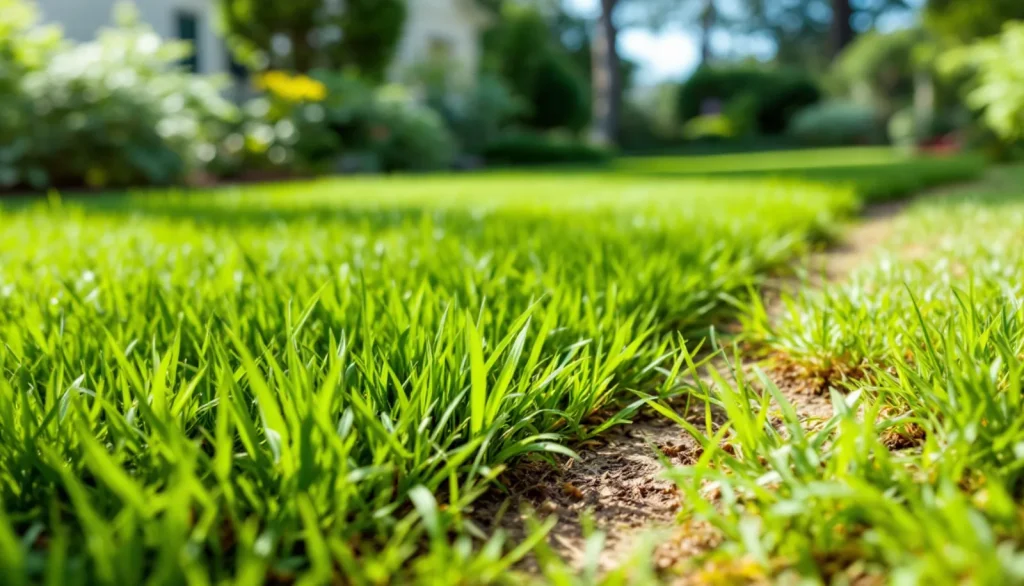
Centipede Grass: Care, Decline Fix, and vs St Augustine
Centipede grass (Eremochloa ophiuroides) is a slow-growing, low-maintenance warm-season turf built for the acidic, sandy soils of the Southeast, and it runs on a “less is more” program: mow at 1 to 1.5 inches, feed almost nothing, and keep the soil pH between 5.0 and 6.0. Native to China and Southeast Asia and introduced to the United States in 1916, it earned the nickname “lazy man’s grass” because it asks for about a quarter of the nitrogen a Bermuda lawn demands. The catch is centipedegrass decline, a slow thinning and die-off that almost always traces back to over-care: too much nitrogen, creeping pH, and fall watering. This guide covers the real care numbers from Clemson, NC State, and University of Georgia extension, then the part most pages skip: how to read decline before the lawn is gone.
Where centipede grass grows and why it is low-maintenance
Centipede grass thrives across the Southeastern coastal plain, roughly from the Carolinas through the Gulf Coast to the Texas line, and in North Carolina it shows up most east of Interstate 95 where soils are sandy and acidic. It is a warm-season grass, so it greens up in late spring, holds color through summer, and goes dormant brown after the first hard frost. Pennington and NC State Extension both place its comfort zone in the southern half of the country; north of the coastal plain, winters are too severe for reliable survival.
Its low-maintenance reputation is real and measurable. Centipede has the slowest growth rate of the common warm-season lawn grasses, spreads by above-ground stems called stolons, and needs only about 1 pound of nitrogen per 1,000 square feet per year on established lawns according to University of Georgia Circular 1003 (Martinez and Waltz, 2022). It mows less often, fertilizes less, and forms a naturally tidy, light-green turf. That same restraint is the trap: people treat it like Bermuda and feed it into decline.
How short should you mow centipede grass?
Mow centipede grass at 1 to 1.5 inches, and never let it climb past 2.5 inches. Clemson HGIC allows a 1 to 2 inch window depending on site, while University of Georgia and NC State Extension both anchor the target at 1 to 1.5 inches because higher cuts build thatch fast and invite disease. Cut often enough that you remove no more than one-third of the blade in a single pass, usually every 7 to 14 days in peak summer.
A sharp blade matters more on centipede than on coarser grasses. Its thin, stoloniferous blades shred under a dull mower, and the brown frayed tips read as drought or disease when the real cause is the equipment. Leave the clippings on the lawn; they return nitrogen and do not add meaningfully to thatch at the correct mowing height.
How much fertilizer does centipede grass actually need?
Almost none. One pound of nitrogen per 1,000 square feet per year is ample for an established centipede lawn, per University of Georgia Circular 1003, and 2 pounds is the hard ceiling no lawn should exceed. Apply nitrogen only after spring green-up is complete and soil temperature at 4 inches reaches 65 degrees Fahrenheit, which usually means mid-May, and stop by August. Skip fall nitrogen entirely; late-season feeding is one of the most reliable ways to trigger decline.
| Input | Centipede target | Source | Why it matters |
|---|---|---|---|
| Annual nitrogen | 1 lb/1,000 sq ft (2 lb absolute max) | UGA C1003; Clemson HGIC 1215 | Excess N drives thatch and disease |
| Soil pH | 5.0 to 6.0 | UGA C1003 | Above 6.0, iron locks up and grass yellows |
| Mowing height | 1 to 1.5 in | UGA, NC State | Above 2.5 in builds thatch |
| Water | ~1 in/week | NC State Extension | Sandy soils: 0.5 in every third day |
| Iron for yellowing | 2 oz ferrous sulfate in 5 gal/1,000 sq ft | NC State; Clemson HGIC | Greens without forcing growth |
| Dethatch trigger | Thatch over 0.25 in | Clemson HGIC 1215 | Thatch blocks water, harbors pests |
Keep phosphorus low. High phosphorus reduces iron availability the same way high pH does, so a low-phosphorus or phosphorus-free formula such as 15-0-15, chosen off a real soil test, is the standard recommendation. When the lawn looks pale and you want color without growth, spray iron rather than reaching for more nitrogen.
Centipede grass and acidic soil: the pH problem
Centipede grass needs acidic soil, ideally pH 5.0 to 6.0, and most of its yellowing problems start when that number drifts up. Above pH 6.0, iron becomes chemically unavailable to the plant, the blades turn pale yellow-green (chlorosis), and homeowners often misread it as a nitrogen shortage and fertilize, which makes the underlying decline worse.
Test the soil every two to three years through your county extension office and correct pH before chasing color. If pH is too high, elemental sulfur or ammonium sulfate as the nitrogen source nudges it down over a season. For a fast cosmetic fix while the pH correction works, ferrous sulfate at 2 ounces in 5 gallons of water per 1,000 square feet greens the lawn within days without pushing the flush of growth that nitrogen would. Our NPK fertilizer guide explains why the phosphorus number on the bag matters as much as the nitrogen for this species.
What is centipedegrass decline and how do you spot it early?
Centipedegrass decline is a progressive thinning and die-off, and it shows up in two distinct windows that most homeowners blur together. The first is spring green-up failure: patches that greened reliably last year stay brown into May and never recover. The second is post-green-up summer collapse: the lawn greens normally, then thins and dies through late spring and summer. University of Georgia Circular 1003 ties both to the same root causes, over-fertilization, high pH, and thatch, not to a single pathogen.
Read the early signals before the bare ground spreads. Watch the timeline so you can act on the right cause:
- Late winter into spring: note any area that was green last summer but is slow or refusing to wake up. Slow green-up is the first decline flag, often pointing to fall nitrogen or excess thatch the prior season.
- At green-up: check color. Unusually dark green turf signals too much nitrogen, which precedes thatch buildup and disease.
- Tug test: if turf lifts easily like a loose carpet, the root system is shallow from thatch and overwatering. Healthy centipede resists the pull.
- Late spring and summer: chlorosis spreading outward usually means pH above 6.0, not a feeding gap. Confirm with a soil test before adding anything.
- Fall: dull or curled blades in a dry fall are drought stress. This is the one time centipede genuinely needs water, and skipping it sets up next spring’s green-up failure.
The fix is almost always to do less, then correct one variable at a time: cut nitrogen to 1 pound per year, dethatch if the layer exceeds 0.25 inch, lower pH toward 5.5, and water in fall drought instead of summer abundance. If a specific spot keeps dying after pH, thatch, and nitrogen are all corrected, NC State Extension notes the realistic call is to replant that area with a better-suited species. For diagnosing the brown areas themselves, our guide to brown patches in a lawn walks through the look-alike causes.
How often should you water centipede grass?
Water established centipede grass about 1 inch per week, counting rainfall, and only when the grass shows drought stress rather than on a fixed daily schedule. NC State Extension recommends 1 inch weekly on most soils and 0.5 inch every third day on sandy soils where water drains fast. Allowing slight wilting between waterings drives deeper roots; daily light watering does the opposite and feeds decline.
Fall is the exception that catches people. Centipede is sensitive to fall drought, and a dry autumn followed by skipped irrigation is a documented cause of the next spring’s green-up failure. Water through fall dry spells, then back off as the grass goes dormant. When you do water in summer, apply 0.75 to 1 inch the next morning after stress appears, per Clemson HGIC. If you are setting up zones, our walkthrough on how to install drip irrigation covers low-volume delivery that suits centipede’s shallow watering needs.
Centipede grass vs St. Augustine: which warm-season grass fits?
Centipede grass wins on low maintenance and tidy looks; St. Augustine wins on shade, traffic, and drought survival. They share the same Southeastern range, so the choice comes down to your yard’s sun, foot traffic, and how much work you want. Centipede needs roughly 6 hours of direct sun and barely any fertilizer; St. Augustine holds up under 4 hours of dappled light and recovers faster from wear, but it drinks and feeds more.
| Factor | Centipede grass | St. Augustine |
|---|---|---|
| Sun need | ~6 hrs direct; light shade only | Tolerates ~4 hrs dappled shade |
| Annual nitrogen | ~1 lb/1,000 sq ft | Higher; multiple feedings |
| Mowing height | 1 to 1.5 in | 2.5 to 4 in |
| Drought survival (no water) | Browns/dies in ~2 to 3 weeks | Can hold up to ~6 weeks |
| Foot traffic | Poor; wears in worn paths | Better; recovers faster |
| Soil pH | Acidic 5.0 to 6.0 | Wider tolerance |
| Establishment | Slow; up to 3 years from seed | Faster from sod/plugs |
Pick centipede if you have full sun, acidic sandy soil, light traffic, and you want the lowest-input lawn the Southeast offers. Pick St. Augustine if you have tree shade, kids or dogs running the same paths, or you need a denser carpet and will accept the higher water and fertilizer bill. Neither loves compaction. If shade is the real problem, our guide on getting grass to grow in shade compares the warm-season options head to head.
Establishing centipede grass from seed or sod
Centipede establishes slowly no matter the method: from seed it germinates in about 28 days but takes up to three years to fully fill in, while sod gives an instant lawn at a higher cost. Seed at 0.25 to 0.5 pound per 1,000 square feet, and mix the fine seed with about 2 gallons of sand per 1,000 square feet to spread it evenly. Plant in late spring once daytime temperatures hold above 60 degrees Fahrenheit and frost danger has passed.
| Method | Typical 2026 cost | Time to full lawn | Best for |
|---|---|---|---|
| Seed | Lowest material cost | Up to 3 years | Patience, large areas, budget |
| Sod (material) | ~$0.35 to $0.90 per sq ft | Instant cover | Fast results, erosion control |
| Sod installed | Add ~$1 to $2 per sq ft labor | Instant cover | Done-for-you, smaller yards |
Centipede sod runs roughly $0.35 to $0.90 per square foot for material in 2026 (HomeAdvisor and LawnLove sod pricing), with professional installation adding about $1 to $2 per square foot. Sod is the practical choice on slopes, in erosion-prone spots, or anywhere you cannot wait three years. For budgeting a full project, our 2026 lawn care cost breakdown sets the regional ranges, and our guide to measuring lawn square footage keeps you from over-ordering seed or sod.
Centipede grass quick answers
The species rewards a light hand. Mow low, feed once, keep it acidic, water in fall droughts, and read the early decline signals before bare ground spreads. Most centipede problems are too much care, not too little, and the fix is almost always subtraction.
Last reviewed: June 2026
HMNDP Editorial Team, reviewed by HMNDP turf and horticulture editors.
Frequently asked questions
How often should you water centipede grass?
Water established centipede grass about 1 inch per week including rainfall, and only when it shows drought stress rather than daily. NC State Extension recommends 1 inch weekly on most soils and 0.5 inch every third day on sandy soils. Fall is the exception: water through dry autumn spells, because fall drought is a documented cause of next spring’s green-up failure.
Why is my centipede grass turning yellow?
Yellowing (chlorosis) on centipede grass usually means iron is locked up, not that the lawn is hungry. Above soil pH 6.0, or with high phosphorus, iron becomes unavailable and blades pale to yellow-green. Test the soil, correct pH toward 5.0 to 6.0, and spray ferrous sulfate at 2 ounces in 5 gallons of water per 1,000 square feet for a fast color fix. Do not add nitrogen.
Why is my centipede grass turning brown?
Centipede grass turns brown for two normal reasons and one bad one. It goes dormant brown in winter after frost, and it browns under summer drought, both recoverable with water or warmth. The serious cause is centipedegrass decline, a progressive thinning from over-fertilization, high pH, or thatch. If brown patches fail to green up by mid-May, suspect decline.
What is the best mowing height for centipede grass?
Mow centipede grass at 1 to 1.5 inches and never let it exceed 2.5 inches. University of Georgia and NC State Extension anchor the target at 1 to 1.5 inches because taller cuts build thatch fast and invite disease. Remove no more than one-third of the blade per pass, usually every 7 to 14 days in summer, and keep the blade sharp to avoid frayed brown tips.
How much fertilizer does centipede grass need?
Almost none. One pound of nitrogen per 1,000 square feet per year is ample for an established lawn, per University of Georgia Circular 1003, with 2 pounds the absolute ceiling. Feed once after spring green-up when soil hits 65 degrees Fahrenheit, usually mid-May, and stop by August. Use a low-phosphorus formula like 15-0-15 and skip fall nitrogen entirely to avoid triggering decline.
What causes centipedegrass decline?
Centipedegrass decline is a slow thinning and die-off caused mostly by over-care: too much nitrogen (over 1 to 2 pounds a year), soil pH above 6.0, thatch over 0.25 inch, and fall drought or fall feeding. University of Georgia Circular 1003 (Martinez and Waltz, 2022) ties it to these factors, not a single pathogen. The fix is to do less and correct one variable at a time.
Centipede grass vs St. Augustine: which is better?
Centipede grass wins on low maintenance, needing about 1 pound of nitrogen a year and 6 hours of sun. St. Augustine wins on shade tolerance (down to roughly 4 hours dappled light), foot traffic recovery, and drought survival (up to 6 weeks versus centipede’s 2 to 3). Choose centipede for full sun and minimal work, St. Augustine for shade, kids, or pets.
How long does centipede grass take to establish?
Centipede grass establishes slowly. From seed it germinates in about 28 days but takes up to three years to fully fill in, because it has the slowest growth rate of common warm-season grasses and spreads by stolons. Sod gives an instant lawn at $0.35 to $0.90 per square foot for material in 2026, plus $1 to $2 per square foot for professional installation.