
By the HMNDP Editorial Team | Last reviewed: June 2026
What bottom watering plants is
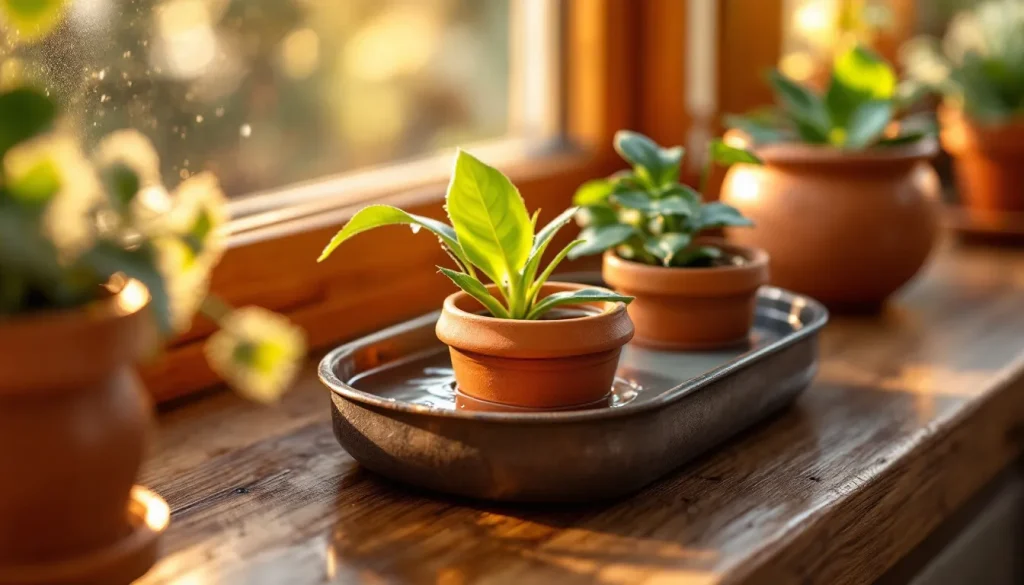
Bottom watering plants means setting a potted plant in a tray, sink, or basin of water and letting the soil pull moisture up through the drainage holes in the base of the pot. Capillary action (wicking) draws water into the root zone from below instead of pouring it on top. The method needs a pot with open drainage holes and works best for containers under about 10 inches wide.
The soil acts like a sponge. Dry potting mix has a low water potential, so it pulls liquid upward until the mix is evenly damp. When the surface starts to feel moist, the whole root ball has absorbed water.
How to bottom water plants step by step
To bottom water a plant, fill a tray or sink with 1 to 2 inches of room-temperature water, set the pot in so the base sits in the water, wait 10 to 45 minutes until the topsoil turns moist, then lift the pot out and let it drain fully before returning it to its spot. The full process takes under an hour for most houseplants.
- Fill the basin. Add 1 to 2 inches of water to a sink, tub, saucer, or dish. Room-temperature water reduces root shock.
- Set the pot in. Place the pot so water covers the drainage holes. For 6-inch pots, an inch of water is usually enough; taller 8 to 10 inch pots may need 2 inches.
- Wait. Leave small pots 10 to 20 minutes and larger or very dry pots up to 45 minutes. Check by pressing a finger into the topsoil.
- Confirm the top is moist. When the surface feels damp, the root ball is saturated. If it never gets there, top up the basin and wait longer.
- Drain fully. Lift the pot out and let excess water run off for a few minutes. Standing water left in a cachepot is the fastest route to soil breakdown and root rot.
Benefits: healthier, deeper root growth
Bottom watering encourages roots to grow downward toward the moisture source, which can build a deeper, more resilient root system than surface watering that keeps moisture near the top. Because the entire root ball wets evenly, roots are less likely to develop dry pockets or channel around a compacted core. This is closest to how a controlled irrigation system delivers water at the root zone rather than the canopy.
Even saturation matters. Top watering often runs straight down the gap between soil and pot wall, wetting little of the actual root mass. Wicking from below fills the mix uniformly.
Benefits: dry leaves for fuzzy-leaved plants
Bottom watering keeps foliage and crowns completely dry, which protects plants that spot, rot, or discolor when water sits on their leaves. African violets, gloxinia, begonias, and other fuzzy-leaved plants are the classic case: droplets on their trichome-covered leaves can cause pale rings or crown rot. Watering from below removes that risk entirely.
Dry foliage also lowers fungal pressure. Wet leaves in still indoor air invite powdery mildew and botrytis, so a bottom-watered plant sidesteps a common disease vector.
How long to leave the pot soaking
Leave a pot soaking until the topsoil feels moist, which is usually 10 to 20 minutes for small pots and up to about 1 hour for large or bone-dry containers. Do not leave a plant sitting in water indefinitely. Once the surface is damp, the root ball is full, and longer soaking only waterlogs the soil and invites rot.
| Pot size | Water depth | Typical soak time |
|---|---|---|
| 4 inch (small) | 1 inch | 5 to 15 minutes |
| 6 inch (medium) | 1 to 1.5 inches | 15 to 30 minutes |
| 8 to 10 inch (large) | 2 inches | 30 to 60 minutes |
| Any size, fully dried out | 2 inches, refill as absorbed | Up to 60 minutes |
How often should you bottom water plants
Bottom water on the same schedule you would top water: when the top 1 to 2 inches of soil is dry, not on a fixed calendar. In practice most tropical houseplants in medium pots need it every 7 to 10 days in summer and every 14 to 21 days in winter. Succulents stretch to every 2 to 4 weeks. Adjust for light, humidity, and season.
The method does not change how fast a plant uses water; it changes how the water is delivered. So frequency still follows dryness, pot size, and time of year.
| Plant type | Pot size | Summer cadence | Winter cadence |
|---|---|---|---|
| Tropical foliage (pothos, monstera, calathea) | 6 inch | Every 7 to 10 days | Every 14 to 21 days |
| Ferns, moisture lovers | 6 inch | Every 4 to 7 days | Every 10 to 14 days |
| African violets, begonias | 4 inch | Every 7 days | Every 10 to 14 days |
| Succulents, cacti | 4 to 6 inch | Every 2 to 3 weeks | Every 4 to 6 weeks |
Small pots dry faster than large ones. A 4-inch pot may need water twice as often as a 10-inch pot holding the same plant.
Bottom vs top watering: the honest comparison
Bottom watering wins on even moisture, dry foliage, and lower overwatering risk. Top watering wins on flushing salts and quick rehydration of severely dry soil. Most experienced growers use bottom watering as the routine method and top watering periodically to rinse the soil. Neither is strictly better; they solve different problems.
| Factor | Bottom watering | Top watering |
|---|---|---|
| Soil moisture evenness | Very even | Often uneven, channels down sides |
| Foliage stays dry | Yes | No |
| Overwatering risk | Lower | Higher |
| Flushes salts and minerals | No, salts accumulate | Yes, rinses them out |
| Fungus gnat pressure | Lower (dry topsoil) | Higher (wet topsoil) |
| Speed for one plant | Slower (10 to 60 min) | Fast (seconds) |
| Needs drainage holes | Required | Strongly recommended |
Does bottom watering help with fungus gnats?
Yes. Bottom watering keeps the top inch or two of soil dry, and fungus gnat larvae need consistently moist topsoil to hatch and feed on organic matter and roots. Starving that top layer of water breaks the gnat life cycle, which runs about 3 to 4 weeks from egg to adult. It is one of the most reliable cultural controls for an active infestation.
Adult fungus gnats lay eggs in the top half inch of moist mix. Larvae cannot survive in dry medium. When you water only from below, that surface layer stays too dry for eggs to hatch, so the population collapses over one to two life cycles.
Pair bottom watering with a layer of coarse sand or a physical top dressing for faster knockdown. This cultural approach is lower-risk than reaching for a chemical control such as a soil-applied pesticide, which targets weeds and pests differently and is rarely needed for gnats indoors.
The downside: salt and mineral buildup (and how to fix it)
Bottom watering’s main drawback is that it never carries dissolved salts, fertilizer residue, and tap-water minerals out of the pot. Instead those minerals travel upward with the water and concentrate at the soil surface, often showing as a white or yellow crust. Over months this can burn roots and brown leaf tips. The fix is a scheduled top-water flush.
Here is the cadence pros use but rarely spell out. Every fourth to sixth bottom watering, top water heavily instead: pour clean water slowly across the whole surface until it runs freely from the drainage holes for 10 to 15 seconds, then let it drain. This rinses accumulated salts downward and out.
| Fertilizing habit | Suggested top-flush cadence |
|---|---|
| Regular liquid feeder (every 2 to 4 weeks) | Flush every 4th watering, or monthly |
| Light or no fertilizer | Flush every 6th watering, or every 2 to 3 months |
| Hard tap water, visible crust | Flush monthly and consider filtered or rainwater |
If you already see a white crust on the surface, scrape off the top half inch of crusted mix and replace it, then do a full top-water flush. Using filtered, distilled, or rainwater slows buildup because it carries fewer dissolved minerals than hard tap water.
Which plants should you not bottom water
Do not bottom water plants in pots without drainage holes, plants in very fine or compacted soil that will not wick, or plants whose root balls never draw moisture to the surface. In those cases water stays trapped at the base and rots roots, or the top never wets and the plant stays thirsty despite soaking. Watch for the failure signs below.
- No drainage holes. Cachepots and decorative containers with sealed bottoms cannot wick. Water pools and drowns roots.
- Fine, compacted, or hydrophobic mix. Old peat that has dried into a brick, or heavy clay-like mixes, may refuse to wick upward. If the top is still dry after an hour, the mix is not moving water.
- Very large containers. Pots over about 12 inches hold too much soil for reliable wicking to the surface in a reasonable time. Top water these.
- Plants prone to crown rot at the base can be bottom watered, but never leave them soaking; drain promptly.
Failure signs to catch early: the topsoil never turns moist even after 60 minutes, water level in the tray does not drop, or the plant wilts while the lower soil stays soggy. Any of these means switch that plant to top watering or repot into a coarser, faster-wicking mix. The same water-movement logic applies outdoors, where poor infiltration drives runoff and soil erosion rather than absorption.
Frequently Asked Questions
What is bottom watering and how does it work?
Bottom watering is setting a potted plant in a shallow tray of water so the soil pulls moisture up through the drainage holes by capillary action. Dry potting mix wicks water into the root ball from below until the whole mix is evenly damp. It requires a pot with open drainage holes and keeps the leaves and soil surface dry.
How do you bottom water plants step by step?
Fill a tray or sink with 1 to 2 inches of room-temperature water, set the pot in so water covers the drainage holes, and wait 10 to 45 minutes. When the topsoil feels moist, the root ball is saturated. Lift the pot out, let it drain fully for a few minutes, then return it to its spot. Never leave it standing in water.
How long should you leave plants sitting in water when bottom watering?
Leave the pot soaking until the topsoil feels moist, which is roughly 5 to 20 minutes for small 4 to 6 inch pots and up to about 1 hour for large or bone-dry containers. Once the surface is damp, the soil is full. Remove the pot promptly; extended soaking past that point waterlogs the mix and raises root-rot risk.
How often should you bottom water plants?
Water when the top 1 to 2 inches of soil is dry, not on a fixed date. Most tropical houseplants in 6-inch pots need it every 7 to 10 days in summer and every 14 to 21 days in winter. Succulents stretch to every 2 to 4 weeks. Small pots dry faster than large ones, so adjust for pot size, light, and season.
Is bottom watering better than top watering?
Bottom watering is better for even soil moisture, dry foliage, and lower overwatering risk. Top watering is better for flushing salts and quickly rehydrating very dry soil. Most growers use bottom watering as the routine and top water every fourth to sixth session to rinse mineral buildup. Neither is universally better; they solve different problems.
Does bottom watering help with fungus gnats?
Yes. Bottom watering keeps the top inch of soil dry, and fungus gnat larvae need moist topsoil to hatch and feed. Starving that surface layer breaks their 3 to 4 week life cycle, so the population falls over one to two cycles. It is one of the most reliable cultural controls for an active gnat problem indoors.
What are the downsides of bottom watering (salt buildup)?
The main downside is that bottom watering never carries salts, fertilizer residue, and tap-water minerals out of the pot. They concentrate at the soil surface as a white or yellow crust and can burn roots over time. Fix it by top watering heavily every fourth to sixth session until water runs from the drainage holes, flushing the salts down and out.
Which plants should you not bottom water?
Avoid bottom watering plants in pots without drainage holes, plants in very fine or compacted soil that will not wick, and very large containers over about 12 inches. Failure signs include topsoil that never turns moist after an hour, a tray water level that does not drop, or soggy lower soil with a wilting plant. Switch those to top watering.