
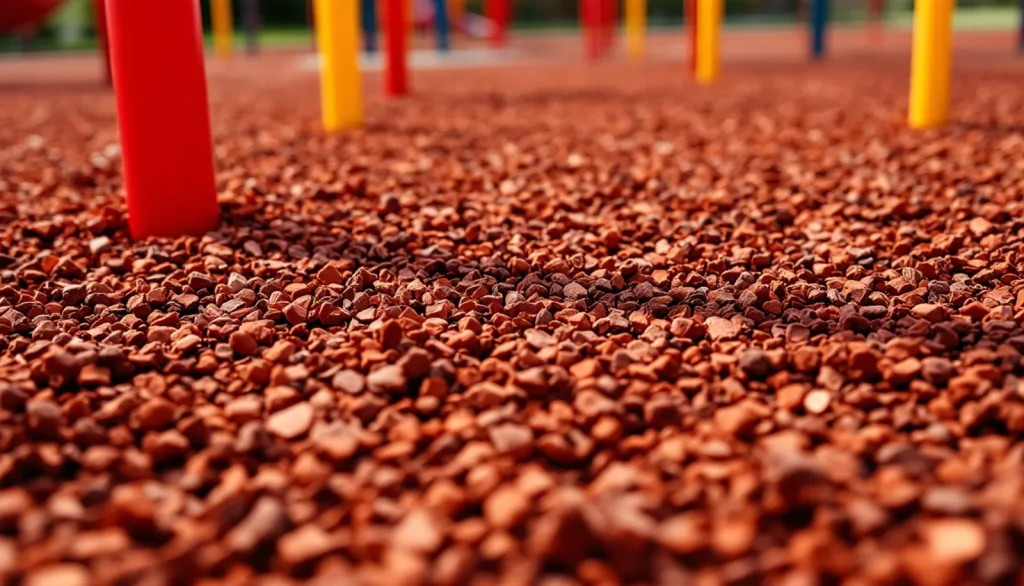
Rubber Mulch: Pros, Cons, Safety, and vs Wood
Rubber mulch is shredded or pelletized recycled tire rubber sold as a long-lasting ground cover for playgrounds, swing sets, and ornamental beds. The honest pitch is durability: a single install can last 10 years or more without fading or washing away, where wood mulch usually gets topped up every year. The honest catch is that it does not feed your soil, it can run hot in full sun, and the zinc and tire-chemical question is real enough that several university extension programs advise against it around edibles. This guide weighs rubber mulch against wood on cost, lifespan, heat, the toxicity debate, and playground safety, then gives a straight verdict on where it earns its price and where it does not.
The short version
- Rubber mulch is ground-up waste tires (crumb or nuggets), typically 10 to 32 mm, with the steel removed.
- Upfront cost runs roughly $8 to $14 per cubic foot, around $120 to $200 per cubic yard, versus about $30 to $45 per cubic yard for wood.
- Lifespan is 10-plus years against wood mulch’s 1 to 4 years before it needs replacing.
- It does not decompose, so it adds zero organic matter and does not feed the soil. Wood does.
- Zinc is the metal that leaches most from tire rubber (zinc can be roughly 1 to 2 percent of the rubber), and high soil zinc can cause leaf chlorosis in plants. Multiple extensions advise against rubber mulch near vegetable gardens.
- For playgrounds, look for IPEMA certification to ASTM F1292. At a compacted 6-inch depth, certified rubber mulch can rate for fall heights into the 10-to-16-foot range.
- Best use: playgrounds, permanent borders, slopes, and dog runs. Worst use: vegetable beds and anything near a storm drain or salmon-bearing stream.
What is rubber mulch made from?
Rubber mulch is recycled tire rubber, ground or shredded into nuggets after the steel belts are removed. According to the Wikipedia summary of the material and matching extension descriptions, pieces typically range from 10 to 32 mm. It comes loose by the bag or cubic yard, or as bonded poured-in-place surfacing for playgrounds. Color is sprayed on, which is why faded product often shows gray tire rubber underneath.
The source material matters because tires are engineered chemistry, not plant fiber. They contain zinc oxide (a vulcanization activator), carbon black, plasticizers, and the antioxidant 6PPD. Zinc can make up roughly 1 to 2 percent of the rubber by weight, and zinc is the metal most consistently identified leaching from tire crumb in laboratory studies. That single fact drives most of the toxicity debate covered below.
Rubber mulch vs wood mulch: the full comparison
Rubber mulch wins on lifespan, weed suppression, and staying put. Wood mulch wins on price, soil health, and fire safety. Neither is the universal answer. The right pick depends on whether you want a permanent low-maintenance surface (rubber) or a living mulch that builds soil and gets refreshed each year (wood). The table below lays out the trade-offs side by side.
| Factor | Rubber mulch | Wood mulch |
|---|---|---|
| Upfront cost | ~$8 to $14 per cubic foot (~$120 to $200 per cubic yard) | ~$30 to $45 per cubic yard |
| Lifespan before replacing | 10-plus years | 1 to 4 years (most refresh annually) |
| Feeds the soil | No, adds no organic matter | Yes, decomposes into nutrients and humus |
| Weed suppression | Good when applied deep; dense and blocks light | Good, but breaks down into a seedbed over time |
| Heat in full sun | Absorbs and holds heat; dark colors run hottest | Stays cooler; insulates roots |
| Fire behavior | Ignites hot (testing has shown burns above 630 F), hard to extinguish, fumes like a tire fire | Flammable too, but lower burn temperature; some types smolder |
| Pests and fungus | No food source for termites or fungi | Can harbor termites, ants, and fungal growth |
| Chemical leaching | Zinc and tire chemicals leach as it weathers; 6PPD breaks down to a salmon-lethal compound | Recycled-lumber mulch may carry CCA preservative; bark mulch is generally clean |
| Playground safety | IPEMA-certified product rates high for fall protection at depth | Engineered wood fiber also IPEMA-certified; compacts and decomposes |
One number reframes the cost gap. Rubber costs three to five times more per yard upfront, but if wood gets replaced every year for a decade and rubber lasts the full 10 years, the lifetime math can favor rubber in a permanent application like a play area or a fixed border. In a bed you replant or redesign often, that durability is wasted and the premium is just a higher bill.
How much does rubber mulch cost, and does it pay off?
Rubber mulch runs roughly $8 to $14 per cubic foot, or about $120 to $200 per cubic yard, versus roughly $30 to $45 per cubic yard for standard wood mulch. Bagged retail rubber often lands near $6 to $9 a bag (about 0.8 cubic feet). The premium only pays back in a spot you will not redig, because the savings come entirely from skipping the annual wood refresh.
To run your own break-even, you need square footage and depth. Multiply bed area by your target depth (2 to 3 inches for beds, much deeper for playgrounds) and convert to cubic yards. Our guide on measuring square footage covers the area math, and our 2026 lawn care cost benchmarks put mulch spending in context against the rest of a yard budget. This page is a decision guide, not a calculator: HMNDP does not sell mulch.
A simple way to decide on price alone:
- Estimate how many years you will keep this bed or surface unchanged.
- For wood, multiply your annual wood cost by that number of years (most beds get refreshed yearly).
- For rubber, take the one-time install cost and assume it survives 10 years.
- If your horizon is under about 4 to 5 years, wood almost always costs less. Past that, in a permanent install, rubber can win.
- Then weigh the non-price factors below, because cost is rarely the deciding issue.
Does rubber mulch get hot? The heat problem
Yes. Rubber absorbs and retains solar heat more than organic mulch, and dark colors in full, direct sun run the hottest. That matters two ways: surface temperature on a playground can climb uncomfortably on a hot afternoon, and higher soil temperature can stress heat-sensitive plants and tree roots. Lighter colors and shaded beds are less affected.
In hot, high-sun regions the heat penalty is a real reason to think twice in a planted bed. If you are landscaping in a desert climate, the cooler, soil-building behavior of organic mulch usually serves plants better, and in many of those markets a no-lawn xeriscape is the smarter move entirely. See our guide to drought-tolerant lawn alternatives and, for region-specific advice, our Phoenix landscaping page, where decomposed granite and drip irrigation outperform any mulch on water efficiency.
Is rubber mulch toxic? The zinc and chemical-leaching debate
This is the contested part, and the honest answer is: it depends on what you are protecting. Human-health risk from contact appears low in most testing, but plant and aquatic risk is better documented. Zinc is the metal that leaches most reliably from tire crumb, and high soil zinc is toxic to plants. Several university programs advise keeping rubber mulch away from vegetable gardens.
On the plant side, Dr. Linda Chalker-Scott, an extension specialist at Washington State University, has documented that rubber mulch breakdown releases heavy metals, plasticizers, and accelerators, and that high soil zinc from rubber can cause leaf chlorosis, reduced tree growth, and increased tree mortality. The University of Illinois Extension’s “Good Growing” program echoes this, citing soil tests with zinc high enough to harm plants. Rubber is not permanent: as it weathers, those breakdown products enter the soil.
On the aquatic side, the evidence is sharper. In a 2020 study published in Science (Tian et al., DOI 10.1126/science.abd6951), University of Washington and partner researchers identified 6PPD-quinone, a transformation product of the tire antioxidant 6PPD reacting with ozone, as the cause of acute mortality in coho salmon in urban streams, at thresholds near 1 microgram per liter. That is why runoff from rubber surfaces near a storm drain or salmon-bearing stream is a genuine concern, not a hypothetical one.
On the human-contact side, the picture is more reassuring but not settled. Reviews of playground crumb rubber, including work summarized by Texas A&M and others, have found that most measured heavy metals fall within US and European safety guidelines and that injury-prevention benefits offset the small measured exposure risk. Researchers still flag higher-than-background zinc, lead, and selenium as reasons for ongoing caution, especially for young children with frequent hand-to-mouth contact. The 2017 federal multi-agency study on crumb rubber (EPA, CDC/ATSDR, CPSC) found chemicals present but did not find a clear increased health risk at typical exposure.
The practical takeaway: rubber mulch is a reasonable choice for a fenced ornamental border or a dog run, a defensible choice for a certified playground, and a poor choice around food crops or anywhere runoff reaches a waterway.
Is rubber mulch safe for playgrounds? IPEMA and ASTM F1292
For fall protection, certified rubber mulch performs well, which is the main reason it is on playgrounds at all. The standard to look for is ASTM F1292, the US impact-attenuation standard, verified by third-party IPEMA certification. F1292 testing drops an instrumented headform and requires G-max under 200 and a Head Injury Criterion (HIC) under 1,000 to pass at a given fall height.
Depth is what makes it work. Independent testing has shown rubber mulch at a 6-inch depth meeting both thresholds at drop heights of 9 and 10 feet, and a compacted 6-inch layer of certified rubber mulch can carry an IPEMA rating for falls in the 12-to-16-foot range. The US Consumer Product Safety Commission’s Public Playground Safety Handbook calls for the protective surface to extend a use zone of at least 6 feet in all directions around equipment. The catch on a playground is the same heat and chemistry caveat above, plus the need to maintain depth as rubber displaces under swings and slides.
If you are specifying a public play surface, buy only IPEMA-certified product, confirm the certified fall height matches your equipment height, and require documentation. Uncertified bulk rubber may look identical and perform nothing like a tested surface.
Does rubber mulch feed the soil or kill weeds?
Rubber mulch does not feed the soil, full stop. It is inert and does not decompose into organic matter, so unlike wood or bark it adds no nutrients, no humus, and no improvement to soil structure. If your goal is healthier dirt and stronger plants over time, organic mulch is the only one of the two that delivers it. Rubber simply sits on top as a cover.
On weeds, rubber suppresses germination reasonably well when applied deep, because it is heavy and blocks light. But because it never breaks down into a seedbed the way decomposing wood eventually does, some homeowners find it stays cleaner longer. Extension sources are split: Illinois Extension notes rubber can be less effective than organic mulch at weed control in practice, so pair it with a landscape fabric underneath if weeds are your main concern. For beds where soil quality is the priority, your fertilizer program matters more than the mulch; see our NPK fertilizer guide.
The honest verdict: when to use rubber mulch
Use rubber mulch where permanence and impact protection are the point and soil health is not. That means certified playgrounds and play areas, fixed ornamental borders you will not redesign, slopes where wood washes away, pathways, and dog runs. In those spots the 10-year lifespan and stay-put weight justify the higher upfront cost. Skip it everywhere the soil or water matters.
Avoid rubber mulch in vegetable gardens and around edibles (zinc and tire-chemical leaching), in hot full-sun beds with heat-sensitive plants, and anywhere runoff can reach a storm drain or stream (the 6PPD-quinone salmon risk). For those uses, organic mulch is the better tool because it cools the soil, feeds it, and carries none of the tire chemistry. The decision is not “which mulch is best” but “what is this spot for.” If you want a contractor to weigh the call for your yard, our guide on finding a reputable landscaper covers the vetting steps before you sign.
Last reviewed: June 2026
HMNDP Editorial Team, reviewed by HMNDP turf and horticulture editors.
Frequently asked questions
Is rubber mulch toxic?
It depends on what you are protecting. Human-contact risk in most testing is low, but plant and aquatic risk is documented. Zinc is the metal that leaches most from tire crumb and high soil zinc harms plants. The tire chemical 6PPD breaks down to 6PPD-quinone, which a 2020 Science study tied to coho salmon deaths. Keep it away from edibles and waterways.
How long does rubber mulch last?
Rubber mulch typically lasts 10 years or more because it does not decompose, compact, or fade the way wood does. Color is sprayed on, so it can dull over time and show gray tire rubber underneath, but the material itself stays intact far longer than wood mulch, which most homeowners refresh every year and which fully breaks down within 1 to 4 years.
How much does rubber mulch cost compared to wood?
Rubber mulch runs roughly $8 to $14 per cubic foot, about $120 to $200 per cubic yard, versus roughly $30 to $45 per cubic yard for wood. That is three to five times more upfront. The premium only pays back in a permanent spot, because the savings come from skipping wood’s annual refresh over a decade.
Is rubber mulch safe for playgrounds?
Certified rubber mulch performs well for fall protection, which is why it is on playgrounds. Look for IPEMA certification to ASTM F1292, which caps G-max under 200 and HIC under 1,000. At a compacted 6-inch depth, certified rubber mulch can rate for falls of 12 to 16 feet. Buy only certified product and match the fall height to your equipment.
Does rubber mulch get hot?
Yes. Rubber absorbs and retains solar heat more than organic mulch, and dark colors in full direct sun run the hottest. That raises both surface temperature on a playground and soil temperature in a bed, which can stress heat-sensitive plants and tree roots. Lighter colors and shaded areas are less affected, but heat is a real reason to avoid it in hot, sunny planted beds.
Does rubber mulch feed the soil?
No. Rubber mulch is inert and does not decompose, so it adds no organic matter, nutrients, or humus to the soil. It simply sits on top as a cover. Wood and bark mulch break down and improve soil structure and fertility over time. If healthier soil is your goal, organic mulch is the only one of the two that delivers it.
Is rubber mulch good for vegetable gardens?
No. University extension specialists advise against rubber mulch around vegetables and edibles because of zinc and tire-chemical leaching as the rubber weathers. High soil zinc can cause leaf chlorosis and reduced growth. For food crops, use a clean organic mulch like bark or straw that cools the soil, feeds it, and carries none of the tire chemistry.
Does rubber mulch stop weeds?
It helps. Rubber suppresses weed germination reasonably well when applied deep, because it is heavy and blocks light, and unlike wood it does not break down into a seedbed. But weeds can still push through, and Illinois Extension notes it can be less effective than organic mulch in practice. Pair it with landscape fabric underneath if weed control is your main goal.