
Artificial turf maintenance in one page
Artificial turf maintenance means rinsing the surface to clear dust, cross-brushing the fibers to keep blades upright, removing leaves and organic debris, spot-cleaning spills, managing pet waste, and topping up infill as it thins. Most residential lawns need light care monthly and a deep clean once or twice a year. Pet households need a rinse-and-deodorize routine every week or two.
Done consistently, this care keeps a quality synthetic lawn looking new for its full 15 to 25 year service life. Skip it, and matting, odor, and drainage problems show up within two or three seasons.
By the HMNDP Editorial Team, independent reporting on lawn care and the green industry. Last reviewed: June 2026.
The core routine: rinse, brush, and clear debris
Three tasks carry most of the load for artificial grass care: rinsing away dust, cross-brushing fibers upright, and removing organic debris before it breaks down. Together they take 20 to 40 minutes for an average 500 square foot lawn and prevent the two most common failures, matting and clogged drainage.
Rinsing and hosing down the turf
Rinse artificial turf with a standard garden hose to wash off dust, pollen, and light dirt that settle into the fibers. A monthly rinse is enough for most lawns; weekly in dry, dusty climates or where pets urinate. Use a fan or shower nozzle at normal household pressure, working across the surface so water carries debris toward the drainage backing.
No detergent is needed for a routine rinse. Water alone clears the fine particulate that dulls color and stiffens blades. In hard-water regions, an occasional rinse also prevents mineral film from building on the fiber tips.
Brushing and cross-brushing the fibers
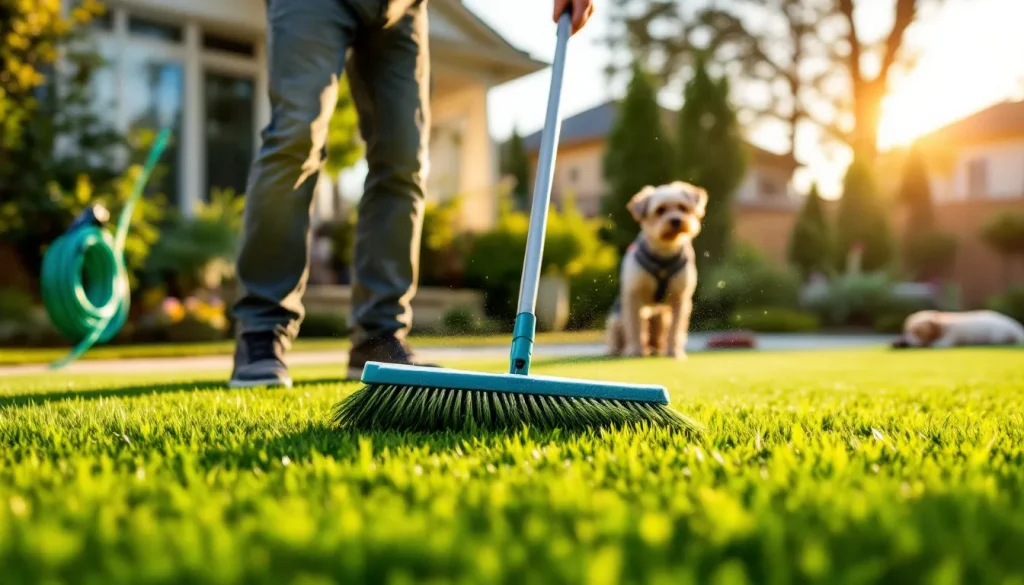
Brush the turf against the grain with a stiff synthetic-bristle broom or a powered turf brush to lift blades that traffic has flattened. “Cross-brushing” means sweeping in the direction opposite to how the blades naturally lean, then in a second direction, which stands fibers up and redistributes infill at the same time. Do this monthly on high-traffic zones, quarterly elsewhere.
Never use a metal or wire brush. Steel bristles snag and fray the polyethylene fibers. A push broom costs about 30 dollars; a cordless power broom runs 150 to 350 dollars and pays off on lawns over roughly 800 square feet.
Removing leaves, debris, and organic matter
Clear leaves, twigs, and grass clippings before they decompose into the pile, because rotting organic matter feeds weeds and moss and can stain the fibers. Use a leaf blower on a low setting or a plastic (never metal) rake. In fall, expect to clear debris weekly under deciduous trees.
A battery leaf blower (50 to 200 dollars) is the fastest tool and avoids disturbing infill the way aggressive raking can. For light litter, a firm plastic lawn rake pulls debris to the edge without catching seams.
Spot cleaning stains and spills
Clean most spills on artificial grass with warm water and a few drops of mild dish soap, blotted with a cloth and rinsed clear. Synthetic fibers are non-absorbent, so food, drink, and grease sit on the surface and lift easily if you act before they dry. Blot, do not scrub, to avoid pushing residue deeper into the pile.
For sticky or dried residue like tree sap, chewing gum, or candle wax, chill the spot with an ice cube until the material hardens, then scrape it off with a plastic edge. Grease or oil responds to a small amount of mineral spirits on a cloth, applied to the stain only and rinsed thoroughly afterward. Avoid bleach, acids, and any solvent-heavy cleaner, which can discolor fibers and void some manufacturer warranties.
Pet waste, urine odor, and bacterial biofilm
Pet care is where artificial turf maintenance gets serious. Solid waste lifts off easily once dry, but urine is the long-term problem: it drains through the backing while ammonia salts and bacterial biofilm accumulate in the infill and at the fiber base. That buildup, not the fresh urine, is what produces the sour smell that worsens in summer heat.
Pick up solid waste daily and rinse the spot with water. Fresh urine needs a plain water rinse within a day so it flushes through before salts concentrate. This alone handles the short term; odor control is a separate, recurring job.
A recurring pet-urine regimen that actually works
For lasting odor control, rotate three tools rather than relying on one. Each targets a different part of the problem, and the biofilm is what most homeowners miss.
- Enzyme cleaner (every 1 to 2 weeks): Enzymatic pet-turf cleaners such as Simple Green Outdoor Odor Eliminator or PE-51 break down the uric acid crystals and biofilm that plain water leaves behind. Enzymes digest the organic source of the smell instead of masking it.
- Diluted white vinegar (monthly, as a reset): A 1-to-1 vinegar-and-water solution neutralizes ammonia and is cheap, but it only treats surface odor and does not remove biofilm. Use it between enzyme treatments, not instead of them.
- Deodorizing infill (installed once, refreshed as needed): Zeolite-based infill (for example ZeoFill) captures ammonia at the molecular level and releases it during rinsing, so the lawn resets each time you water it. It is the structural fix for a heavy-use dog run.
Deodorizer sprays alone fail because they never reach the crystallized salts down in the infill. If odor persists after enzyme treatment, the infill itself is saturated and needs a rinse-and-top-up, covered below.
How often should you clean and brush artificial turf?
Maintenance frequency depends on use. Most standard residential lawns need only light monthly attention plus one or two deep cleans a year. Pet households and high-traffic areas need a quarterly deep clean at minimum, and weekly rinsing where dogs relieve themselves. The table below sets a realistic schedule by scenario.
| Task | Standard lawn | Pet household | High-traffic area |
|---|---|---|---|
| Rinse / hose down | Monthly | Weekly | Every 2 weeks |
| Cross-brush fibers | Quarterly | Monthly | Monthly |
| Clear leaves / debris | As needed (weekly in fall) | Weekly | Weekly |
| Deep clean / sanitize | Annual or biannual | Quarterly | Biannual |
| Infill check / top-up | Every 2 years | Annually | Annually |
| Edge weed treatment | Twice a year | Twice a year | Twice a year |
Weed removal and prevention along edges and seams
Weeds on artificial grass do not grow up through quality turf; they root in windblown organic debris that collects on the surface and along edges and seams. Keeping the lawn clear of decomposing matter is the real prevention. Pull any weeds that appear by hand, and treat perimeters twice a year to stop new growth.
A vinegar-based weed spray or a standard glyphosate-free herbicide applied to seams and borders in spring and late summer stops most volunteer weeds. Moss and algae in shaded, damp corners respond to the same clearing routine plus better drainage; the same shade dynamics that trouble a real lawn apply here, which our guide on growing grass in shade explains in more detail. A weed-barrier membrane installed under the turf, if you have one, does most of this work for you.
Keeping infill level and topping it up
Infill is the layer of granular material brushed down between the fibers. It weights the turf flat, keeps blades standing upright, protects the backing from UV, and provides drainage. As traffic, brushing, and rinsing gradually displace it, the pile starts to lie flat and feel thin. Checking and topping up infill is the single most overlooked part of artificial turf maintenance.
How to tell when infill is low
Part the fibers with your fingers in a high-traffic spot and look at the base. Healthy turf shows infill covering roughly one-third to one-half of the blade height. If you see mostly backing with fibers lying flat and slow to spring back after brushing, the infill has thinned and needs replenishing. Low infill also shows up as faster matting and a hotter surface in summer.
Choosing and adding infill
Most residential turf uses about 1 to 2 pounds of infill per square foot at installation. To top up, cross-brush the area first to expose the base, then spread new infill with a drop spreader at roughly half a pound per square foot, and brush again to work it down evenly. Choose the type based on your situation.
| Infill type | Material | Best for | Approx. cost |
|---|---|---|---|
| Silica sand | Rounded quartz sand | General ballast, budget lawns | $8 to $15 / 50 lb |
| Coated sand (Envirofill) | Acrylic-coated sand with Microban | Pets, odor resistance | $35 to $55 / 50 lb |
| Zeolite (ZeoFill) | Volcanic mineral | Capturing urine ammonia odor | $25 to $45 / 50 lb |
| Crumb rubber | Recycled tire granules | Cushioning, play and sports turf | $10 to $20 / 50 lb |
| Acrylic-coated cooling (T Cool) | Evaporative cooling granules | Hot, dry climates | $40 to $60 / 40 lb |
Silica sand is the economical default. For a dog run, antimicrobial or zeolite infill earns its higher price by controlling odor at the source. Match any top-up to the infill already installed when you can.
Repairing burned, torn, or damaged sections
Small burns, tears, and worn patches are repairable without replacing the whole lawn. Synthetic fibers melt near 175F, so the usual culprits are barbecue embers, dropped cigarettes, and reflected sunlight off low-E windows. For a damaged patch, cut out the affected section with a utility knife, fit a matching turf offcut, and bond it with seam tape and outdoor turf adhesive.
Line up the fiber direction of the patch with the surrounding grass so the repair disappears once brushed. Reflected-glare burns tend to recur in the same spot, so a screen, awning, or window film usually matters more than the patch itself. Keep the offcuts left over from installation; they are the ideal color and pile match for future repairs.
Preventing matting and flattening in high-traffic areas
Matting happens where the same footsteps land day after day: pathways, gate approaches, and around patio furniture. The fix is regular cross-brushing to stand the fibers back up, plus a few layout habits that spread the load. Turf rated with a higher face weight and shorter pile resists matting better in these zones from the start.
Brush high-traffic lanes monthly against the grain, and rotate movable furniture and planters every few weeks so no single patch takes constant pressure. Keeping infill topped up in these areas is critical, because thin infill lets blades fold flat and stay there. For permanent walkways, stepping stones set into the turf remove the wear entirely.
Seasonal and climate playbook
Artificial turf care changes with the weather, and this is where most guides go silent. Summer heat, autumn leaf fall, and winter ice each demand a different response. The schedule below adjusts the core routine for each season, with specific do’s and don’ts for extreme conditions.
| Season | Priority tasks |
|---|---|
| Spring | Full deep clean, cross-brush entire lawn, check and top up infill, treat edges for weeds |
| Summer | Manage surface heat, rinse dust weekly in dry climates, stay on top of pet-urine odor |
| Fall | Clear falling leaves weekly, blow out debris before it decomposes, second weed treatment |
| Winter | Remove snow gently, never use metal tools or salt, let thin ice melt naturally |
Keeping artificial grass cool in summer
On a hot, sunny day, artificial turf can reach 150F or higher, far above the air temperature, because the fibers absorb solar radiation. To cool it before pets or children use it, spray the surface with a garden hose; the water drops the temperature within seconds, though the effect lasts only 20 to 30 minutes as it evaporates. For lasting relief, hot-climate homeowners use evaporative-cooling infill or shade sails over the most-used areas.
Snow and ice removal without damage
Light snow can be left to melt on its own, since turf drains freely as it thaws. To clear deeper snow, use a plastic shovel or a stiff broom and push, do not scrape, along the fiber direction. Never use a metal shovel or an ice pick, which tears the backing, and never apply rock salt or de-icing chemicals, which foul the infill and drainage. For ice, let it melt naturally rather than chipping at it.
Artificial turf maintenance cost: DIY vs. professional
Maintenance is the top related search that no competing guide prices out. Here are real numbers. DIY care runs about 50 to 150 dollars a year in supplies once you own the basic tools, with a first-year outlay of 150 to 400 dollars for a broom, blower, and cleaners. Professional cleaning is priced by area, typically 0.20 to 0.50 dollars per square foot per visit, with most companies setting a 100 to 250 dollar minimum.
| Item | DIY | Professional |
|---|---|---|
| Routine clean / rinse | Water only, a few dollars | $0.20 to $0.35 / sq ft |
| Deep clean + sanitize (pet) | $20 to $40 per gallon of enzyme cleaner | $0.30 to $0.50 / sq ft |
| Power broom / de-matting | $150 to $350 (one-time tool) | Included in service visit |
| Infill top-up | $25 to $55 per 50 lb bag | $0.15 to $0.30 / sq ft plus material |
| Section repair | Offcut + $20 tape/adhesive | $100 to $500 per repair |
| Typical annual total (500 sq ft) | $50 to $150 recurring | $200 to $500 per visit |
For a standard lawn, DIY is clearly cheaper and the tasks are straightforward. Hiring a professional makes sense in three cases: a large pet area with entrenched odor, a lawn that needs power-brushing and re-sanding after years of neglect, or repairs involving seams and burns. If you are choosing a company for cleaning or repair, our guide on how to choose an artificial turf company covers what to check before you sign. Weighing synthetic against a live lawn entirely is a separate calculation; homeowners comparing the two often look at how long grass seed takes to grow and the watering demands of new seed before deciding.
Frequently Asked Questions
How much does artificial turf maintenance cost per year (DIY vs. professional)?
DIY maintenance runs about 50 to 150 dollars a year in supplies once you own a broom, leaf blower, and cleaner, with a first-year tool outlay of 150 to 400 dollars. Professional cleaning is priced by area at roughly 0.20 to 0.50 dollars per square foot, with most companies charging a 100 to 250 dollar minimum per visit. DIY is cheaper for standard lawns.
How often should you clean and brush artificial turf?
Rinse a standard lawn monthly and cross-brush it quarterly, with one or two deep cleans a year. Pet households should rinse weekly, brush monthly, and deep clean quarterly. High-traffic areas need monthly brushing to prevent matting. Clear leaves and debris as they fall, which usually means weekly attention in autumn under deciduous trees.
What equipment and supplies do you need to maintain artificial grass?
The essentials are a garden hose, a stiff synthetic-bristle push broom (about 30 dollars) or a power broom (150 to 350 dollars), a plastic rake or leaf blower, mild dish soap, and an enzyme pet-odor cleaner if you have dogs. Add a bag of matching infill for top-ups and a drop spreader. Avoid all metal brushes, rakes, and shovels, which damage fibers and backing.
Do you need to add or replace infill on artificial turf, and how do you know when?
Yes. Infill gradually displaces from traffic, brushing, and rinsing, and most lawns need a top-up every one to two years. Check by parting the fibers in a busy spot: healthy turf shows infill covering one-third to one-half of the blade height. If you see mostly backing and flat, slow-recovering blades, spread new infill at about half a pound per square foot and brush it in.
How do you get rid of pet urine smell and bacteria on artificial turf?
Plain water rinsing handles fresh urine, but the lasting smell comes from uric acid crystals and bacterial biofilm in the infill. Treat it with an enzyme cleaner every one to two weeks to digest the organic source, use diluted white vinegar monthly as a reset, and install zeolite deodorizing infill for heavy-use dog areas. Deodorizer sprays alone fail because they never reach the crystallized salts.
How do you remove and prevent weeds on artificial grass?
Weeds root in decomposed debris on the surface and along seams, not up through quality turf. Keep the lawn cleared of organic matter, pull any weeds by hand, and treat edges and borders twice a year with a vinegar-based or standard weed spray in spring and late summer. A weed-barrier membrane under the turf prevents most volunteer growth from the start.
Can you pressure wash artificial turf without damaging it?
Use caution. A pressure washer on a low setting, held at least 12 inches back with a wide fan tip, can clean stubborn areas, but high pressure at close range displaces infill and can separate seams or fray fibers. For routine cleaning a standard garden hose is safer and sufficient. Reserve pressure washing for occasional deep cleans and keep the wand moving.
How do you keep artificial grass cool in summer and clear it of snow in winter?
In summer, turf can exceed 150F, so hose it down to cool the surface for 20 to 30 minutes before use, or install cooling infill and shade sails for lasting relief. In winter, let light snow melt on its own, and clear deeper snow by pushing with a plastic shovel or broom along the fiber direction. Never use metal tools, ice picks, or rock salt.