
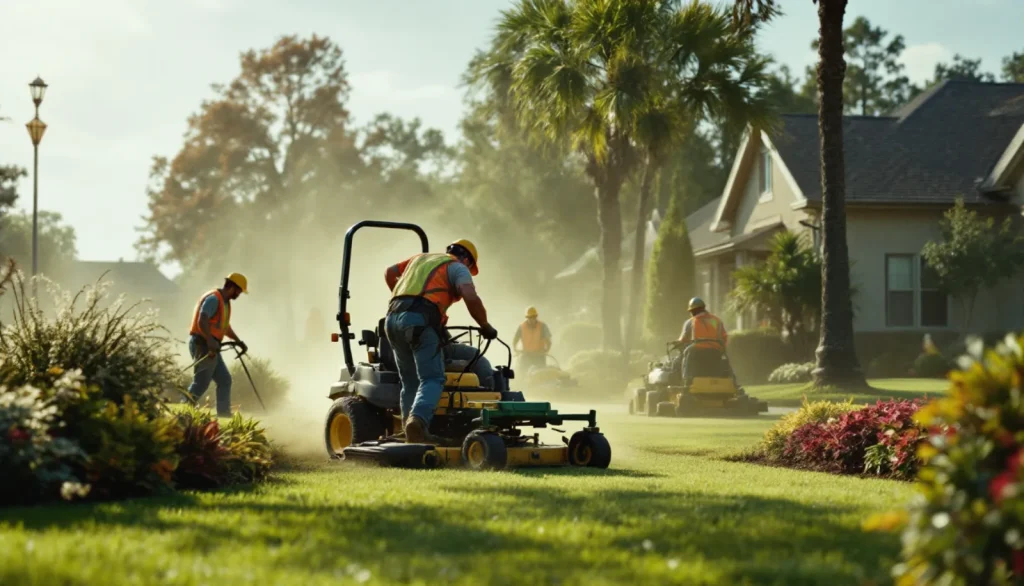
The H-2A program landscape crews rely on for seasonal mowing, mulch, and installation work just got more expensive. The U.S. Department of Labor’s 2026 Adverse Effect Wage Rate (AEWR) determinations, published in the Federal Register in December 2025, raised the required H-2A hourly wage in every state, with the national median landing in the $17 to $19 per hour band and several states clearing $22 per hour. For landscape operators who depend on H-2A workers to cover the April-to-November maintenance season, the AEWR move resets the wage floor that anchors their entire labor budget.
The short version
- 2026 H-2A Adverse Effect Wage Rates are set state by state by the U.S. Department of Labor, published in the Federal Register in December 2025.
- National AEWR median sits at roughly $17 to $19 per hour, with California at $21.95, Washington at $20.27, Oregon at $20.37, and Florida at $16.23.
- Landscape operators using H-2A must also provide free furnished housing, 3/4 work guarantee, inbound transportation reimbursement, and return transportation.
- H-2A is uncapped (no annual visa cap, unlike H-2B), but the DOL job-order and certification process runs 75 to 120 days lead time.
- Audits by the DOL Wage and Hour Division have climbed sharply, with a focus on housing inspection compliance and wage record reconstruction.
What changed for 2026
Every December, the U.S. Department of Labor sets the AEWR for the following calendar year based on the U.S. Department of Agriculture’s Farm Labor Survey. The 2026 numbers were published in the Federal Register in late December 2025 and took effect in the new year. The methodology change that DOL adopted in the 2023 final rule continues to apply, which means certain non-field occupations on the H-2A certification are paid at the higher of the standard AEWR or the BLS occupational wage for that specific job code in that specific metropolitan or non-metropolitan area.
For landscape operators, the practical impact is twofold. First, the standard AEWR went up in nearly every state, with the largest jumps in the Pacific Northwest and the Midwest corn belt. Second, any landscape crew operating across a multi-state footprint has to track which AEWR applies to which worker on which day. A crew that crosses from Pennsylvania ($16.55) into New York ($17.80) on Monday morning is technically owed the New York rate for the New York portion of the workweek.
Why landscape operators use H-2A in the first place
Most green-industry seasonal labor historically ran on the H-2B visa, which is capped at 66,000 per year nationally and gets oversubscribed within hours of the registration window opening. The H-2B cap shortfall has pushed an increasing share of larger landscape operators toward H-2A, which has no annual cap. The DOL has interpreted the H-2A statute to include certain landscape and horticulture activities that touch on agricultural production, particularly nursery, sod farm, and Christmas tree operations, as well as the maintenance work at agricultural production sites.
The trade press has tracked a steady migration of mid-market landscape operators into H-2A specifically because the alternative is to lose the cap lottery on H-2B and have no seasonal labor at all. The cost of an H-2A worker is higher than H-2B once housing and transportation are added in, but the certainty of getting the visa often outweighs the cost.
By the numbers: 2026 AEWR sampling
| State | 2026 AEWR | Year-over-year change |
|---|---|---|
| California | $21.95/hr | +3.1% |
| Oregon | $20.37/hr | +2.7% |
| Washington | $20.27/hr | +2.9% |
| New York | $17.80/hr | +3.5% |
| Pennsylvania | $16.55/hr | +3.4% |
| Texas | $15.97/hr | +2.6% |
| Florida | $16.23/hr | +2.9% |
| Georgia | $15.13/hr | +2.4% |
| National median (approx) | $17 to $19/hr | +2.8% to +3.5% |
The hidden costs
The AEWR is only the most visible piece of the H-2A cost stack. Federal regulations also require employers to provide free furnished housing that meets ETA inspection standards, three meals per day at cost or kitchen facilities for self-provision, the 3/4 work guarantee that pays a worker for at least three-quarters of the contracted workweek hours regardless of weather or workflow, and inbound plus return transportation between the worker’s home country and the worksite.
A useful rule of thumb is that the fully loaded H-2A worker cost lands roughly $4 to $7 per hour above the published AEWR once housing, transportation, meals, the 3/4 guarantee, the DOL certification fees, and the recruiter or agent fees are amortized across the contract season. A California H-2A worker on a 35-week contract is therefore costing the landscape operator $26 to $29 per hour fully loaded, not $21.95.
Why audits matter more in 2026
DOL Wage and Hour Division audits of H-2A employers stepped up in 2024 and again in 2025. The agency has signaled that 2026 will continue the trend. The audit focus areas are housing inspection compliance, accurate timekeeping records that survive reconstruction, full reimbursement of inbound and return transportation, and correct application of the higher of state AEWR or BLS occupational wage where the worker performs non-field tasks.
Penalty exposure has also climbed. The DOL has the authority to debar employers from future H-2A use for two to three years for substantive violations. Several mid-sized horticulture and landscape operators have been hit with debarment orders in the past 18 months, which removes their seasonal labor pipeline overnight.
What landscape operators should do
The first move is to rebuild the 2026 labor budget with the new AEWR baked in. Operators who built their 2026 budget against the 2025 AEWR are running 3 to 4 percent under-funded on labor before the season starts.
The second move is to audit the housing. The 2024 ETA inspection guidance tightened the required-square-footage-per-worker rule and the kitchen and bathroom ratio rules. Operators who have not refreshed their housing inspection since 2022 should expect to fail under the current standard. Address the gaps before the DOL shows up.
The third move is to revisit the multi-state crew rotation policy. If the crew works across two or more states during a single workweek, the timekeeping has to capture which hours were worked in which state. Most green-industry time-tracking apps (Aspire, ServicePro, SingleOps) can be configured to log the state on the clock-in, but few operators have it turned on.
For broader context on the labor squeeze across the green industry, see our coverage of the US landscaping market, the BrightView consolidation trend, and the TruGreen residential business. Operators thinking about employee ownership as a labor retention play should look at the Davey Tree and Ruppert Landscape models.
FAQ
Can a landscape maintenance company actually use H-2A?
Sometimes. H-2A is technically for agricultural labor, which DOL has interpreted to include nursery, sod, Christmas tree, and certain horticulture production work. Pure residential mow-and-blow maintenance generally does not qualify and runs on H-2B instead. Operators who do a mix of nursery production and landscape installation may have a path into H-2A for the nursery side.
What is the difference between H-2A and H-2B for landscape work?
H-2A is uncapped, agricultural-coded, and has the AEWR plus housing requirements. H-2B is capped at 66,000 per year nationally, non-agricultural, and runs on the prevailing wage from DOL rather than AEWR. Most landscape maintenance crews are on H-2B because the work does not meet the H-2A agricultural test.
How long does the H-2A certification process take?
Plan on 75 to 120 days from job order filing to worker arrival. The State Workforce Agency, the DOL Office of Foreign Labor Certification, and the USCIS petition all sit in series. Operators who want workers on site for an April 1 start should be filing the job order in mid-December.
Are the workers covered by state minimum wage if it is higher than AEWR?
Yes. The employer must pay the highest of the AEWR, the federal minimum wage, the state minimum wage, the local minimum wage, or the prevailing wage. In high-minimum-wage states this can push the effective rate above the published AEWR.
What is the 3/4 work guarantee?
The employer must pay the worker for at least three-quarters of the contracted workweek hours regardless of whether weather or workflow allowed the worker to actually work. A 40-hour weekly contract therefore carries a minimum 30-hour pay obligation per week.
What this means for crew pricing
The 2026 AEWR move puts upward pressure on crew labor rates that operators have to pass through to commercial accounts and residential customers. A maintenance route built on a fully loaded $28 per hour H-2A crew member needs to charge meaningfully more per mowing visit than a route built on a $19 per hour domestic crew member. The pass-through math is rarely 1:1 because operators absorb some of the cost as a labor-stability premium, but operators who try to absorb the entire AEWR increase typically watch margins fall 2 to 4 points inside a single season.
The cleaner play is to take the AEWR increase to the customer at the renewal cycle with a clear explanation of the federal wage determination behind it. Most commercial property managers and HOA boards understand a federally published wage determination far better than they understand a generic price increase letter. Operators who lead with the public AEWR table and the corresponding 3 to 5 percent route price adjustment generally close the renewal without losing accounts.
Bottom line
The 2026 AEWR move pushes labor costs up across the entire H-2A landscape footprint. Operators should rebuild the labor budget, refresh the housing inspection, and tighten multi-state timekeeping before the audit risk catches up. The H-2A program remains the most reliable seasonal labor pipeline for operators who qualify, but the cost-of-compliance bar continues to rise. For more on operator margins, see our coverage of lawn care news and the landscapers directory.