
By the HMNDP Editorial Team, independent reporting on lawn care, landscaping, and the green-industry business.
Last reviewed: June 2026
Does spray on grass seed actually work?
Spray on grass seed does work, but it grows grass, not a lawn. Products like Hydro Mousse germinate when you match the seed to your climate, prep bare soil first, and water two to three times a day for two to three weeks. Skip any of those and results look thin. It shines at spot-repairing small bare patches, not covering a whole yard.
The green foam you see in the ads is real and useful. A dye in the mix marks where you have already sprayed so you get even coverage. The dye is cosmetic and fades in a week or two. It is not fertilizer and it is not what makes grass grow.
Most disappointing reviews are not product failures. They are watering failures, wrong-climate seed, or seed sprayed onto hard, unraked dirt where it never made contact with soil.
What Hydro Mousse and “lawn in a bottle” actually are
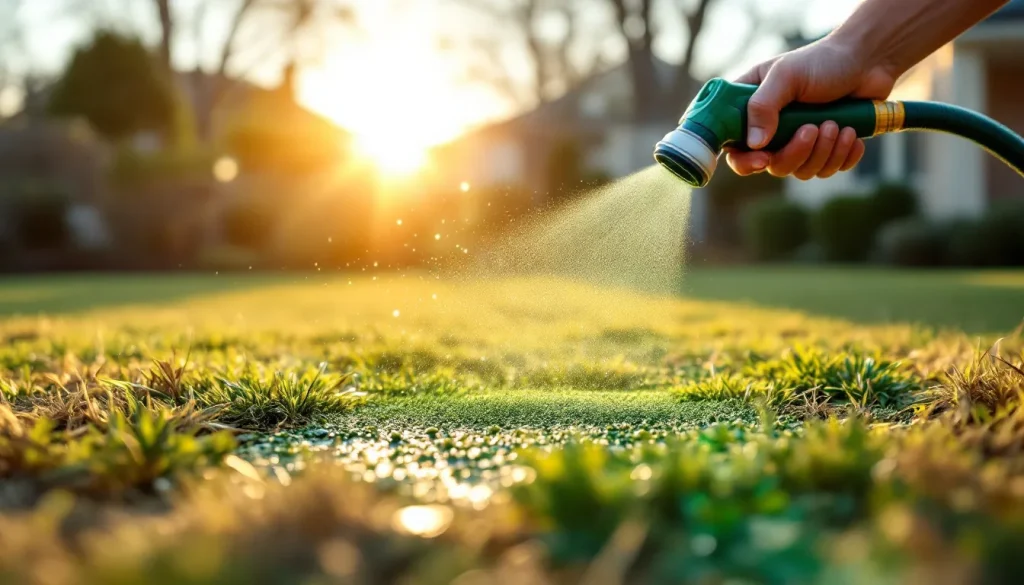
Hydro Mousse is the flagship spray on grass seed kit sold in the US. It is a plastic bottle that screws onto a garden hose. Inside is grass seed suspended in a green mulch and a tackifier (a sticky binder) that helps seed cling to soil. Water flowing through the hose mixes and sprays the slurry. A refill kit runs roughly 20 to 30 dollars and covers about 100 square feet.
The bottle is a shrunk-down, consumer version of what landscaping crews do with a truck-mounted tank. The chemistry is the same idea: seed plus mulch plus binder, applied wet. The difference is scale, seed quality, and how much mulch actually lands per square foot.
Spray on grass seed vs hydroseeding vs traditional seeding
Spray on grass seed (the bottle) is cheapest per kit but priciest per square foot and only practical for small patches. Professional hydroseeding covers whole yards fast at a moderate rate per square foot. Traditional broadcast seeding is the cheapest way to cover real area if you are willing to spread seed and mulch by hand. Here is the honest side-by-side.
| Option | Typical cost | Cost per sq ft | Best coverage | Germination | Best for |
|---|---|---|---|---|---|
| DIY spray bottle (Hydro Mousse) | $20 to $30 per kit | $0.20 to $0.30 | ~100 sq ft | 7 to 21 days | Small bare patches |
| Professional hydroseeding | $500 to $4,000 per yard | $0.06 to $0.20 | Whole yards, slopes | 5 to 14 days | New lawn establishment |
| Traditional broadcast seeding | Seed $0.02 to $0.05 per sq ft | $0.02 to $0.05 | Any size, DIY | 7 to 21 days | Budget full lawns |
The math is blunt. On a 100 square foot patch the bottle costs about the same as a bag of seed but saves you the raking-in step. On a 5,000 square foot yard, buying enough bottles would cost more than 1,000 dollars and take a weekend of spraying. That is where hydroseeding or a broadcast spreader wins.
What is inside the bottle, and will it grow in your region?
Every consumer spray on grass seed kit ships one generic seed blend, usually a cool-season mix of perennial ryegrass and fescue. That blend thrives in the northern US and struggles or dies in hot southern zones. The bottle does not warn you, and this is the single biggest reason results disappoint.
If you live in a warm-season region (much of the South, Southwest, and Gulf Coast), Bermuda, St. Augustine, and Zoysia are what actually hold up in your heat. A cool-season kit sprayed in July in Texas browns out fast. In that case, buy region-correct seed and spread it yourself, or read our guide to Bermuda grass seed before you buy any bottle.
The fix is simple: match seed to your zone first, product second. Our roundup of the best grass seed by climate and use shows which species suit which regions, and it is the step the bottled kits skip.
Spot repair vs full-lawn seeding: where spray-on fits
Spray on grass seed is a spot-repair tool. It is built to fix bare patches, thin edges, pet spots, and small worn strips near walkways. On those, the attach-to-hose ease and the coverage dye make it faster and tidier than hand-seeding.
For a full new lawn, the bottle is the wrong tool. You would need dozens of kits, and the mulch layer per square foot is too thin to hold moisture across a large area. New lawn establishment over a whole yard is a job for hydroseeding or a broadcast spreader plus straw or a seed blanket.
How to actually get spray on grass seed to grow (step by step)
Success depends on three things reviews rarely name: soil prep, seed-to-soil contact, and a strict watering schedule. Do all three and germination in 7 to 21 days is realistic. Skip one and you get the “grew grass but not a lot” result. Follow this order.
- Loosen the soil. Rake the bare patch until the top quarter inch is crumbly. Seed sprayed on hard dirt washes off and never roots.
- Time it right. Seed in the season that suits your grass type. Our guide to the best time to plant grass seed covers cool-season versus warm-season windows.
- Shake and spray evenly. Agitate the bottle so seed stays suspended, then spray until the green dye covers the whole patch with no gaps.
- Press seed into contact. Walk over the area or tamp it lightly so seed touches soil. This one step lifts germination noticeably.
- Water 2 to 3 times a day for 2 to 3 weeks. Keep the top inch damp, never soaked, never dry. A single missed hot day can kill sprouting seed. This is the make-or-break step.
- Ease off once grass is 2 inches tall. Shift to deeper, less frequent watering and hold off mowing until blades reach about 3 inches.
One more tip: use fresh seed. If your kit or seed bag has sat for years, germination drops. See whether grass seed goes bad before you count on old stock.
DIY hydroseed slurry for a bigger area
If you want spray-on coverage on more than a patch without hiring a contractor, you can mix a basic slurry yourself in a bucket or a pump sprayer. It will not match a pro rig, but it beats buying a dozen bottles for a 500 to 1,000 square foot area.
A workable home mix per roughly 100 square feet: region-correct grass seed at the bag’s stated rate, about 2 to 3 pounds of paper or wood mulch, a quart of water, and a small scoop of a tackifier such as guar gum or a store-bought soil binder. Stir to a thick, pourable paste, then pour or pump it over raked soil and keep it evenly damp on the same 2-to-3-times-a-day schedule. The mulch holds moisture the way the bottle’s foam does, just at a lower cost per square foot.
Where to buy spray on grass seed
Spray on grass seed is widely stocked. Hydro Mousse and similar kits sell at Lowe’s, The Home Depot, Walmart, and Amazon, usually in the lawn-and-garden aisle or as a seasonal endcap in spring and fall. Refill pouches and starter bottles are sold separately, so check which you are buying.
Prices cluster around 20 to 30 dollars per kit across retailers. Before you add one to the cart, confirm the seed blend on the label matches your climate. A cheap kit with the wrong grass type is more expensive than the right seed bought loose.
Frequently Asked Questions
Does spray on grass seed actually work?
Yes, with conditions. Spray on grass seed germinates and fills bare patches when the seed suits your climate, the soil is raked loose, and you water two to three times daily for two to three weeks. It works best on small spots, not whole yards. Thin results almost always come from wrong-region seed, hard unprepped soil, or inconsistent watering rather than a faulty product.
How much does spray on grass seed cost per square foot?
A consumer bottle like Hydro Mousse costs roughly 20 to 30 dollars and covers about 100 square feet, so about 0.20 to 0.30 dollars per square foot. Professional hydroseeding runs 0.06 to 0.20 dollars per square foot for whole yards. Traditional broadcast seeding is cheapest at 0.02 to 0.05 dollars per square foot in seed, if you spread it yourself.
What is the best spray on grass seed?
Hydro Mousse is the best-known and most available spray on grass seed kit in the US, sold at Lowe’s, Home Depot, Walmart, and Amazon for about 20 to 30 dollars. The “best” choice depends less on brand and more on whether the seed blend matches your region. In warm-season zones, region-correct Bermuda, St. Augustine, or Zoysia seed usually outperforms any generic cool-season bottle.
How long does spray on grass seed take to grow?
Most spray on grass seed sprouts in 7 to 21 days, depending on grass type and soil temperature. Perennial ryegrass can show green in about a week, while fescue and warm-season grasses take longer. Consistent moisture is the deciding factor. If the top inch of soil dries out during germination, timelines stretch or seed dies before it roots.
What’s the difference between spray on grass seed and hydroseeding?
They use the same idea, seed plus mulch plus a sticky binder applied wet, at very different scales. Spray on grass seed is a hose-attached bottle for small patches at about 0.20 to 0.30 dollars per square foot. Hydroseeding uses a truck or trailer tank to cover whole yards and slopes at 0.06 to 0.20 dollars per square foot, with a thicker mulch layer that holds moisture better.
Can you use spray on grass seed for a large area or a whole lawn?
It is not practical. A single bottle covers about 100 square feet, so a 5,000 square foot lawn would need dozens of kits and cost over 1,000 dollars, plus a full weekend of spraying. The mulch layer is also too thin per square foot to hold moisture across a big area. For whole lawns, choose hydroseeding or a broadcast spreader with straw.
Where can you buy spray on grass seed?
Spray on grass seed kits are sold at Lowe’s, The Home Depot, Walmart, and Amazon, usually in the lawn-and-garden section and as spring and fall seasonal displays. Prices run about 20 to 30 dollars per kit. Starter bottles and refill pouches are sold separately, so check the label to confirm you are buying the version and seed blend you need.
What kind of grass seed is inside Hydro Mousse, and will it grow in my region?
Hydro Mousse and most consumer kits ship a generic cool-season blend, typically perennial ryegrass and fescue. That suits northern US lawns but struggles in hot southern zones. If you live in a warm-season region, a cool-season bottle often browns out. Match seed to your climate first: buy Bermuda, St. Augustine, or Zoysia seed for the South rather than relying on the default blend.