
By the HMNDP Editorial Team, independent reporting on lawn care, landscaping, fertilizer, water, and the green industry.
Last reviewed: June 2026
What is soil made of? The short answer
Soil is made of four things: minerals (weathered rock), organic matter (decomposed plants and animals), water, and air. In a healthy topsoil, minerals make up about 45 percent by volume, organic matter about 5 percent, water about 25 percent, and air about 25 percent. The mineral and organic parts are solid. The water and air sit in the empty gaps between solids, called pore space.
| Component | What it is | Typical share by volume | State |
|---|---|---|---|
| Minerals | Tiny bits of broken-down rock (sand, silt, clay) | ~45% | Solid |
| Organic matter | Dead and decayed plants, animals, and microbes (humus) | ~5% | Solid |
| Water | Rain and groundwater held in the gaps | ~25% | Liquid |
| Air | Oxygen and other gases in the gaps | ~25% | Gas |
That 45/5/25/25 split is the classic “ideal loam” model used in soil science textbooks. Real soil shifts around it constantly. After heavy rain, water rises and air drops. In a drought, air rises and water drops. The mineral and organic percentages stay steady because they are the fixed solid framework.
The four core components of soil in detail
Soil’s four components each do a different job. Minerals give soil its body and hold nutrients. Organic matter feeds life and stores water. Water carries dissolved nutrients to roots. Air delivers oxygen to roots and soil organisms. Remove any one and the soil stops working as a growing medium.
Minerals (about 45 percent)
Minerals are the largest part of soil and come from rock that has broken into tiny pieces. These particles range from gritty sand you can see down to clay so fine it feels like powder. Minerals supply elements plants need, including potassium, calcium, magnesium, and iron, and they form the skeleton that everything else sits inside.
Organic matter (about 5 percent)
Organic matter is the dead stuff: fallen leaves, dead roots, insect bodies, animal droppings, and the microbes that ate them. As it breaks down it becomes humus, a dark, spongy material. Even at only 5 percent by volume, organic matter drives most of soil’s fertility and its ability to hold water like a sponge.
Water (about 25 percent)
Water fills roughly half of the empty pore space. It is never pure water. It is a thin solution carrying dissolved minerals and nutrients, which is how roots actually drink and feed at the same time. Soil scientists call this the soil solution. Too little water and plants wilt. Too much and roots drown because water pushes out the air.
Air (about 25 percent)
Air fills the other half of the pore space. Roots and soil organisms need oxygen to breathe, just like animals do. Soil air holds more carbon dioxide and water vapor than the air above ground because organisms are constantly respiring underground. Compacted soil (from foot traffic or heavy machinery) squeezes out this air and suffocates roots.
Solids versus pore space: the 50/50 rule
By volume, a healthy soil is roughly half solid and half empty space. The solid half is minerals plus organic matter (about 45 percent plus 5 percent). The empty half is pore space, split between water and air (about 25 percent each). Those pores are not wasted room. They are where water and air live, and where roots and organisms move.
The size of the pores matters as much as the amount. Large pores drain fast and hold air. Small pores cling to water and release it slowly to roots. A good soil has a mix of both, which is why loam (a balanced blend of particle sizes) grows plants so well.
Sand, silt, and clay: the three mineral particle sizes
The mineral 45 percent of soil is sorted into three particle sizes: sand, silt, and clay. The only difference between them is how big the grains are. Sand is the coarsest, silt is medium, and clay is the finest. The mix of these three sizes decides how soil feels, drains, and holds nutrients.
| Particle | Size range (diameter) | Feel | Behavior |
|---|---|---|---|
| Sand | 0.05 to 2.0 mm | Gritty | Drains fast, holds few nutrients |
| Silt | 0.002 to 0.05 mm | Smooth, like flour | Holds water well, moderate nutrients |
| Clay | Less than 0.002 mm | Sticky when wet | Holds water and nutrients tightly, drains slowly |
Sand grains can be 1,000 times wider than clay particles. That size gap explains everything downstream: big sand grains leave big gaps that drain quickly, while tiny clay particles pack tight and grip water. To picture the scale, if a clay particle were the size of a coin, a sand grain would be the size of a car.
Soil texture is set by the sand, silt, and clay ratio
Soil texture is the proportion of sand, silt, and clay in a given soil, and it barely changes over a human lifetime. A soil that is roughly 40 percent sand, 40 percent silt, and 20 percent clay is called loam, the balance most plants prefer. Scientists read these ratios off the USDA soil texture triangle. Learn more about the different types of soil and how their textures behave in the garden.
How soil forms from weathering of parent rock
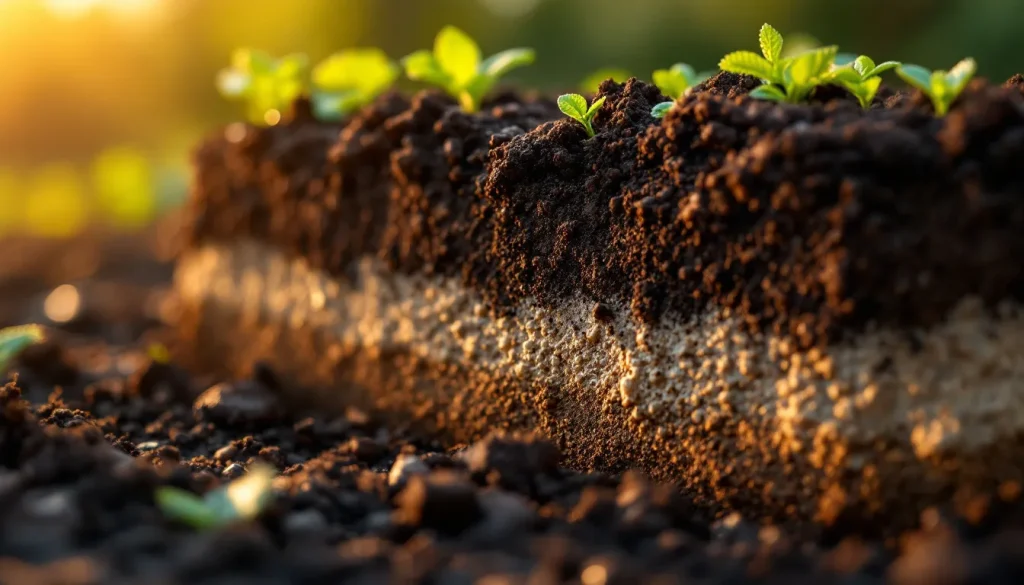
Soil forms when solid rock, called parent material or parent rock, slowly breaks into smaller and smaller pieces through weathering. Rain, freezing and thawing, wind, plant roots, acids, and living organisms all chip away at rock over long spans of time. Those mineral fragments then mix with decaying organic matter to become soil.
- Physical weathering: Water freezes in cracks and expands, splitting rock. Temperature swings and grinding by wind and rivers wear it down further.
- Chemical weathering: Water and mild acids (including carbonic acid from rainwater) dissolve and alter minerals, releasing nutrients.
- Biological weathering: Roots pry cracks open, lichens secrete acids, and burrowing animals break material apart.
- Mixing: Dead plants and animals decompose into the mineral grit, adding organic matter and forming true soil layers.
This is why soil in different regions looks and behaves differently: it inherits traits from whatever rock sits beneath it. For a deeper walkthrough of each stage, see our explainer on how soil is formed.
Organic matter and humus: the decomposed layer
Organic matter is every once-living thing in soil, at every stage of decay. Fresh leaves and roots are the raw input. Humus is the end product: dark, stable, crumbly material that no longer looks like the plant or animal it came from. Bacteria, fungi, and earthworms do the breaking down, turning dead tissue into plant food.
Humus punches far above its weight. It holds up to 90 percent of its weight in water, binds soil particles into crumbs that resist erosion, and slowly releases nitrogen, phosphorus, and sulfur as it decays. Gardeners add compost and manure for exactly this reason. Those inputs are concentrated organic matter that feeds the humus cycle and supports how fertilizer delivers nutrients to plants.
What is soil made of chemically? The elements inside
Chemically, soil is mostly a handful of elements. By weight, the mineral portion is dominated by oxygen (around 47 percent) and silicon (around 28 percent), followed by aluminum, iron, and smaller amounts of calcium, potassium, sodium, and magnesium. The organic and living portions add carbon, nitrogen, hydrogen, and phosphorus. These few elements build almost everything in soil.
| Element | Rough share of mineral soil by weight | Where it comes from |
|---|---|---|
| Oxygen (O) | ~47% | Bound in minerals and water |
| Silicon (Si) | ~28% | Sand and silicate minerals (quartz) |
| Aluminum (Al) | ~8% | Clay minerals |
| Iron (Fe) | ~5% | Iron oxides (gives soil red and brown color) |
| Carbon, nitrogen, phosphorus | Trace to a few % | Organic matter and living organisms |
Two facts flow from this chemistry. First, silicon and oxygen combine as silica (the same stuff as quartz and glass), which is why sand is so hard and inert. Second, iron is why soil color ranges from rusty red to yellow to gray: it is literally the rock rusting. The carbon and nitrogen fraction is tiny by weight but is what living things are built from, which leads to the part most pages skip.
What living organisms are in soil? Why soil is not just dirt
Soil is alive, and that is the single biggest thing most explanations leave out. A single teaspoon of healthy soil can hold more microorganisms than there are people on Earth: billions of bacteria, plus fungi, protozoa, nematodes, and larger creatures like earthworms, mites, and beetles. This living fraction is small by weight but runs the whole system.
- Bacteria: Up to a billion in one gram of soil. They decompose organic matter and convert nitrogen into forms plants can use.
- Fungi: Their thread-like networks (mycorrhizae) connect to plant roots and extend their reach for water and nutrients.
- Earthworms: They eat organic matter and mineral grit, mix layers together, and their tunnels create pore space for air and water.
- Protozoa and nematodes: They graze on bacteria and fungi, releasing nutrients that plants absorb.
This biology is the honest line between soil and dirt. Dirt is displaced soil with the life stripped out: the mineral particles are still there, but the organisms, structure, and organic matter are gone. Soil is a living community. The same living network is why healthy soil resists pests and disease better than sterile ground, and why herbicides and other soil chemicals are studied for their effects on soil organisms, not just weeds.
Is soil made of poop, dead plants, or animal waste?
Partly, yes, and this is worth saying plainly because people search for it. The organic matter fraction of soil (about 5 percent) genuinely includes decomposed plants, dead animals, and animal droppings, including manure. Over time these break down into humus, which no longer looks or smells like waste. So soil is not “made of poop,” but decomposed waste is one real ingredient in the organic layer.
The same goes for the “made of plants” question. Dead leaves, roots, stems, and wood are a major source of soil organic matter. They rot, get eaten by microbes and worms, and become humus. This recycling loop is why forests build deep, dark topsoil on their own: every fallen leaf feeds the soil below. Nothing living is wasted, it just changes form.
The key point is that raw waste and fresh plant litter are only the starting materials. By the time they are true soil, they have been fully digested by billions of organisms into stable humus. That is different from a pile of manure or a heap of leaves, which are inputs, not finished soil.
Frequently Asked Questions
What are the 4 things soil is made of?
Soil is made of four components: minerals (weathered rock, about 45 percent by volume), organic matter (decomposed plants and animals, about 5 percent), water (about 25 percent), and air (about 25 percent). Minerals and organic matter are the solid part. Water and air fill the pore space between the solids. The balance shifts as soil wets and dries.
What is soil made of chemically (what elements)?
By weight, mineral soil is mostly oxygen (around 47 percent) and silicon (around 28 percent), followed by aluminum (around 8 percent) and iron (around 5 percent), with smaller amounts of calcium, potassium, sodium, and magnesium. Organic matter and living organisms add carbon, nitrogen, hydrogen, and phosphorus. Silicon and oxygen form silica (quartz sand), and iron gives soil its red or brown color.
Is soil made of poop or animal waste?
Partly. Soil’s organic matter (about 5 percent) includes decomposed animal droppings and dead animals, along with dead plants. Over time, microbes and earthworms break this material into humus, which no longer resembles waste. So soil is not simply “made of poop,” but decayed manure and animal remains are genuine ingredients in the organic fraction that feeds plants.
Where does soil come from and how is it formed?
Soil forms when solid rock (parent material) breaks into tiny pieces through weathering: freezing, thawing, rain, wind, acids, roots, and organisms. Those mineral fragments then mix with decomposing plants and animals to become soil. The process is extremely slow, and the type of rock underneath strongly shapes the soil’s texture, color, and fertility for thousands of years.
What is the difference between sand, silt, and clay?
Sand, silt, and clay are the same material (weathered rock) at three particle sizes. Sand is coarsest (0.05 to 2 mm) and drains fast. Silt is medium (0.002 to 0.05 mm) and feels smooth like flour. Clay is finest (under 0.002 mm), feels sticky, and holds water and nutrients tightly. Their ratio sets a soil’s texture.
What living organisms are in soil?
Soil teems with life. One teaspoon can hold billions of bacteria plus fungi, protozoa, nematodes, earthworms, mites, and insects. Bacteria and fungi decompose organic matter and cycle nitrogen. Earthworms mix layers and build pore space. This living community, not just the mineral particles, is what makes soil fertile and separates true soil from lifeless dirt.
What is the difference between soil and dirt?
Soil is a living system: mineral particles plus organic matter, water, air, and billions of organisms working together. Dirt is soil that has been displaced and lost its life, structure, and organic matter, for example the dust on your shoes. The mineral grains are still there, but the biology and structure that grow plants are gone.
How long does it take for soil to form?
Soil forms very slowly. Producing roughly one inch of topsoil can take 500 to 1,000 years under natural conditions, depending on climate, rock type, and vegetation. Full, deep soil profiles can take thousands of years to develop. This slow pace is why soil is treated as a nonrenewable resource on human timescales and why preventing erosion matters so much.