
By the HMNDP Editorial Team | Independent reporting on lawn care, forage, and the green industry.
Last reviewed: June 2026
What is orchard grass?
Orchard grass (Dactylis glomerata) is a cool-season perennial bunchgrass grown across North America for pasture, hay, green chop, and silage. It grows in tufted clumps rather than spreading by runners, produces soft and highly palatable leaves, and greens up early in spring. It is a non-native species, introduced to the United States from Europe in the mid-1700s.
The grass belongs to the family Poaceae and carries several common spellings, including orchardgrass as one word and cocksfoot in the United Kingdom and Australia. It thrives in partial shade, which is how it earned the “orchard” name, tolerating conditions that many other forage grasses cannot.
Growers value it for one main reason: versatility. A single orchard grass stand can be grazed, cut for dry hay, chopped green, or ensiled, and it mixes cleanly with legumes such as alfalfa and red clover because its bunch habit leaves room for a companion plant.
How do you identify orchard grass?
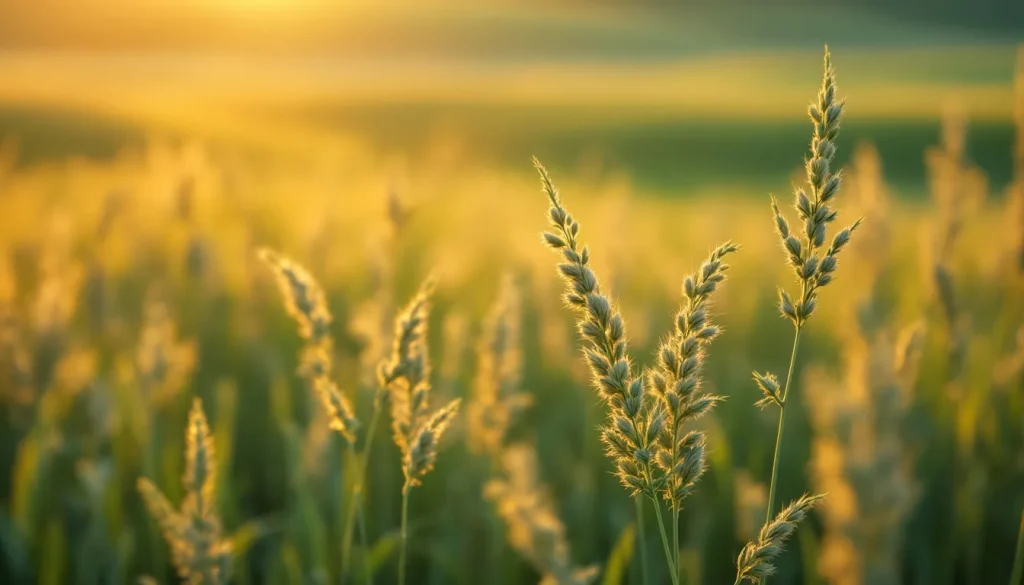
Identify orchard grass by three features: a tall, membranous ligule (2 to 10 mm) where the leaf meets the stem, blue-green leaf blades folded in a V shape in the bud, and a distinctive branched seedhead with spikelets clustered on one side, often compared to a chicken’s foot. It grows in coarse clumps, not a solid turf, and colonizes old fields, roadsides, and pasture edges.
The leaves are flat, keeled along the midrib, and rough to the touch near the tip, with no ear-like auricles at the base. New clumps show a bluish cast that distinguishes them from the brighter green of ryegrass or fescue.
The seedhead is the clearest tell. It emerges as a loose panicle in mid to late spring, with dense one-sided clumps of spikelets held at the ends of stiff branches. Once you learn the chicken-foot shape, orchard grass is hard to confuse with anything else in a mixed field.
Is orchard grass good for horses?
Orchard grass is well suited to horses. Its leaves are soft and palatable, most horses eat it readily, and mature hay typically tests at 8 to 13 percent crude protein, which suits idle and lightly worked horses. Its main advantage is lower sugar than many grasses when cut at the right stage, making it a common choice for easy keepers and metabolic horses.
Horse owners choose orchard grass hay for its consistent leaf-to-stem ratio and low dust when cured properly. Because the species matures early, first-cutting hay can turn stemmy fast, so many horse-hay producers grow late-maturing cultivars or take second and third cuttings for finer, leafier bales.
For growing your own horse turnout or dry-lot forage, pairing it with a legume raises protein without heavy fertilizer. If you are weighing forage species more broadly, our overview of how to choose the best grass seed for your goal walks through matching species to use.
How much sugar (NSC) is in orchard grass hay?
Orchard grass hay usually tests between 10 and 15 percent nonstructural carbohydrate (NSC), the combined water-soluble sugars, fructan, and starch. That range often falls below timothy, which can climb to 12 to 18 percent NSC, making orchard grass a reasonable lower-sugar option for laminitis-prone and insulin-resistant horses. NSC varies with cutting time, cultivar, weather, and curing, so testing every lot is the only way to be sure.
Veterinary guidance for metabolic horses commonly targets hay below 10 to 12 percent NSC. Orchard grass can meet that threshold, but it is not guaranteed to. Cool, sunny days and drought stress push sugars up in any cool-season grass, and afternoon-cut hay tends to test higher than morning-cut.
| Factor | Effect on orchard grass NSC | Practical action |
|---|---|---|
| Cutting time of day | Higher in afternoon, lower before dawn | Cut early morning for metabolic horses |
| Maturity at harvest | Later cuts can lower sugar, raise fiber | Delay for lower NSC if protein allows |
| Cold, sunny weather | Raises sugar (fructan storage) | Avoid cold-snap and drought cuttings |
| Soaking hay 30 to 60 min | Removes some soluble sugar | Soak for high-risk horses |
The reliable move is a forage analysis from a lab such as Equi-Analytical or Dairyland. A $25 to $60 test tells you the actual NSC of your bales, which matters far more than the species name on the tag.
Orchard grass vs timothy, tall fescue, and bromegrass
Orchard grass separates from other cool-season forages on four points buyers care about: it matures earliest, yields more than timothy, regrows faster than bromegrass, and lacks the endophyte risk of common tall fescue. Timothy stays the horse-market premium for finish and low dust, tall fescue wins on drought and traffic, and bromegrass offers strong sod and winter hardiness. The table below compares the traits that drive a planting decision.
| Trait | Orchard grass | Timothy | Tall fescue | Smooth bromegrass |
|---|---|---|---|---|
| Growth habit | Bunch | Bunch | Bunch | Sod-forming |
| Maturity | Earliest | Late | Mid | Mid to late |
| Regrowth after cutting | Fast | Slow | Fast | Slow |
| Palatability | High | Very high | Moderate (endophyte issue) | High |
| Drought tolerance | Moderate | Low | High | Moderate to high |
| Grazing traffic tolerance | Low to moderate | Low | High | High |
| Typical seed cost (per lb) | $3 to $6 | $3 to $5 | $2 to $4 | $3 to $6 |
The practical takeaway: choose orchard grass when you want fast, versatile forage that mixes with legumes and greens up early. Choose timothy for premium horse hay, tall fescue for hard-grazed or dry ground, and bromegrass for a durable grazing sod. Many producers plant an orchard grass and legume blend to capture yield and protein together.
Is orchard grass suitable for cattle and other livestock?
Orchard grass is a strong choice for cattle, sheep, and goats. Its high palatability drives strong intake, early spring growth extends the grazing season, and fast regrowth suits rotational systems. It carries no prussic-acid or serious toxicity concerns, and unlike endophyte-infected tall fescue it does not cause fescue toxicosis in cattle. Managed well, it supports both stocker gains and dairy forage.
For grazing operations, orchard grass responds to rotational management better than continuous grazing. It stores few reserves at the base of the plant, so grazing it too short or too often thins the stand quickly.
In hay and silage systems, its early maturity lets producers take a first cutting ahead of most other grasses, then two or three more through the season under good moisture and fertility.
What is the seeding rate and cost for orchard grass per acre?
Seed orchard grass at 10 to 20 pounds per acre in a pure stand, or 6 to 10 pounds per acre in a legume mix. At a typical seed price of $3 to $6 per pound, expect $30 to $120 per acre in seed. Plant 1/4 to 1/2 inch deep into a firm, weed-free seedbed, using a drill for the most even stand or broadcasting followed by a cultipacker.
| Planting scenario | Seeding rate (lb/acre) | Approx. seed cost (per acre) |
|---|---|---|
| Pure stand, drilled | 8 to 12 | $24 to $72 |
| Pure stand, broadcast | 12 to 20 | $36 to $120 |
| With alfalfa or clover | 6 to 10 | $18 to $60 |
Buy certified seed from farm-supply retailers, forage seed dealers, and cooperatives such as Tractor Supply, local Southern States and CHS branches, or online sellers like Nature’s Seed and Hancock Seed. Look for named cultivars rather than “variety not stated,” since improved varieties handle maturity and disease far better. For general timing across grass types, see our guide on the best time to plant grass seed.
When and how do you plant orchard grass?
Plant orchard grass in late summer (August to mid-September) or early spring, when soil temperatures sit near 50 to 60 degrees Fahrenheit and moisture is reliable. Late-summer seeding is usually best because it reduces weed competition and lets seedlings establish before winter. Follow these steps for a strong stand.
- Soil test and correct pH to 6.0 to 7.0, applying lime months ahead if needed.
- Prepare a firm, fine seedbed, or use a no-till drill into managed sod.
- Seed 1/4 to 1/2 inch deep at the rate for your system.
- Cultipack after broadcasting to press seed into contact with soil.
- Hold off grazing until plants are well rooted and 8 to 10 inches tall, usually the season after seeding.
Orchard grass adapts to USDA zones 4 through 8 and prefers well-drained soils with moderate fertility. It tolerates shade better than most forage grasses, which is why it persists at field edges and under scattered trees. Warm-region growers weighing a summer-active alternative can compare it with a warm-season species in our explainer on what Bermuda grass is and where it fits.
The downside: rapid maturity, grazing sensitivity, and weed status
Orchard grass has a real dual nature that most guides skip. It matures faster than any common cool-season grass, so quality drops sharply if a cutting or grazing pass slips even a week late. It also stores few basal reserves, tolerates hard grazing poorly, and shows up as an aggressive volunteer weed in lawns and a recognized grass-pollen allergen in late spring.
The maturity problem is the biggest management trap. Heads emerge early, and once the plant bolts, protein falls and fiber climbs quickly. Late-maturing cultivars such as Persist, Potomac, and Benchmark spread the harvest window and are worth the small seed premium.
The grazing problem follows from its bunch habit. Continuous or close grazing thins a stand within a few years, so rotational grazing with recovery periods is close to mandatory for a lasting pasture. A healthy stand typically persists 4 to 6 years, longer under good management.
In lawns, orchard grass is treated as a coarse weed. Its blue-green clumps grow faster than surrounding turf, resist most broadleaf herbicides, and usually require spot treatment with a non-selective product and reseeding. Homeowners choosing a cleaner lawn species can start with our roundup of Bermuda grass seed options for warm climates.
Frequently Asked Questions
What is orchard grass and what is it used for?
Orchard grass (Dactylis glomerata) is a cool-season perennial bunchgrass introduced from Europe and grown across North America. It is used for pasture, hay, green chop, and silage. Growers value its soft, palatable leaves, early spring growth, fast regrowth, and shade tolerance. It mixes well with legumes like alfalfa and red clover, making it one of the most versatile forage grasses available.
Is orchard grass good for horses?
Yes, orchard grass suits most horses. It is soft, palatable, and typically tests at 8 to 13 percent crude protein in mature hay, which fits idle and lightly worked horses. It often carries lower sugar than timothy, making it useful for easy keepers and metabolic horses. Because it matures early, second and third cuttings usually give the leafiest, lowest-dust horse hay.
What is the difference between orchard grass and timothy hay?
Orchard grass matures earlier, regrows faster, and yields more than timothy, while timothy stays the premium horse-hay standard for its clean finish and very low dust. Timothy can test higher in sugar (12 to 18 percent NSC) than orchard grass (10 to 15 percent), so orchard grass is often the better lower-sugar choice. Many horse owners blend the two.
How much sugar (NSC) is in orchard grass hay?
Orchard grass hay generally tests 10 to 15 percent nonstructural carbohydrate (NSC), which combines soluble sugars, fructan, and starch. Values shift with cutting time, maturity, cultivar, and weather, so cold, sunny, or drought conditions push sugar higher. For laminitis-prone horses that need hay under 10 to 12 percent NSC, a forage lab test on each lot is the only reliable confirmation.
What is the seeding rate for orchard grass per acre?
Seed 10 to 20 pounds per acre in a pure stand, or 6 to 10 pounds per acre when mixing with a legume such as alfalfa or clover. Drilling at 8 to 12 pounds per acre gives the most even stand. Plant 1/4 to 1/2 inch deep into a firm, weed-free seedbed. Expect roughly $30 to $120 per acre in seed cost.
When should you plant orchard grass?
Plant in late summer (August to mid-September) or early spring, when soil temperatures reach about 50 to 60 degrees Fahrenheit and moisture is dependable. Late-summer seeding is usually best because weed competition is lower and seedlings establish before winter. Correct soil pH to 6.0 to 7.0 before planting, and delay grazing until plants are firmly rooted and 8 to 10 inches tall.
How do you identify orchard grass?
Look for a tall membranous ligule (2 to 10 mm), blue-green blades folded in a V shape in the bud, and a branched seedhead with spikelets clustered on one side, resembling a chicken’s foot. It grows in coarse clumps rather than a solid turf and commonly appears in old fields, roadsides, and pasture edges. It has no auricles at the leaf base.
Is orchard grass a perennial and how long does it live?
Yes, orchard grass is a cool-season perennial. A well-managed stand typically persists 4 to 6 years, and longer under rotational grazing and good fertility. Because it stores few reserves at the plant base, close or continuous grazing thins stands quickly. Using late-maturing cultivars, avoiding overgrazing, and maintaining soil fertility all extend the productive life of an orchard grass field.