
By the HMNDP Editorial Team. Last reviewed: June 2026.
Funeral flowers, decided in five minutes
Funeral flowers are floral arrangements sent to honor someone who has died and to comfort the bereaved. Immediate family usually orders the casket spray. Friends, coworkers, and extended family send standing sprays, wreaths, baskets, or a plant. Send them to the funeral home before the service, unless the obituary requests donations “in lieu of flowers” or the family’s faith discourages them.
Two questions settle most of the decision. What is your relationship to the person who died, and where is the service being held? Answer those and the right arrangement, price range, and delivery address fall into place. The sections below give you each answer directly, with real US cost bands and etiquette by faith.
Types of funeral flower arrangements
Funeral arrangements fall into six recognizable forms: casket sprays, standing sprays, wreaths, crosses, hearts, and basket or vase arrangements. Larger tribute pieces (sprays, wreaths, crosses) are designed to be displayed at the service on easels or the casket. Smaller baskets and vases travel well to a home. The form signals who sent it and how close they were.
| Arrangement | What it is | Where it goes | Typically sent by |
|---|---|---|---|
| Casket spray (coffin spray) | Flowers draped over the top of the casket, full-couch or half-couch | On the casket | Immediate family |
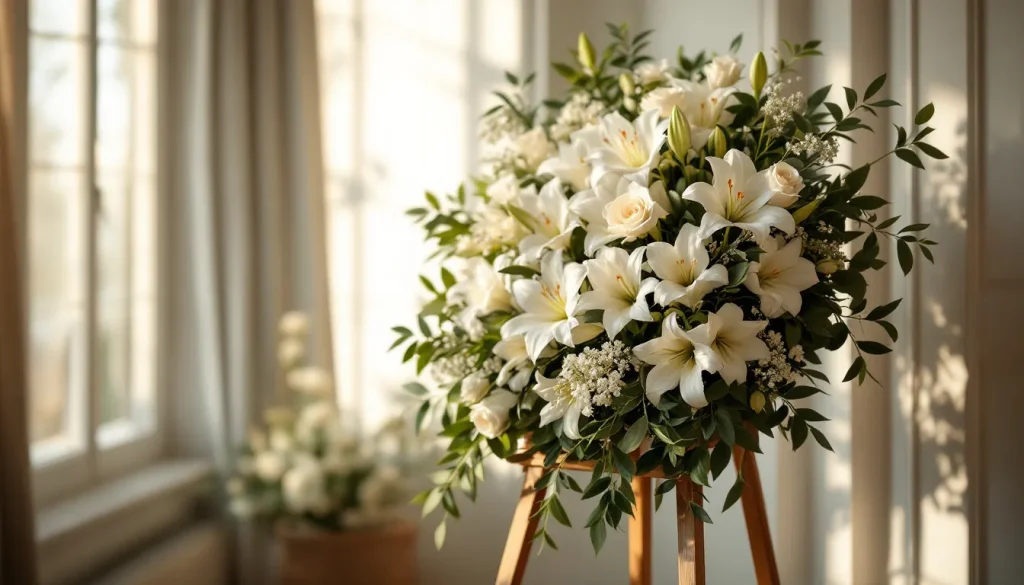
| Standing spray | One-sided display on an easel | Beside the casket at the service | Friends, coworkers, extended family |
| Wreath | Circular arrangement symbolizing eternal life | On an easel at the service or graveside | Organizations, colleagues, clubs |
| Cross | Cross-shaped floral tribute | On an easel, common at Christian services | Family or close friends |
| Heart | Heart-shaped tribute, sometimes with an open center | On an easel at the service | Spouse, children, close family |
| Basket or vase arrangement | Compact bouquet in a container | Funeral home or the family home | Anyone, especially distant senders |
Funeral flowers vs sympathy flowers
Funeral flowers and sympathy flowers are not the same thing, and the difference is mostly about place and timing. Funeral flowers are large tribute pieces displayed at the service or graveside, ordered to arrive before it begins. Sympathy flowers are smaller arrangements sent to the bereaved person’s home, appropriate any time in the weeks after a death.
Use funeral flowers when you know the service details and want a public tribute. Use sympathy flowers when you missed the service, when the family is sitting shiva or receiving visitors at home, or when you simply want a private gesture. A vase of seasonal blooms or a living plant is the standard sympathy choice because it fits a kitchen counter, not an easel.
Who sends which funeral flower arrangement
Match the arrangement to your relationship, and you avoid both under-sending and overstepping. The casket spray is reserved for immediate family because it sits on the casket itself. Everyone else chooses a piece scaled to how close they were. This relationship framework is the single most useful thing to get right, and most florist pages never spell it out.
| Your relationship | Appropriate choice | Why |
|---|---|---|
| Spouse, children, parents (immediate family) | Casket spray, or a heart | The casket spray is the family’s tribute and goes on the casket |
| Siblings, grandchildren, extended family | Standing spray, cross, or wreath | Large easel pieces read as close family without claiming the casket |
| Close friends | Standing spray or wreath | Visible tribute at the service |
| Coworkers, employer, teams | Wreath or standing spray, group-funded | One shared piece from “The team at ___” is standard |
| Neighbors, acquaintances, distant relatives | Basket, vase arrangement, or plant | Warm and appropriate without implying deep intimacy |
| Could not attend | Sympathy flowers or a plant to the home | Reaches the family directly after the service |
When several coworkers or friends want to contribute, pool funds for one larger piece rather than sending many small ones. A crowded funeral home has limited easel space, and one strong standing spray signed by a group makes more impact than six competing vases.
How much funeral flowers cost
Funeral flower prices in the US in 2026 generally run from about $50 for a small vase arrangement to $700 or more for a full casket spray. Price is driven by size, stem count, flower type (imported orchids and premium roses cost more than carnations), and how fast you need delivery. The bands below are typical retail ranges, not quotes, and vary by region and florist.
| Arrangement | Typical US price range (2026) | What drives the higher end |
|---|---|---|
| Vase or basket arrangement | $50 to $150 | Premium stems, larger container |
| Living plant (peace lily, orchid, dish garden) | $40 to $150 | Plant size and decorative pot |
| Wreath | $100 to $300 | Diameter, all-rose or all-orchid builds |
| Standing spray | $150 to $500 | Height, density, premium flowers |
| Cross or heart | $150 to $400 | Size and solid-flower coverage |
| Casket spray (half-couch) | $200 to $500 | Coverage and stem grade |
| Casket spray (full-couch) | $400 to $1,000+ | Full casket coverage in premium blooms |
“Premium” and “luxury” tiers on florist sites usually mean more stems and higher-grade flowers packed more densely, not a different design. Expect standard, deluxe, and premium versions of the same piece to step up roughly 25 to 50 percent each. If budget is tight, a smaller arrangement in beautiful condition reads better than a large sparse one.
Which flowers to send and what they mean
Certain flowers carry sympathy meaning that has held for generations, and choosing on symbolism gives your tribute a quiet message. Lilies signal restored innocence and peace, white roses convey reverence, and carnations offer remembrance and affordability. You do not have to overthink color, but white and soft tones are the safe, traditional default for sympathy. For a broader primer on bloom symbolism, see our guide to annual flowers and their meanings.
| Flower | Common meaning | Good for |
|---|---|---|
| Lily (white) | Peace, restored innocence, the soul at rest | The classic funeral flower, any service |
| Calla lily | Beauty, resurrection, elegance | Understated, modern tributes |
| Rose (white) | Reverence, purity, honor | Formal tributes and family pieces |
| Rose (red) | Love and grief | Spouse or deeply close relationships |
| Carnation | Remembrance, admiration, long-lasting | Budget-friendly, hardy for long viewings |
| Orchid | Enduring love and sympathy | A living plant gift to the home |
| Chrysanthemum | Death and mourning in much of Europe and Asia; general use in the US | Check regional custom before sending |
White is universally safe. Soft pastels suit a celebration of a long life, while brighter mixes fit an upbeat memorial or a younger person. When you know the deceased loved a specific bloom, sending it matters more than any rule.
Where and when to send funeral flowers
Send tribute pieces to the funeral home so they arrive the morning of or the day before the service, and send comfort arrangements to the family home. Address the delivery to the funeral home’s name with the deceased’s full name and service date so staff can stage it correctly. Graveside-only services and green burials may not display flowers at all, so confirm first.
| Send to | Best for | Timing |
|---|---|---|
| Funeral home or church | Sprays, wreaths, crosses, hearts | Day before or morning of the service |
| Family home | Sympathy vases, baskets, plants | Anytime in the days and weeks after |
| Graveside | Only if the family requests it | Coordinate with the funeral director |
Include the funeral home’s phone number when ordering online so the florist can confirm delivery access and viewing hours. If the service is private or the obituary lists no location, default to the family home.
Religious and cultural fit
Flowers are welcome at many services and discouraged at others, so match the family’s tradition before you order. Jewish funerals generally do not include flowers, and a donation or food to the shiva home is the expected gesture. Catholic, Protestant, and most Christian services welcome flowers, while some Hindu and Muslim customs have specific norms. When in doubt, ask the funeral home.
| Tradition | Flowers? | Better or additional gesture |
|---|---|---|
| Catholic / Protestant | Yes, widely welcomed | Crosses and standing sprays are common |
| Jewish | Generally not customary | Charitable donation; food to the shiva home |
| Hindu | Often yes, especially garlands and loose flowers | Follow family guidance on color and form |
| Muslim | Varies; often modest or discouraged | Ask the family; donations may be preferred |
| Buddhist | Yes, white flowers preferred; avoid red | Simple white arrangements |
| “In lieu of flowers” requested | Honor the request; skip flowers | Give to the named charity in the person’s name |
When an obituary says “in lieu of flowers, donations to ___,” treat it as an instruction, not a suggestion. You can still send a single small sympathy arrangement to the home later if you want a personal touch, but the public gesture should be the requested donation.
Same-day delivery and ordering online
Same-day funeral flower delivery is widely available through local florists and national networks when you order before the cutoff, usually late morning to early afternoon on weekdays. The florist fulfilling your order is almost always a shop near the funeral home, so ordering “local to the service” avoids long transport and wilting. Confirm the cutoff time and the funeral home’s viewing hours before you check out.
- Confirm the service details: funeral home name, address, date, and viewing or service time.
- Choose the arrangement that matches your relationship using the framework above.
- Pick a florist located near the funeral home for same-day capability and freshness.
- Enter the deceased’s full name so staff can match the flowers to the correct service.
- Add your card message and, for group orders, list every sender or the team name.
- Check the same-day cutoff at checkout and request delivery the day before if timing is tight.
For a home delivery, ask a neighbor or family member to be available, or choose a hardy option like a plant that survives a doorstep drop. Standard arrangements ship faster than custom premium builds, so if you need same-day, a ready design is the safer bet.
What to write on the card, plus plant and donation alternatives
Keep funeral card messages short, warm, and specific. Sign your full name and your connection so the grieving family knows who sent it, since they may be reading dozens of cards during an exhausting week. If flowers are discouraged or you want something longer-lasting, a living plant or a charitable donation is a thoughtful, welcome alternative.
Simple messages that always work:
- “With deepest sympathy from the Ramirez family.”
- “Thinking of you and holding you close. Love, Aunt Dana.”
- “[Name] touched so many lives. With love from all of us at Northside Elementary.”
- “No words are enough. We are here for whatever you need. The Chen family.”
A living plant is a strong alternative because it outlasts cut flowers and gives the family something to tend. A peace lily, orchid, or dish garden can sit on a windowsill for months. If you want the gift to thrive, include a quick care note; the same watering, light, and feeding basics that keep any houseplant healthy apply, and our overview of plant nutrition and feeding covers the fundamentals of keeping green things fed. For families in drought-prone regions who worry about watering, our notes on low-water plant care point toward hardy, forgiving choices.
When flowers are not appropriate at all, a donation to the charity named in the obituary is the clearest way to honor the person. Many funeral homes and charities let you note the donation “in memory of” so the family is informed. That combination, a donation plus a brief handwritten card, often means more than any arrangement. For more practical guides across gardening and green-industry topics, browse the HMNDP Learn hub.
Frequently Asked Questions
What flowers are appropriate to send for a funeral?
Lilies, roses, carnations, orchids, and chrysanthemums are all appropriate funeral flowers. Lilies are the traditional choice and symbolize peace and restored innocence. White and soft pastel tones are the safe default for any service. If you know the deceased loved a particular flower, sending it is more meaningful than following convention. When unsure, a white lily or white rose arrangement never feels wrong.
What do different funeral flowers mean and symbolize?
Each funeral flower carries traditional meaning. White lilies represent peace and the soul at rest, white roses convey reverence and honor, and red roses express love and grief. Carnations signal remembrance, orchids symbolize enduring love, and calla lilies stand for beauty and resurrection. Chrysanthemums mean mourning in much of Europe and Asia. Choosing by symbolism adds a quiet, personal message to your tribute.
How much do funeral flowers cost?
US funeral flowers in 2026 typically cost $50 to $150 for a vase arrangement, $100 to $300 for a wreath, $150 to $500 for a standing spray, and $200 to $1,000 or more for a casket spray depending on coverage. Price is driven by size, stem count, flower grade, and delivery speed. “Premium” tiers usually add more and higher-grade stems, not a different design.
What is the difference between funeral flowers and sympathy flowers?
Funeral flowers are large tribute pieces such as sprays, wreaths, and crosses, displayed at the service and timed to arrive before it begins. Sympathy flowers are smaller arrangements or plants sent to the bereaved person’s home, appropriate any time in the weeks after a death. Use funeral flowers for a public tribute at a known service, and sympathy flowers for a private gesture to the family.
Who should send which type of funeral flower arrangement?
Immediate family (spouse, children, parents) traditionally sends the casket spray, since it sits on the casket. Extended family and close friends send standing sprays, wreaths, or crosses. Coworkers and organizations pool funds for one shared wreath or spray. Neighbors, acquaintances, and anyone who cannot attend send a basket, vase, or plant. Matching the arrangement to your relationship avoids both under-sending and overstepping.
Should funeral flowers be sent to the funeral home or the family’s house?
Send large tribute pieces such as sprays and wreaths to the funeral home so they arrive the day before or morning of the service. Send comfort arrangements, vases, and plants to the family home, where they can be received any time after. Address funeral-home deliveries with the deceased’s full name and the service date so staff can stage them correctly. Confirm the venue if the obituary lists none.
Can you get same-day funeral flower delivery?
Yes. Same-day funeral flower delivery is widely available through local florists and national networks when you order before the daily cutoff, usually late morning to early afternoon on weekdays. Choose a florist located near the funeral home for faster delivery and fresher flowers. If timing is tight, request delivery the day before the service, and pick a ready-made standard design rather than a custom premium build.
What should you write on a funeral flower card, and when are flowers not appropriate?
Keep the card short, warm, and signed with your full name and your connection to the family, for example “With deepest sympathy from the Ramirez family.” Flowers are not appropriate when the obituary requests donations “in lieu of flowers,” or at most Jewish funerals, where a charitable donation or food to the shiva home is the expected gesture. When unsure about a family’s tradition, ask the funeral home.